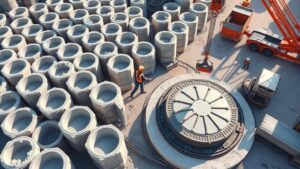
Innovative concrete construction methods are transforming the industry with advanced techniques and best practices. You’ll find pre-engineered flat panel systems and 3D volumetric approaches that greatly reduce construction time and enhance quality control. Hybrid methods combine precast and in-situ techniques for maximum efficiency, while thin joint masonry accelerates timelines and improves wall strength. Augmented reality boosts accuracy and real-time quality control, integrating seamlessly with BIM. Sustainable practices incorporate eco-friendly materials and self-healing concrete. Twin-wall technology and robotics further streamline processes. These cutting-edge methods not only save time and resources but also elevate structural integrity and project outcomes. Exploring these innovations can revolutionize your approach to concrete construction.
Key Takeaways
- Pre-engineered and modular construction systems reduce construction time and improve quality through off-site manufacturing.
- Hybrid concrete construction methods combine precast and in-situ techniques to optimize efficiency and structural integrity.
- Thin joint masonry applications use specialized adhesive mortars to accelerate construction timelines and reduce material consumption.
- Precast concrete foundations offer superior quality control, faster installation, and enhanced durability across various climates.
- 3D volumetric construction approaches minimize on-site labor, improve quality control, and significantly reduce construction time.
Pre-engineered Flat Panel Systems
Pre-engineered flat panel systems represent a significant leap forward in concrete construction efficiency. These modern methods of construction utilize off-site manufacturing to drastically reduce construction time, transforming projects from months-long endeavors to weeks-long completions.
You’ll find that these systems excel in repetitive designs, standardizing production techniques to lower project costs and enhance overall efficiency. Similar to volumetric concrete mixing, pre-engineered flat panel systems offer flexibility and cost-efficiency in construction projects, allowing for real-time adjustments and customization.
When you opt for pre-engineered flat panel systems, you’re choosing construction materials that guarantee consistent quality and durability. Components are produced in controlled environments, minimizing weather-related delays and maintaining high standards.
You’ll appreciate the significant reduction in waste, as precise off-site manufacturing leads to fewer errors and excess materials.
The versatility of these systems allows you to adapt them for various building types, including commercial, residential, and industrial structures. This flexibility makes pre-engineered flat panels a popular choice in contemporary construction projects.
Insulating Concrete Formwork Techniques

Insulating Concrete Formwork (ICF) techniques represent a significant advancement in energy-efficient construction. This method utilizes double-walled polystyrene panels filled with concrete, offering superior thermal insulation that can reduce heating and cooling costs by up to 50%.
You’ll find that ICF structures provide enhanced durability and resistance to extreme weather conditions, making them suitable for various climates, including hurricane and earthquake-prone areas. ICF aligns with the industry’s goal of reducing embodied carbon in concrete, contributing to more sustainable building practices. This innovative approach not only enhances energy efficiency but also supports the broader mission of lowering the construction sector’s environmental impact.
One of the key advantages of ICF is its ability to speed up construction time. Projects are often completed faster than with traditional methods due to the quick assembly process. Additionally, ICF offers excellent acoustic insulation, reducing noise transmission between spaces—a particularly valuable feature in residential and multi-family buildings.
From an environmental perspective, ICF is a sustainable choice. It reduces energy consumption throughout the building’s lifecycle and can incorporate recycled materials in the formwork.
3D Volumetric Construction Approaches

Construction sites are evolving into assembly points with the rise of 3D volumetric construction approaches. You’ll find that this innovative method involves manufacturing entire building modules in controlled factory settings, which are then transported to the site for assembly. This approach greatly reduces construction time by 20-50% and minimizes on-site labor requirements.
3D volumetric construction offers several advantages:
| Benefit | Impact |
|---|---|
| Quality Control | Improved consistency |
| Waste Reduction | Enhanced sustainability |
| Speed | Faster project delivery |
You’ll notice that this modular construction technique is particularly effective for repetitive designs, such as hotels and student housing. By incorporating finishes and features during the manufacturing process, you’re able to streamline the overall construction timeline.
In urban areas where space is limited and rapid construction is essential, 3D volumetric construction provides a viable solution for addressing housing shortages. You’ll find that this method mitigates weather-related delays commonly associated with traditional construction techniques.
Hybrid Concrete Construction Methods

Hybrid concrete construction methods offer a powerful blend of precast and in-situ techniques, optimizing project efficiency and quality.
You’ll find these approaches particularly effective for large-scale projects, where they can reduce timelines by up to 30% compared to traditional methods.
By combining off-site fabrication with on-site assembly, you’re able to accelerate building processes while maintaining structural integrity and enhancing overall project management.
These methods also present opportunities for incorporating innovative cement recycling techniques, which can greatly reduce the carbon footprint of concrete production.
The integration of recycled cement in hybrid construction processes aligns with global efforts to minimize the environmental impact of the construction industry.
Combining Precast and In-situ
As the construction industry evolves, innovative methods that combine the best of precast and in-situ concrete techniques have emerged. Hybrid concrete construction offers a powerful solution to enhance structural integrity while streamlining the construction process. By integrating precast elements with on-site casting, you’ll benefit from improved quality control and accelerated project timelines.
This approach allows you to manufacture components off-site, reducing on-site labor and weather-related delays. You’ll also minimize material waste by up to 30%, optimizing resource utilization. The hybrid method can reduce costs by approximately 15% compared to traditional techniques, primarily due to faster assembly and decreased labor expenses.
| Aspect | Precast | In-situ | Hybrid |
|---|---|---|---|
| Quality Control | High | Variable | High |
| Adaptability | Limited | High | High |
| Speed | Fast | Slower | Fast |
| Waste Reduction | Moderate | Low | High |
Accelerated Building Processes
Building on the advantages of hybrid concrete construction, accelerated building processes have revolutionized project timelines and efficiency. By combining precast and in-situ methods, you’ll considerably reduce construction costs and timelines, with projects completed up to 30% faster than traditional techniques. This approach is particularly beneficial for large-scale developments with tight deadlines.
The integration of 3D-printed concrete components further enhances these accelerated processes, offering even greater design flexibility and sustainability.
Accelerated building processes in hybrid concrete construction utilize precast concrete foundations and other elements, streamlining on-site assembly. You’ll notice improved safety conditions due to reduced complexity and faster installation procedures. The construction industry benefits from optimized labor costs and enhanced quality control, as precast components are manufactured in controlled environments.
You can expect greater design flexibility with hybrid systems, accommodating various architectural styles while ensuring robust performance across diverse environmental conditions. The accelerated building processes also promote sustainability by minimizing material waste and optimizing resource usage.
As you implement these innovative methods, you’ll experience improved project efficiency, reduced environmental impact, and enhanced structural integrity. The combination of precast and in-situ techniques in hybrid concrete construction represents a considerable advancement in accelerated building processes, offering numerous advantages for modern construction projects.
Large-scale Project Applications
Large-scale projects have been transformed by the implementation of hybrid concrete construction methods. You’ll find that these innovative techniques combine precast elements with cast-in-place processes, resulting in faster construction timelines and improved quality for expansive structures.
By adopting this approach, you can achieve significant cost savings, reducing labor hours by approximately 30% compared to traditional methods. These methods often utilize high-strength C40 concrete for its exceptional load-bearing capacity and durability in critical infrastructure components.
Hybrid Concrete Construction has proven successful in various large-scale applications, including commercial buildings and infrastructure projects. You’ll benefit from enhanced structural integrity and design flexibility while minimizing weather-related delays.
The use of precast components fabricated in controlled environments guarantees consistent quality across all project elements. By incorporating these methods, you’ll accelerate project completion by 20-50%, streamlining your construction process.
Furthermore, you’ll support sustainable practices by optimizing resource usage and reducing your carbon footprint. The integration of hybrid techniques not only improves efficiency but also minimizes waste through precise material utilization.
As you implement Hybrid Concrete Construction in large-scale projects, you’ll experience a synergy of speed, quality, and sustainability that revolutionizes the construction industry.
Thin Joint Masonry Applications

You’ll find that thin joint masonry applications offer significant advantages in modern construction.
By utilizing specialized adhesive mortars, you can achieve accelerated construction timelines, reducing build times by up to 30% compared to traditional methods.
This technique not only minimizes mortar consumption but also enhances wall strength through more uniform bonding, resulting in improved structural performance and longevity of your masonry projects.
Similar to innovative LC3 concrete, thin joint masonry contributes to reduced environmental impact and improved sustainability in construction practices.
Accelerated Construction Timelines
Thin joint masonry’s innovative approach revolutionizes construction timelines, offering a significant advantage in today’s fast-paced building industry. You’ll find that this technique can reduce build times by up to 25% compared to traditional masonry methods, making it an ideal choice for projects with tight deadlines.
By utilizing special adhesive mortars, you’ll need less mortar overall, allowing for quicker assembly of wall systems and accelerating the construction process. Similar to how proper subgrade preparation is essential for concrete slabs, thin joint masonry requires careful attention to detail during installation to guarantee peak performance and longevity.
When you implement thin joint masonry, you’re not only speeding up construction but also improving structural strength. The precise joints created by this method enhance the overall durability of your construction.
You’ll also benefit from reduced waste, as the technique uses less mortar and allows for easier handling and transportation of materials on-site. This is particularly effective for large-scale projects, where you’ll see substantial cost savings in both labor and materials while maintaining high-quality standards.
Reduced Mortar Consumption
Building upon the accelerated construction timelines, reduced mortar consumption stands out as a key advantage of thin joint masonry applications. This innovative construction technique considerably reduces the amount of mortar used by employing special adhesive mortars, allowing for joint thickness to be minimized to just 3-5 mm.
You’ll find that this approach not only speeds up construction by up to 30% but also leads to substantial cost savings on materials and labor. In line with low-carbon concrete initiatives, thin joint masonry contributes to reducing the overall carbon footprint of construction projects by minimizing the use of cement-based materials.
When you implement thin joint masonry, you’re choosing a method that enhances wall strength while creating a tighter building envelope. This results in improved energy efficiency for your structure.
The technique supports modern design aesthetics, enabling you to construct thinner walls that maximize usable space without compromising structural integrity or thermal performance.
Enhanced Wall Strength
Employing thin joint masonry techniques greatly enhances wall strength, surpassing traditional construction methods both in durability and structural integrity. This innovative approach utilizes specially formulated adhesive mortar, creating a superior bond between masonry units.
The thin mortar layer, typically 3-5 mm thick, optimizes wall construction by reducing the overall amount of mortar needed while improving the wall’s overall performance. This method aligns with the growing demand for sustainable construction practices, as it can considerably reduce the carbon footprint associated with concrete production.
You’ll find that thin joint masonry offers considerable advantages regarding structural integrity. The reduced mortar thickness minimizes weak points in the wall, resulting in a more cohesive and robust structure.
This enhanced strength contributes to improved building stability and longevity. Additionally, the technique aligns with sustainable construction practices by reducing material waste and improving energy efficiency.
When you implement thin joint masonry, you’ll notice a notable improvement in thermal performance. The reduced mortar layer minimizes thermal bridging, leading to better insulation and increased energy efficiency in buildings.
This enhanced wall strength, combined with improved thermal properties, makes thin joint masonry an excellent choice for modern construction projects seeking to balance structural integrity with sustainable design principles.
Precast Concrete Foundation Innovations

Numerous advancements in precast concrete foundation technology have revolutionized the construction industry.
You’ll find that precast concrete foundations offer superior quality control, as they’re manufactured in controlled environments, minimizing defects compared to traditional in-situ methods. This approach notably accelerates construction timelines, allowing for foundation installation in days rather than weeks, reducing weather-related delays.
Innovative materials like coffee grounds and low-carbon alternatives are being incorporated into concrete mixtures, enhancing strength and sustainability.
You’ll appreciate the robustness and durability of precast foundations, which provide enhanced resistance to environmental factors across various climates.
These innovative construction techniques can also lead to reduced project costs by lowering labor expenses and streamlining project timelines through efficient off-site production.
Recent innovations in precast technology have further improved thermal performance and longevity.
You’ll benefit from integrated insulation and moisture barriers, which enhance the foundation’s overall efficiency. As a result, you’ll experience improved energy conservation and long-term structural integrity.
Twin-Wall Technology Advancements

Twin-wall technology has emerged as a groundbreaking advancement in concrete construction. This innovative method combines precast and in-situ concrete techniques, utilizing two precast panels interconnected with an integrated lattice girder system. The result is a construction process that markedly enhances structural integrity while streamlining on-site operations.
You’ll find that twin-wall technology offers numerous benefits for your projects. It drastically reduces labor costs and construction time, as panels are manufactured off-site and rapidly assembled on-site. This approach can cut project timelines by up to 50% compared to traditional methods, minimizing weather-related delays.
The system’s excellent thermal insulation properties make it suitable for various building types, from residential to industrial structures.
When you implement twin-wall technology, you’re investing in precision and quality. The factory-controlled production guarantees consistent standards, contributing to long-term building performance and sustainability.
You’ll also appreciate the system’s versatility, as it can be adapted to diverse architectural designs. By incorporating twin-wall technology into your construction processes, you’re embracing a method that combines efficiency, durability, and advanced engineering principles.
Augmented Reality in Concrete Construction

You’ll find that Augmented Reality (AR) is revolutionizing concrete construction through enhanced project planning, improved accuracy, and real-time quality control.
AR’s integration with Building Information Modeling (BIM) enables you to visualize project phases and allocate resources more efficiently before breaking ground.
During construction, you can leverage AR applications to verify dimensions, identify structural elements, and reduce errors by 20-30%, ultimately improving on-site safety and minimizing costly rework.
AR for Project Planning
Augmented Reality (AR) is revolutionizing project planning in concrete construction, offering a myriad of benefits that enhance efficiency and reduce errors. By leveraging AR technology, you’ll be able to visualize 3D models superimposed onto the real-world environment, improving collaboration and decision-making among stakeholders.
This advanced visualization technique can reduce project planning time by up to 30%, allowing you to identify potential design and construction issues before physical work begins.
Integrating AR with Building Information Modeling (BIM) enables your construction teams to optimize project workflows and guarantee precise resource allocation.
You’ll experience enhanced communication among team members, resulting in a 20% reduction in errors and rework costs. AR applications provide real-time data overlay, aiding in site monitoring and facilitating better adherence to safety protocols by visualizing hazards in the working environment.
Enhancing Construction Accuracy
Through the integration of Augmented Reality (AR) with Building Information Modeling (BIM), concrete construction accuracy has reached unprecedented levels. You’ll find that AR applications allow construction professionals to overlay digital models onto physical spaces, ensuring precise alignment and adherence to specifications throughout the building process. This technology enables you to visualize complex designs on-site, considerably enhancing planning accuracy and reducing errors.
By leveraging AR in concrete construction, you’ll experience improved real-time collaboration among stakeholders, leading to more efficient resource allocation and project execution. You’ll notice that utilizing AR can reduce construction time by as much as 20% through improved layout verification and early identification of potential issues.
This proactive approach not only enhances accuracy but also contributes to increased safety on the job site. You’ll be able to visualize hazards and plan accordingly, minimizing risks to workers.
As you implement AR technology in your concrete construction projects, you’ll find that it’s an invaluable tool for enhancing overall construction accuracy. The seamless integration of digital models with physical spaces will revolutionize your approach to planning, execution, and quality control in concrete construction.
Real-time Quality Control
Real-time quality control in concrete construction has been revolutionized by the integration of Augmented Reality (AR) technology. You’ll find that AR enables immediate visualization of design specifications directly on the construction site, allowing you to detect and address errors as they occur.
This technology overlays digital information onto the physical environment, greatly enhancing your ability to maintain high-quality standards throughout the project.
By implementing AR in conjunction with Building Information Modeling (BIM), you’ll gain access to up-to-date information on site conditions. This integration facilitates timely adjustments and reduces costly rework, ultimately improving your project’s efficiency.
Studies have shown that AR can decrease construction errors by up to 30%, ensuring compliance with safety and performance standards.
Moreover, AR enhances collaboration among project stakeholders by providing an interactive platform for design review. This improved communication can boost efficiency by up to 40%, minimizing misunderstandings related to design and quality control.
As you implement AR in your concrete construction projects, you’ll experience a marked improvement in real-time quality control, leading to higher overall project quality and reduced construction errors.
Sustainable Concrete Practices

Sustainable concrete practices are revolutionizing the construction industry by addressing environmental concerns and promoting long-term durability. You’ll find that the use of eco-friendly materials, such as Green Concrete and supplementary cementitious materials (SCMs), considerably reduces carbon emissions during production. This sustainable solution not only benefits the environment but also enhances the overall performance of structures.
Innovations like self-healing concrete, which contains bacteria that seal cracks autonomously, offer a remarkable advancement in durability. You’ll notice reduced maintenance costs and extended lifespans of structures when implementing this technology. Additionally, the incorporation of recycled materials, such as fly ash and slag, contributes to waste reduction and promotes a circular economy in construction.
- Permeable concrete allows for better water management
- Lightweight concrete reduces material usage and transportation costs
- Self-healing concrete minimizes maintenance requirements
You should consider implementing these sustainable practices to achieve multiple benefits:
- Reduced environmental impact through lower carbon emissions
- Enhanced durability and longevity of structures
- Improved resource efficiency and waste reduction
- Better water management in urban areas
- Decreased energy consumption in transportation and construction processes
Advanced Robotics in Concrete Works

Advanced robotics are revolutionizing concrete works, offering unprecedented levels of precision and efficiency. You’ll find that these modern construction techniques are transforming construction sites, automating tasks like concrete pouring, finishing, and quality control. This automation markedly reduces labor costs and construction time, making projects more cost-effective and timely.
Concrete technology has advanced with the integration of AI-equipped robotic systems. These systems analyze real-time data to optimize concrete mix designs and monitor curing processes, ensuring consistent and durable final products.
You’ll also see robotic arms being used for 3D printing of concrete structures, enabling the creation of intricate designs and custom shapes that were previously impractical or impossible.
Drones with advanced imaging technology are now essential for site surveying and monitoring. They provide accurate project progress tracking, minimizing delays in construction phases.
The adoption of advanced robotics in concrete works is growing rapidly, with a projected CAGR of 8.3% from 2020 to 2027. This growth reflects the industry’s recognition of robotics’ potential to enhance productivity and revolutionize concrete construction methods.
Frequently Asked Questions
What Is the Latest Innovation in Concrete?
You’ll find 3D printing leading concrete innovations, alongside self-healing concrete and smart concrete. These technologies incorporate sustainable materials and fiber reinforcement, enhancing durability and customization. They’re revolutionizing construction with improved efficiency and reduced environmental impact.
What Is Innovative Construction Method?
You’ll find innovative construction methods revolutionizing the industry. They’re advanced techniques incorporating sustainable materials, smart sensors, robotic automation, modular design, and 3D printing to enhance efficiency, reduce costs, and improve overall building performance.
What Is the New Technology in Concrete Slab?
You’ll find new concrete slab technologies include smart concrete with embedded sensors, self-healing capabilities, lightweight aggregates for reduced weight, 3D printing for customization, and sustainable solutions incorporating recycled materials. These innovations enhance performance, durability, and eco-friendliness in construction.
What Is the New Invention of Concrete?
Like a phoenix rising from ashes, concrete’s rebirth includes self-healing concrete, biodegradable aggregates, and smart sensors. You’ll find 3D printed structures revolutionizing construction, while transparent concrete offers aesthetic possibilities. These innovations enhance durability, sustainability, and functionality in modern construction.
Conclusion
You’ve traversed the cutting edge of concrete innovation, from pre-engineered panels to robotic precision. These techniques aren’t just bricks and mortar; they’re the keystones of tomorrow’s construction. As you implement these methods, you’re not only pouring foundations but sculpting the future of urban landscapes. The concrete jungle is evolving, and you’re the architect of its transformation. Embrace these advancements to build stronger, smarter, and more sustainable structures.
Related Articles

Master the basics of ready mix concrete, its diverse types, and widespread availability to enhance your next construction project.

Get the inside scoop on Ordinary Portland Cement Concrete and discover why it's the backbone of modern construction projects—find out Read more

Mastering the art of high-strength concrete reveals the secrets to crafting resilient structures. Discover how this innovation transforms modern construction.