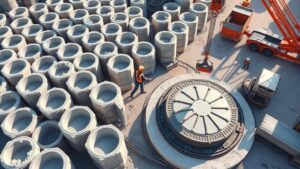
Ordinary Portland Cement (OPC) concrete is your go-to material for countless construction projects. It’s made from cement, water, sand, and gravel, and it stands out for its strength, durability, and versatility. You’ll find it in important structures like bridges, roads, and buildings. The cement itself undergoes a fascinating process from raw materials to a finely ground product. OPC concrete’s properties, like workability and thermal performance, make it ideal for various applications. Plus, you have sustainable alternatives and best practices to explore for eco-friendly construction. Get ready to explore how OPC concrete can power up your projects!
Key Takeaways
- OPC concrete consists of cement, water, sand, gravel, and admixtures, providing versatility and strength for various construction projects.
- The production process involves raw material preparation, clinker production, and grinding, emphasizing efficiency and sustainability.
- Aluminate and C4AF compounds in OPC influence setting time, heat generation, and concrete durability.
- OPC concrete is used in infrastructure, precast, and prestressed applications, offering durability, workability, and thermal properties.
- Sustainable practices include using blended cements and alternatives like geopolymer concrete to reduce environmental impact.
Introduction
Ordinary Portland Cement (OPC) concrete is a fundamental building material used in countless construction projects. It’s been around for over a century, playing an essential role in everything from sidewalks to skyscrapers.
As a construction professional, understanding OPC concrete is important because it forms the backbone of modern infrastructure.
Definition of Ordinary Portland Cement (OPC) concrete
You know OPC concrete as a versatile construction material made from a blend of cement, water, and aggregates. This mix has been a staple in the building industry for centuries. When you look at its historical context, you see that OPC concrete has evolved considerably. Early builders had to adapt their construction methods, but today, thanks to material innovations, you’ve got a much more efficient and durable product on hand.
You might be curious about its widespread use. Well, usage statistics show that OPC concrete is the most commonly used type of concrete worldwide. It’s not just popular; it’s essential. From skyscrapers to sidewalks, this material is everywhere.
Regulatory standards guarantee that the quality and safety of OPC concrete meet strict guidelines, so you can trust it for your projects.
Brief history and widespread use in construction
From its inception in the early 19th century, Portland cement concrete has revolutionized the construction industry with its unparalleled strength and versatility. Before this, Roman concrete was the gold standard, known for its durability and use in iconic structures like the Pantheon. But with the advent of Portland cement, a significant historical milestone was reached, shifting the construction evolution into high gear.
Early uses of Portland cement concrete included building bridges, roads, and buildings that needed to stand the test of time. Its ability to set underwater made it a game-changer for many projects. As you dive deeper into its history, you’ll notice how it outperformed other cement alternatives, making it the go-to material for numerous construction applications.
Here are three key points to understand its widespread use:
- Strength and Durability: Portland cement concrete can withstand harsh weather and heavy loads.
- Versatility: It’s used in everything from residential homes to massive industrial projects.
- Historical Impact: Its introduction marked a significant advancement over previous materials, such as lime-based cements and Roman concrete.
Understanding these aspects will give you a solid foundation in the history and importance of Portland cement concrete in construction.
Importance of understanding OPC concrete for construction professionals
Why is it essential for construction professionals to grasp the intricacies of Portland cement concrete? Understanding OPC concrete is important for several reasons. First, safety training is a top priority. Knowing the material properties and proper handling techniques keeps everyone on site safe. No one wants accidents, right?
Second, let’s talk about economic benefits. When you know how to use OPC concrete efficiently, you can save money on materials and labor. This also means projects can stay within budget, making clients happy.
Then there’s the environmental impact. Being aware of how OPC concrete affects the environment helps you make better choices. You might opt for alternative materials or methods that reduce your carbon footprint.
Understanding construction techniques is also crucial. Each project might need a different approach, and being knowledgeable about OPC concrete allows you to adapt quickly. You’ll be able to tackle any challenge that comes your way with confidence.
Composition of OPC Concrete

When you think about the composition of Ordinary Portland Cement (OPC) concrete, it’s important to start with its key ingredients: cement, water, sand, and gravel. Each of these components plays a vital role in giving concrete its strength and durability.
Additionally, the chemical composition of Portland cement, including compounds like calcium silicates and aluminates, is essential for the hardening process.
Key ingredients and their roles
When making Ordinary Portland Cement (OPC) concrete, you’ll need four main ingredients: Portland cement, water, aggregates like sand and gravel, and sometimes admixtures for special properties.
Portland cement acts as the glue that binds everything together, while water helps it harden and gain strength.
Aggregates provide bulk and stability, and admixtures can be added to improve workability or durability, depending on what you need.
Portland cement
Although often overlooked, the composition of Ordinary Portland Cement (OPC) plays a critical role in determining the strength and durability of concrete.
You’ll find that OPC is composed of key ingredients:
- Limestone – Provides calcium oxide.
- Clay – Supplies silica, alumina, and iron.
- Gypsum – Controls the setting time.
These ingredients impact the environmental impact, cost analysis, and alternative uses of OPC.
Water
Water is an essential component in the composition of OPC concrete, as it facilitates the chemical reaction known as hydration. You’ve got to make sure water quality is of high quality for a successful hydration process. Balancing the water cement ratio is key, and proper curing methods help maintain moisture control.
| Factor | Importance | Control Methods |
|---|---|---|
| Water Quality | Ensures hydration | Use clean water |
| Hydration Process | Strengthens mix | Monitor reactions |
| Water Cement Ratio | Affects strength | Measure accurately |
| Curing Methods | Maintains moisture | Use proper techniques |
Aggregates (sand and gravel)
Aggregates, including sand and gravel, form the bulk of the OPC concrete mix, providing volume, stability, and strength.
You’ll need to understand:
- Aggregate types: Different materials like crushed stone and recycled concrete.
- Particle size: A mix of fine and coarse particles for best strength.
- Sand sources and gravel grades: Guarantee high-quality materials for durability.
Aggregate blending is important for a strong concrete mix.
Admixtures (optional)
Admixtures can greatly enhance the performance and workability of OPC concrete, offering solutions for specific construction needs.
You can use plasticizer additives and water reducers to make the mix easier to work with.
Air entrainers help in cold climates, while hydration accelerators speed up curing.
Pozzolanic materials improve strength and durability.
These admixtures let you tailor the concrete for any project.
Chemical composition of Portland cement
When you look at the chemical composition of Portland cement, you’ll find it mainly includes calcium silicates (C3S and C2S) and calcium aluminates (C3A and C4AF), which are essential for strength and durability.
Gypsum is also added to control the setting time, so your concrete doesn’t harden too quickly.
Understanding these components helps you appreciate why OPC concrete is reliable for construction projects.
Calcium silicates (C3S, C2S)
The calcium silicates, primarily C3S (tricalcium silicate) and C2S (dicalcium silicate), play a pivotal role in determining the strength and durability of Ordinary Portland Cement (OPC) concrete. They’re key in the hydration process and silicate reaction, leading to concrete hardening.
Early strength gain:
- C3S reacts quickly.
Long-term strength:
- C2S reacts slowly.
Cement chemistry:
- Both contribute to overall strength.
Calcium aluminates (C3A, C4AF)
Calcium aluminates, including C3A (tricalcium aluminate) and C4AF (tetra-calcium aluminoferrite), greatly impact the setting time and heat generation of OPC concrete. They influence hydration behavior and heat evolution, affecting how quickly the concrete sets.
These compounds also play a role in durability factors and chemical interactions, which are vital for the long-term performance of your concrete structures.
Gypsum
Gypsum, often added in small quantities, plays an essential role in controlling the setting time of OPC concrete.
You’ll find gypsum benefits construction by:
- Enhancing workability – It makes the mix easier to handle.
- Preventing flash setting – It gives you more time to work with the concrete.
- Improving strength – It contributes to the final strength.
Manufacturing Process of OPC

Let’s chat about how Ordinary Portland Cement (OPC) is made.
You start by getting the raw materials ready, then cook them in a super-hot kiln to make clinker.
After that, you grind the clinker with some gypsum and finally package it up for distribution.
Raw material preparation
The manufacturing process of Ordinary Portland Cement (OPC) starts with the careful preparation of raw materials to guarantee top quality and performance. You need to focus on a few key areas to make sure the final product meets all standards.
First, you’ll gather the main ingredients: limestone, clay, and other materials. Using recycled materials and alternative binders can also be considered to improve sustainability. Proper raw storage is vital to keep the materials dry and uncontaminated.
Now, let’s look at the steps involved:
- Material Handling: Efficient material handling ensures that the raw materials are transported and mixed correctly. This involves conveyor belts, crushers, and mixers to get everything just right.
- Waste Management: It’s essential to manage any waste generated during the preparation process. Proper waste management helps reduce environmental impact and can even save you money.
- Quality Control: Regular testing and monitoring are necessary to make sure the raw materials meet quality standards. This can prevent issues down the line and ensure a consistent final product.
Clinker production in cement kiln
Once the raw materials are prepped and mixed, they move into the cement kiln for clinker production, an essential step in creating high-quality Ordinary Portland Cement. You’ll see that the rotary kiln, a long, rotating cylinder, plays a central role here.
As the materials enter the kiln, they’re heated to extremely high temperatures, often reaching up to 1450°C. This intense kiln temperature is necessary to transform the raw materials into what’s known as clinker.
Fuel efficiency is critical in this process since the kiln consumes a lot of energy. Modern kilns are designed to be as efficient as possible, using fuels like coal, natural gas, or even alternative fuels to minimize costs and environmental impact.
Once the materials are heated, they undergo chemical changes and form small, marble-sized balls called clinker.
After the clinker’s formed, it needs to cool down quickly. Clinker cooling is crucial because it stabilizes the material and makes it ready for the next production steps. Efficient cooling also helps in recovering heat, which can be reused in the kiln, further improving fuel efficiency.
Now, you’re one step closer to creating that durable, reliable cement!
Grinding of clinker with gypsum
After cooling, the clinker is ground into a fine powder, often with the addition of gypsum to control the cement’s setting time. This step is vital in the manufacturing process of Ordinary Portland Cement (OPC) because it determines the final product’s quality.
Let’s break down this grinding process:
- Grinding efficiency: You want the clinker to be ground efficiently to save time and energy. Efficient grinding guarantees that the cement particles are uniform in size, which improves its overall performance.
- Particle size: The particle size plays a significant role in the cement’s strength and durability. Smaller particles mean a larger surface area, which helps in better hydration and stronger cement.
- Gypsum addition: Adding gypsum helps control the setting time of the cement. Without it, the cement would set too quickly, making it hard to work with. Typically, around 5% of the mixture is gypsum, but this can vary based on the desired setting time.
The clinker composition and fineness control are key factors in this grinding process. The right balance ensures that the cement is neither too coarse nor too fine, giving you a high-quality product ready for the next steps in construction.
Packaging and distribution
Usually, OPC is packaged in durable bags or bulk containers to guarantee it reaches construction sites intact and ready for use. Packaging materials are chosen carefully to protect the cement from moisture and contamination. You’ll often see OPC in 50 kg bags, which are easy to handle and store.
Effective logistics management is vital for delivering OPC through various distribution channels. This involves planning the most efficient routes and ensuring the cement is transported safely. Whether by truck, train, or ship, the goal is to get the cement to its destination without delays.
| Packaging Type | Advantages | Disadvantages |
|---|---|---|
| Bags | Easy to handle and store | Limited capacity per unit |
| Bulk Containers | Ideal for large projects | Requires specialized equipment |
| Palletized Bags | Easy to transport in bulk | Higher initial cost |
| Silos | Best for massive storage | Needs permanent installation |
Throughout the supply chain, maintaining ideal storage conditions is essential. Cement should be kept in a dry, cool place to prevent it from hardening prematurely. Proper storage ensures that when the OPC finally arrives at your construction site, it’s in perfect condition, ready for mixing and use. By understanding these logistics and packaging strategies, you can better manage your construction projects.
Properties and Performance of OPC Concrete

When discussing OPC concrete, it’s crucial to take into account its strength development. This informs you about how strong the concrete gets over time.
It’s also important to think about durability, workability, and how the concrete handles heat. Additionally, consider any issues with shrinkage and cracking.
Strength development
Strength development in Ordinary Portland Cement (OPC) concrete hinges on the hydration process of cement particles. When water mixes with cement, hydration starts, forming compounds that bind the concrete components together. This process is essential for strength gain.
To guarantee your concrete achieves desired strength, consider these factors:
- Curing time: The longer the concrete cures, the more time it has to gain strength. Typically, concrete needs at least 28 days of curing to reach its full potential.
- Curing temperature: Temperature affects how quickly the hydration process occurs. Higher temperatures speed up hydration but can lead to cracks, while lower temperatures slow it down. Maintaining an ideal curing temperature helps in achieving balanced strength gain.
- Maturity method: This method combines curing time and temperature to predict concrete strength. By monitoring these factors, you can estimate when your concrete will reach its required strength, ensuring your project’s success.
Paying close attention to these elements will help you create strong, durable concrete structures. Remember, the hydration process is like a domino effect—the better you control the early stages, the stronger your concrete will be in the long run.
Durability
To guarantee your concrete structures stand the test of time, understanding the durability of Ordinary Portland Cement (OPC) concrete is essential. Durability is about how well your concrete can withstand various environmental factors without deteriorating. These factors include exposure to moisture, temperature changes, chemicals, and even daily wear and tear.
You need to pay attention to surface durability, which is how resistant the concrete surface is to damage and erosion. This is particularly important in areas with heavy traffic or harsh weather conditions. To make sure your OPC concrete is up to the task, durability tests are conducted. These tests assess the concrete’s resistance to cracking, scaling, and other forms of degradation.
Long term performance is another critical aspect. You want your concrete to remain strong and intact for many years. However, there are durability challenges you might face, such as freeze-thaw cycles, chemical attacks, and abrasion. By understanding these challenges and how to address them, you can greatly extend the lifespan of your concrete structures.
Incorporating proper materials, mix designs, and protective measures will help you build concrete structures that last and endure the test of time.
Workability
Understanding durability is just one part of the equation; you also need to focus on the workability of OPC concrete to guarantee it performs well during construction. Workability determines how easily you can mix, transport, place, and finish the concrete. To measure workability, you’ll use several tests.
- Slump Test: This is the most common test. You’ll fill a cone-shaped mold with concrete, remove the mold, and measure how much the concrete slumps or settles. It’s quick and easy, giving you a good initial idea of workability.
- Flow Table: This test involves placing concrete on a flow table and jolting it to see how much it spreads out. It helps you understand the flowability and consistency of your mix.
- Vee Bee Consistometer: This test is a bit more complex. You’ll vibrate a concrete sample and measure how long it takes to change shape. It gives you a precise workability measurement, especially for stiffer mixes.
Another method, the Compaction Factor Test, measures the degree of compaction of concrete. It’s useful when you need more detailed data on how well the concrete will compact under its own weight.
Thermal properties
Thermal properties of OPC concrete greatly impact its performance and durability in various environmental conditions. When you’re working with OPC concrete, understanding its heat storage and thermal conductivity is vital. Heat storage refers to the concrete’s ability to absorb and retain heat. This can be advantageous in maintaining stable indoor temperatures, especially in buildings.
Thermal conductivity measures how well concrete transfers heat. OPC concrete has moderate thermal conductivity, meaning it can slowly transfer heat, providing some insulation properties. However, it’s not as effective as materials specifically designed for insulation.
You’ll find that temperature effects on OPC concrete are significant. For instance, in hot weather, the concrete can expand, while in cold conditions, it contracts. This thermal expansion and contraction can affect the overall stability and integrity of your structures.
Additionally, it’s important to take into account how temperature changes impact concrete’s performance. Rapid temperature shifts can cause stress within the concrete, potentially leading to structural issues over time. By understanding these thermal properties, you can better plan and execute construction projects, ensuring the longevity and effectiveness of your OPC concrete structures.
Shrinkage and cracking
While thermal properties are important, you also need to take into account how shrinkage and cracking can affect the performance of OPC concrete. Shrinkage happens when concrete loses moisture, causing it to contract and sometimes crack. This can be broken down into three main types: thermal shrinkage, plastic shrinkage, and drying shrinkage.
Thermal shrinkage: This occurs when the concrete cools down after setting. As temperatures drop, the concrete contracts, and if it’s restrained, cracks can form.
Plastic shrinkage: Happens when the concrete is still fresh and hasn’t fully hardened. Rapid moisture loss from the surface can cause it to shrink and crack.
Drying shrinkage: Takes place over a longer period as the concrete dries out completely. Water evaporates from the hardened concrete, causing it to shrink and potentially crack.
You can manage these issues through crack control methods, like using reinforcement bars or fibers. Another way is shrinkage compensation, which involves adding materials that expand to counteract the shrinkage.
Types and Applications of OPC Concrete
Now, let’s talk about the different types of Ordinary Portland Cement (OPC) and where you might use them.
OPC comes in various grades, each suited for specific construction needs, like building bridges, roads, and houses.
Understanding these types will help you choose the right one for your project, making sure it meets safety and durability standards.
Ordinary Portland Cement (OPC) types
When you’re talking about Ordinary Portland Cement (OPC), you’ll find it comes in three main types: OPC 33 grade, OPC 43 grade, and OPC 53 grade.
Each type has its own strengths and specific uses, making them suitable for different construction projects.
Let’s look at what makes each grade unique and where you might use them.
OPC 33 grade
OPC 33 grade cement is commonly used for general construction work where high strength isn’t a critical requirement. It’s a popular choice due to several factors:
- Comparative analysis: OPC 33 offers balanced performance.
- Market demand: High in regions with moderate construction needs.
- Cost efficiency: More affordable while meeting safety standards.
Regional preferences often influence its widespread use.
OPC 43 grade
Moving from OPC 33 grade, OPC 43 grade cement offers higher strength and is suitable for more demanding construction projects. This grade provides a balanced setting time and moderate hydration heat, making it ideal for diverse environments.
Its cement fineness enhances workability, while its strength classes guarantee durability. Follow the proper mixing procedure to achieve best results.
OPC 53 grade
You’ll find OPC 53 grade cement excels in high-strength applications like bridges and high-rise buildings due to its superior compressive strength. Its manufacturing processes guarantee it meets stringent quality standards.
Key factors include:
- Mixing ratios: Precise proportions for best performance.
- Hydration process: Ensures proper chemical reaction and hardening.
- Setting time: Fast, enabling quicker construction progress.
Applications in construction
When it comes to construction, you’ll find that Ordinary Portland Cement Concrete (OPC) is incredibly versatile. It’s used in building everything from houses and skyscrapers to bridges and roads.
You can also see OPC concrete in precast and prestressed elements, making it essential for many infrastructure projects.
Buildings and structures
Ordinary Portland Cement (OPC) concrete is a fundamental material in the construction of residential buildings, commercial structures, and infrastructure projects due to its strength and durability.
You’ll rely on:
- Building materials: Choosing the right components.
- Structural design: Ensuring stability and integrity.
- Construction safety: Protecting workers and the public.
Effective project management and engineering principles guide these processes.
Infrastructure projects
Beyond residential and commercial structures, OPC concrete plays a vital role in the construction of infrastructure projects such as highways, bridges, and dams. It’s essential for urban development and transportation infrastructure, ensuring safe and durable bridge construction, expansive highway networks, and robust airport terminals.
OPC concrete’s versatility and strength make it a top choice for these critical projects, supporting modern life and connectivity.
Precast and prestressed concrete
Did you know that precast and prestressed concrete, made with OPC, revolutionizes construction by offering enhanced strength and durability? Here’s how it works:
- Precast molds: Concrete is shaped into various forms.
- Prestressed strands: Steel strands are tensioned before curing.
- Load distribution: The tensioning process helps distribute loads evenly.
These methods, combined with effective curing methods, make structures more resilient and efficient.
Advantages and Limitations of OPC Concrete

When you think about Ordinary Portland Cement (OPC) concrete, it’s important to understand both its advantages and limitations.
You’ll find that OPC concrete is strong, durable, and widely available, making it a popular choice for many construction projects. However, it’s not without its drawbacks, such as a high carbon footprint and susceptibility to cracking under certain conditions.
Advantages
You’ll appreciate Ordinary Portland Cement (OPC) concrete for its versatility and widespread availability, making it a go-to choice for many construction projects.
It boasts high compressive strength, which means it can handle heavy loads without breaking a sweat.
Plus, its durability and resistance to weathering guarantee that your structures stand the test of time.
Versatility and widespread availability
Ordinary Portland Cement (OPC) concrete stands out because you can find it almost anywhere and use it for a wide range of construction projects. Its cost efficiency, local availability, and material versatility make it a top choice.
- Cost Efficiency: OPC concrete is affordable and reduces overall project costs.
- Local Availability: Easily sourced from local suppliers.
- Material Versatility: Suitable for various applications.
High compressive strength
Another standout feature of OPC concrete is its high compressive strength, which makes it ideal for load-bearing structures.
Compressive tests show how well it can handle heavy loads. You can adjust mix ratios to achieve different strength variations.
Proper curing impacts its final strength, ensuring it meets the necessary load capacity. Understanding these factors helps you maximize OPC concrete’s potential.
Durability and resistance to weathering
One of the key advantages of OPC concrete is its exceptional durability and resistance to weathering. You’ll appreciate how it handles:
- Freeze-thaw cycles: It minimizes damage in cold climates.
- Sulfate resistance: Prevents deterioration from sulfate-rich soils.
- Chloride penetration: Reduces corrosion risks for steel reinforcements.
Plus, it effectively resists carbonation effects and alkali silica reaction, ensuring long-lasting structures.
Limitations
Now, let’s talk about some limitations of Ordinary Portland Cement Concrete.
You might notice it has low tensile strength, making it less ideal for structures that face a lot of tension.
Additionally, it’s prone to chemical attacks and has a high carbon footprint during production, which isn’t great for the environment.
Low tensile strength
A significant limitation of Ordinary Portland Cement (OPC) concrete is its inherently low tensile strength. You might face issues like:
- Cracking behavior: Without fiber reinforcement, cracks can form easily.
- Stress distribution: Uneven stress can lead to structural problems.
- Tensile tests: OPC concrete often fails these tests without additional tensile reinforcement.
To improve, consider adding fiber reinforcement to help handle stress better.
Susceptibility to chemical attacks
Despite its widespread use, OPC concrete is particularly vulnerable to chemical attacks, which can compromise its durability and structural integrity. Alkali silica reaction, sulfate attack, chloride penetration, and poor carbonation resistance are common issues.
Additionally, OPC concrete has low acid resistance, making it less suitable for environments with aggressive chemicals. Being mindful of these limitations is essential for making informed decisions in construction projects.
High carbon footprint in production
In addition to its susceptibility to chemical attacks, OPC concrete’s high carbon footprint during production raises significant environmental concerns. To reduce this impact, focus on:
- Energy consumption: Lowering energy use in cement manufacturing.
- Emission reduction: Adopting cleaner technologies.
- Carbon offsets and sustainable alternatives: Using eco-friendly production methods and materials.
Advancements and Alternatives

Now, let’s talk about some cool advancements and alternatives to regular cement.
You might be interested in blended cements like PPC and PSC that offer better performance and durability.
There are also high-performance concretes and sustainable cement options that are kinder to the environment.
Blended cements (PPC, PSC)
Blended cements, such as Portland Pozzolana Cement (PPC) and Portland Slag Cement (PSC), offer significant advancements and sustainable alternatives to traditional Ordinary Portland Cement. By incorporating pozzolana materials like fly ash and silica fume, these cements not only improve performance but also contribute to waste recycling. Fly ash, a byproduct of coal combustion, and silica fume, a byproduct of silicon and ferrosilicon alloy production, add strength and durability to the concrete mix.
PSC, on the other hand, uses slag cement, which is produced from the blast furnace slag in steel production. This helps in utilizing industrial waste, reducing the carbon footprint, and conserving natural resources. Blended cements bring several benefits to your construction projects:
- Enhanced Durability: Both PPC and PSC offer better resistance to chemical attacks, making your structures last longer.
- Environmental Benefits: By recycling industrial byproducts like fly ash and slag, you’re contributing to waste reduction and sustainability.
- Cost-Effectiveness: These cements can be more economical due to reduced raw material costs and improved performance.
High-performance concrete
Building on the benefits of blended cements, high-performance concrete (HPC) offers even greater advancements in strength, durability, and sustainability for your construction projects.
Imagine a concrete that not only lasts longer but also performs better under stress. That’s HPC for you!
One key feature of HPC is fiber reinforcement. By adding fibers, you enhance the concrete’s toughness and resistance to cracking.
Another important component is silica fume, a byproduct of silicon production, which greatly improves the concrete’s strength and reduces its permeability.
You’ll also find superplasticizers in HPC, which make the concrete more workable without adding extra water. This means you can pour and shape it easily while maintaining its strength.
Curing methods play an essential role in achieving the desired properties of HPC. Proper curing ensures the concrete reaches its maximum potential in terms of durability and strength.
Don’t forget about shrinkage reducers; they help minimize the cracks that can form as the concrete dries and hardens.
By incorporating these advancements, you’re not just building structures; you’re creating lasting, high-quality works that stand the test of time.
Sustainable cement alternatives
When you’re looking at sustainable alternatives to traditional cement, two exciting options are geopolymer concrete and calcium sulfoaluminate cement.
Geopolymer concrete uses industrial by-products and can greatly cut down on CO2 emissions.
Calcium sulfoaluminate cement not only reduces carbon footprint but also offers faster setting times and better durability.
Geopolymer concrete
Exploring geopolymer concrete opens up exciting possibilities for more sustainable and eco-friendly construction alternatives. By using alkaline activators with fly ash and slag inclusion, you can create a durable material. The curing conditions play an essential role in its performance.
Consider the environmental impact:
- Reduced CO2 emissions
- Recycling industrial by-products
- Enhanced durability
Geopolymer concrete is truly a game-changer!
Calcium sulfoaluminate cement
Shifting focus from geopolymer concrete, calcium sulfoaluminate cement emerges as another promising sustainable alternative with its rapid hardening and lower carbon footprint.
You’ll find its setting time is faster, which can be a real time-saver. Plus, it offers great sulfate resistance.
When comparing costs, it’s competitive. The hydration process is efficient, and the overall environmental impact is significantly lower.
Best Practices in Using OPC Concrete
To get the best results when using Ordinary Portland Cement (OPC) concrete, you’ll need to focus on a few key areas.
Start with the right mix design and proportioning to guarantee strength and durability, then pay close attention to proper curing techniques.
Don’t forget about quality control and testing, along with sustainable construction practices, to make sure your project is both effective and eco-friendly.
Mix design and proportioning
Consistently achieving the right mix design and proportioning in OPC concrete guarantees maximum strength and durability for your construction projects. To secure the best results, focus on the following key elements: mixing methods, aggregate grading, water-cement ratio, strength optimization, and admixture selection.
First, use proper mixing methods to make certain all components blend evenly. This helps avoid weak spots that could jeopardize the concrete’s integrity.
Second, pay attention to aggregate grading. Using well-graded aggregates provides a better particle distribution, creating a denser and more durable concrete mix.
Third, control the water-cement ratio meticulously. Too much water can weaken the concrete, while too little can make it difficult to work with. Aim for the perfect balance to optimize strength and workability.
Here are three steps to help you master mix design:
- Calculate Your Ratios: Measure the exact proportions of cement, water, and aggregates.
- Select Appropriate Admixtures: Choose admixtures that enhance specific properties like setting time or durability.
- Test Your Mix: Conduct trial batches to ensure your mix meets the required specifications before full-scale application.
Proper curing techniques
Ensuring proper curing techniques in OPC concrete is essential for achieving maximum strength and durability in your construction projects.
First, you’ll need to focus on initial curing, which begins right after the concrete is placed and finished. This step is important for moisture retention, preventing the concrete from drying out too quickly.
The curing duration generally ranges from a few days to a couple of weeks, depending on the specific project requirements.
During this period, it’s crucial to keep the concrete moist to allow for proper hydration. You can use various curing methods to achieve this, such as water curing, where you continuously wet the surface, or using curing blankets to maintain moisture.
Another effective approach is to apply curing agents, which are chemical compounds sprayed onto the concrete surface to form a protective layer. These agents help retain moisture and can be particularly beneficial in areas where water curing isn’t feasible.
Quality control and testing
Quality control and testing are essential for guaranteeing that your OPC concrete meets all required standards and performs efficiently in your construction projects. You can’t afford to skip these steps if you want to maintain quality assurance and achieve your goals.
First off, you need to be familiar with the various testing methods. These methods help you evaluate the mix consistency and make certain that the concrete will hold up under different conditions.
Here are three key tests to take into account:
- Slump Test: This checks the concrete’s workability and consistency. A good slump indicates a well-mixed batch.
- Compressive Strength Test: Vital for determining the concrete’s ability to withstand loads. Meeting the right compressive strength is a critical quality benchmark.
- Air Content Test: This measures the amount of air in the concrete mix. Proper air content helps with durability, especially in freeze-thaw conditions.
Adhering to established testing standards ensures that your concrete is up to standard. Reliable testing helps you meet quality benchmarks, which is essential for the long-term success of your projects.
Sustainable construction practices
Incorporate sustainable construction practices by optimizing your OPC concrete mix to reduce environmental impact. One way to do this is by using recycled materials like crushed glass or old concrete in your mix. Not only does this help in waste reduction, but it also gives your project a green building edge.
Think about carbon sequestration too. You can incorporate materials that absorb carbon dioxide over time, effectively reducing the overall carbon footprint of your construction. Additionally, focus on energy efficiency by using energy-efficient equipment and methods during the mixing and curing process. This not only saves you money but also cuts down on the energy consumed.
Another key aspect is sourcing your materials locally to minimize transportation emissions. Locally sourced materials often require less energy to transport, contributing to overall energy efficiency. Also, consider using supplementary cementitious materials like fly ash or slag. These not only enhance the durability of your concrete but also make use of industrial by-products, further promoting waste reduction.
Conclusion

In wrapping up, let’s remember how essential OPC concrete is to construction projects.
You’ll also want to keep an eye on future trends and challenges in the cement industry.
Recap of the importance of OPC concrete in construction
Ordinary Portland Cement (OPC) concrete remains essential in construction due to its versatility, strength, and durability. It’s the go-to choice for many projects because it meets a wide range of needs. You’ll find OPC concrete in everything from skyscrapers to sidewalks, proving its importance time and time again.
Let’s break down why OPC concrete is so crucial:
- Strength and Durability: OPC concrete can withstand heavy loads and harsh conditions, making it perfect for long-lasting structures.
- Cost-Effective: It’s relatively affordable compared to other construction materials. Plus, its availability keeps costs manageable.
- Ease of Use: OPC concrete is easy to mix, pour, and mold, making construction faster and safer.
When you consider the environmental impact, OPC concrete has room for improvement, but ongoing innovations are addressing these concerns.
Construction safety is another plus, as OPC provides a stable and predictable material to work with.
In terms of cost analysis, it’s often the most economical choice, balancing price and performance.
Market demand remains high, driven by consistent regional preferences for reliable building materials.
Future trends and challenges in cement industry
As we look ahead, the cement industry faces evolving trends and challenges that will shape its future.
One key trend is carbon capture. You’ll see more companies working to reduce their carbon footprints by capturing and storing carbon emissions. It’s a significant step towards making cement production greener.
Digital transformation is another exciting change. With advanced technologies, you can expect smarter factories that use data to improve efficiency and reduce waste. Imagine cement plants that run like well-oiled machines, cutting down on errors and boosting productivity.
Waste management will also play an important role. Using waste materials in cement production not only reduces landfill but can also lower production costs. This ties into the idea of a circular economy, where waste is reused and recycled, creating a more sustainable loop.
Material innovation is the final piece of the puzzle. New materials are being developed to make cement stronger, more durable, and even more eco-friendly. These innovations will help the industry meet future demands without compromising our planet’s health.
Emphasis on balancing performance, cost, and sustainability
Balancing performance, cost, and sustainability in cement production is essential for the industry’s future success. You’ve got to think about how to make high-quality cement while keeping expenses low and being kind to the planet. That’s a tall order, but it’s doable with the right approach.
First off, focus on vital energy efficiency. Using energy-efficient processes and machinery can cut down costs and reduce carbon emissions.
Next, consider carbon offset programs. By investing in projects that reduce greenhouse gases, you can counterbalance the carbon footprint of cement production.
Lastly, it’s crucial to conduct a lifecycle assessment. This will help you understand the environmental impact from production to disposal, allowing for smarter decisions.
Here’s a quick breakdown:
- Energy Efficiency: Implement energy-saving technologies to reduce costs and emissions.
- Carbon Offset: Invest in projects that help to neutralize your carbon footprint.
- Lifecycle Assessment: Evaluate the full impact of cement from creation to end-use.
Also, don’t forget about resource conservation. Using materials wisely and recycling whenever possible can save money and help the environment.
Aiming for green certification can make your project more appealing to eco-conscious clients. Balancing these elements isn’t easy, but it’s the way forward for sustainable construction.
Frequently Asked Questions
What Is the Optimal Curing Time for OPC Concrete?
You should cure OPC concrete for at least 7 days to guarantee strength development. Use curing methods like moisture control, curing compounds, and proper hydration process to optimize results. Longer curing improves durability and overall performance.
How Do Temperature Variations Affect the Setting Time of OPC Concrete?
Temperature variations affect OPC concrete’s setting time by altering the hydration process. Higher temperatures speed up chemical reactions, while lower temperatures slow them down. Admixture effects and curing methods help manage temperature control for best setting.
Can OPC Concrete Be Used for Underwater Construction Projects?
You won’t believe how OPC concrete handles marine structures! Yes, you can use it underwater, but underwater chemicals can mess with the hydration process. You’ll face setting challenges, so make mix adjustments to guarantee durability.
What Are the Common Signs of OPC Concrete Degradation?
You might notice OPC concrete degradation through distinct cracking patterns, surface discoloration, and strength reduction. Chemical attack and moisture intrusion also play significant roles in weakening the concrete’s integrity over time, leading to visible damage.
How Should OPC Concrete Be Stored Before Use?
To store OPC concrete properly, you should use airtight storage containers for moisture control. Guarantee the site conditions are dry and stable. Quality assurance requires weather protection measures like tarps or shelters to maintain ideal conditions.
Conclusion
Wrapping up, you now have a solid grasp of Ordinary Portland Cement (OPC) concrete. Picture a sturdy bridge or a towering skyscraper; OPC concrete is the backbone of these structures.
You know its composition, how it’s made, and its strengths and weaknesses. By understanding best practices and staying updated on advancements, you’ll guarantee your projects are both durable and efficient.
So, the next time you see a construction site, you can appreciate the crucial role OPC concrete plays.
Related Articles

Mastering the art of high-strength concrete reveals the secrets to crafting resilient structures. Discover how this innovation transforms modern construction.

Keep reading to discover how lightweight concrete is transforming construction with its blend of strength, sustainability and cost-efficiency.

Achieve game-changing construction with High-Performance Concrete. Known for unparalleled strength and durability. Discover its incredible potential now.