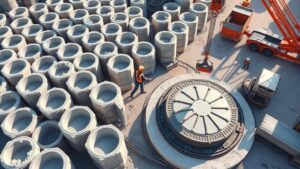
Ready mix concrete is a versatile building material composed mainly of cement, aggregates, and water, along with special admixtures to enhance its properties. Whether you’re tackling a small home project or overseeing a large construction site, there’s a specific type of ready mix to fit your needs. These types are designed to achieve various strengths, workabilities, and durability requirements, ensuring the right mix for any environment. Widely available through local suppliers, these concrete mixes are prepared under stringent quality controls to maintain consistency and performance. Curious about how these materials work together to hold up the world around you? There’s plenty more to uncover about this indispensable construction component.
Key Takeaways
- Ready mix concrete comprises cement, aggregates, water, and admixtures, tailored for specific construction needs.
- Various cement types and water-to-cement ratios influence the concrete’s strength and durability.
- Admixtures and supplementary cementitious materials (SCMs) like fly ash or silica fume enhance concrete properties.
- Ready mix concrete is available in different types, each designed for particular applications and performance requirements.
- The availability of ready mix concrete is widespread, serviced by numerous suppliers offering diverse product ranges and delivery options.
Introduction
Ready mix concrete is quite an interesting topic, and you’re about to find out why it’s so essential in modern construction.
First, let’s get a clear idea of what ready mixed concrete actually is.
This will help you understand its key benefits and why it’s preferred for various building projects.
Definition of ready mixed concrete
Ready-mixed concrete is a precisely blended mixture of cement, aggregates, and water that’s prepared at a plant and delivered to construction sites, typically in rotating drum mixer trucks. You’ve likely seen these massive concrete trucks on the road, but have you ever wondered what’s spinning inside? Let’s break it down:
- Concrete Mix Design: This guarantees the right proportions of materials to meet specific strength and durability requirements.
- Batching Plant: This is where the magic happens—materials are weighed and mixed to create the perfect batch.
- Concrete Production: Once mixed, the concrete is immediately transported in concrete trucks to maintain its workability and prevent premature hardening.
Understanding these elements, you’re better equipped to appreciate the complexities of ready-mixed concrete.
History and Development

Let’s take a look at how ready mix concrete came to be.
Starting in the early 20th century, this material revolutionized the construction industry through significant milestones and technological advancements.
You’ll see how its growth has shaped buildings and infrastructure around the world.
Invention of ready mixed concrete in the early 20th century
In the early 20th century, engineers developed ready mixed concrete, revolutionizing construction with a more uniform and time-efficient material. You might be wondering how this all came about. Here’s a quick rundown:
- Composition: Engineers started mixing cement, aggregates, and water in specific ratios.
- Transit: The use of a transit mixer allowed this mixture to be transported while keeping it agitated and ready to pour upon arrival.
- Efficiency: This method streamlined processes, reducing the labor and time involved in on-site mixing.
Key milestones and technological advancements
Following the invention of ready mixed concrete, several key milestones and technological advancements have shaped its development and application in the construction industry. You’ve seen concrete mix optimization take huge strides, enabling more durable and sustainable structures.
Concrete quality control has become more rigorous, ensuring that every batch meets high standards before it’s poured.
With concrete performance modeling, engineers can now predict how concrete will behave under various conditions, enhancing safety and efficiency.
Furthermore, concrete additives have revolutionized the way structures withstand environmental stresses, and concrete testing equipment has become more sophisticated, allowing for precise measurements and quicker adjustments on the job site.
All these advancements contribute significantly to constructing safer, longer-lasting buildings.
Growth of the ready mixed concrete industry
The ready mixed concrete industry has experienced significant growth since its inception, evolving with advancements in technology and expanding globally. You’ve seen concrete everywhere, but you mightn’t realize how it’s become a staple for modern construction. Here’s how it’s shaping up:
- Diversification of Concrete Suppliers: There’s been a surge in the number of suppliers, amplifying competition and driving innovation in the concrete industry.
- Expansion in Concrete Applications: From infrastructure concrete projects like bridges and roads to commercial concrete in buildings, its uses have broadened substantially.
- Global Reach: Originally a local business, the industry has grown to serve global markets, adapting to various regional needs and standards.
This growth isn’t just about quantity; it’s about enhancing quality and sustainability too.
Composition and Materials

As you explore ready mix concrete, it’s important to understand what goes into it. You’ll find that cement, aggregates, water, admixtures, and supplementary cementitious materials each play a key role in the final product.
Let’s look at how these components combine to guarantee durability and strength in the structures you see every day.
Cement: types, role, and proportion
Cement, essential in binding the components of ready mix concrete together, comes in various types and proportions. You’ll find that the type of cement used can greatly influence the concrete properties. Here’s what you need to know:
- Water-Cement Ratio: This is important as it affects the concrete’s strength and durability. Lower ratios lead to higher strengths.
- Admixtures: These are added to enhance specific characteristics like setting time and workability.
- Supplementary Cementitious Materials: Items like fly ash or slag can be mixed with cement, improving sustainability and performance.
Understanding these elements helps you adjust the mix for better performance and durability. Remember, the right blend of cement and additives ensures your concrete meets the specific needs of your project.
Aggregates: coarse and fine, grading, and quality
After exploring how cement influences ready mix concrete, let’s examine the role of aggregates, which include both coarse and fine components, and understand their grading and quality. Aggregates are essential; they impact the compressive strength and durability of your concrete. Coarse aggregates generally consist of gravel or crushed stone, while fine aggregates are typically sand.
Grading of aggregates is vital for concrete’s best performance. It ensures a uniform distribution of particle sizes, which enhances the workability and prevents excessive cement use, cutting down costs. Quality control in aggregates involves rigorous testing to meet specific standards for cleanliness and size, ensuring the concrete you’re working with isn’t just strong but also durable. Regular concrete testing further verifies the compressive strength, ensuring each mix meets the set requirements.
Water: importance of clean, potable water
In ready mix concrete, the quality of water used must be clean and potable to guarantee the mixture’s integrity and performance. Impurities in water can affect concrete strength, durability, and workability.
Here’s why you should care about the water in your concrete mix:
- Concrete Strength: Clean water guarantees the chemical reactions bond materials effectively, maximizing strength.
- Workability: The right water quality makes concrete easier to mix, transport, and pour.
- Durability: Using clean, potable water reduces the risk of contaminants that can degrade concrete over time, enhancing longevity.
Admixtures: types, functions, and benefits
Admixtures enhance the properties of concrete by improving its strength, workability, and durability. You’ll find that admixtures come in various types, each serving a unique function. Plasticizers and superplasticizers, for instance, make your concrete more fluid without requiring extra water. This means you can pour it more easily and it’ll settle more smoothly into forms.
Then, there are accelerators and retarders. Accelerators speed up the curing process, which is perfect if you’re on a tight schedule. On the other hand, retarders slow things down, giving you more time to work with the concrete in hot weather or complex projects. These additions not only make your job easier but can significantly prolong the life of your concrete structures.
Supplementary cementitious materials
Supplementary cementitious materials, often referred to as SCMs, enhance concrete’s performance by altering its chemical and physical properties. You’ll find these materials essential when you want your concrete to be more durable and environmentally friendly. Here’s a quick rundown:
- Fly Ash: This byproduct from coal combustion helps reduce the concrete’s permeability and improves its strength.
- Slag: Coming from iron and steel manufacturing, slag contributes to higher strength and resistance against chemical attacks.
- Silica Fume: Extremely fine particles that fill voids in concrete, greatly enhancing its durability and load capacity.
These materials, including geopolymer concrete and alkali-activated concrete, not only improve the sustainability of projects but also offer innovative solutions in modern construction practices.
Production Process

As you move into the production process of ready mix concrete, you’ll see how each step is essential for the final product. You’ll start with proportioning and batching, where ingredients are carefully measured and mixed to guarantee consistency.
Then, we’ll explore the different types of mixers and the importance of timing and consistency in the mixing process, all while keeping an eye on quality control and making necessary adjustments.
Proportioning and batching
How do we guarantee that ready mix concrete meets specific quality standards during production? It all starts with precise proportioning and batching, which are vital for ensuring the desired concrete performance and consistency. Here’s what you need to know:
- Measurement Accuracy: Every ingredient, including cement, water, aggregates, and additives, must be measured with high precision. This ensures the mix doesn’t deviate from the specified consistency and setting time.
- Quality of Ingredients: Only top-quality materials are used to prevent issues like weak concrete or delayed hardening.
- Batching Process Control: Advanced batching systems control the sequence and timing of ingredient addition, essential for maintaining concrete quality assurance and producing specialized mixes like controlled low-strength material.
This meticulous process is key to achieving reliable and effective concrete.
Mixing: types of mixers, time, and consistency
After precise proportioning and batching, the next critical step in ready mix concrete production involves the mixing process. Different types of mixers, mixing times, and consistency levels play pivotal roles in achieving the desired concrete quality. Concrete mixers are essential for blending the ingredients uniformly. These mixers vary widely; drum mixers rotate to mix the concrete, while pan mixers use a stationary pan and rotating blades.
Mixing time is important too; it affects the final strength and workability of your concrete. Typically, mixing lasts about 10 to 15 minutes to make sure everything’s combined perfectly.
Quality control: testing, monitoring, and adjustments
To guarantee the highest quality of ready mix concrete, it’s essential to conduct thorough testing, monitor processes closely, and make necessary adjustments during production.
Here’s what you need to focus on:
- Slump Test: This simple test measures the workability and consistency of the concrete. It’s vital for ensuring the mix isn’t too wet or dry.
- Air Content Testing: You’ll check the air content to guarantee durability, especially in freeze-thaw environments. It helps prevent future cracking and scaling.
- Non-Destructive Testing of Concrete: Techniques like ultrasonic testing assess structural integrity and concrete strength without damaging your material.
Delivery: transit mixers, truck types, and capacity
Once the quality control checks are complete, focus shifts to delivering the ready mix concrete using transit mixers, various truck types, and understanding their capacities. These mixers are vital for not only transporting but also maintaining the concrete’s workable consistency. Typically, truck capacities range from small 3 cubic meters to large 12 cubic meters, catering to different project sizes.
When planning your delivery, you’ll choose between standard trucks for easier accessibility and larger ones for bulk delivery. Remember, the key to efficient concrete placement is coordinating the arrival of these trucks to keep the pouring process smooth. This way, you’ll guarantee the ready mix concrete reaches the site in perfect condition, ready for use.
Special considerations for weather and placement
When planning the placement of ready mix concrete, consider how different weather conditions can impact the curing process and final strength. Here are a few tips:
- Temperature: Cold weather can slow down the curing process, whereas hot weather can cause it to cure too quickly. Aim to place concrete when temperatures are moderate.
- Concrete Pump: Utilize a concrete pump to place concrete more efficiently, especially in hard-to-reach areas or during extreme weather conditions.
- Finishing and Curing Concrete: Make sure you’re finishing concrete smoothly and curing it properly. Cover it to avoid too much moisture loss in hot weather, and use heating blankets in cold conditions.
Properties and Performance
You’re about to get a handle on what makes ready mix concrete tick when it comes to properties and performance.
First off, let’s talk about how fresh concrete behaves – aspects like workability, slump, and temperature play vital roles.
Then, we’ll explore how it holds up over time, focusing on strength, durability, and other key hardened concrete properties.
Fresh concrete properties: workability, slump, air content, temperature
To guarantee top performance, it’s important to grasp the properties of fresh concrete, including workability, slump, air content, and temperature. You’ll find that understanding these aspects can greatly impact your project’s success.
Here are key points to keep in mind:
- Workability: This determines how easy the concrete is to manipulate. Poor workability can lead to segregation, where materials separate, compromising the structure.
- Slump: It measures the consistency of the concrete. A higher slump indicates a more fluid mix, which affects how the concrete settles and shapes.
- Air Content and Temperature: Both are essential for preventing flaws. Optimal air content enhances durability, while the right temperature ensures proper curing without premature hardening.
Hardened concrete properties: strength, durability, permeability, shrinkage
After examining the properties of fresh concrete, let’s now focus on how it behaves once hardened, specifically looking at its strength, durability, permeability, and shrinkage.
Once concrete hardens, it develops a range of properties that determine its long-term performance. Its tensile strength is important, as it dictates how well the material can resist being pulled apart, reducing the risk of cracking.
Durability refers to its ability to withstand wear and environmental conditions without deteriorating. Permeability measures how resistant it’s to water infiltration, which is essential in preventing damage and maintaining structural integrity.
Factors affecting properties
Several factors influence the properties and performance of hardened concrete, including the mix design, curing conditions, and the use of admixtures. Here’s how these elements specifically impact your concrete:
- Mix Design: The ratios of cement, sand, and gravel determine the strength and durability. An improper balance can weaken the concrete.
- Curing Conditions: The temperature and moisture levels during curing influence the heat of hydration, impacting the final hardness.
- Admixtures: Adding components like air-entraining agents helps manage the freeze-thaw cycles, while fiber reinforcement enhances toughness.
Understanding these factors helps you guarantee that your concrete mix meets your specific needs, whether you’re laying a simple patio or building a complex infrastructure.
Performance standards and specifications
Understanding the performance standards and specifications is vital as they define the quality and durability of your ready mix concrete. You’ll need to familiarize yourself with ASTM and EN standards, which set the benchmarks for concrete strength and overall quality. These guidelines guarantee that the concrete mix design meets specific requirements for your construction projects, enhancing safety and longevity.
Moreover, concrete quality control is essential. It’s not just about mixing the right ingredients; it’s about consistent testing and adjustments to achieve peak performance. By adhering to these standards, you’re not just following rules—you’re ensuring that your structure will stand strong and endure, whatever comes its way. So, always check these standards and keep your quality control in check!
Advantages and Benefits

You’ll find that ready mix concrete comes with several standout advantages.
To begin with, its consistency and quality control guarantee that every batch meets the exact specifications required for your project.
Not only does this save time and labor, but it also reduces waste and proves to be more cost-effective in the long run.
Consistency and quality control
Maintaining consistent quality in ready mix concrete greatly enhances the reliability and durability of your construction projects. When you’re dealing with ready mix concrete, concrete quality control becomes paramount. By ensuring concrete consistency and conducting rigorous concrete testing, you’re setting up your project for success.
Here’s how you benefit:
- Reduced Risk of Structural Failures: Proper concrete mix design minimizes the likelihood of cracks and other flaws.
- Improved Longevity: Consistent quality means your structures withstand environmental stresses better.
- Enhanced Aesthetic Appeal: Uniform concrete provides a smoother, more professional finish.
Time and labor savings
Switching to ready mix concrete saves you time and labor, streamlining your construction process. When you choose ready mix, concrete contractors can focus more on efficient concrete finishing and less on mixing. This means quicker concrete formwork setup and faster concrete curing times. The majority of the work—mixing the concrete—is handled off-site, so your project site stays cleaner and more organized, reducing overall labor costs.
Moreover, since the concrete arrives pre-mixed, there’s no guesswork involved in achieving the right consistency. This precision reduces errors and rework, helping your project stay on schedule. It’s a smooth process from start to finish, ensuring that deadlines are met without sacrificing quality. Ready mix concrete isn’t just a choice; it’s a smart business move.
Flexibility and customization
Ready mix concrete offers unmatched flexibility and customization options to meet your specific project needs. No matter the aesthetic or functional requirement of your construction project, you’ve got plenty of choices to make your vision a reality. Here’s how:
- Self-consolidating concrete guarantees smooth finishes without mechanical vibration.
- Precast concrete allows various shapes and sizes to be manufactured and cured off-site, enhancing precision and quality.
- Colored and stamped concrete provide unique, vibrant finishes, while exposed aggregate concrete offers a rugged, textured look, ideal for slip-resistant surfaces.
Whether you’re aiming for practicality with precast options or eye-catching designs with colored and stamped concrete, you can tailor every mix to your project’s specifics, ensuring both performance and style.
Waste reduction and environmental benefits
Using ready mix concrete greatly reduces waste and enhances environmental sustainability in construction projects. By incorporating green concrete and recycled aggregates, you’re participating in concrete sustainability initiatives that are vital today.
This approach helps in concrete waste management by ensuring materials are used more efficiently on-site, minimizing excess. What’s more, concrete recycling becomes a feasible practice, converting waste from old projects into valuable resources for new ones.
You’ll find that these methods not only support the environment but also promote a cycle of reuse that keeps materials out of landfills. Embracing these practices means you’re actively contributing to a greener construction environment, where every bit of effort counts towards a healthier planet.
Cost-effectiveness
You’ll find that opting for ready mix concrete isn’t only environmentally beneficial but also highly cost-effective. Whether you’re laying down a concrete foundation for a new home, building a durable industrial concrete structure, or simply paving a reinforced concrete slab for your patio, the benefits are clear.
- Reduced Material Waste: Precise mixing means you only pay for what you use, slashing potential excess.
- Less Labor Intensive: Ready mix concrete requires fewer workers on site, which translates into lower labor costs.
- Durability and Longevity: Structures made from ready mix concrete, be it residential or industrial, generally last longer, ensuring that your investment pays off over time.
With these advantages, you’re not just saving money; you’re investing in quality and sustainability.
Applications and Uses
Now, let’s look at how ready mix concrete is put to use.
You’ll find it everywhere, from the walls of your home to the vast spans of bridges.
It’s essential in residential buildings, powers through demands in commercial spaces, and holds up under the heavy loads in industrial settings.
Residential
In residential construction, ready mix concrete serves as a foundational material for building durable driveways, patios, and foundations. It’s versatile, ensuring your home doesn’t just stand strong but also looks great.
You’re likely familiar with concrete driveways, but let’s explore a bit further into how ready mix concrete is used in other residential aspects:
- Concrete Walls: Essential for robust and energy-efficient homes, forming the backbone of your living space.
- Concrete Columns and Beams: These elements support your home structurally, ensuring it withstands various stresses.
- Concrete Repair Materials: Handy for fixing cracks or damages, maintaining the integrity and appearance of your concrete structures over time.
With these applications, ready mix concrete proves indispensable in residential settings.
Commercial
Shifting focus to commercial environments, ready mix concrete offers diverse applications from constructing high-rise buildings to paving large industrial complexes. You’ll find it indispensable for concrete repair and rehabilitation in large shopping centers and office parks. Concrete overlays and resurfacing are key for maintaining the aesthetic and functional quality of parking lots and walkways, ensuring safety and durability. Additionally, concrete protection techniques are vital in preserving the structural integrity of buildings exposed to heavy traffic and environmental stressors.
Here’s a quick look at some common uses:
| Application | Purpose | Importance |
|---|---|---|
| Concrete Overlay | Aesthetic improvement | High |
| Concrete Repair | Structural integrity | Critical |
| Concrete Resurfacing | Surface renewal | Essential |
| Concrete Rehabilitation | Longevity enhancement | Very High |
These applications guarantee that commercial spaces not only look good but are built to last.
Industrial
While ready mix concrete is versatile in commercial settings, its utility in industrial applications is equally crucial, supporting the construction and maintenance of facilities such as factories and power plants. You’ll find that this material isn’t just about laying foundations; it’s integral to several key aspects of industrial building:
- Construction of Heavy-Duty Floors: Factories require durable floors that withstand heavy machinery and constant traffic. Roller-compacted concrete provides this sturdiness.
- Building Robust Walls and Structures: Using concrete 3D printing, industries can now construct complex, precise structures with less waste.
- Creating Long-Lasting Concrete Pavements: Ideal for access roads and loading areas, these pavements support the heavy loads and frequent use typical in industrial zones.
Ready mix concrete isn’t just a building material; it’s a crucial part of industrial growth and efficiency.
Infrastructure
Ready mix concrete strengthens infrastructure by providing durable materials for bridges, roads, and tunnels. When you’re driving over a concrete bridge or through a concrete tunnel, you’re experiencing the robustness of prestressed concrete firsthand. This type of concrete is tensioned to provide extra strength, making it a top choice for heavy-duty structures that require resilience against loads and weather conditions.
Concrete dams, too, rely heavily on this material for their stability and longevity. Architectural concrete, on the other hand, isn’t just about strength; it also adds aesthetic value to infrastructure, allowing for design flexibility that complements functionality. So, next time you pass these concrete marvels, you’ll know there’s a lot going on beneath that sturdy surface.
Specialty applications
Beyond its foundational role in infrastructure, ready mix concrete also serves in specialized applications that demand unique properties and performance. You’ll find that this versatile material isn’t just for sidewalks or buildings; it shines in more niche categories too. Here’s how:
- Decorative Concrete: You can use it to add aesthetic appeal to your patios or driveways. It’s not only functional; it’s stylish!
- Pervious Concrete: Ideal for areas needing effective water drainage, this permeable concrete reduces runoff and helps manage stormwater.
- Shotcrete: Known also as sprayed concrete, it’s perfect for stabilizing slopes and constructing complex shapes, like tunnels, thanks to its unique application process.
These applications prove that ready mix concrete isn’t just practical; it’s incredibly adaptable to your specific needs!
Choosing and Specifying Ready Mixed Concrete
When you’re prepared to use ready mix concrete, you’ll need to take into account several key factors to make sure you get the right mix for your project.
It’s crucial to specify the performance criteria clearly, as this will guide the suppliers in delivering a product that meets your needs.
Additionally, understanding the best practices for placing, finishing, and curing can greatly impact the final strength and durability of the concrete.
Factors to consider
Before selecting ready mix concrete, consider the project’s specific requirements and environmental conditions. You’ll need to think about how the concrete will be used and the types of stresses it will need to endure. Here are three important factors to keep in mind:
- Concrete Reinforcement: Depending on the load expectations, you might need reinforced concrete to enhance strength and durability.
- Concrete Joints and Surface Treatments: Proper joint placement can prevent cracks, while surface treatments protect against weathering.
- Concrete Sealers and Coatings: These are essential for protecting the concrete from moisture, chemicals, and physical wear.
Choosing the right mix and treatments ensures your project stands the test of time.
Specifying concrete performance criteria
To ensure your project’s success, you must specify the performance criteria for the ready mix concrete you choose. It’s not just about strength and durability; you need to take into account the concrete’s environmental impact. Utilizing concrete sensors and smart concrete, powered by nanotechnology, helps monitor and enhance concrete’s properties and sustainability. You should also evaluate the concrete life cycle and aim to minimize the concrete carbon footprint. Here’s a quick look at how these technologies can impact your project:
| Feature | Benefit | Emotional Impact |
|---|---|---|
| Concrete Sensors | Precise monitoring | Peace of mind |
| Smart Concrete | Adjusts to conditions | Confidence in durability |
| Nanotechnology | Enhanced performance | Awe at cutting-edge tech |
| Life Cycle Assessment | Sustainability focus | Pride in eco-friendliness |
| Carbon Footprint | Reduced environmental impact | Satisfaction in responsibility |
Choosing wisely means a stronger, smarter, and more sustainable build.
Working with ready mixed concrete suppliers
Selecting the appropriate ready mixed concrete supplier involves evaluating their capability to meet your project’s specific requirements. You’ll want to guarantee they can provide the specialized mixes you need, like low-carbon cement for sustainability, or mass concrete for larger structures.
Here are the key factors to evaluate:
- Product Range: Can they supply specialized options such as concrete strengthening additives, underwater concrete, or flowable fill?
- Delivery Capability: Assess their ability to deliver on time and handle the volume required, especially for big projects.
- Technical Support: Do they offer expert advice on mix design and application?
Choosing the right supplier is essential for the success of your project, making these considerations indispensable.
Best practices for placing, finishing, and curing
To guarantee the durability and appearance of your project, it’s essential to follow best practices for placing, finishing, and curing ready mixed concrete. Start by consulting ACI guidelines to make sure proper handling.
When placing concrete, monitor for bleeding to prevent water pooling on the surface, which can weaken the structure. Add steel fibers, synthetic fibers, or glass fibers to enhance strength and reduce cracking.
During finishing, keep your movements consistent and timely; avoid overworking the surface.
Finally, curing is vital—don’t rush it! Cover the concrete to maintain moisture and temperature, allowing it to strengthen optimally.
Future Trends and Innovations
As you look ahead, you’ll see that the future of ready mix concrete is brimming with exciting prospects. Innovations like sustainable and eco-friendly concrete aren’t just better for the planet; they’re becoming a necessity for modern construction standards.
Additionally, with the development of high-performance concrete and advanced admixtures, you’ll find that achieving stronger and more durable structures is becoming easier and more efficient.
Sustainable and eco-friendly concrete
Exploring sustainable and eco-friendly concrete reveals cutting-edge innovations shaping the future of construction. You’re entering a world where every material choice impacts the planet, and concrete is no exception. Embracing ASTM and EN standards, the industry is leveraging concrete petrography and concrete microscopy to develop greener options.
Here are a few innovations you should know about:
- Recycled Aggregate Concrete: Utilizing crushed recycled concrete as aggregate reduces landfill waste and cuts down resource consumption.
- Geopolymer Concrete: Made from industrial byproducts, this type markedly lowers the carbon footprint compared to traditional cement-based concrete.
- Carbon Capture and Storage (CCS): Techniques that capture and permanently store CO2 emissions from the concrete production process.
These advancements aren’t just about building; they’re about building responsibly.
High-performance concrete
Exploring these sustainable foundations, high-performance concrete emerges as the forefront of innovation, enhancing both strength and durability for modern construction demands. As you delve into your next project, consider how this advanced concrete can meet your needs. Its unique properties include impressive compressive strength and better resistance to environmental impacts, making it ideal for bridges, skyscrapers, and highways.
| Property | Benefit | Applications |
|---|---|---|
| Higher density | Improved durability | Skyscrapers |
| Low permeability | Reduced environmental impact | Marine structures |
| Enhanced strength | Longer lifespan | Bridges |
| Thermal resistance | Energy efficiency | High-rise buildings |
With these features, you’re not just building; you’re investing in a future where structures stand stronger and last longer.
Advanced admixtures and additives
The future of construction relies heavily on advanced admixtures and additives, promising significant enhancements in concrete performance and sustainability. Here’s what you can look forward to:
- Nano-materials: You’ll see the integration of nano-silica and nano-titanium dioxide, which can drastically improve strength and self-cleaning properties.
- Bio-based components: Researchers are exploring plant-derived admixtures that reduce carbon footprints and enhance chemical resistance.
- Smart sensing additives: Imagine concrete that monitors its own health, equipped with sensors to detect cracks, stress, or moisture issues.
These innovations aren’t just cool; they’re game changers. They’ll not only make buildings and infrastructures safer but also greener and smarter. Get ready to see the future poured right before your eyes!
Conclusion
As we conclude, let’s revisit the vital insights you’ve gained about ready mix concrete.
You’ve seen its pivotal role in construction and why it’s a wise choice for your projects.
Now, you’re encouraged to contemplate how this versatile material can benefit your future endeavors.
Recap of key points
In wrapping up, it’s essential to remember that ready mix concrete offers reliability and quality control for various construction projects. As you’ve seen, this material is more than just a mixture; it’s an indispensable component in building structures that last.
Here are the key takeaways:
- Composition: It’s made of cement, water, and aggregates, tailored for specific needs.
- Types: You’ve learned about different forms such as transit mixed and shrink mixed, each suited for unique project requirements.
- Availability: It’s widely accessible, ensuring you can get high-quality concrete delivered right to your job site.
Keep these points in mind as you choose the right ready mix concrete for your next project.
Importance of ready mixed concrete for construction
Ready mix concrete greatly enhances the efficiency and stability of construction projects. You’ll find that it not only speeds up the building process but also guarantees a higher level of consistency and quality compared to traditional on-site mixing. The precision in mixing ratios and adherence to specific standards minimizes the risk of human error, making your structures safer and more durable.
Moreover, it’s more environmentally friendly; it reduces material wastage and site disturbances. Whether you’re constructing a small home or a large commercial complex, ready mix concrete provides a reliable foundation that meets modern construction demands. It’s tailored to fit specific requirements, ensuring that every project you undertake has the best possible start.
Encouragement to explore further and consider ready mixed concrete
Given these benefits, you should consider incorporating ready mix concrete into your next construction project. This material isn’t just versatile; it’s a game changer in building. Here’s why:
- Consistency and Quality: Ready mix guarantees a uniform mixture every time, enhancing structural integrity.
- Cost-efficiency: It reduces material wastage and labor costs, saving you money in the long run.
- Eco-friendly Options: Many suppliers now offer sustainable mixes that minimize environmental impact.
Frequently Asked Questions
How Does Weather Affect the Curing Time of Ready Mix Concrete?
Weather greatly influences your ready mix concrete’s curing time. Hot, dry conditions speed it up, while cold slows it down. You’ll need to adjust your project timeline based on the weather forecast.
Can Ready Mix Concrete Be Colored or Textured?
Yes, you can color and texture ready mix concrete to match your artistic vision. It’s like painting with durable materials; just choose your hue and texture, and transform your space uniquely.
What Are the Environmental Impacts of Producing Ready Mix Concrete?
Producing ready mix concrete has a substantial impact on the environment, as it emits carbon dioxide and consumes large amounts of water and energy. You’ll also find it contributes to air and water pollution during its production.
How Does Ready Mix Concrete Contribute to Building Safety?
Ready mix concrete enhances building safety by providing consistent quality and strength. It’s engineered to meet specific standards, ensuring your construction withstands various stresses and weather conditions, making your buildings safer and more durable.
What Are the Legal Regulations Surrounding Ready Mix Concrete Usage?
Imagine a world where ready mix concrete wears a suit and tie! You’ve got to follow strict legal guidelines, ensuring quality and safety in construction. Don’t overlook these or you’ll face hefty fines.
Conclusion
So, what’s the verdict on ready mix concrete? It’s more than just a mixture; it’s a revolution in building. From skyscrapers to sidewalks, its versatility is unmatched.
As we look to the future, innovations in eco-friendly materials and advanced technologies are set to boost its performance even further. Keep your eyes peeled—ready mix isn’t just sticking around; it’s evolving, shaping our world in ways we’re just beginning to grasp.
Ready to see where it can take us?
Related Articles

Get the inside scoop on Ordinary Portland Cement Concrete and discover why it's the backbone of modern construction projects—find out Read more

Mastering the art of high-strength concrete reveals the secrets to crafting resilient structures. Discover how this innovation transforms modern construction.

Keep reading to discover how lightweight concrete is transforming construction with its blend of strength, sustainability and cost-efficiency.