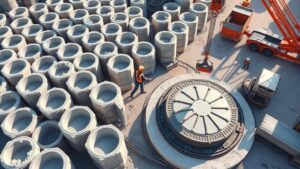
High-strength concrete is your ticket to building super-strong, resilient structures. Imagine concrete with compressive strength over 6,000 psi, capable of withstanding immense pressure. It’s made from a mix of cement, aggregates, water, and admixtures, and can include materials like fly ash and silica fume for extra durability. Popular in skyscrapers and vital infrastructure, it resists fire, weather, and freeze-thaw cycles. High-strength concrete shapes safer, taller, and more sustainable buildings. Curious about how it all works and what the future holds for this incredible material? You’re about to uncover some fascinating insights that will elevate your understanding.
Key Takeaways
- High-strength concrete achieves compressive strengths over 6,000 psi, essential for tall buildings and critical infrastructure.
- Incorporating fly ash and silica fume enhances the strength and durability of high-strength concrete.
- Optimized mix proportions and water-cement ratios are crucial for achieving desired performance and workability.
- High-strength concrete offers exceptional fire resistance, low thermal conductivity, and freeze-thaw durability.
- Emerging technologies like ultra-high-performance concrete and machine learning are shaping the future of high-strength concrete.
Introduction
High-strength concrete is a type of concrete known for its exceptional durability and load-bearing capacity, making it essential in modern construction projects.
You’ll find it fascinating that this material has evolved greatly over the years, thanks to advancements in technology and materials.
Understanding its history and importance helps you appreciate how far we’ve come in building stronger, more resilient structures.
High-strength concrete and its significance in modern construction
In modern construction, concrete with a compressive strength exceeding 6,000 psi is known for its essential role in building taller, more durable structures. You’ve probably noticed how skyscrapers seem to touch the clouds these days. That’s thanks to high-strength concrete. It’s stronger and more resilient, making it perfect for projects where regular concrete just won’t cut it.
Historically, concrete has come a long way from simple mixtures to these advanced forms. High-strength concrete plays a pivotal role in safety considerations, ensuring buildings can withstand extreme forces like earthquakes and heavy loads. Plus, it doesn’t just make buildings safer; it also has a significant economic impact. These structures last longer and require fewer repairs, saving money in the long run.
From an environmental sustainability perspective, high-strength concrete is a winner too. It reduces the amount of material needed, which means less waste and a smaller carbon footprint. Technological advancements have made it easier to produce and use, making it a go-to choice for modern architects and builders.
Brief history and evolution of high-strength concrete technology
The journey of concrete from basic forms to today’s high-strength varieties reveals fascinating advancements in materials science and engineering. You might be surprised to learn that concrete has been around for thousands of years. In ancient times, Egyptians and Romans used early versions of concrete to build structures that still stand today.
Fast forward to the 20th century, and you’ll see the introduction of innovative additives that revolutionized concrete technology. One of the historical milestones in this evolution timeline was the development of Portland cement in the 1820s. This cement became a key ingredient in modern concrete.
As you move through history, the 1960s and 1970s marked significant technological breakthroughs. During this period, researchers discovered that adding materials like fly ash and silica fume could drastically improve concrete’s strength and durability.
Early adopters of high-strength concrete were mostly in the construction of tall buildings and infrastructure projects. These pioneers paved the way for the concrete we use today. The continuous evolution of high-strength concrete technology has relied heavily on experimenting with innovative additives and refining production techniques.
Each step in this journey has brought us closer to creating stronger, more resilient structures that can withstand the test of time.
Properties and Characteristics

When you think about high-strength concrete, it’s all about the impressive compressive strength, which sets it apart from regular concrete.
You’ll find it has outstanding mechanical properties, making it durable and resistant to harsh environmental factors, including high temperatures.
Compared to normal-strength concrete, high-strength concrete offers enhanced performance in many demanding applications.
Compressive strength range and classification
High-strength concrete typically boasts a compressive strength exceeding 6,000 psi, making it ideal for demanding construction projects. To determine this strength, you’ll rely on various testing methods. These methods, such as cylinder tests and cube tests, help establish the compressive limits and guarantee the concrete meets specific performance metrics.
Concrete grades are assigned based on these tests, indicating the strength and durability of the material. For example, grades can range from C30 to C100, signifying different strength thresholds. The higher the grade, the stronger and more resilient the concrete will be.
When you consider these performance metrics, it becomes clear why high-strength concrete is so popular. It can withstand heavy loads, resist wear and tear, and last longer than conventional concrete.
Contractors and engineers often choose high-strength concrete for skyscrapers, bridges, and other critical infrastructure projects where reliability is key.
Mechanical properties
When you explore the mechanical properties of high-strength concrete, you’ll notice its impressive tensile strength, which helps it resist cracking under tension.
Another key trait is its modulus of elasticity, indicating how much it will deform under stress.
Understanding its stress-strain behavior will show you how this concrete performs under different loads, ensuring it meets the demands of various construction projects.
Tensile strength
Tensile strength plays a pivotal role in determining how high-strength concrete performs under stress and resists cracking.
You’ll find that:
- Fiber reinforcement: Adding materials like steel fibers boosts tensile strength.
- Tensile testing: This process measures how well the concrete handles pulling forces.
- Crack propagation: Understanding failure mechanisms helps in designing concrete that doesn’t crack easily.
These elements secure concrete’s durability and resilience.
Modulus of elasticity
The modulus of elasticity is a fundamental factor in how concrete deforms under loads, directly impacting its performance in various applications.
You’ll find that the elastic modulus, also known as Young’s modulus, measures concrete elasticity and stiffness properties. Understanding this helps predict deformation behavior, ensuring your structures are both strong and resilient.
With this knowledge, you can better design and use high-strength concrete.
Stress-strain behavior
Understanding stress-strain behavior is essential for predicting how high-strength concrete will respond under different loads. You’ll need to take into account several factors:
- Creep behavior: How the concrete deforms over time under constant stress.
- Shrinkage effects: Changes in volume as the concrete dries.
- Fatigue resistance: The concrete’s ability to withstand repeated loading.
Microstructure analysis and nonlinear modeling help in understanding these behaviors.
Durability and resistance to environmental factors, including high temperatures
High-strength concrete excels in durability, withstanding harsh environmental conditions and high temperatures effectively. One of its key features is remarkable fire resistance, making it a safe choice for buildings and infrastructure. This type of concrete exhibits low thermal conductivity, which means it doesn’t easily transfer heat, helping to protect structures during fires. It also handles temperature cycling well, maintaining its strength and integrity even when exposed to repeated heating and cooling.
When it comes to weather exposure, high-strength concrete stands up against all kinds of elements. Whether it’s blazing sun, pouring rain, or heavy snow, this concrete stays strong. Its freeze-thaw durability is particularly impressive. In cold climates where water can freeze and thaw repeatedly, high-strength concrete resists cracking and deterioration better than many other materials.
You might think that such toughness would make it difficult to work with, but that’s not the case. High-strength concrete is designed to be versatile and user-friendly, meeting the needs of various construction projects.
Comparison with normal-strength concrete
When comparing normal-strength concrete to high-strength concrete, you’ll notice significant differences in their properties and characteristics. High-strength concrete offers several advantages that make it stand out, but it also comes with its own set of challenges and considerations.
First, let’s talk about cost. High-strength concrete generally costs more due to the materials and specific curing techniques required. However, it can be more cost-effective in the long run because of its durability and reduced maintenance needs.
Next, consider shrinkage control. High-strength concrete tends to shrink less than normal-strength concrete, which means fewer cracks over time. This improved cracking behavior can lead to longer-lasting structures and fewer repairs.
Finally, think about construction challenges. Working with high-strength concrete isn’t always easy. It requires precise mixing, careful curing techniques, and sometimes even specialized equipment to handle the increased weight and density.
Here’s a quick summary:
- Cost Analysis: Higher initial cost, but potentially lower long-term expenses.
- Shrinkage Control: Less shrinkage and cracking, leading to more durable structures.
- Construction Challenges: Requires precise handling and specialized techniques.
Understanding these differences can help you make better decisions for your construction projects.
Materials and Mix Design

When you’re working with high-strength concrete, understanding the materials and mix design is essential. You need to focus on key components like cement, aggregates, and water, and how supplementary cementitious materials can boost performance.
Optimizing the mix proportions and the water-cement ratio, along with selecting the right type and quality of aggregates, will help you achieve the best results, especially with advancements in ultra-high-strength concrete mixes.
Key components
When you’re talking about high-strength concrete, you need to focus on four main components:
cement, aggregates, water, and admixtures.
Each one plays a vital role in the mix design and overall strength.
Let’s break down how these materials work together to create a concrete that’s both durable and strong.
Cement
For high-strength concrete, selecting the appropriate type of cement is essential to achieving the desired performance and durability. You need to understand the different types available and their specific applications.
Cement production involves a detailed manufacturing process, including cement additives that enhance properties.
Don’t forget about cement testing for quality assurance.
Here are three key points:
- Types available
- Manufacturing process
- Cement additives
Aggregates
Aggregates play a significant role in high-strength concrete, providing the necessary bulk, strength, and durability to the final mix.
You should consider recycled aggregates for sustainability. Pay attention to aggregate grading and moisture levels to guarantee consistency.
Aggregate shape and texture also impact the mix’s performance. By mastering these factors, you’ll create concrete that’s both resilient and high-performing.
Water
Water’s quality and quantity are essential in determining the strength and workability of high-strength concrete.
You need to focus on:
- Water Temperature: Keeping it consistent aids the hydration process.
- Water Purity: Avoid impurities that could weaken the mix.
- Curing Duration and Evaporation Control: Proper curing prevents premature evaporation, ensuring a strong final product.
Paying attention to these factors is vital!
Admixtures
Incorporating admixtures into your concrete mix can greatly enhance its strength, durability, and workability.
Adjusting the chemical composition with superplasticizers improves efficiency, allowing for easier handling.
Air entraining admixtures help combat freeze-thaw cycles, while shrinkage reduction agents minimize cracking.
Adding pozzolanic materials triggers a beneficial reaction, boosting the concrete’s resilience.
Role of supplementary cementitious materials
Using supplementary cementitious materials like fly ash, silica fume, and metakaolin can really boost the strength and durability of your concrete mix.
These materials not only enhance the concrete’s performance but also make it more environmentally friendly.
Fly ash
Fly ash plays an important role in enhancing the durability and strength of high-strength concrete by acting as a supplementary cementitious material. It also helps reduce the carbon footprint and manage waste effectively.
Key benefits include:
- Environmental impact: Lowers greenhouse gases.
- Energy savings: Less energy needed for production.
- Lifecycle analysis: Extends the lifespan of concrete structures.
Silica fume
Silica fume greatly enhances the strength and durability of high-strength concrete by filling in the microscopic voids between cement particles. You’ll love its benefits, like increased compressive strength and reduced permeability.
Incorporation techniques can be a bit tricky, so follow guidelines closely. While cost implications are notable, handling precautions are essential.
Plus, it’s environmentally friendly, reducing industrial waste.
Metakaolin
Metakaolin greatly enhances the performance of high-strength concrete by improving its mechanical properties and durability.
You’ll find that Metakaolin applications are vast, and here are some key points:
- Metakaolin benefits: Improves strength and reduces permeability.
- Metakaolin sourcing: Derived from kaolin clay.
- Metakaolin processing: Requires careful thermal treatment.
While Metakaolin costs can be higher, the improvements are often worth it.
Optimizing mix proportions and water-cement ratio
To achieve high-strength concrete, you need to carefully balance the mix proportions and water-cement ratio.
First, let’s talk about admixture selection. Admixtures are like the vital ingredients that can enhance the performance of your mix. Choose the right ones to improve workability, reduce water content, and accelerate hydration kinetics.
Next, focus on mixing techniques. Proper mixing guarantees that all components are evenly distributed, which is essential for consistent strength. Whether you’re using a drum mixer or a pan mixer, make sure you follow the recommended procedures.
When it comes to proportioning methods, it’s all about finding the perfect balance between cement, water, and aggregates. Too much water weakens the concrete, while too little makes it difficult to work with. Use optimization strategies to determine the best proportions.
Hydration kinetics also play a role. This is the chemical reaction between cement and water. Faster hydration can lead to quicker strength gain, but it needs to be controlled to avoid cracking.
Influence of aggregate type and quality on concrete properties
The type and quality of aggregates directly impact the strength, durability, and overall performance of your high-strength concrete mix. Not all aggregates are created equal, and considering factors like aggregate grading, surface texture, particle shape, mineral composition, and aggregate cleanliness can make a significant difference.
First, let’s talk about aggregate grading. Proper grading guarantees a well-distributed mix of particle sizes, which helps fill voids and reduces the amount of cement paste needed. This leads to stronger concrete.
Next up is surface texture. Aggregates with rough surfaces provide better bonding with the cement paste, enhancing the concrete’s overall strength. Smooth aggregates might look nice, but they don’t offer the same level of grip.
Finally, consider particle shape. Angular particles interlock better than rounded ones, giving your concrete higher strength and less shrinkage. Besides, the mineral composition of your aggregates can affect durability; some minerals are more reactive and can lead to issues like alkali-silica reaction.
Don’t forget about aggregate cleanliness, either. Dirty aggregates can introduce unwanted impurities, weakening the concrete and affecting its long-term performance. So, always make sure your aggregates are clean and properly washed before mixing.
Advancements in ultra-high-strength concrete mix designs
Building on the importance of aggregate selection, let’s explore how advancements in ultra-high-strength concrete mix designs are pushing the boundaries of what’s possible in construction.
One exciting development is the integration of nanotechnology. Adding nanoparticles to the mix can greatly enhance the concrete’s strength and durability. It’s like giving your concrete a superhero upgrade!
Another key advancement is the use of fiber reinforcement. By mixing in fibers, you can improve the concrete’s toughness and resistance to cracking. This makes it perfect for structures that need to withstand heavy loads and harsh conditions.
Sustainability impacts are also a big focus. New mix designs aim to reduce the carbon footprint by using eco-friendly materials and recycling waste products. This not only helps the environment but also meets growing industry demands for greener construction practices.
Of course, cost analysis is important. While these advanced materials can be more expensive upfront, their long-term benefits often outweigh the initial costs. Over time, they can lead to savings in maintenance and repairs.
Production and Quality Control

Now that you know about materials and mix design, let’s talk about production and quality control for high-strength concrete.
You’ll need to pay attention to batching, mixing, and transportation to guarantee the concrete performs well.
Proper placement, consolidation, and curing methods, along with strict quality control measures and testing, are essential for achieving the desired strength.
Batching, mixing, and transportation considerations
Effective batching, mixing, and transportation are essential to maintaining the quality of high-strength concrete. You need to pay close attention to these elements to avoid common issues that can compromise your project.
Here are some important considerations:
- Batching errors: Mistakes in measuring and combining ingredients can lead to inconsistencies. Ensure accurate measurements and thorough checks to avoid these errors. Even small deviations can affect the concrete’s strength and workability.
- Mixing time: The duration of mixing plays an important role in achieving uniformity. Too little mixing can result in uneven distribution of materials, while over-mixing can reduce workability. Aim for the optimal mixing time to get the best results.
- Transportation challenges: Moving high-strength concrete to the construction site comes with its own set of hurdles. Temperature control is essential during transit to prevent premature setting or loss of workability. Additionally, ensure the concrete is transported quickly and efficiently to maintain its quality.
Placement, consolidation, and finishing techniques
Properly placing, consolidating, and finishing high-strength concrete is essential to guarantee its durability and performance. When you first pour the concrete, it’s important to meet the specific slump requirements. This guarantees the concrete’s consistency, making it easier to work with and preventing excessive bleeding. You don’t want too much water rising to the surface, as this weakens the mix.
Using vibration techniques during consolidation helps eliminate air pockets and ensures a denser, more robust structure. You’ll need to carefully vibrate the concrete, avoiding over-vibration, which can cause segregation. Think of it like shaking a can of soda – too much and you’ve got a mess.
Surface leveling is the next step. Properly level the surface to avoid any dips or bumps, which can affect the concrete’s strength and appearance. You’ll want to use the right finishing tools for this, like trowels and screeds, to achieve a smooth, even finish.
Don’t rush this part; a well-leveled surface sets the stage for a long-lasting concrete structure.
Curing methods and their impact on strength development
Properly curing high-strength concrete is essential for achieving maximum durability and strength. You’ll want to know about several methods and how they impact strength development. Here’s a quick rundown:
- Steam curing: This method involves applying steam to accelerate the curing process. It’s especially useful in colder climates where concrete mightn’t cure properly on its own. You’ll find it speeds up the strength gain, letting you use the concrete sooner.
- Curing blankets: These are practical for maintaining a consistent temperature during the curing duration. By covering the concrete, you secure it retains moisture and heat, which are vital for strength development. Think of curing blankets as a cozy layer keeping your concrete warm and hydrated.
- Wet curing: Here, you keep the concrete surface continuously wet. This method is super effective as it prevents the concrete from drying out too quickly, leading to excellent strength development. You can use sprinklers, wet burlap, or even ponding to keep that moisture level just right.
Membrane curing is another option where you apply a sealing compound to lock in moisture. Each method has its benefits, and choosing the right one depends on your specific project needs.
Quality control measures and testing procedures
Ensuring high-strength concrete meets quality standards involves rigorous quality control measures and precise testing procedures. You need to start with proper personnel training, making sure everyone knows how to handle the materials and equipment correctly. This step is vital because trained personnel can catch issues early on.
Next, you’ll focus on testing frequency. Regular tests help identify any problems before they become serious. You should perform calibration checks on all your equipment to guarantee accuracy. Imagine trying to bake a cake without knowing if your oven’s temperature is correct—calibration checks are just as essential for concrete testing.
Sampling methods are another key component. You can’t test every batch of concrete, so you take samples that represent the whole lot. Make sure to follow standard procedures, so your samples are accurate.
Once you’ve got your samples, it’s time for data analysis. This step helps you understand how well your concrete is performing. You can spot trends and make adjustments as needed.
Importance of mold size, material, and specimen preparation
To guarantee accurate testing results, you must pay close attention to the size and material of your molds, as well as the preparation of your specimens. The quality of your concrete depends greatly on these factors. Let’s break down why these elements are so essential.
First, the size and material of your mold are key. Different mold materials, like steel or plastic, provide various benefits. Steel molds offer better temperature stability and less mold corrosion, while plastic molds are lighter but may require more frequent replacement.
Second, specimen preparation is crucial. Make sure your mold release agent is applied evenly to avoid any damage to the surface finish of your concrete. A smooth surface finish is crucial for accurate strength measurements.
Finally, curing environment plays a significant role. You need a consistent environment to control temperature and humidity. This ensures your concrete cures properly and achieves the desired strength.
Here’s a quick summary:
- Mold Material: Choose between steel and plastic molds considering mold corrosion and temperature stability.
- Surface Preparation: Apply mold release properly for a smooth surface finish.
- Curing Environment: Maintain consistent temperature and humidity for the best curing.
Structural Design and Applications

When you use high-strength concrete in structural design, you receive several benefits like enhanced durability and minimized material use, which can save costs.
You need to take into account specific design codes and provisions to guarantee safety and efficiency.
This type of concrete is ideal for precast and prestressed applications, making it perfect for high-rise buildings, bridges, and other infrastructure projects.
Benefits of using high-strength concrete
Using high-strength concrete offers several benefits that can enhance your construction projects.
You’ll find that reduced member sizes free up more space, allowing for creative design possibilities.
Plus, increased span lengths and improved durability mean fewer repairs and longer-lasting structures.
Reduced member sizes
High-strength concrete allows for slimmer structural elements, enabling architects and engineers to create more elegant and space-efficient designs. You benefit from:
- Column reduction: Smaller columns mean more usable space.
- Weight savings: Lighter structures reduce foundation needs.
- Slender structures: Achieve a sleek look with less material.
This material efficiency contributes to better space optimization in your projects, making them both practical and visually appealing.
Increased span lengths
You can achieve longer span lengths without compromising structural integrity by incorporating high-strength concrete into your designs. This approach enhances structural efficiency and optimizes span lengths.
Using composite materials improves load distribution and reduces beam deflection. You’ll find it easier to achieve span optimization, which ultimately leads to more innovative and flexible architectural designs, making your projects stand out.
Improved durability
By incorporating high-strength concrete into your structures, you greatly enhance their durability, ensuring they withstand harsh environmental conditions and heavy loads for extended periods.
This concrete offers:
- Corrosion resistance: Protects against rust and decay.
- Freeze-thaw cycles: Endures repeated freezing and thawing.
- Chemical attacks: Resists damage from sulfates and carbonation, maintaining structural integrity.
Design considerations and code provisions for high-strength concrete structures
When designing high-strength concrete structures, engineers must take into account specific code provisions and performance requirements to guarantee safety and durability. One key factor is seismic performance. High-strength concrete needs to handle the intense forces during an earthquake. By following guidelines, you confirm the building can sway without collapsing, protecting lives.
Fire resistance is another important consideration. Codes specify how long concrete must withstand high temperatures before it loses structural integrity. This helps in planning for safe evacuation times during a fire.
Shrinkage control is also significant. Concrete shrinks as it dries, which can cause cracks. By using the right materials and techniques, you can minimize shrinkage and maintain strength.
Creep behavior, or the slow deformation under sustained load, must be accounted for as well. Engineers design structures to manage this, ensuring that over time, the building remains stable.
Lastly, load distribution is essential. High-strength concrete allows for more efficient load-bearing designs. Codes guide you on how to distribute weights evenly, ensuring the structure can support not just its own weight, but also external loads like furniture, people, and weather conditions.
Precast and prestressed concrete applications
Precast and prestressed concrete revolutionize structural design by offering superior strength, flexibility, and efficiency in construction. You’ll find that using these materials saves time and boosts quality.
Precast factories produce components under controlled conditions, guaranteeing consistent quality. Prestressed tendons are inserted into the concrete to enhance strength, allowing it to handle greater loads and stresses.
Here’s what you should know:
- Formwork Techniques: In precast factories, advanced formwork techniques create precise shapes and sizes for concrete elements. This precision reduces waste and speeds up construction processes on-site, saving you time and money.
- Curing Conditions: Precast elements are cured under ideal conditions, which improves the concrete’s durability and strength. By controlling temperature and humidity, precast factories ensure that each piece meets high standards.
- Load Considerations: Prestressed concrete uses tendons that are tensioned to counteract loads. This means the concrete can handle heavier weights and longer spans without cracking, making it ideal for challenging projects.
Using precast and prestressed concrete means you’re getting a product designed to be strong, reliable, and ready for whatever your project demands. So, explore these techniques and see how they can transform your construction approach!
Use in high-rise buildings, bridges, and infrastructure projects
High-strength concrete plays a crucial role in the structural design of high-rise buildings, bridges, and infrastructure projects. Using this material, you can achieve remarkable results in terms of structural health and durability.
When dealing with high-rise buildings, high-strength concrete helps in load distribution, guaranteeing that the weight is evenly spread across the structure. This not only enhances stability but also offers excellent vibration control, reducing the sway you might feel in tall buildings.
| Application | Benefit |
|---|---|
| High-rise buildings | Load distribution |
| Bridges | Impact resistance |
| Infrastructure | Seismic retrofitting |
In bridges, high-strength concrete provides incredible impact resistance. This means the bridge can withstand heavy traffic and harsh weather conditions without cracking or deteriorating. It also contributes to seismic retrofitting, making older bridges safer and more resilient against earthquakes.
For general infrastructure projects, high-strength concrete is a game-changer. It enhances structural health by providing a robust foundation that can endure various stresses and strains. Whether you’re building a new highway or upgrading an existing one, this material ensures your projects are long-lasting and reliable.
Sustainability and economic advantages of high-strength concrete
Beyond enhancing structural health and durability, using high-strength concrete offers substantial sustainability and economic advantages. By integrating high-strength concrete into your projects, you’re not just building sturdier structures; you’re also making a positive impact on the environment and your budget.
First, high-strength concrete promotes green construction by reducing the overall material needed for a project. Because it’s stronger, you can use less of it, which means less waste and a smaller carbon footprint.
Second, it significantly lowers lifecycle costs. Structures made with high-strength concrete last longer and require less maintenance, saving you money in the long run. Imagine not having to worry about frequent repairs or replacements—sounds good, right?
Third, this material enhances energy efficiency. High-strength concrete has excellent thermal properties, so buildings made with it can better regulate temperature, leading to lower energy bills for heating and cooling.
Here’s a quick summary:
- Green Construction: Less material means less waste and a smaller carbon footprint.
- Lifecycle Costs: Longer-lasting structures require less maintenance and repair.
- Energy Efficiency: Better thermal properties result in lower energy bills.
Embrace high-strength concrete for its economic viability and its role in waste reduction and environmental conservation. You’ll be making a smart choice for both your wallet and the planet.
Advancements and Future Trends
You’re about to see some exciting advancements in high-strength concrete, like the development of ultra-high-performance concrete (UHPC).
Emerging technologies and research are paving the way for its use in extreme environments and resilient infrastructure.
Plus, machine learning is stepping in to help optimize mix designs and predict properties, making everything more efficient and reliable.
Development of ultra-high-performance concrete (UHPC)
Recent advancements in ultra-high-performance concrete (UHPC) have revolutionized the construction industry, paving the way for stronger and more durable structures. By incorporating fiber reinforcement, you can dramatically enhance the material’s crack resistance, making your projects last longer and withstand more stress.
Advanced curing methods also play an essential role in UHPC development, ensuring that the concrete reaches its best strength and durability.
But that’s not all! Here are three key factors that make UHPC a game-changer:
- Crack Resistance: The addition of fiber reinforcement helps to control cracks, preventing them from spreading and compromising the structural integrity.
- Shrinkage Control: Modern curing methods and the right mix design can greatly reduce shrinkage, minimizing the risk of cracks and ensuring a longer lifespan for your structures.
- Sustainability Factors: UHPC uses less material for a given strength, reducing the carbon footprint and contributing to more sustainable construction practices.
Emerging technologies and research directions
As UHPC continues to set new benchmarks in construction, emerging technologies and innovative research are pushing the boundaries even further.
One exciting advancement is the use of nano engineering additives. These tiny particles enhance the concrete’s strength and durability, making it even stronger than before. Imagine concrete that can practically heal itself! Researchers are exploring self-healing properties by embedding tiny capsules in the mix that release healing agents when cracks appear.
Another area of focus is improving carbonation resistance. By making concrete more resilient to this process, we can extend the lifespan of structures and reduce maintenance costs.
Speaking of innovative solutions, how about biodegradable formworks? These are eco-friendly molds that can decompose naturally, reducing waste and environmental impact.
But it doesn’t stop there. Have you ever thought about concrete that can block out sound? New developments in acoustic insulation are making this a reality. By incorporating specific materials, researchers are creating concrete that can greatly reduce noise pollution.
These advancements aren’t just enhancing the quality of construction materials but also paving the way for a more sustainable and resilient future in building practices.
Potential applications in extreme environments and resilient infrastructure
Ultra-high-performance concrete (UHPC) is revolutionizing the way we build resilient infrastructure in extreme environments. Imagine dealing with the biting cold of the Arctic, the immense pressure underwater, or the need for secure military bunkers. UHPC can handle it all. It’s not just about strength; it’s about resilience and durability.
Consider these potential applications:
- Arctic Installations: UHPC is perfect for structures in the Arctic. Its strength and resistance to freezing temperatures guarantee that buildings can withstand harsh weather without cracking or failing.
- Underwater Structures: Think underwater tunnels and marine platforms. UHPC’s ability to resist water and pressure makes it ideal for constructing long-lasting, durable underwater structures.
- Military Bunkers and Disaster Shelters: UHPC’s incredible strength can provide enhanced protection. Whether it’s a military bunker or a disaster shelter, this concrete can offer security against blasts and natural disasters.
And we’re not stopping there. Imagine space habitats built with UHPC, providing safe and durable living spaces for astronauts. This concrete’s remarkable properties make it a game-changer for building resilient infrastructure in the most extreme conditions you can think of.
Machine learning approaches for optimizing mix designs and predicting properties
Machine learning is revolutionizing how we optimize concrete mix designs and predict their properties, pushing the boundaries of what’s possible in construction. By leveraging advanced techniques like neural networks, genetic algorithms, and support vector machines, you can now make more precise and efficient decisions in creating high-strength concrete.
Neural networks mimic the human brain, learning from vast amounts of data to identify patterns and predict outcomes. This means you can predict the strength and durability of concrete mixes before even mixing them.
Genetic algorithms, inspired by natural selection, help you find the best mix design by evolving solutions over multiple iterations. Imagine selecting the fittest concrete recipe from a pool of candidates!
Support vector machines are another powerful tool, classifying data into categories for better decision-making. And let’s not forget reinforcement learning, where algorithms learn by trial and error, continuously improving the mix designs based on feedback.
Predictive analytics ties all these approaches together, giving you a crystal ball to foresee how different mix designs will perform in real-world scenarios. With these machine learning methods, you’re not just guessing—you’re making informed, data-driven choices that enhance strength and resilience.
Case Studies

Let’s look at some cool real-world examples where high-strength concrete has made a big impact.
You’ll learn about landmark structures and cutting-edge projects that have pushed the limits of this amazing material.
We’ll also share lessons learned and best practices from these projects, so you can see how high-strength concrete is changing the game.
Landmark structures and innovative projects utilizing high-strength concrete
High-strength concrete has been pivotal in creating some of the world’s most iconic and innovative structures. You might be amazed at how this material enables architects and engineers to explore the limits of design and durability.
Let’s delve into a few remarkable examples where high-strength concrete has made a monumental impact:
- Burj Khalifa: Standing tall in Dubai, the Burj Khalifa is the world’s tallest building. High-strength concrete was essential in its construction, allowing for a slender, more aerodynamic design that can withstand strong winds and seismic activities.
- Hoover Dam: An engineering marvel from the 1930s, the Hoover Dam relies on high-strength concrete to hold back the enormous pressure of the Colorado River. This massive structure showcases the durability and longevity of high-strength concrete.
- Millau Viaduct: This stunning bridge in France, which soars high above the Tarn River Valley, utilizes high-strength concrete to support its slender towers and long spans. The Millau Viaduct is a demonstration of the material’s ability to combine strength with elegance.
These examples, along with others like the Petronas Towers and the Three Gorges Dam, highlight how high-strength concrete shapes our world, enabling the creation of structures that are both beautiful and resilient.
Lessons learned and best practices from real-world applications
From the extensive use of high-strength concrete in landmark projects around the world, several valuable lessons and best practices have emerged, guiding future applications. One critical takeaway is the importance of cost analysis. Before starting a project, you should understand the financial implications, making sure the budget can handle the material’s premium cost.
Risk management is another key lesson. You need to anticipate potential issues, such as unexpected weather conditions or supply chain disruptions, and have a plan to address them. Proper maintenance strategies also play a crucial role. Regular inspections and timely repairs can help extend the lifespan of structures, saving you money in the long run.
Workforce training can’t be overlooked. Your crew needs to be well-versed in handling high-strength concrete, which behaves differently from regular concrete. Invest in training sessions to boost their skills and ensure quality work.
Safety protocols are equally important. High-strength concrete projects often involve heavy machinery and high elevations, so rigorous safety measures must be in place to protect workers.
Conclusion
To sum up, you can see how high-strength concrete offers significant benefits, from enhanced durability to greater load-bearing capacity.
Looking forward, there’s exciting potential for further advancements in this field. Designers, engineers, and researchers should continue exploring innovative ways to maximize the advantages of high-strength concrete in construction projects.
Recap of the importance and benefits of high-strength concrete
Why is high-strength concrete essential in modern construction?
Well, it’s all about ensuring that the structures you build are safe, durable, and efficient. High-strength concrete offers numerous benefits that make it a top choice for various construction projects. Here’s why you should consider using it:
- Structural integrity and Load capacity: High-strength concrete enhances the structural integrity of buildings. This means your construction can handle greater loads, making it ideal for skyscrapers, bridges, and other large structures.
- Construction efficiency and Maintenance savings: Using high-strength concrete can speed up construction processes, leading to significant time and cost savings. Plus, because it’s more durable, you’ll spend less on maintenance and repairs over the building’s lifespan.
- Seismic performance: In areas prone to earthquakes, high-strength concrete provides better seismic performance. It can withstand the intense forces during an earthquake, reducing the risk of catastrophic failures.
Future outlook and potential for further advancements
Looking ahead, the future of high-strength concrete promises even greater innovations and applications in construction. Imagine using nanotechnology integration to create concrete that’s not only stronger but also more versatile. By adding tiny particles, you can enhance the material’s properties, making it more durable and resistant to wear and tear.
Smart materials are another exciting development. These can adapt to environmental changes, like temperature or moisture, making your structures safer and longer-lasting. Plus, with 3D printing, you can create complex shapes and forms that were once impossible, opening up new design possibilities and reducing waste.
Bio-inspired designs are also on the horizon. By mimicking natural structures, you can develop concrete that’s both strong and lightweight, much like the bones of birds or the shells of mollusks. This approach can lead to more sustainable and efficient building materials.
And let’s not forget carbon capture. High-strength concrete can incorporate methods to trap carbon dioxide, helping to reduce greenhouse gases and combat climate change.
Recommendations for designers, engineers, and researchers working with high-strength concrete
When working with high-strength concrete, how can you guarantee peak performance and longevity in your projects? By following a few key recommendations, you’ll ensure your designs are both robust and sustainable.
Here are three essential guidelines to bear in mind:
- Adhere to Safety Guidelines
Always prioritize safety. High-strength concrete can handle significant loads, but you must follow strict safety guidelines to prevent structural failures. Make sure all workers are trained and equipped with proper safety gear.
- Implement Rigorous Testing Protocols
Don’t skimp on testing. Regularly test your concrete to confirm it meets the required strength and durability standards. Testing protocols like compressive strength tests help you verify that your mix is up to the task.
- Incorporate Sustainability Practices
Think green. Use sustainable materials and methods to reduce your environmental impact. This could mean using recycled materials or optimizing your mix to lower the carbon footprint. Sustainability practices are essential for modern construction.
Frequently Asked Questions
What Are the Common Challenges in Curing High-Strength Concrete?
Did you know improper curing can reduce concrete strength by up to 50%? You’ll face challenges like ensuring proper curing methods, maintaining moisture retention, managing the hydration process, and monitoring curing duration and post curing conditions.
How Does Temperature Affect the Performance of High-Strength Concrete?
Temperature affects high-strength concrete’s performance by creating thermal gradients and hydration heat. You must manage temperature control and curing conditions to prevent thermal expansion, which can lead to cracking or reduced strength.
What Are the Costs Associated With Using High-Strength Concrete Compared to Conventional Concrete?
You’ll find that material costs and labor expenses for high-strength concrete are higher, but its durability benefits and potential long-term savings can offset these. Project timelines might also be shorter, adding value overall.
Can High-Strength Concrete Be Used in Underwater Construction?
You might think high-strength concrete isn’t suitable for underwater construction, but it is. With proper mixing techniques, underwater durability, careful admixtures selection, suitable placement methods, and effective reinforcement strategies, you can achieve reliable underwater structures.
How Does High-Strength Concrete Respond to Chemical Exposure?
High-strength concrete’s chemical resistance depends on admixture influence and permeability rates. You’ll find that its durability factors are essential in preventing surface degradation. Properly formulated, it effectively withstands harsh chemical exposure, maintaining structural integrity.
Conclusion
So, you’ve made it to the end. Well, congratulations! You’re practically a high-strength concrete guru now.
The next time someone mentions concrete, you can dazzle them with your knowledge about its properties, materials, and applications. Maybe even throw in a fun fact about future trends for good measure.
Just remember, mastering high-strength concrete isn’t just about knowing the mix; it’s about appreciating the blend of art and science that makes it all possible.
Keep on building!

Get the inside scoop on Ordinary Portland Cement Concrete and discover why it's the backbone of modern construction projects—find out Read more

Keep reading to discover how lightweight concrete is transforming construction with its blend of strength, sustainability and cost-efficiency.

Achieve game-changing construction with High-Performance Concrete. Known for unparalleled strength and durability. Discover its incredible potential now.