Concrete for Foundations & Footings in Manchester & Cheshire
Structural concrete for strip footings, trench fill, rafts and pad foundations — mixed fresh to BS 8500, and pumped or barrowed straight into the trenches.
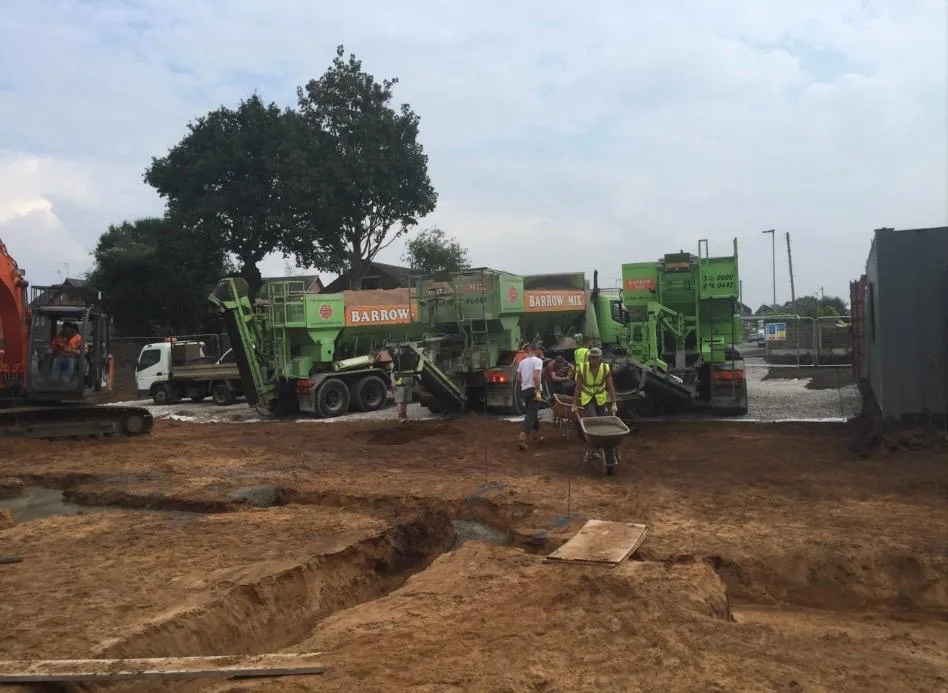
The foundations carry the whole building, so the concrete has to be right. Barrow Mix supplies structural concrete for foundations and footings across Greater Manchester, Cheshire and the North West — batched fresh on-site by our volumetric wagons to BS 8500, in the grade your job and ground conditions call for.
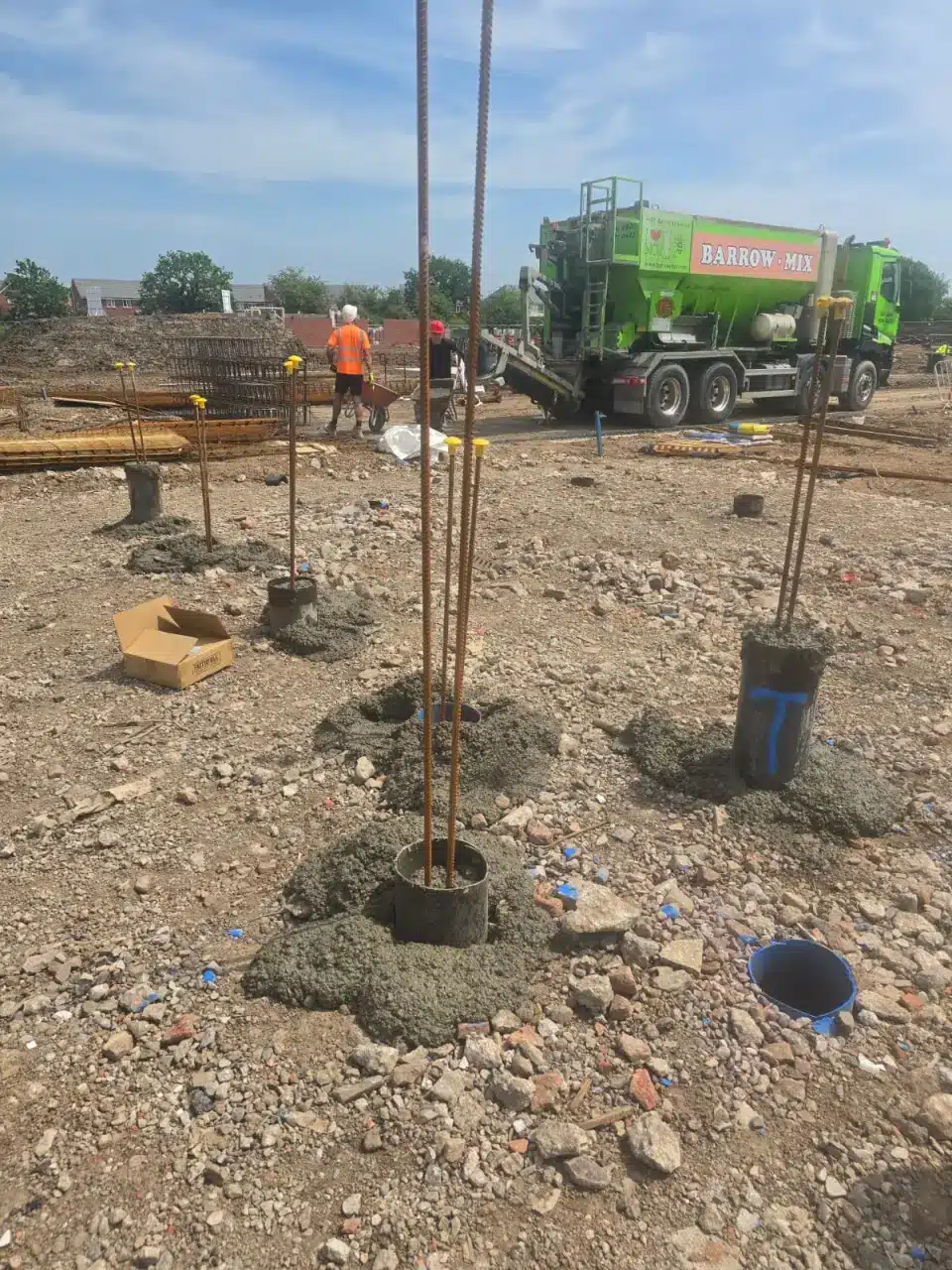
Because we mix on the spot, you get fresh concrete to the exact quantity, with no part-loads wasted — and we’ll pump or barrow it straight into the trenches when access is tight.
Foundations we supply concrete for
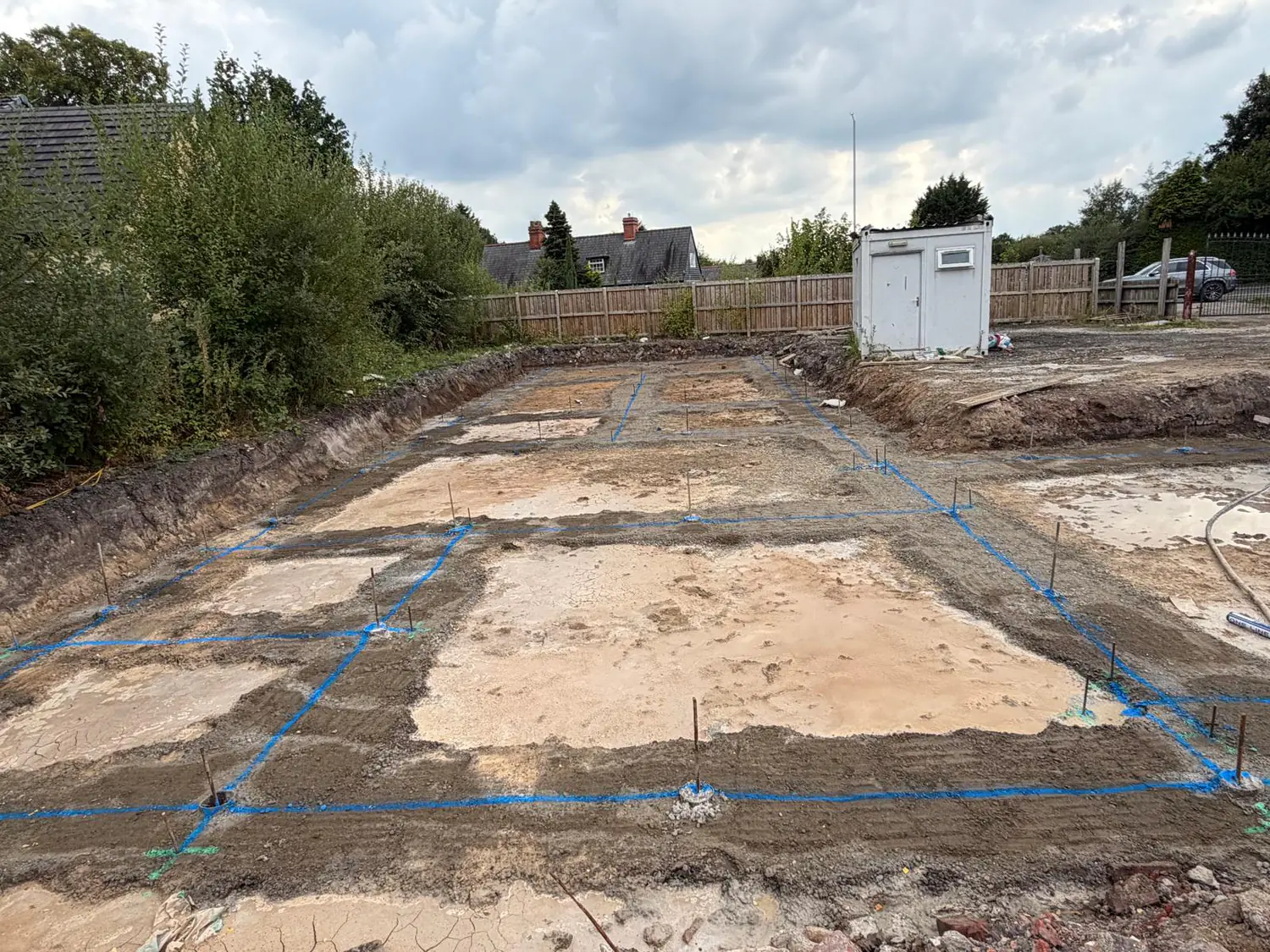
Strip foundations and trench fill
Raft foundations and ground-bearing slabs
Pad foundations, machine bases and column footings
Reinforced ground beams and structural footings
Underpinning to existing foundations (barrowed or pumped into restricted access)
It depends on the design, ground and whether the foundation is reinforced – commonly C20 to C35 (or a designated RC/FND mix) to BS 8500. Tell us the job and your engineer’s spec and we’ll batch the right grade.
What’s the difference between strip foundations and trench fill?
Strip foundations have a band of concrete at the base of the trench with blockwork built up off it; trench fill fills most of the trench with concrete. Both need the correct grade and depth – we supply the concrete for either.
Can you pump concrete into foundation trenches?
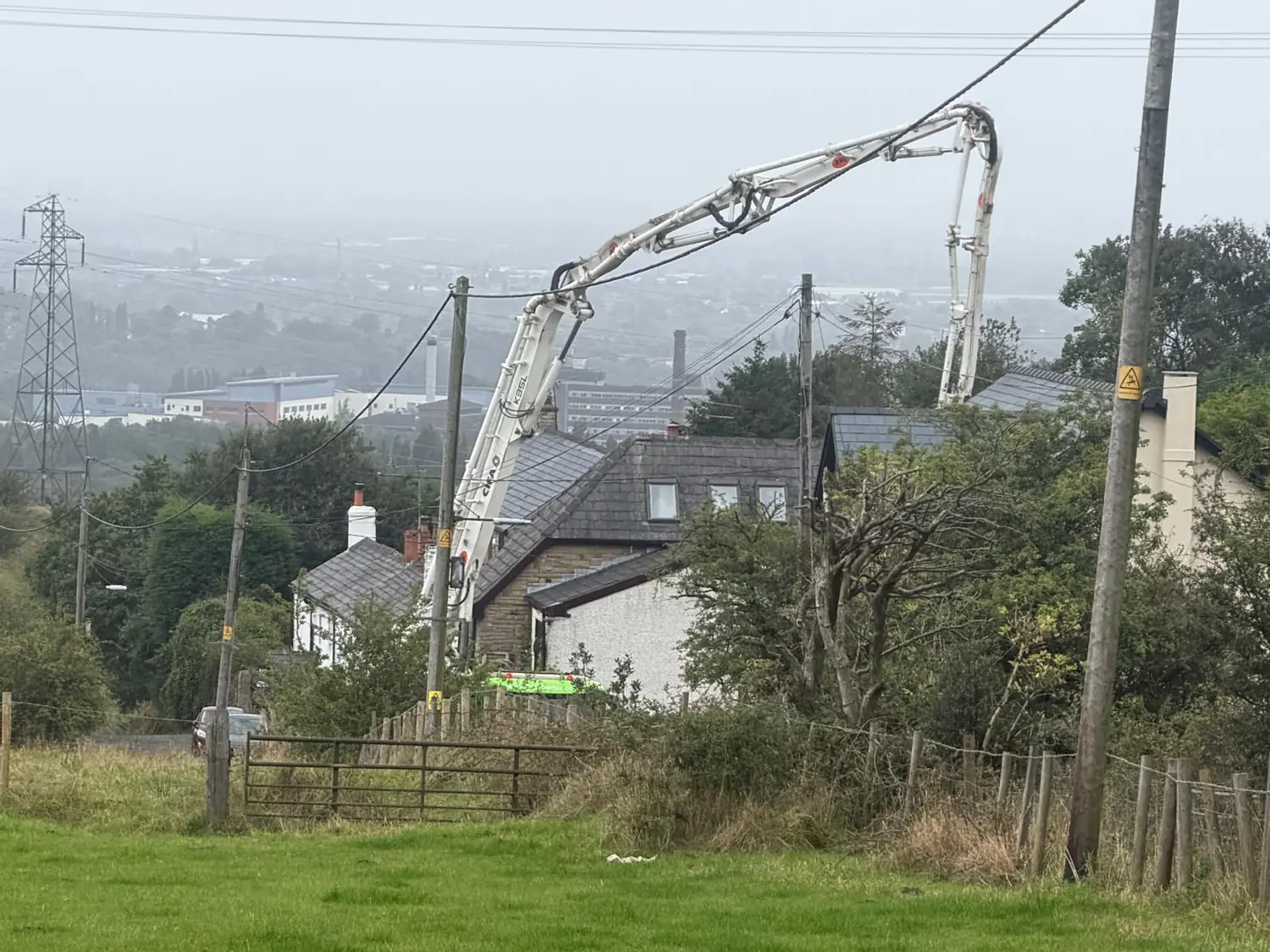
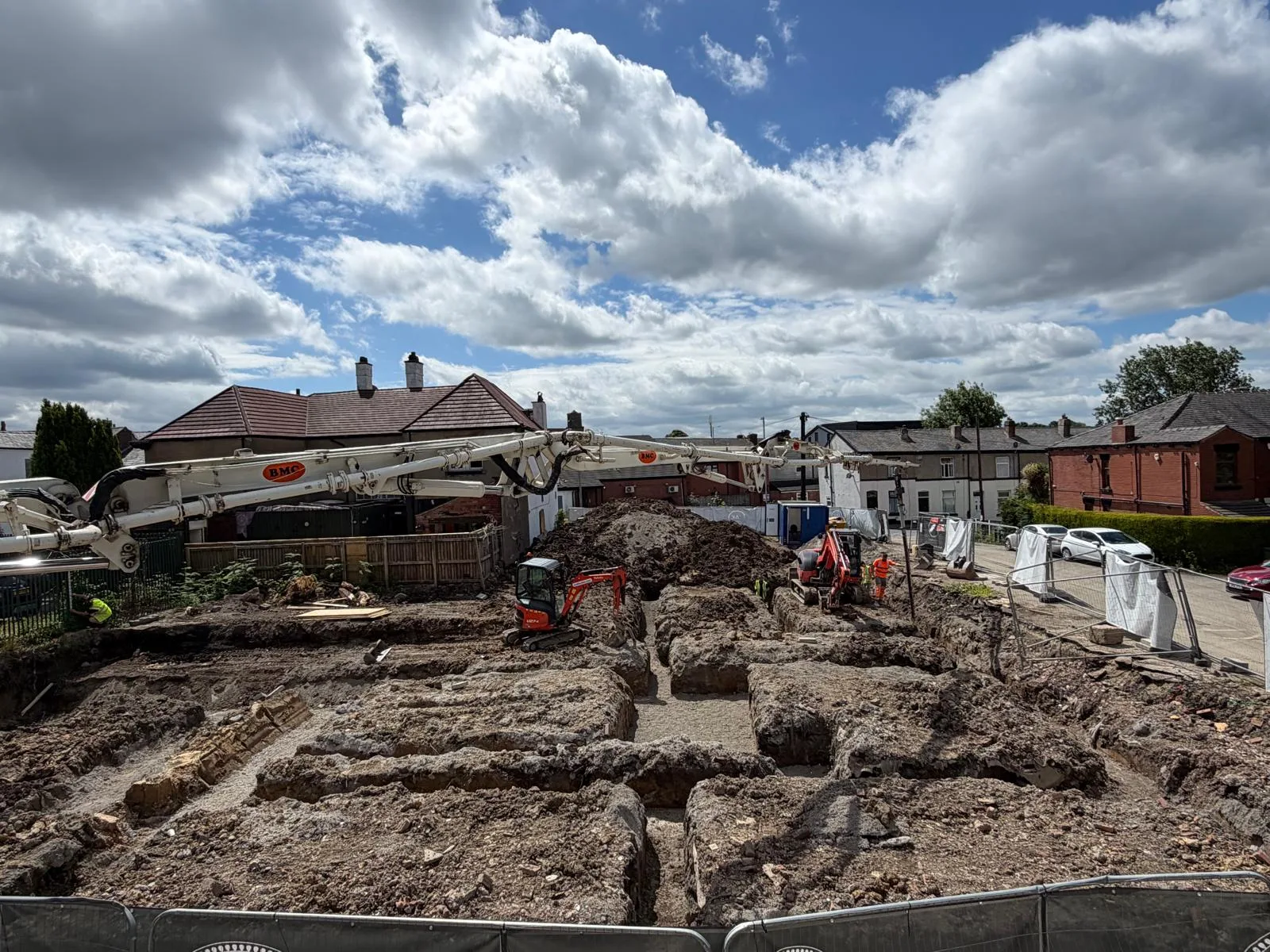
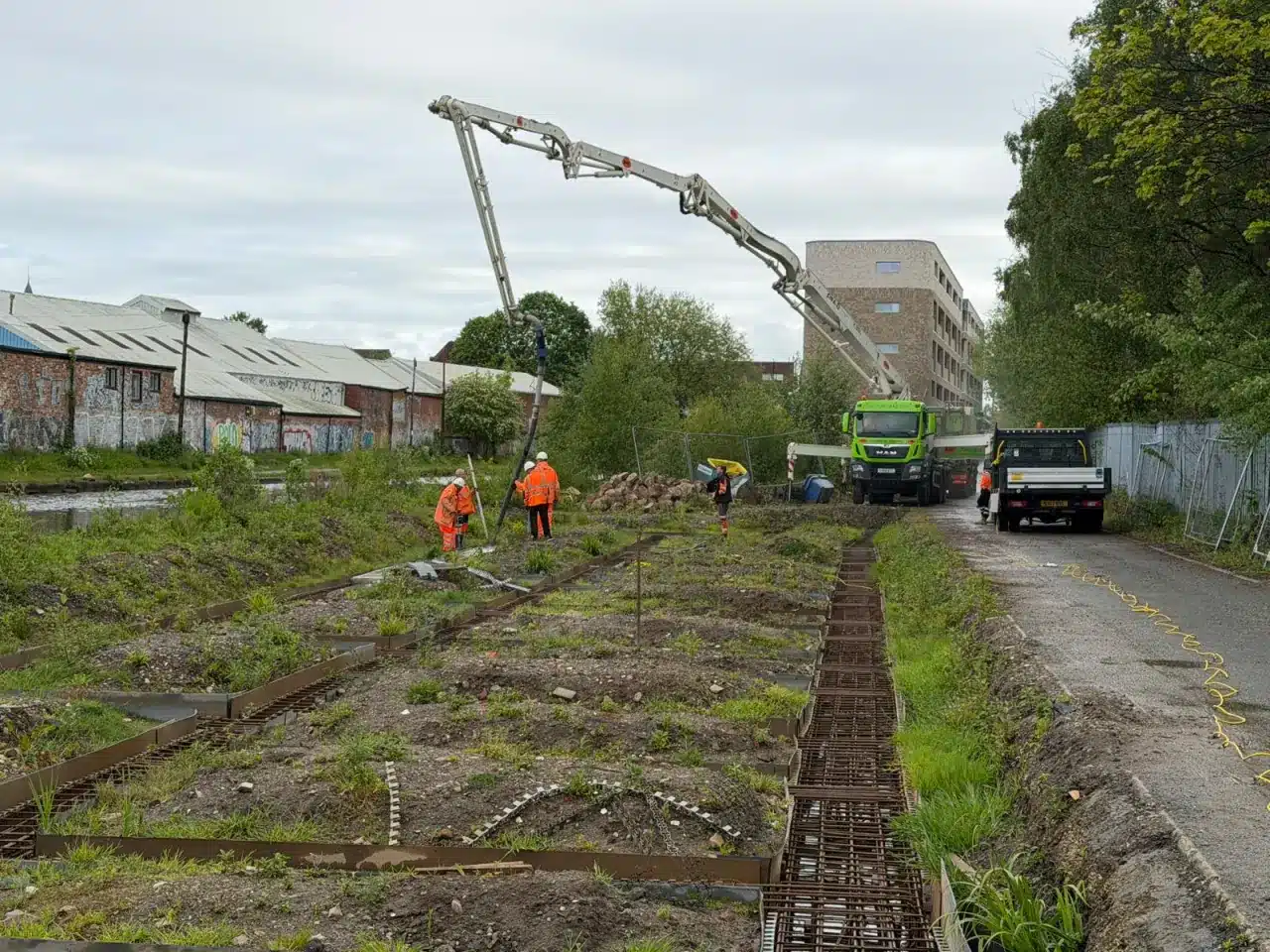
Yes – we pump and barrow concrete straight into the trenches, which is ideal for tight access, underpinning and where a wagon can’t get close.
Do you cover my area?
We supply foundation concrete across Greater Manchester, Cheshire and the North West. Send your postcode and the job for a quote.
★★★★★
Had concrete from us?
A quick Google review helps other people across Manchester and Cheshire find us. Thank you!
Strip, trench fill, raft or pad — we’ll batch the right grade fresh on site and pump or barrow it into the trenches across Greater Manchester, Cheshire and the North West. Free, no-obligation quotes.
Concrete foundations are essential structural elements that provide stability and load distribution for buildings.
You’ll encounter three primary types: T-shaped, slab-on-grade, and frost-protected.
Proper site preparation, including soil testing and excavation, is critical before construction begins. You must select the right concrete mix based on compressive strength requirements and environmental factors.
Formwork and reinforcement installation precede the pouring process, where compaction techniques guarantee ideal density.
After pouring, curing and protection methods are important for achieving maximum strength.
Regular maintenance and timely repairs will preserve your foundation’s integrity.
Understanding these key aspects will help you make informed decisions about your construction project.
Key Takeaways
Concrete foundations provide structural support for buildings and come in various types, including T-shaped, slab-on-grade, and frost-protected.
Proper site preparation and soil testing are crucial for determining the appropriate foundation type and ensuring long-term stability.
Selection of the right concrete mix is essential, considering factors like compressive strength requirements and environmental conditions.
Formwork and reinforcement installation are critical steps in the foundation construction process, enhancing structural integrity.
Proper pouring techniques, compaction, and curing methods are vital for creating a durable and long-lasting concrete foundation.
Types of Concrete Foundations
Concrete’s versatility in foundation construction is evident in the three primary types: T-shaped, slab-on-grade, and frost-protected foundations. Each type is designed to address specific soil conditions and climate factors, guaranteeing structural integrity and longevity.
Proper ground preparation is essential for all foundation types, involving soil assessment, compaction, and the creation of a stable base.
T-shaped foundations are your go-to option for areas with freezing temperatures. They feature footings below the frost line, with walls constructed after the footing has cured. This design prevents frost heave and guarantees stability in colder climates.
Slab-on-grade foundations consist of a single, thick layer of concrete with thicker edges that provide integral footing. You’ll find these suitable for regions without frost, but they can be enhanced with insulation if necessary. This type offers a cost-effective solution for warmer climates.
Frost-protected foundations utilise rigid polystyrene insulation around the foundation walls to maintain ground temperatures above freezing. You’ll benefit from this design in heated structures, as it provides protection against frost heave without the need for deep excavation.
When selecting a foundation type, you must consider local building codes, environmental conditions, and the specific load-bearing requirements of your structure. Each foundation type offers unique advantages, tailored to meet the demands of diverse construction scenarios.
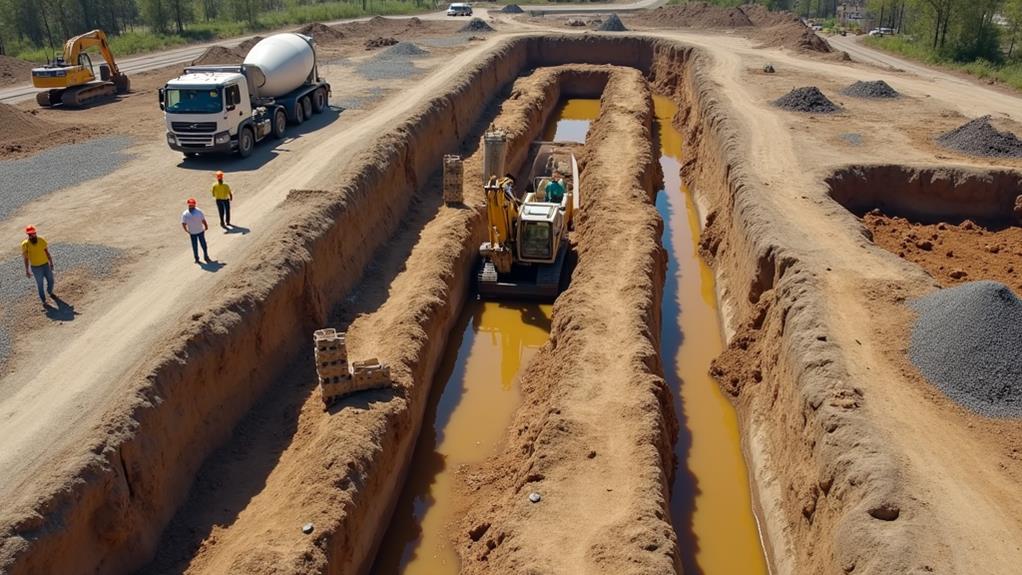
Site Preparation and Excavation
You’ll need to conduct soil testing procedures to determine the soil’s bearing capacity and composition before excavation begins.
These tests will inform your choice of excavation equipment, which should be selected based on soil type, site conditions, and project requirements.
Soil compaction is critical for guaranteeing the durability and performance of your concrete base.
Proper equipment selection guarantees efficient excavation and minimises the risk of over-digging or soil disturbance, contributing to a stable foundation for your concrete structure.
Soil Testing Procedures
The foundation of any successful construction project lies in understanding the soil beneath it. You’ll need to conduct thorough soil testing procedures to determine the soil composition and load-bearing capacity. These tests typically involve collecting samples from various depths to inform your foundation design.
Standard tests you’ll employ include:
Test Type
Purpose
Key Information
Standard Penetration Test (SPT)
Measures soil resistance
Informs load-bearing capacity
Atterberg Limits Test
Assesses soil plasticity
Essential for fine-grained soils
Drainage Assessment
Evaluates water flow
Prevents future water accumulation
A geotechnical engineer will analyse these test results to recommend the appropriate foundation type and depth. You’ll need to guarantee that excavation reaches a depth that provides stable support, which may vary from centimetres in hard rock to several metres in soft soils.
Excavation Equipment Selection
With soil testing complete, attention shifts to selecting the appropriate excavation equipment for site preparation. You’ll need to take into account the project scale, soil type, and site conditions to choose between backhoes, mini-excavators, or larger tracked excavators.
For expansive projects, tracked excavators offer superior stability and digging depth, whilst wheeled excavators provide better mobility in confined spaces. When selecting equipment, it’s important to think about sustainable alternatives to traditional concrete-heavy construction methods, which can greatly reduce environmental impact.
Match your bucket size to the soil volume and type you’re removing. Larger buckets expedite the process but may sacrifice precision. Be mindful of equipment weight, as heavier machines can cause soil compaction, potentially affecting foundation conditions.
Prioritise excavation safety by implementing:
Shoring equipment to prevent collapses
Proper site access paths for equipment and workers
Personal protective equipment for all personnel
Regular equipment maintenance checks
Equipment maintenance is vital for peak performance and safety. Conduct daily inspections of hydraulic systems, tracks or wheels, and digging attachments.
Verify all operators are properly trained and familiar with the specific equipment they’re using.
Selecting the Right Concrete Mix
Selecting the right concrete mix for foundations is vital to guarantee the structural integrity and longevity of your building project.
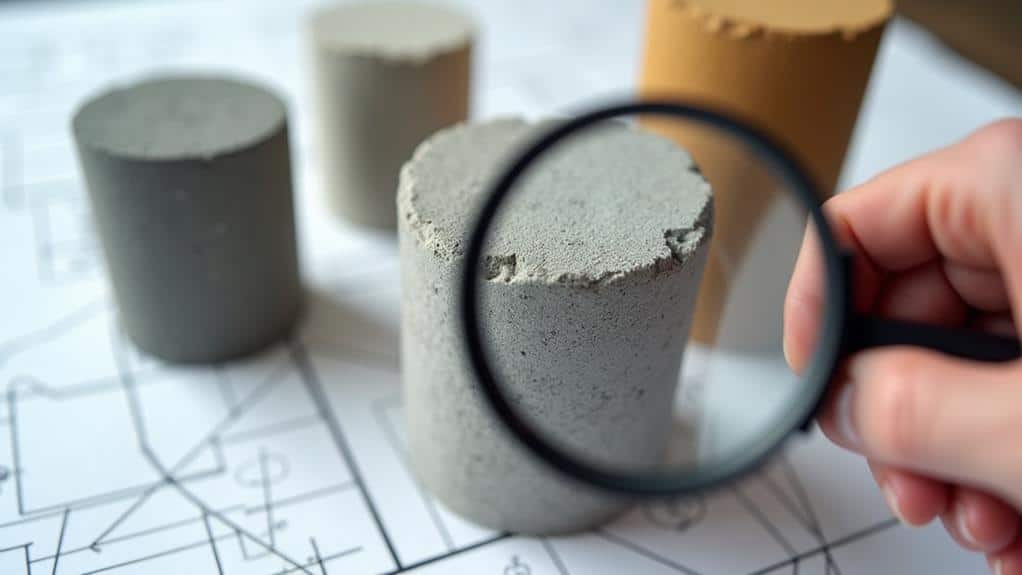
You’ll need to take into account the compressive strength required for your specific project, with C25 suitable for smaller builds and C30 or higher for larger projects exposed to moisture and frost. Environmental factors play a pivotal role in your selection, as the mix must withstand local climate conditions and ground characteristics.
Concrete strength comparison between C20 and C25 shows that C25 offers higher durability and is more suitable for structural applications requiring greater loads.
Different mix ratios of cement, sand, water, and aggregates impact the concrete’s durability and suitability. For instance, C20 (GEN3) is ideal for ordinary slabs on gravel bases.
You should tailor your choice to the load-bearing needs of your structure and the surrounding environment.
It’s advisable to consult experts in concrete selection to guarantee compliance with building regulations and best long-term performance.
Don’t overlook the curing time of your chosen mix, as proper curing greatly enhances strength and durability. Typically, a minimum of seven days is required for best hardening.
Formwork and Reinforcement
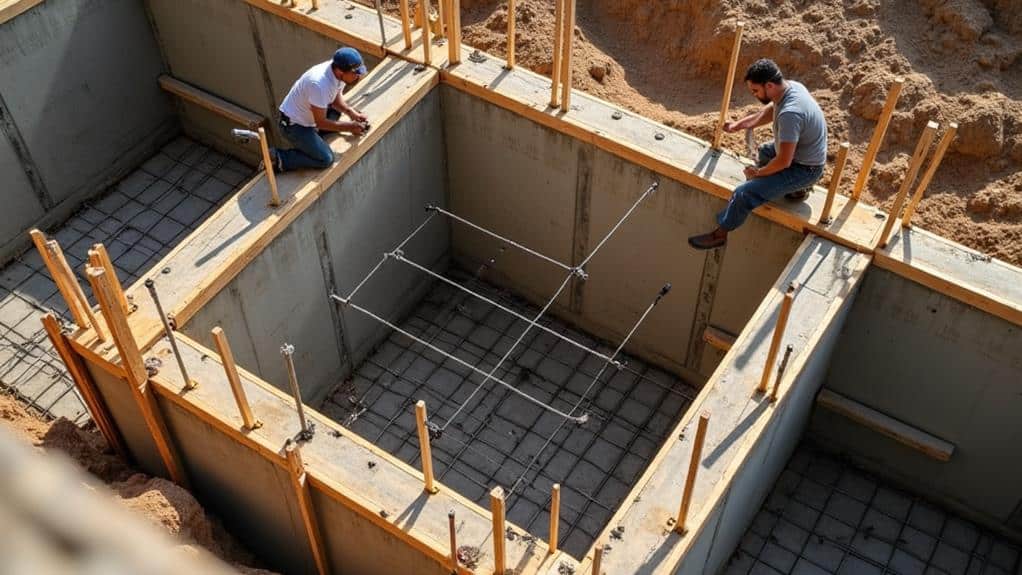
Formwork and reinforcement form the backbone of a robust concrete foundation. When constructing your foundation, you’ll need to carefully design and implementformwork using materials such as wood, metal, or plastic. These structures must withstand the weight of wet concrete and additional loads during pouring, necessitating proper bracing and support to maintain dimensional accuracy.
Reinforcement techniques involve the strategic placement of steel bars (rebar) or mesh within the formwork. This reinforcement enhances the concrete’s tensile strength and mitigates cracking. It’s essential to position rebar at least 50mm from the concrete surface to guarantee adequate coverage and corrosion protection.
To visualise the formwork and reinforcement process, consider these key steps:
Erect sturdy formwork structures
Install reinforcement with precise spacing
Pour concrete into the prepared forms
Allow for proper curing before removing formwork
The formwork removal timing is vital, typically occurring 24-48 hours after pouring, depending on temperature and concrete type.
This careful orchestration of formwork materials and reinforcement techniques guarantees a solid foundation for subsequent construction phases, providing the structural integrity necessary for long-lasting concrete foundations.
Pouring and Compaction Techniques
Once the formwork and reinforcement are in place, the next phase in creating a solid concrete foundation involves pouring and compaction techniques.
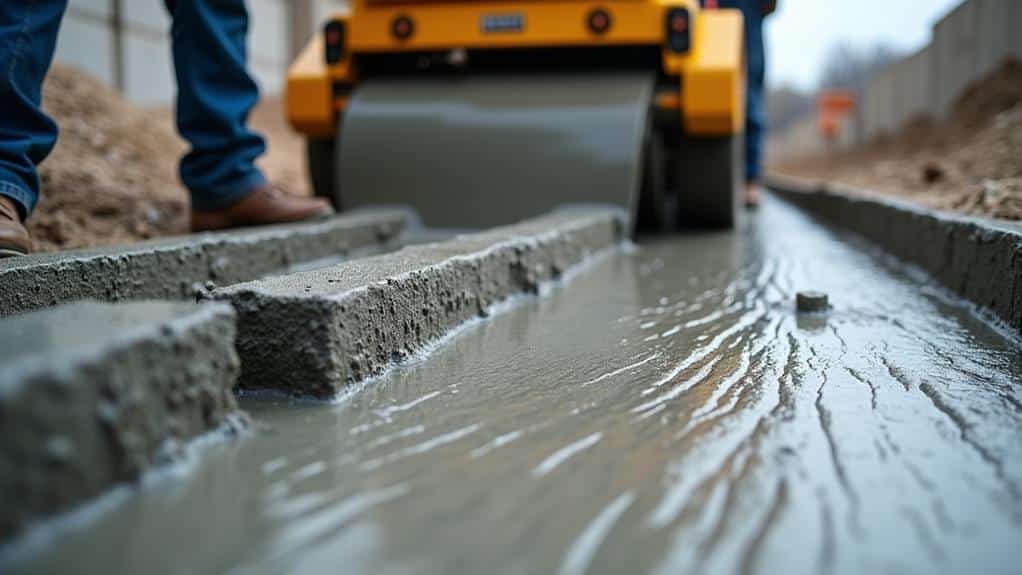
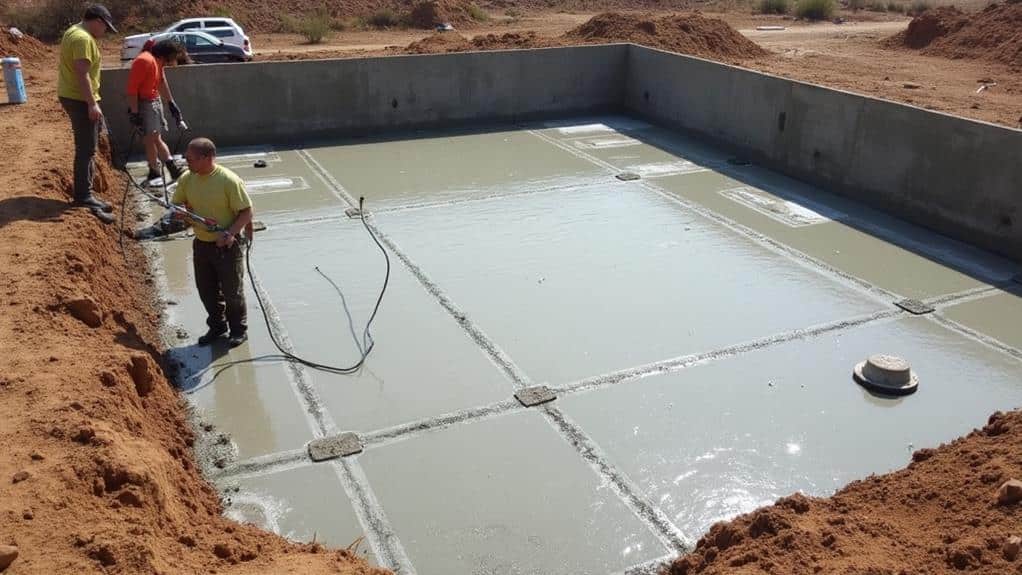
You’ll need to employ proper pouring techniques using a concrete pump or chute to guarantee even distribution and minimise segregation, especially in hard-to-reach areas. This approach is vital for maintaining the mix’s integrity throughout the foundation.
Compaction methods are important for eliminating air pockets and achieving a dense, strong foundation. You should use a vibrating poker during the pouring process to enhance compaction considerably.
The ideal thickness for footings typically ranges from 200mm to 300mm, depending on structural requirements and soil conditions.
Temperature conditions greatly impact the curing process. In cold weather, for instance, the setting time can double, necessitating additional measures to maintain ideal curing conditions.
Throughout the pouring process, you must regularly check the concrete for consistency. Any inconsistencies can lead to weak spots and compromise the overall integrity of the foundation.
Curing and Protection Methods
You’ll need to implement moisture retention techniques to prevent excessive water loss during concrete curing.
Apply curing compounds or cover the surface with plastic sheets to maintain ideal hydration.
Additionally, you must control temperature conditions, using insulating blankets in cold weather and providing shade or mist cooling in hot conditions, to guarantee proper curing and achieve the desired strength and durability of your concrete foundation.
Moisture Retention Techniques
Maintaining proper moisture levels is vital for the successful curing of concrete foundations. Effective moisture management techniques guarantee ideal strength development and prevent issues like cracking or surface dusting. You’ll need to implement these methods for a minimum of seven days to achieve the best results.
To retain moisture in your freshly poured concrete, consider applying curing compounds or covering the surface with plastic sheeting. These techniques create a barrier that prevents excessive water loss during the significant hardening period.
In hot weather conditions, you must take extra precautions to protect the concrete from rapid drying. Use wet hessian or plastic sheeting to maintain hydration levels and prevent premature moisture loss.
During cold weather, it’s essential to keep the concrete above 3°C to avoid compromised strength. Employ insulating blankets to prevent freezing and maintain the necessary temperature for proper curing.
To guarantee effective moisture retention, regularly inspect your concrete for:
Surface cracks or fissures
Powdery or dusty areas
Uneven colouration
Slow strength development
Temperature Control Measures
Temperature control plays a key role in concrete curing, complementing moisture retention techniques for ideal foundation strength. You’ll need to maintain temperatures above 3°C to prevent ice formation and potential damage. In cold weather, expect the concrete setting time to double, necessitating extended curing periods and additional protective measures.
To guarantee peak hardening and durability, you must implement effective temperature control measures for a minimum of seven days. Consider using frost blankets or plastic sheeting to protect against rapid drying and retain heat. These coverings also serve as a barrier against rain, preventing surface damage from heavy water accumulation.
For thorough temperature control, incorporate the following strategies:
Method
Cold Weather
Hot Weather
Covering
Insulating blankets
Reflective sheeting
Heating
Portable heaters
Shading/cooling
Monitoring
Temperature sensors
Infrared thermometers
Timing
Afternoon pours
Early morning pours
Implement a robust temperature monitoring system to track concrete curing progress. This allows you to adjust frost protection measures as needed, guaranteeing consistent curing conditions throughout the process. By maintaining peak temperature and moisture levels, you’ll achieve a strong, durable concrete foundation that meets structural requirements.
Maintenance and Repair Strategies
To guarantee the longevity and stability of concrete foundations, implementing effective maintenance and repair strategies is imperative. Regular foundation inspections are essential for identifying early signs of issues, such as cracks or uneven floors.
These inspections should be coupled with proper maintenance practices, including keeping the foundation’s perimeter clear of debris and vegetation to prevent moisture retention and erosion.
Addressing drainage solutions promptly is critical for preserving structural integrity. Ascertain proper grading away from the foundation to prevent water accumulation. Routine checks for standing water near the foundation are necessary, as excessive moisture can lead to erosion and weakening over time.
When significant foundation problems arise, repairs may involve:
Underpinning to stabilise the foundation
Slab jacking to lift and even out concrete slabs
Crack injection to seal and reinforce damaged areas
Installation of drainage systems to divert water away from the foundation
Frequently Asked Questions
What Is the Best Type of Concrete Foundation?
You’ll find that the best foundation type depends on your specific conditions. Consider soil, climate and building design when choosing among foundation types. Evaluate T-shaped, slab-on-grade and frost-protected options, ensuring appropriate construction materials for ideal performance and durability.
How Deep Should Concrete Foundations Be?
You’ll need to determine foundation depth based on soil stability. Conduct soil tests to assess load-bearing capacity. Generally, aim for at least 1 metre deep in cold climates, but increase depth for unstable soils or heavy structures.
What Is Concrete Foundation?
A foundation is your building’s structural base. You’ll find various foundation types, each offering specific advantages. It distributes loads, enhances stability, and protects against soil movement. Concrete foundations excel in strength, durability, and moisture resistance.
Is a Poured Concrete Foundation Good?
Yes, a poured concrete foundation is good. You’ll benefit from its numerous advantages, including superior foundation durability. It offers excellent strength, adaptability to soil conditions, and moisture resistance when properly cured and fitted with a damp-proof membrane.
Conclusion
You’ve explored the critical aspects of concrete foundations, from types and preparation to maintenance. As you consider your next project, remember: the strength of your structure relies on these hidden supports. Will your foundation withstand the test of time? It’s up to you to apply this knowledge meticulously. Analyse soil conditions, select appropriate mixes, and execute each step with precision. The longevity of your construction hinges on these fundamental decisions and actions.
Mastering the art of high-strength concrete reveals the secrets to crafting resilient structures. Discover how this innovation transforms modern construction.