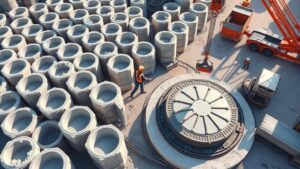
Concrete plays a vital role in the foundations of skyscrapers, providing the strength needed to support heavy loads from gravity and lateral forces. It bears the enormous weight of the building while resisting twisting and swaying caused by wind and seismic activity. Proper load distribution is essential to prevent issues like uneven settling, which can compromise structural integrity.
Using the correct concrete mix and reinforcement techniques significantly enhances durability against environmental factors. For instance, reinforced concrete can withstand harsh weather conditions better than standard mixes. Recognising the importance of concrete in foundation design helps us appreciate the complex engineering that enables the construction of these towering structures. This insight sheds light on the advanced practices that shape our urban landscapes.
Key Takeaways
- Concrete is vital for providing compressive strength in skyscraper foundations, effectively supporting heavy loads from both materials and occupants.
- Reinforced concrete increases tensile strength and durability, allowing foundations to endure lateral forces from wind and seismic activity.
- Different foundation types, like pile and caisson foundations, make use of concrete to efficiently transfer loads to stable soil or bedrock.
- The versatility of concrete means it can be specially mixed for various environmental conditions, ensuring long-lasting performance and structural integrity.
- Regular maintenance and inspections of concrete foundations are essential to tackle issues such as cracking and moisture, helping to extend their lifespan and stability.
Key Forces Impacting Skyscraper Foundations

When designing skyscraper foundations, several key forces significantly impact their stability and safety. Lateral loads, mainly from wind, affect how loads are distributed and can cause considerable sway, requiring foundations that can resist tilting and collapse. As the building’s height increases, the risk of wind-induced twisting effects also grows, necessitating deeper and stronger foundations. Seismic loads from earthquakes introduce horizontal shaking forces that can destabilise foundations, so designs must be capable of absorbing and redistributing this energy. Soil-structure interaction is crucial; different soil types behave differently under heavy loads, which can influence overall stability. Environmental factors, like temperature changes, require the inclusion of expansion joints to allow for material movement, ensuring the foundation’s long-term durability and performance. Additionally, the use of deep foundations is essential for anchoring buildings into strong soil or bedrock, providing stability in challenging geological conditions. Furthermore, understanding the importance of proper design is vital to ensure that all these forces are adequately addressed in the foundation design.
Understanding Gravity Load in Foundation Design

Understanding gravity load in foundation design is crucial for ensuring the stability and safety of skyscrapers. It refers to the downward forces caused by the weight of materials and occupants. A thorough assessment of gravity load is necessary, involving calculations of total downward forces, including the weight of concrete, steel, and glass, as well as live loads from furniture and people. This total load significantly impacts your foundation stability analysis, influencing the choice of foundations, such as piles, mats, or spread footings. Additionally, using ready-mix concrete can enhance the consistency and quality of the foundation, ensuring it meets the required standards.
To avoid differential settlement and ensure proper load distribution, it’s essential to design structural elements that effectively transfer these loads to the foundation, taking into account soil bearing capacity and long-term effects like creep. For example, in a high-rise building, if the foundations aren’t adequately designed to handle the weight, it could lead to uneven settling, potentially causing structural damage. Additionally, understanding the geology and soil conditions at the construction site is vital for accurate foundation design and load management.
The Role of Lateral Load in Stability
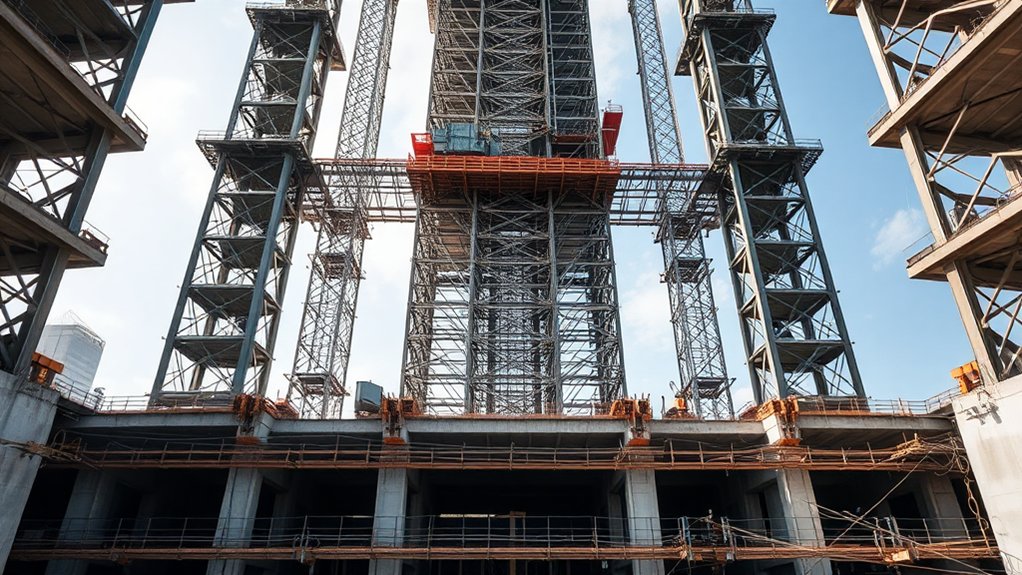
Lateral loads, arising from external forces like wind and seismic activity, present a significant challenge in skyscraper design.
It’s crucial to understand these forces to ensure structural integrity. Skyscrapers must be built to resist these horizontal loads, which can result in swaying or, in extreme cases, collapse. To tackle lateral loads, deep foundations, such as pile foundations, secure buildings into stable soil or bedrock. Additionally, the use of reinforced concrete in construction provides enhanced tensile strength and durability, which are critical for withstanding such forces.
Features like moment frames and shear walls are designed to flex and absorb energy, enhancing stability. The use of braced frames further strengthens the structure by transferring lateral forces efficiently to the foundation.
Seismic Load Considerations for Skyscrapers
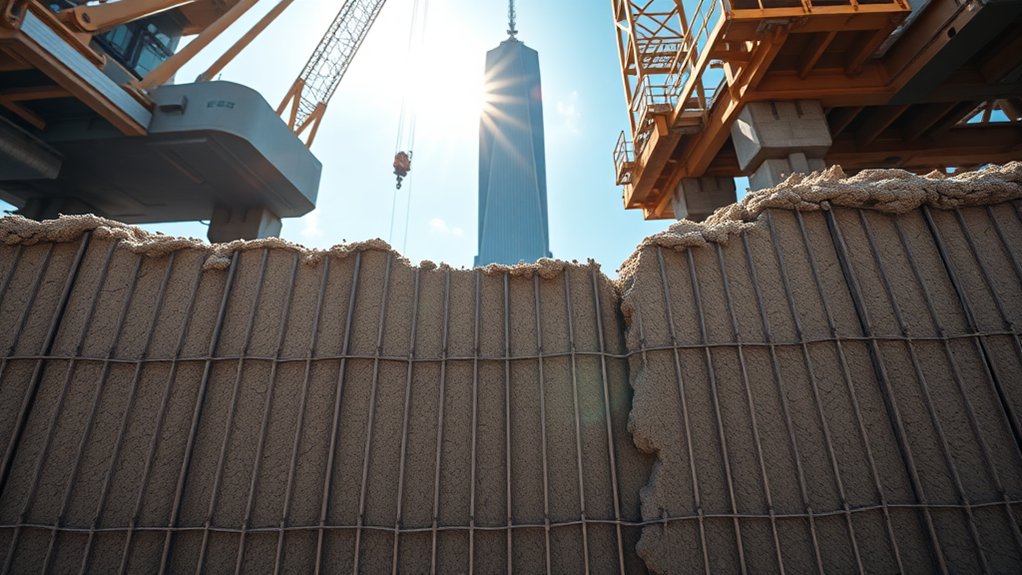
Seismic load assessments are crucial for ensuring the structural integrity of skyscrapers, particularly in areas prone to earthquakes.
When designing foundations, it’s vital to incorporate strategies for seismic resilience and innovative foundation designs to withstand dynamic forces.
Here are key considerations:
- Dynamic Bearing Capacity: Assess how your foundation performs under seismic loads.
- Soil Liquefaction: Evaluate the risk of soil liquefaction and its effects on stability.
- Foundation Types: Select suitable foundations, such as rafts or shear walls, tailored to the specific site conditions.
- Ductility Requirements: Ensure your foundation can accommodate ductility for energy absorption during seismic events.
Soil Pressure and Its Effects on Foundations
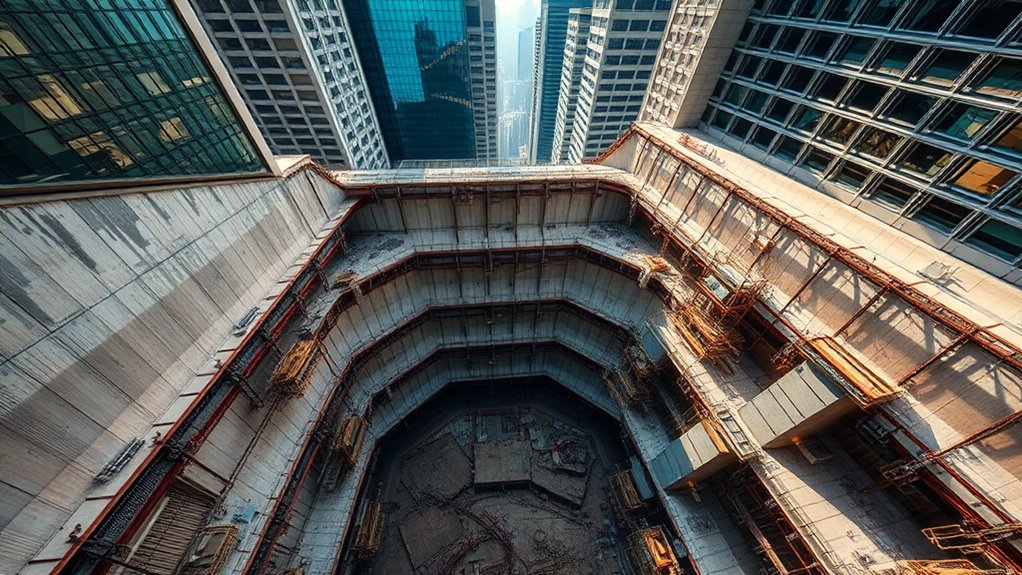
Soil pressure significantly affects the stability and performance of foundations, varying with soil type, moisture content, and environmental conditions.
It’s essential to recognise that the soil beneath your foundation distributes structural loads differently based on its composition, such as clay or sand.
Conducting a foundation settlement analysis is crucial; it helps predict how your foundation will respond to changing soil pressures.
Employing effective soil compaction methods can improve load-bearing capacity and reduce the risk of foundation movement.
Additionally, monitoring hydrostatic pressures and soil swelling is vital for maintaining stability.
Types of Foundations Used in Skyscrapers

When choosing foundations for skyscrapers, you’ll find several types, each suited to specific conditions.
Pile foundations, such as end-bearing, friction, and bored piles, are designed to effectively transfer loads into stable soil or bedrock.
On the other hand, caisson foundations provide a strong solution for waterlogged areas, offering watertight structures capable of supporting significant weights and addressing complex engineering challenges.
Pile Foundation Variants
Understanding the different types of pile foundations is crucial for the successful construction of skyscrapers. Each type has its own advantages suited to specific soil conditions and structural needs.
Here are the main pile types you may encounter:
- End-Bearing Piles: These piles transfer loads directly to stable bedrock, making them highly effective in solid ground.
- Friction Piles: When bedrock is deep, these rely on skin friction to support loads, ideal for softer soils.
- Bored Piles: These minimise noise during installation by drilling and then filling with concrete, making them suitable for urban areas.
- Driven Piles: Best for dense soils, these are installed using impact methods, offering quick and reliable support.
Conducting a thorough soil analysis is essential to determine the right foundation depth and material.
The chosen installation method impacts load distribution and overall performance, ensuring the skyscraper can effectively resist lateral forces and settle appropriately.
Caisson Foundation Features
Caisson foundations offer a strong solution for skyscrapers built on difficult terrains, especially in waterlogged or deep soil conditions. They effectively transfer loads to stable soil or rock layers, ensuring the structure remains secure.
The advantages of caissons include their resistance to scour and erosion, as well as their adaptability to various soil types, making them essential for tall buildings. Common types include open, pneumatic, and floating caissons, each suited for specific environments.
However, there are challenges to consider, such as high construction costs and complex installation processes, which can affect project budgets and timelines.
Understanding both the benefits and drawbacks of caisson foundations is crucial for making informed decisions in skyscraper design and construction.
The Mechanism of Pile Foundations

While pile foundations may seem complex, their primary function is to provide stability for tall structures in difficult soil conditions. They transfer loads to deeper, more stable soil layers or bedrock, ensuring the building remains sound.
Key points include:
- Types of Piles: Options like end-bearing, friction, bored, driven, and composite piles are tailored for different soil types.
- Installation Methods: Techniques such as driven, bored, jacked, and cased piling dictate how piles are set in place.
- Load Transfer: Piles effectively carry loads, helping to avoid settlement problems.
- Adaptability: They’re suitable for various soil conditions and construction needs.
Deep Rock and Caisson Foundations Explained
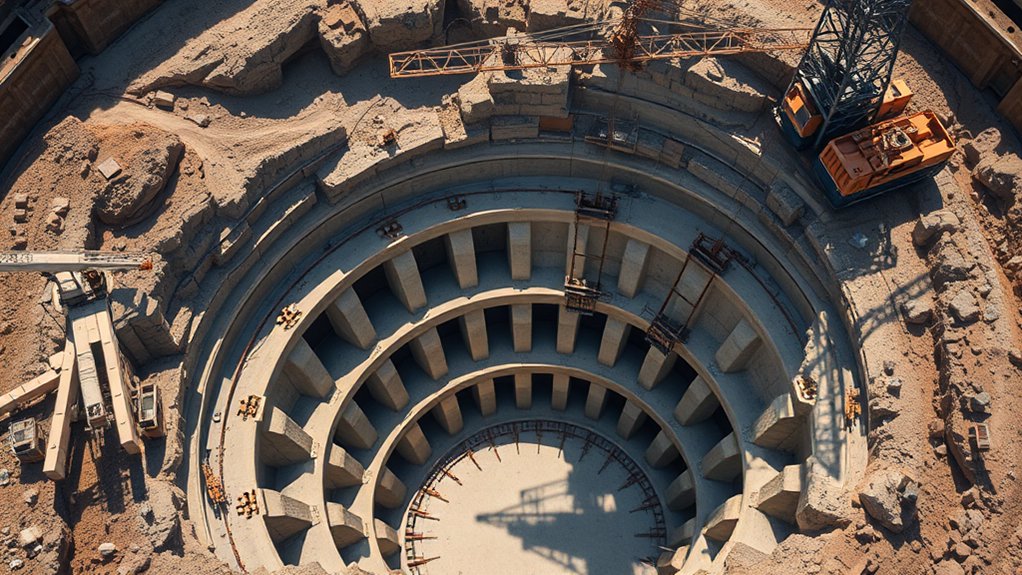
When designing deep rock and caisson foundations, it’s crucial to grasp the principles of socketed shaft design for stability in challenging geological conditions.
You should also be familiar with caisson construction techniques to effectively transfer loads and manage water pressures.
These elements are vital for ensuring that your skyscraper can withstand external forces and maintain its structural integrity.
Socketed Shaft Design
Socketed shaft design is crucial for skyscraper foundations, particularly in challenging geological conditions.
These deep foundations are drilled into rock to effectively support heavy loads, offering several benefits while also presenting specific challenges.
Here’s what to consider:
- Advantages of Socketed Shafts:
- High load-bearing capacity
- Reduced foundation movement
- Stability in weak soil conditions
- Improved structural integrity with modern materials
- Challenges of Socketed Shafts:
- Accurate rock assessment can be complex
- Variability at different sites may complicate designs
- Excavation methods can influence costs and timelines
- Environmental factors, such as groundwater, can impact performance
Being aware of these factors is essential for the successful use of socketed shafts in skyscraper projects.
Caisson Construction Techniques
In skyscraper foundations, caisson construction techniques offer a robust solution for deep rock and difficult soil conditions. Different types of caissons—such as box, open, pneumatic, and floating—are designed to meet specific environmental requirements.
The process begins by positioning the caisson formwork using a towboat and guiding system. Concrete is then poured into the steel perimeter forms, causing the caisson to sink gradually.
Once it reaches the desired depth, air domes are removed, and excavation occurs through dredge wells to facilitate further sinking. Finally, the bottom dredge wells are filled with concrete to seal the foundation.
These methods ensure that caissons effectively transfer loads to stable soil or rock layers, making them suitable for skyscrapers and other heavy structures.
Load Transfer Mechanisms
Understanding load transfer mechanisms is vital for the structural integrity of deep rock and caisson foundations. These mechanisms ensure that loads from the building are effectively conveyed to the ground.
Key elements include:
- Load Path: The route through which loads travel from the structure to the foundation.
- Structural Elements: Components such as beams, columns, and walls that distribute loads.
- Gravity and Lateral Loads: Forces like the weight of the building and environmental impacts, which necessitate careful design.
- Foundation Types: Options such as deep rock and caisson foundations, chosen based on specific soil conditions.
Design Procedures for Skyscraper Foundations

When designing foundations for skyscrapers, it’s crucial to carry out a comprehensive site investigation that includes soil analysis, groundwater assessment, and land surveys. These factors are vital for informing your foundation design and ensuring adherence to engineering standards.
| Step | Description |
|---|---|
| Soil Analysis | Assess bearing capacity and types of soil layers. |
| Groundwater Assessment | Evaluate the impact of the water table on stability. |
| Geotechnical Reports | Offer insights for selecting the appropriate foundation type. |
| Load Calculation | Examine the effects of gravity, wind, and seismic forces. |
Choosing the right foundation type—be it shallow, deep, or composite—depends on the site conditions. It’s advisable to use design software for optimisation and to implement strict quality control during construction to ensure safety and performance standards are met.
Ensuring Durability in Foundation Materials
Choosing the right type of foundation is crucial, but ensuring the durability of the materials used is just as vital for the stability of skyscrapers.
To enhance material durability and foundation resilience, keep these factors in mind:
- Material Composition: Use high-strength concrete made from quality cement, aggregates, and water.
- Cement Types: Select Ordinary Portland Cement or blended cements for improved resistance.
- Moisture Resistance: Employ waterproofing methods to guard against water damage.
- Admixtures: Use chemical admixtures to enhance workability and durability.
Addressing Engineering Challenges in Foundation Design
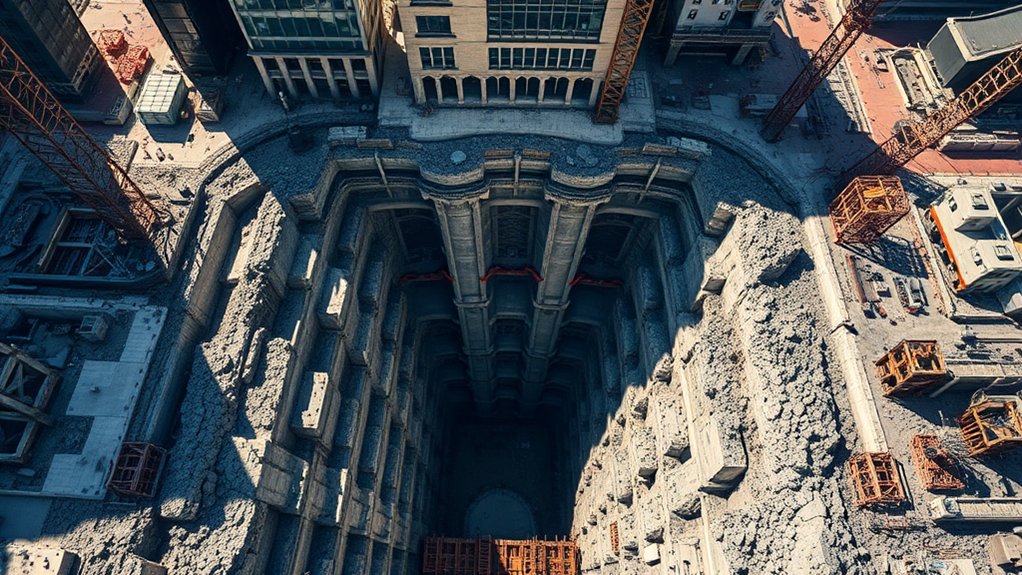
When designing skyscraper foundations on soft soil, it’s crucial to consider load transfer.
You must assess how forces are distributed to avoid uneven settlement and potential structural failure.
Solutions like pile foundations or caissons can provide stability and effectively manage loads.
For instance, using piles can anchor the building deeper into firmer soil, ensuring it remains secure.
Soft Soil Solutions
Addressing the challenges of soft soil in skyscraper foundations requires precise engineering solutions to ensure structural integrity and safety.
Here are several key strategies to consider:
- Deep Foundation Methods: Piles are driven into stable ground to transfer loads effectively.
- Soil Replacement: Replacing soft soil with crushed rock can significantly enhance bearing capacity.
- Geosynthetic Applications: Using geotextiles and geogrids can strengthen the soil.
- Drainage Systems: Vertical wick drains can help speed up consolidation and reduce settlement.
These soil stabilisation techniques not only improve foundation stability but also enhance the long-term performance of skyscrapers in difficult terrains.
Understanding these methods is vital for successful foundation design in soft soil conditions.
Load Transfer Balancing
Understanding load transfer balancing is crucial for engineers designing skyscraper foundations, as it significantly affects structural integrity and safety. Effective load balancing ensures that forces are evenly distributed, reducing the risk of issues such as excessive settlement or bearing capacity failure. To optimise foundations, it’s important to consider various load transfer mechanisms, including end bearing and skin friction.
| Load Transfer Mechanism | Description |
|---|---|
| End Bearing | Transfers load to strong soil or rock layers |
| Skin Friction | Transfers load along sides via friction |
| Combination | Utilises both end bearing and skin friction |
| Pile Foundations | Transfers load to deeper soil or bedrock |
The Importance of Maintenance for Long-term Performance
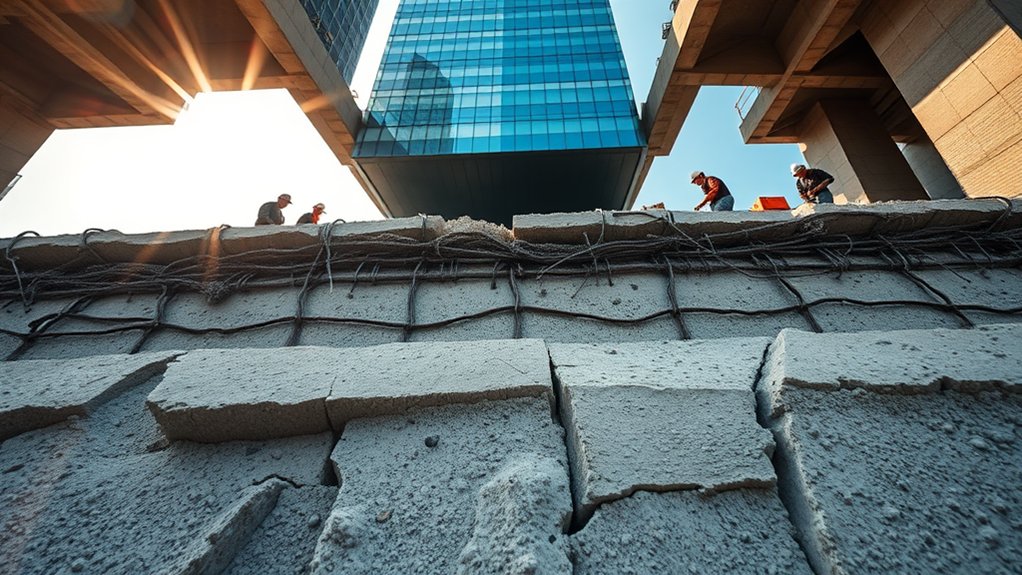
While foundation maintenance may be overlooked, its significance for the long-term performance of skyscrapers is crucial. Regular upkeep ensures structural integrity and helps avoid expensive repairs later on.
Here’s what to focus on:
- Foundation Inspections: Carry out checks twice a year to note any changes and identify potential issues early.
- Moisture Management: Effective sealing and drainage systems are vital to stop moisture ingress and soil erosion.
- Crack Repair: Addressing cracks promptly stops small problems from becoming major structural failures.
- Preventive Maintenance: Establish routine maintenance practices to reduce risks and prolong the foundation’s lifespan.
Frequently Asked Questions
What Materials Are Commonly Used in Concrete for Skyscraper Foundations?
In skyscraper foundations, high-performance concrete is often used alongside reinforced steel to provide exceptional strength. This combination boosts durability, allowing the structure to bear heavy loads and resist environmental pressures while maintaining its integrity over time. For instance, when constructing tall buildings in urban areas, this robust mix ensures they remain stable even in adverse weather conditions.
How Does Temperature Affect Concrete During Foundation Curing?
Temperature fluctuations significantly impact the curing of concrete. High temperatures speed up strength development but increase the risk of cracking, whereas low temperatures slow down hydration. For instance, during a heatwave, it’s essential to keep the concrete moist to prevent it from drying too quickly. Conversely, in colder weather, using insulating blankets can help maintain warmth. Regularly monitoring these temperature changes ensures optimal curing conditions, enhancing the durability and structural integrity of your concrete.
What Role Do Additives Play in Foundation Concrete Mixtures?
Additives are like the special ingredients in a chef’s signature recipe. They boost the performance of concrete by enhancing strength, durability, and workability. For instance, accelerators can speed up the setting time, while water reducers help improve the mix without adding extra water. These additives play a crucial role in achieving the desired quality in concrete mixtures.
How Is Concrete Tested for Strength Before Use in Foundations?
Concrete strength is assessed by testing its compressive and tensile strength. This is typically done using methods such as laboratory cylinder tests and field-cured cylinders. These tests, conducted under both controlled and real-world conditions, ensure the concrete meets the necessary standards for structural integrity before it is used in foundations.
What Are the Environmental Impacts of Concrete Production for Skyscraper Foundations?
Concrete production for foundations significantly contributes to carbon emissions, releasing large quantities of CO2. To lessen this impact, consider incorporating recycling practices. For example, using recycled aggregates can reduce waste and diminish the overall environmental footprint of concrete.
Conclusion
In the realm of skyscrapers, foundations act like the roots of a sturdy tree, anchoring it securely against the elements. Just as a tree requires strong roots to withstand harsh winds, a skyscraper’s foundation must endure gravity, lateral forces, and seismic activity. Through the use of advanced materials and thoughtful design, engineers ensure these towering structures remain stable for years to come. It’s important to recognise that a well-maintained foundation is the silent supporter of the skyscraper’s impressive height, allowing us to appreciate its grandeur without worry.

Keen to learn how Roller-Compacted Concrete (RCC) is revolutionizing pavement design with unmatched strength and efficiency? Discover its game-changing benefits Read more

A strong concrete foundation requires careful planning and execution; discover the essential steps to ensure your structure's durability and longevity.

Key advancements in concrete technology are reshaping construction; discover how innovations like self-healing properties and 3D printing are revolutionizing the Read more