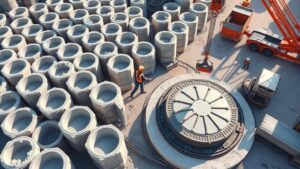
Innovations such as self-healing concrete enhance durability by using bio-based agents to autonomously repair cracks. 3D-printed concrete structures enable complex designs while minimising material waste. Ultra-high performance concrete (UHPC) offers exceptional strength for demanding applications. Green concrete solutions incorporate recycled materials to support sustainability, while smart concrete features embedded sensors for real-time structural monitoring. Furthermore, nanotechnology improves strength and introduces self-healing properties, and carbon-absorbing concrete helps reduce environmental impact. Delve into these advancements for a clearer understanding.
Key Takeaways
- Self-healing concrete uses bio-based agents to mend cracks, significantly prolonging the lifespan of structures.
- Smart concrete, equipped with embedded sensors, provides real-time information on structural integrity, allowing for proactive maintenance and improving safety.
- Ultra-High Performance Concrete (UHPC) boasts remarkable strength and durability, making it suitable for demanding projects like bridges and high-rise buildings.
- 3D-printed concrete enables complex designs while minimising material waste, transforming efficiency and creativity in construction.
- Carbon-absorbing concrete captures CO2 during its curing process, promoting sustainability and lessening the environmental impact of building projects.
Self-Healing Concrete

As researchers delve into concrete technology, self-healing concrete emerges as a promising innovation that can improve durability and cut maintenance costs.
This advanced material uses self-healing mechanisms inspired by nature, incorporating bio-based components like encapsulated healing agents or bacteria that activate when cracks form. Once a crack appears, these agents are released to fill gaps and restore strength.
Self-healing concrete not only extends the lifespan of structures but also reduces the need for repairs, leading to considerable savings in the long run. Additionally, this technology has the potential to double road surface lifespan, significantly minimizing the occurrence of potholes.
3D-Printed Concrete Structures

Traditional construction methods often restrict design flexibility, but 3D-printed concrete structures are changing the game. This innovative technology allows for the creation of intricate shapes and customised components that conventional techniques struggle to replicate.
By employing advanced 3D printing methods, complex geometries can be produced quickly and with less material waste, making construction more efficient.
With 3D printing, designs can be optimised for both structural integrity and visual appeal. Furthermore, the adaptability of 3D-printed concrete enables on-site manufacturing, which can significantly reduce transportation costs and project timelines.
As you delve into these advancements, you’ll see that they not only enhance design freedom but also expand the possibilities of architectural creativity.
Ultimately, 3D-printed concrete is transforming how we approach construction, opening up new avenues for innovation.
Ultra-High Performance Concrete (UHPC)

Ultra-High Performance Concrete (UHPC) provides significant improvements in strength and durability, transforming the construction industry.
Its adaptable uses include bridges and tall buildings, where standard concrete may not suffice.
Enhanced Strength and Durability
When it comes to construction materials, few can rival the strength and durability of Ultra-High Performance Concrete (UHPC). This advanced concrete boasts impressive flexural toughness, enabling it to endure substantial bending forces without cracking.
Its unique formulation improves thermal resistance, making it suitable for extreme temperatures.
Incorporating high-quality aggregates and fibres, UHPC achieves compressive strengths often exceeding 150 MPa, far exceeding traditional concrete. This enhanced performance not only extends the lifespan of structures but also reduces maintenance costs over time. Additionally, the use of supplementary cementitious materials in UHPC formulations contributes to its superior durability and sustainability.
As you plan your next project, consider that the durability and strength of UHPC can lead to safer, more resilient builds, revolutionising your construction approach.
Versatile Applications in Construction
The versatility of Ultra-High Performance Concrete (UHPC) makes it an excellent choice for various construction applications, especially in modern engineering projects.
Its unique formulation offers exceptional strength and durability, making it suitable for challenging environments. UHPC can be used for both structural and aesthetic purposes, allowing for diverse architectural designs.
Whether it’s for bridges or building facades, UHPC’s adaptability and outstanding performance are ideal for innovative projects. Additionally, its ability to endure extreme conditions helps lower maintenance costs, which adds to its attractiveness. Furthermore, its high load-bearing capacity ensures that it can support heavy structures without compromising safety.
Green Concrete Solutions

As you look into green concrete solutions, think about how using recycled materials can boost sustainability in your projects.
Incorporating carbon capture technology not only cuts emissions but also enhances the concrete’s performance.
Furthermore, adding biodegradable materials can improve the environmental impact of your mixes without compromising structural strength.
Recycled Materials Utilization
Recycled materials are transforming concrete technology by promoting sustainable practices that minimise environmental impact. By using recycled materials, you improve material efficiency and encourage sustainable sourcing, both vital for contemporary construction.
Here are four key benefits:
- Reduced Waste: Reusing materials like crushed concrete cuts down on landfill waste.
- Lower Carbon Footprint: Using recycled aggregates lessens the demand for new materials, resulting in lower emissions.
- Cost Savings: Recycled materials often come at a lower cost, helping to keep project budgets in check.
- Improved Performance: Some recycled materials can boost the durability and strength of concrete mixtures.
Adopting recycled materials not only drives innovation but also positions your projects as environmentally responsible, aligning with the industry’s growing sustainability objectives.
Carbon Capture Technology
Carbon capture technology is transforming the concrete industry by significantly reducing greenhouse gas emissions during production.
Various methods of carbon sequestration are now being used to capture CO2 produced in the cement-making process. These techniques not only lower emissions but also improve the performance of concrete, making it a more sustainable option for construction.
By adopting these technologies, you can help reduce the carbon footprint of concrete, supporting global efforts to tackle climate change.
As the industry moves towards greener solutions, understanding and implementing carbon capture methods will keep you at the forefront of this vital change in construction, promoting both efficiency and environmental responsibility.
Biodegradable Additives Integration
Traditional concrete typically contains non-biodegradable components, but integrating biodegradable additives offers a significant opportunity for change in the construction industry.
This shift not only promotes sustainability but also reduces environmental impact. Using biodegradable materials can lead to innovative solutions that meet today’s sustainability objectives.
Here are some key benefits:
- Reduced Waste: Biodegradable additives break down over time, leading to less landfill waste.
- Improved Soil Health: After demolition, these materials can enhance soil quality, supporting plant growth.
- Lower Carbon Footprint: Using biodegradable options helps cut down the carbon emissions linked to concrete production.
- Enhanced Durability: Certain biodegradable materials can strengthen concrete against environmental stressors.
Adopting these biodegradable additives is essential for advancing sustainable construction practices.
Smart Concrete With Embedded Sensors

As the need for resilient infrastructure increases, smart concrete with embedded sensors is becoming a game-changer in civil engineering. These sensors track essential factors like temperature, humidity, and stress levels in real-time, providing critical data for assessing structural integrity.
By harnessing data analytics, it’s possible to foresee potential failures and streamline maintenance schedules, which not only enhances safety but also cuts costs.
For instance, if sensors detect unusual stress levels in a bridge, maintenance can be scheduled before any serious issues arise, ensuring public safety.
Furthermore, smart concrete can adjust to environmental changes, promoting durability and longevity.
As you consider the implications of smart concrete, think about how it could transform your construction projects, resulting in infrastructures that are both resilient and efficient, meeting today’s demands.
Recycled Aggregate Concrete
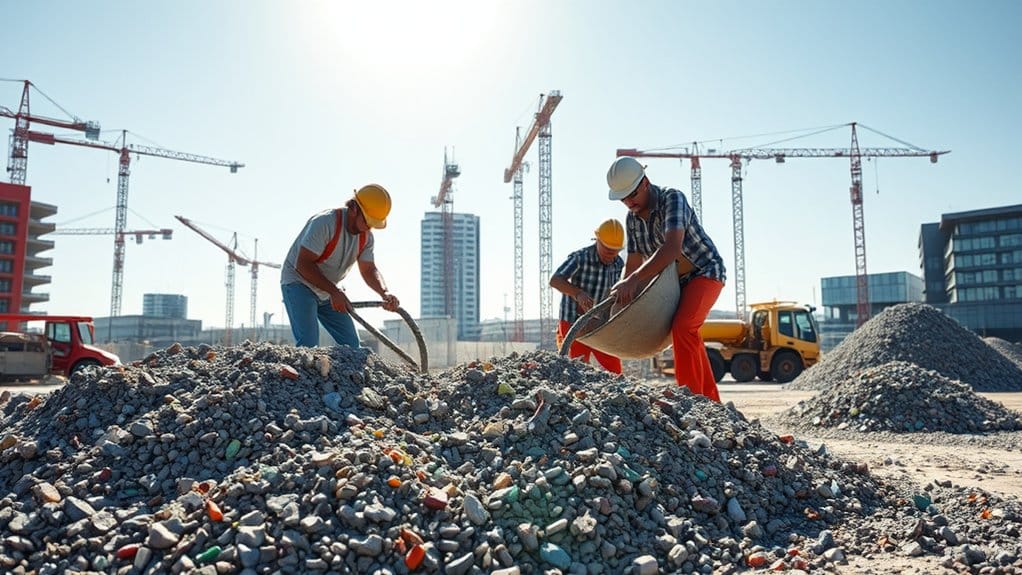
The construction industry is increasingly embracing sustainability, leading to a rise in the use of recycled aggregate concrete (RAC). This innovative solution replaces natural aggregates with recycled concrete, offering significant ecological and economic benefits.
Here are four key advantages of RAC:
- Environmental Impact: It helps reduce landfill waste and conserves natural resources by repurposing old concrete.
- Cost Efficiency: It can lower material costs since recycled aggregates are often cheaper to source.
- Performance: RAC can match the strength and durability of traditional concrete, making it a reliable choice.
- Regulatory Compliance: It aligns with growing sustainability standards in construction, ensuring projects meet environmental regulations.
Using RAC not only supports a greener future but also makes good financial sense for builders.
Nanotechnology in Concrete

Nanotechnology significantly boosts the strength of concrete by using nanoparticles that fill gaps and enhance particle bonding.
It also introduces self-healing properties, allowing concrete to mend micro-cracks on its own, which can prolong its life.
Furthermore, adding nanoscale materials increases durability, making concrete more resistant to environmental wear and tear.
Enhanced Strength Properties
While conventional concrete has always been prized for its durability, recent advancements in nanotechnology have significantly improved its strength properties.
Here are some ways you can use these innovations for better structural performance:
- Nanoparticle Additives: These enhance the bond between cement particles, leading to increased compressive strength.
- Advanced Testing Methods: Employ techniques such as scanning electron microscopy to evaluate and improve material characteristics.
- Microstructure Engineering: Customising the concrete’s microstructure can result in better performance under stress.
- Increased Durability: Enhanced resistance to environmental factors can prolong the lifespan of concrete structures.
Self-Healing Mechanisms
Imagine a future where concrete structures can repair themselves, significantly cutting maintenance costs and extending their lifespan. This innovation is based on self-healing mechanisms created through nanotechnology, using materials inspired by nature to replicate natural healing processes.
These materials contain capsules or fibres filled with healing agents that activate when cracks occur, effectively sealing fractures and restoring the structure’s integrity. By incorporating these mechanisms into concrete, we not only enhance durability but also improve resilience against environmental factors.
This self-repairing capability marks a major step forward in construction technology, promoting sustainable building practices and reducing resource consumption. Embracing these innovations will transform how concrete is used in the construction industry.
Improved Durability Factors
With the growing need for durable and long-lasting concrete structures, incorporating nanotechnology into concrete mixes is becoming increasingly important. This method boosts durability, supports sustainable practices, and significantly enhances performance.
Here are four key advantages of using nanotechnology in concrete:
- Reduced Permeability: Nano-additives fill tiny voids, which helps to prevent water and chemicals from penetrating the concrete.
- Increased Strength: Nanoparticles improve the bond between cement and aggregates, resulting in stronger concrete.
- Self-Healing Properties: Nanotechnology allows for the development of materials capable of repairing minor cracks on their own.
- Temperature Resistance: Nanomaterials enhance thermal stability, enabling structures to endure extreme weather conditions.
Incorporating these innovations can lead to more resilient constructions, benefiting both builders and the environment.
Concrete That Absorbs Carbon Dioxide

Concrete that absorbs carbon dioxide is a significant step forward in sustainable building materials. This innovative concrete captures CO2 from the atmosphere during the curing process, helping to reduce the environmental impact of traditional concrete, which is a leading source of greenhouse gas emissions.
By using this carbon-absorbing concrete in your projects, you can’t only enhance the sustainability of your structures but also improve their durability.
Consider the long-term advantages of a reduced carbon footprint and increased longevity for your buildings. Ultimately, choosing concrete that absorbs carbon dioxide aligns with broader sustainability goals, making it a smart choice for conscientious builders in the UK.
Lightweight Concrete Innovations

The rise of lightweight concrete innovations is revolutionising construction methods by significantly reducing the weight of structures without sacrificing strength.
By using advanced materials, you can boost performance and enhance energy efficiency. Here are four key innovations to consider:
- Lightweight Aggregates: Materials like expanded clay or pumice reduce concrete density and improve structural efficiency.
- Aerated Concrete: This type contains air bubbles, which enhance insulation properties and lower thermal mass.
- Polymer-modified Concrete: The addition of polymers increases adhesion and flexibility, resulting in more durable and lighter structures.
- Foamed Concrete: This mix provides excellent thermal insulation and lower weight, making it suitable for non-load bearing applications.
These advancements contribute to sustainable construction solutions, optimising material usage and energy consumption.
High-Strength Fiber-Reinforced Concrete

High-strength fibre-reinforced concrete (HSFRC) is a significant advancement in concrete technology, known for enhancing structural integrity and performance.
By incorporating fibre reinforcement into the concrete mix, HSFRC improves tensile strength, ductility, and durability. This makes it particularly suitable for demanding applications like bridges, high-rise buildings, and industrial floors, where traditional concrete might struggle under pressure.
The fibres help reduce cracking and shrinkage, resulting in a more resilient material that can endure harsh conditions. Additionally, using HSFRC can lower maintenance costs over time, making it a practical solution for modern construction challenges.
Embracing HSFRC in your projects can contribute to safer, longer-lasting structures.
Frequently Asked Questions
How Does Concrete Technology Impact Overall Construction Costs?
Concrete technology improves cost efficiency by minimising material waste and reducing labour requirements. Innovations in this field enhance sustainability, which can lead to lower long-term expenses. For instance, utilising recycled aggregates can cut costs while being environmentally friendly. These factors significantly impact overall construction costs in your projects.
What Is the Lifespan of Advanced Concrete Innovations?
Did you know that advanced concrete can last up to 100 years? Assessing its durability is crucial for ensuring structural integrity over time. Innovations in concrete technology continually improve its longevity, making it a sustainable option for modern construction projects. For instance, using fibre-reinforced concrete can enhance its strength and reduce maintenance costs, providing a practical solution for builders and developers alike.
Are There Any Safety Concerns With New Concrete Technologies?
Yes, there are safety concerns with new concrete technologies. It’s essential to comply with regulations and adopt sustainable practices. For instance, using improper materials can lead to structural failures, such as cracks or collapses, and may also harm the environment. Prioritising safety and sustainability is crucial for the longevity of any construction project.
How Do These Innovations Affect Construction Timelines?
Innovative concrete technologies can shorten construction timelines by as much as 30%. This improvement in project management and scheduling efficiency means you can complete projects more quickly and allocate resources more effectively, all while maintaining high standards of quality. For instance, using faster-setting concrete allows builders to continue work on other phases sooner, ultimately speeding up the entire project.
What Industries Benefit Most From Advanced Concrete Technologies?
Infrastructure development and sustainable construction see significant advantages from advanced concrete technologies. These innovations improve durability, minimise environmental impact, and simplify construction processes, resulting in more efficient and robust urban environments. For instance, using self-healing concrete can extend the lifespan of roads and bridges, reducing maintenance costs and disruption.
Conclusion
In the ever-changing construction industry, adopting these concrete innovations is essential. As the saying goes, “Adapt or perish.” By incorporating self-healing properties, 3D printing, and sustainable practices, you can improve structural integrity and lessen environmental impact. Staying ahead with these advancements ensures your projects remain competitive and robust. The future of construction hinges on these transformative technologies, expanding the possibilities within the built environment.

Keen to learn how Roller-Compacted Concrete (RCC) is revolutionizing pavement design with unmatched strength and efficiency? Discover its game-changing benefits Read more
Advancing construction techniques, Ultra-High-Performance Concrete (UHPC) promises unmatched durability and efficiency, but what groundbreaking innovations lie ahead?

How does concrete transform skyscraper foundations into engineering marvels capable of withstanding nature's forces? Discover the secrets behind their strength Read more