Concrete is non-combustible, meaning it won’t catch fire or release harmful fumes, which significantly boosts fire safety. Its low thermal conductivity helps it maintain structural integrity during extreme heat, slowing down the spread of flames. With natural fire barriers and strong compartmentation, concrete can give occupants crucial time to evacuate safely. These qualities allow for innovative fire-resistant designs. You’ll find various practical applications and compliance standards in the realm of fire safety when using concrete.
Key Takeaways
Concrete is non-combustible, meaning it doesn’t burn or release harmful fumes during a fire, which significantly enhances safety for occupants and reduces fire risks. It boasts a fire resistance rating of one to two hours, meeting UK building regulations without the need for extra fire retardants.
Under high heat, concrete maintains its structural integrity, preventing structural failures and acting as a passive fire barrier that helps contain fires. Effective compartmentalisation with concrete slows the spread of fire, allowing occupants more time to evacuate safely, with walls providing considerable fire separation durations.
Additionally, its low thermal conductivity and heat resistance ensure that concrete structures remain durable and stable in extreme temperatures, contributing to overall fire safety.
Non-Combustibility of Concrete

While many building materials can catch fire, concrete is unique because it’s inherently non-combustible. This is due to its composition of chemically inert materials that don’t ignite or react in fire conditions. Concrete performs exceptionally well in fires, as it doesn’t provide fuel and doesn’t release toxic fumes, which enhances safety for occupants. With a fire resistance rating of one to two hours, concrete structures meet UK building regulations without needing additional fire retardants. Its durability ensures that, even in high heat, the structure remains intact, preventing failures. Consequently, concrete not only offers protection against fire hazards but also ensures safe evacuation routes during emergencies. Furthermore, concrete’s excellent fire separation performance helps protect vulnerable populations that may need more time to escape during a fire. The use of high-performance concrete enhances fire resistance, further contributing to the safety of the building.
Thermal Insulation and Heat Transfer Properties

The thermal insulation and heat transfer properties of concrete are crucial for improving building performance and energy efficiency.
Conventional concrete typically has a thermal conductivity between 0.8 and 1.6 W/mK, while specialised products like Thermedia can achieve values as low as 0.3–0.4 W/mK. A lower thermal conductivity means better insulation, which helps reduce heat transfer. Additionally, lower-density concrete blocks offer enhanced thermal resistance due to the increased air voids that trap heat. Furthermore, concrete’s thermal conductivity is lower than that of steel or glass, making it an excellent choice for energy-efficient building designs. Recent advancements in sustainable concrete materials have further improved thermal performance through the use of innovative additives.
However, managing moisture is vital; higher moisture levels can raise thermal conductivity, making wet concrete less effective as an insulator.
To optimise thermal performance, it’s essential to keep moisture content low, ensuring that concrete structures effectively withstand temperature fluctuations.
Structural Integrity Under Extreme Temperatures
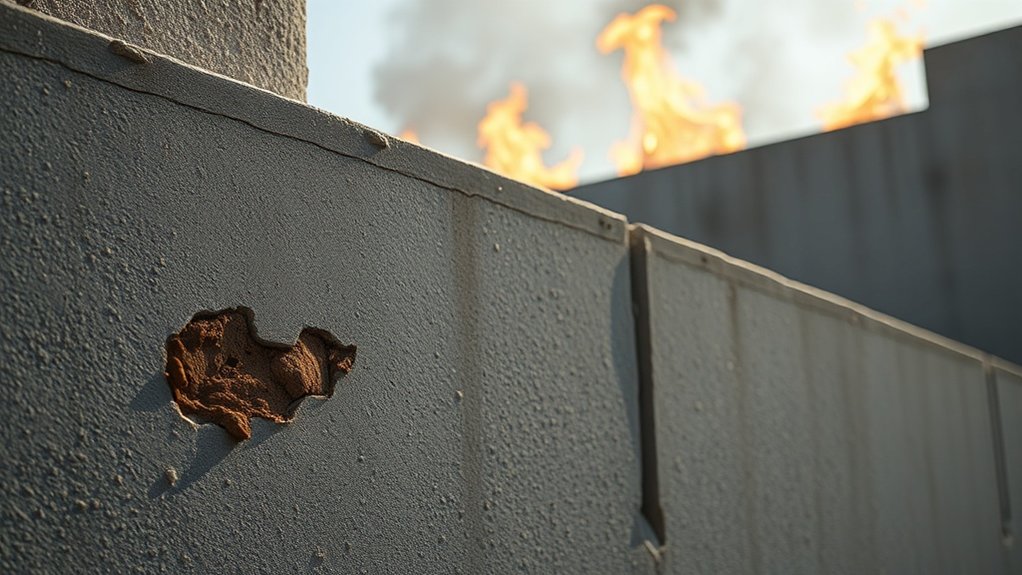
When assessing structural integrity in extreme temperatures, exceptional heat resistance is vital for concrete. It’s important that the structure experiences minimal deformation to maintain its load-bearing capacity during fire exposure. Furthermore, spalling resistance significantly boosts concrete’s durability, enabling it to endure intense conditions without failing catastrophically. However, in hot climates, high curing temperatures can lead to reduced strength and increased risk of cracking, making proper construction practices essential for maintaining integrity. Implementing energy-efficient production techniques can also enhance the resilience of concrete in extreme conditions.
Exceptional Heat Resistance
Concrete’s exceptional heat resistance is vital for maintaining structural integrity during extreme temperature events. Its low thermal conductivity helps limit heat transfer, while its high heat capacity enables significant heat absorption, providing a thermal buffering effect. This reduces internal temperature rises, thereby protecting reinforcement within.
| Temperature Range | Strength Retention | Fire Resistance Level |
|---|---|---|
| Up to 300 °C | Minimal loss | High |
| 300 °C – 750 °C | Usable residual | Moderate |
| Above 750 °C | Reduced capacity | Limited |
| Heat Resistant | Up to 1,650 °C | Exceptional |
Additionally, concrete is non-combustible, which further reduces the risk of fire spread, ensuring safety and durability in fire-prone areas. This makes it an excellent choice for fire-resistant buildings.
Minimal Structural Deformation
Maintaining structural integrity under extreme temperatures relies on minimising deformation. Concrete’s low thermal expansion, especially in comparison to materials like steel, ensures limited distortion when exposed to heat. Effective management of thermal strain helps concrete preserve its microstructure resilience, keeping differential expansion in check.
The uniform matrix and aggregate interlock help reduce internal stresses during temperature changes, preventing excessive cracking.
Good design, including sufficient concrete cover, protects steel reinforcement from rising temperatures, maintaining bond integrity and load-bearing capacity. Concrete retains considerable strength even at temperatures between 400 and 600 °C, and its gradual reduction in compressive strength further supports structural stability.
Spalling Resistance Features
Understanding spalling resistance is crucial for maintaining structural integrity during extreme temperatures, as rapid heating can create high internal pressures within concrete. Key factors that influence spalling mechanisms include moisture levels, temperature differences, and material properties.
| Factor | Description | Impact on Spalling |
|---|---|---|
| Moisture Content | Increased moisture heightens pressure build-up | Raises the risk of explosive spalling |
| Temperature Gradients | Causes compressive and tensile stresses | Can induce spalling in thicker sections |
| Fibre Reinforcement | Improves ductility and crack management | Mitigates the severity of spalling |
For instance, if concrete has a high moisture content and experiences a sudden temperature spike, it can lead to explosive spalling, which compromises the structure. Ensuring proper moisture control and considering reinforcement options can greatly enhance spalling resistance.
Fire Barrier and Compartmentation Benefits

When considering fire barriers and compartmentation in concrete buildings, you’re looking at effective fire separation and improved structural stability.
The non-combustible nature of concrete, combined with its low thermal conductivity, provides strong barriers that prevent the spread of fire while maintaining structural integrity under heat.
This not only safeguards occupants but also aids emergency services by containing flames and smoke within specific compartments.
For instance, in a multi-storey building, well-designed fire compartments can significantly slow down the spread of fire, giving people more time to evacuate safely.
Effective Fire Separation
How do concrete structures improve fire separation?
Concrete serves as a strong fire barrier, significantly slowing the spread of fire between compartments. Its low thermal conductivity limits heat transfer, protecting neighbouring areas.
Standard 100mm concrete block walls provide at least 120 minutes of fire separation, while thicker walls can last over four hours. This effective compartmentation enables firefighters to work more efficiently, helping to control and extinguish fires.
Furthermore, concrete walls retain their structural integrity and insulation during a fire, preventing internal fire spread. By using single-leaf masonry walls reinforced with plaster or fire-resistant boards, you can enhance protection even further.
In essence, concrete’s fire resistance ensures compliance with building regulations while improving safety in various structures.
Enhanced Structural Stability
Concrete is a robust material that maintains its structural integrity during fires, ensuring stability and safety. Its low thermal conductivity slows down heat transfer, protecting internal components and preventing sudden collapse.
Unlike wood or steel, concrete doesn’t burn or fuel fires, which enhances its structural stability. Its dense composition acts as a passive fire barrier, effectively containing fires and limiting their spread, which is crucial for fire safety.
Concrete walls can achieve high fire resistance ratings, aiding in compartmentation and reducing overall building loss. This reliability in fire situations, recognised in UK building codes, ensures that concrete structures retain their strength, providing essential stability for occupants and emergency responders during critical events.
Environmental and Safety Advantages

Concrete offers significant environmental and safety benefits due to its distinctive properties and modern production methods, which support sustainable building practices. By using recycled aggregates and supplementary cementitious materials, you can significantly lower the environmental impact of your projects.
Sourcing raw materials locally helps cut down on transportation emissions, further promoting sustainability.
Moreover, concrete is non-combustible, which enhances safety by preventing fire spread and structural collapse during fires. Its durability reduces the need for repairs and additional fireproofing, saving resources in the long run.
Innovations such as carbon capture in production and self-healing concrete also contribute to a lower environmental footprint, aligning with a circular economy approach.
Practical Applications in Fire-Resistant Design

When designing fire-resistant structures, it’s crucial to understand how to effectively apply concrete to ensure safety and meet fire regulations. Here are some essential fire safety measures and construction techniques to consider:
- Concrete Cover: Ensure a concrete cover thickness of 20mm to 50mm. This is vital for protecting steel reinforcement and maintaining structural integrity during a fire.
- Insulated Concrete Forms (ICF): ICFs are an excellent choice for walls as they combine insulation with concrete, offering fire ratings of 3 to 4 hours without the need for additional fireproofing.
- Element Thickness: Stick to minimum thickness requirements for slabs and walls—such as 100mm for one-hour fire ratings—to slow down heat transmission and improve fire resistance.
These practices will help create robust structures that prioritise safety and compliance with fire codes.
Design Standards for Fire Resistance in Concrete Structures
Design standards for fire resistance in concrete structures are crucial for ensuring safety and compliance with regulations.
It’s important to follow codes such as ACI 216.1-07 and the International Building Code (IBC), which specify fire resistance ratings and guidelines.
Eurocode 2 outlines methods for calculating minimum dimensions to achieve sufficient fire resistance without the need for mandatory testing.
Make sure your designs meet or exceed the required cover protection and dimensions set out in both local and international concrete codes.
Additionally, performance-based design allows you to optimise structural elements by simulating fire scenarios and assessing heat transfer.
Frequently Asked Questions
How Does Concrete Compare to Other Materials in Fire Resistance?
Concrete excels in fire resistance compared to other materials because of its excellent thermal insulation and high fire ratings. Unlike wood, which can ignite easily, or steel, which can lose strength under heat, concrete maintains its structural integrity for longer. This means it reduces heat transfer and enhances safety during fires, making it a reliable choice for buildings.
Can Concrete Structures Withstand Chemical Fires?
Yes, concrete structures can withstand chemical fires because they have low thermal conductivity and are non-combustible. For instance, in industrial settings where chemicals are handled, concrete can help prevent the spread of flames and reduce the risk of structural collapse. Even with surface damage from intense heat, concrete retains its strength and stability, making it a reliable choice for fire-prone environments.
What Maintenance Is Needed for Fire-Resistant Concrete?
Maintaining fire-resistant concrete is essential. Inspect it annually for any damage, check the fireproof coatings, ensure the thermal insulation remains intact, and address any issues swiftly to maintain its protective qualities against heat and fire. Regular upkeep is crucial, much like checking the brakes on your car to ensure safety.
How Does Moisture Affect Concrete’s Fire Resistance?
Moisture absorption significantly affects concrete’s fire resistance. When concrete contains high moisture levels, it generates increased internal pressure during heating. This can lead to spalling, where pieces of concrete break off, compromising its structural integrity. By managing moisture content, we can improve fire resistance and ensure greater durability in concrete structures. For instance, using waterproofing measures can help maintain lower moisture levels, enhancing safety in buildings exposed to fire risks.
Are There Any Color Options for Fire-Rated Concrete?
Yes, there are plenty of colour options for fire-rated concrete! Ranging from natural earthy shades to bright, bold colours, you can create attractive designs without compromising on fire resistance. This allows you to achieve both visual appeal and safety in your projects.
Conclusion
In conclusion, concrete is a strong defender against fire, much like a sturdy castle shielding its occupants. Its non-combustible nature, along with excellent thermal insulation and structural strength, makes it a top choice for fire-resistant buildings. By effectively dividing spaces, concrete improves safety and reduces environmental impact. When considering design standards, remember that using concrete can significantly enhance fire resistance, ensuring safety and longevity for years to come.

Learn the essential concrete safety practices every contractor must implement to protect their team and project—discover the critical steps you Read more

Concrete dust can pose serious health risks; learn essential safety measures to protect yourself and your crew while working on Read more
Discover the hidden dangers of silica exposure in concrete work and learn crucial prevention strategies to safeguard your health—what steps Read more