A 4-inch concrete slab typically takes 28 days to fully cure, reaching about 99% of its maximum strength. During this time, you’ll see significant strength gains, with 65% achieved in the first week. You can expect light foot traffic after 24 hours and light vehicle traffic after 7 days. However, curing time can vary based on factors like temperature, moisture, and mix design. Proper moisture management and temperature control are essential for ideal curing. Regular strength testing at 7, 14, and 28 days helps monitor progress. Understanding the nuances of concrete curing can greatly impact your project’s success and longevity.
Key Takeaways
- A 4-inch concrete slab typically takes 28 days to fully cure and reach 99% of its maximum strength.
- Initial curing occurs within 24-48 hours, allowing for light foot traffic after 24 hours.
- The concrete reaches about 65% of its strength within the first week of curing.
- Light vehicle traffic can be supported after 7 days of curing.
- Proper moisture management and temperature control are crucial for optimal curing and strength development.
Understanding Concrete Curing Process
Concrete curing is a vital process that directly impacts the strength and durability of your finished product. For a 4-inch slab, the standard curing time is approximately 28 days, during which the concrete can reach about 99% of its strength. The curing process begins immediately after pouring, with the initial 24 to 48 hours being essential for preventing surface cracks and guaranteeing proper hydration.
Proper curing practices are necessary for achieving ideal results and preventing issues like cracking and surface defects that can arise from premature use. The time invested in curing ultimately saves future repair costs and guarantees long-term performance.
During the first week, your concrete will gain notable strength, achieving around 65% of its total strength. This period highlights the importance of maintaining ideal moisture levels throughout the curing process. Proper curing techniques, such as water-retaining methods or chemical curing compounds, can enhance the overall durability and longevity of your concrete slab.
Several factors affect the concrete curing time, including ambient temperature and humidity levels. The ideal conditions for effective hydration range between 50°F and 85°F.
It’s important to take these environmental factors into account when planning your project, as they can greatly influence the curing process and the final quality of your 4-inch concrete slab. By understanding and managing these variables, you’ll guarantee a successful curing process and a robust final product.
Typical Curing Timeline for 4-Inch Slabs

You’ll find that a typical 4-inch concrete slab follows a predictable curing timeline. The initial curing period is essential, lasting at least 7 days to achieve approximately 50% of the slab’s maximum strength. During this time, you’ll observe considerable strength gains, with the concrete reaching about 65% of its full strength within the first week.
Environmental conditions play an essential role in determining the actual curing duration, with factors like temperature and humidity considerably impacting the process.
The complete curing process for a 4-inch concrete slab typically spans 28 days, at which point it achieves roughly 99% of its maximum strength. However, it’s important to note that the slab’s usability increases progressively:
- After 24 hours: Ready for light foot traffic
- After 7 days: Can support light vehicle traffic
- After 28 days: Reaches near-maximum strength
While the concrete may appear dry after 28 days, it’s essential to verify the moisture content before installing flooring. Experts often recommend waiting at least 30 days post-pour to guarantee ideal conditions.
Factors Affecting Curing Time
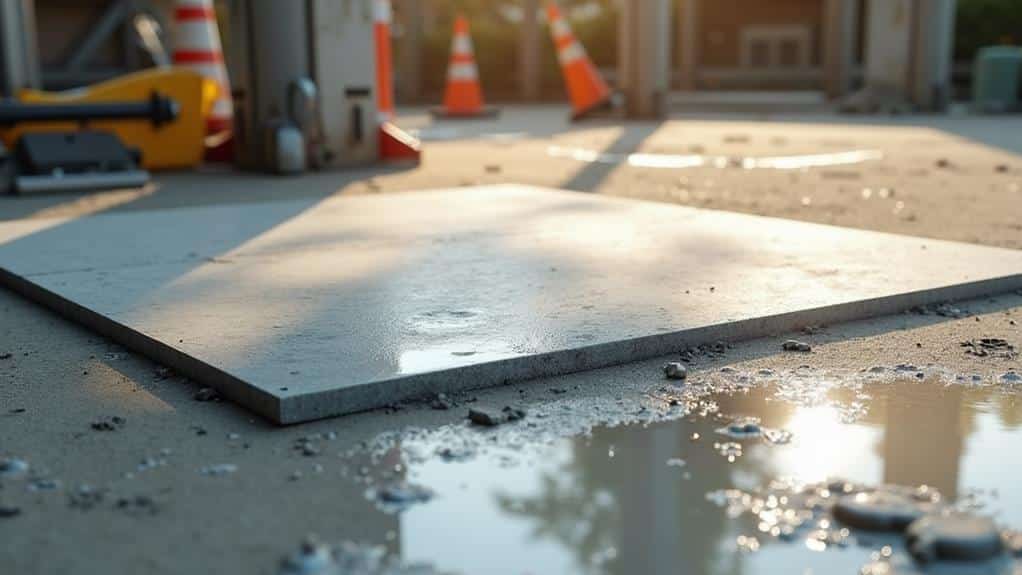
While the typical curing timeline for a 4-inch slab provides a general guideline, several key factors can greatly impact the actual curing duration of concrete. Ambient temperature plays a vital role in the curing process. Temperatures below 50°F can greatly slow down curing, while the ideal range lies between 50°F and 85°F. You’ll need to take this into account when planning your project.
Proper curing techniques are necessary for achieving ideal strength and minimizing the risk of cracking. These techniques include maintaining consistent moisture levels and protecting the concrete from rapid drying.
The water-to-cement ratio is another important factor affecting curing time. A lower ratio can enhance hydration and accelerate curing, but be cautious not to use excess water, as it can prolong the drying process.
You’ll also need to take into account humidity levels and wind conditions, as they influence moisture retention and evaporation rates.
Proper curing techniques are necessary for achieving ideal strength and durability. You should focus on maintaining consistent moisture and protecting the concrete from harsh environmental conditions.
Remember that thicker slabs generally require more time to cure fully. By carefully managing these factors, you can guarantee your 4-inch concrete slab cures effectively, reaching its maximum strength within the expected timeframe.
Strength Development During Curing

You’ll observe rapid strength development in concrete during the initial curing phase, with approximately 70% of its strength achieved within the first week.
Various factors influence this process, including the concrete mix design, environmental conditions, and curing methods employed.
Similar to paver block strength, the water-cement ratio and quality of materials used greatly impact the final compressive strength of concrete.
Proper curing conditions, such as maintaining adequate humidity and temperature, are essential for ideal strength development.
To accurately assess the concrete’s strength progression, you can conduct compressive strength tests at specific intervals, typically at 7 and 28 days after pouring.
Early Strength Gain
During the initial stages of curing, concrete undergoes a rapid strength development process. You’ll observe significant early strength gain within the first week of the curing period. After just 24 hours, your concrete will have achieved approximately 15% of its final strength, increasing to 25% by the 48-hour mark.
This early strength gain is vital for the overall performance and durability of your concrete structure. Proper water-cement ratio is essential for achieving ideal strength and durability during the curing process. Ensuring the correct consistency of your concrete mix will contribute to its long-term structural integrity.
The amount of time required for concrete to cure fully is typically around 28 days, but you’ll notice substantial progress much sooner. By the end of the first week, your concrete should reach about 65% of its potential strength, allowing for light traffic under ideal conditions.
To maximize the benefits of early strength gain, consider implementing moist curing practices for at least seven days. This approach can enhance your concrete’s strength by up to 50% compared to minimal curing methods.
Key milestones in the concrete curing process include:
- 24 hours: 15% strength achieved
- 48 hours: 25% strength achieved
- 7 days: 65% strength achieved
Factors Affecting Strength Development
Strength development during concrete curing is influenced by several key factors that can greatly impact the final product’s performance. The most significant period for a 4-inch concrete slab is the first week, during which it typically reaches about 70% of its ultimate strength.
Environmental conditions play a pivotal role in this process, with temperatures between 50°F and 85°F being ideal for effective curing.
Embodied carbon evaluation has become increasingly important in the construction industry, with a growing focus on accurate data for material emissions and their environmental impact. This evaluation is essential for achieving net zero goals in construction and helps identify ways to mitigate the carbon footprint of concrete.
The water-to-cement ratio is another fundamental factor that can affect concrete strength and drying time. A lower ratio can accelerate curing and improve final strength, while excess water can hinder the hydration process. You’ll need to carefully control this ratio to achieve the desired results.
Proper curing techniques are indispensable, especially during the first three days when the concrete can gain up to 50% of its strength. Maintaining appropriate humidity levels is crucial for continued hydration and strength development.
Remember that most concrete mixtures achieve approximately 90% of their ultimate strength within 28 days, making this period significant for evaluating overall performance.
Testing Concrete Strength
Testing concrete’s strength during the curing process is essential for guaranteeing the final product meets design specifications and safety standards. When curing concrete, you’ll typically perform compression strength tests at various intervals to assess the development of the concrete mix over time.
These tests, conducted at 7, 14, and 28 days, provide valuable insights into the hydration process and strength gains. High-strength concrete, known for its superior durability and enhanced resistance to cracking, requires even more precise monitoring during the curing process to achieve its exceptional properties.
For a 4-inch concrete slab, you can expect the following strength development timeline:
- Within the first week, the slab reaches approximately 70% of its strength
- By 14 days, further strength gains are observed
- At 28 days, the cured slab achieves around 99% of its designed strength
It’s important to note that the hydration process continues even after the initial curing period, allowing concrete to gain strength gradually over months and years.
To accurately monitor the curing process and guarantee compliance with required specifications, follow ASTM C31 standards for taking strength samples at specified intervals. These tests help you evaluate the concrete’s performance and make any necessary adjustments to achieve the desired strength and durability for your project.
Moisture Management in Concrete Curing
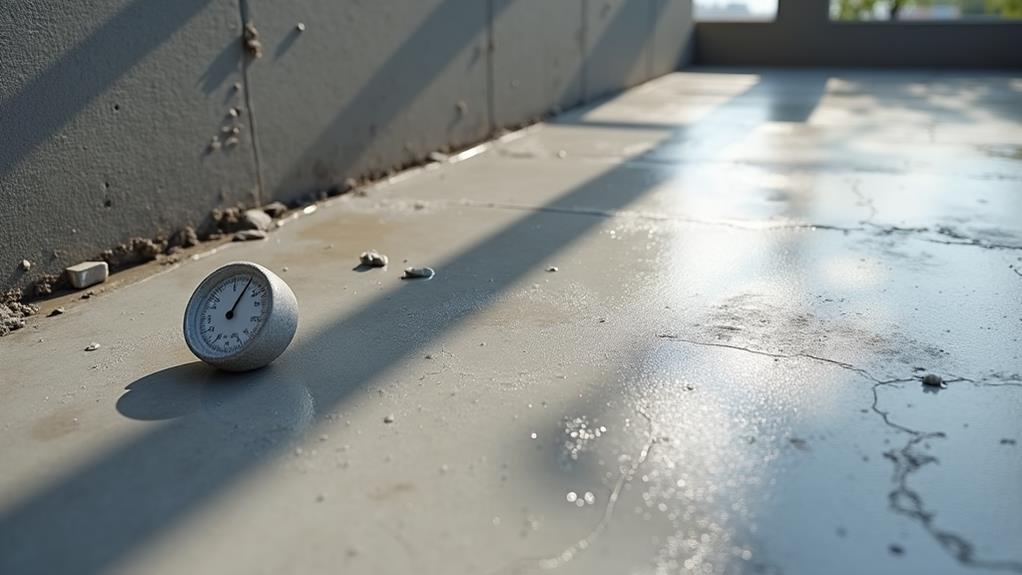
At the heart of successful concrete curing lies effective moisture management. You’ll need to carefully control moisture levels throughout the process to guarantee peak hydration and strength development.
Proper moisture retention is vital, as it allows the necessary chemical reactions to occur, enhancing the concrete’s durability and structural integrity. Similar to sponge city projects that manage urban stormwater, effective concrete curing requires a balance of water absorption and retention to achieve desired outcomes.
You must prevent excessive moisture evaporation immediately after pouring, as rapid loss can lead to cracking and weakened concrete. Aim to maintain a relative humidity level of around 50% during curing. Higher levels (65-75% RH) can greatly extend drying times and increase the risk of mold growth.
To preserve surface moisture and promote proper hydration, employ curing techniques such as water curing, damp coverings, or chemical membranes. These methods effectively control evaporation and maintain consistent moisture distribution throughout the concrete.
Monitor environmental conditions closely, including temperature and wind velocity, as they directly impact moisture levels. By actively managing these factors, you’ll maintain the ideal moisture balance for successful curing.
Temperature’s Role in Curing

Throughout the curing process, temperature plays a pivotal role in determining concrete’s final strength and durability. The ideal temperature range for effective curing is between 50°F and 85°F.
When temperatures fall below 50°F, the curing process slows considerably, impacting strength development. Conversely, high temperatures accelerate hydration reactions but can lead to rapid water evaporation, increasing the risk of cracking.
Carbon capture technologies are also being developed to reduce the carbon footprint of concrete production, with some innovations potentially reducing emissions by up to 50%.
To guarantee ideal curing, you must manage temperature and moisture retention carefully. Consider these key points:
- Maintain consistent temperatures during curing to prevent fluctuations that can affect moisture retention.
- Implement cold weather curing techniques, such as insulating blankets or heating systems, when temperatures drop below 50°F.
- Use evaporation retardants in high-temperature conditions to prevent surface moisture loss.
Temperature’s role in curing extends beyond just setting time. It affects the concrete’s overall strength, durability, and resistance to cracking.
Curing Methods for 4-Inch Slabs

To effectively cure a 4-inch concrete slab, you’ll need to employ moisture retention techniques and temperature control strategies.
You can maintain ideal moisture levels through water curing methods like flooding or mist spraying, or by applying chemical curing compounds to form a protective membrane.
Proper preparation of the base, including cleaning and repairing any damaged bricks, is essential for guaranteeing a stable foundation before pouring concrete.
Additionally, you must monitor and regulate the temperature, keeping it between 50°F and 85°F, to guarantee proper curing and strength development.
Moisture Retention Techniques
For 4-inch concrete slabs, proper moisture retention is vital during the initial curing phase.
You’ll need to implement effective techniques to maintain adequate moisture levels for at least 7 days to guarantee peak strength gain. Water curing methods, such as using wet burlap coverings, are essential for this process.
Additionally, you can employ plastic sheeting to prevent moisture loss due to evaporation, keeping the concrete hydrated throughout the curing process.
Membrane curing is particularly effective in dry areas, acting as a barrier to retain moisture and promote desired strength.
To enhance moisture retention, consider the following techniques:
- Apply evaporation retardants to the concrete surface, especially in hot, windy, or low-humidity conditions.
- Utilize mist spraying or ponding to keep the surface continuously damp, promoting hydration and improving strength and durability.
- Monitor environmental conditions regularly and adjust curing methods accordingly to guarantee full strength potential.
Temperature Control Strategies
Beyond moisture retention, temperature control plays a key role in the curing process for 4-inch concrete slabs.
You’ll need to maintain an ideal temperature range of 50°F to 85°F to guarantee proper curing and prevent issues like cracking. Implement water curing methods, such as flooding or misting, to regulate temperature and retain moisture during the initial curing phase.
Innovative technologies like CaptureCrete can further enhance the curing process by absorbing CO2 and improving concrete durability.
To enhance your temperature control strategies, cover the slab with plastic sheeting. This provides insulation against temperature fluctuations and reduces evaporation, promoting more uniform curing.
In colder conditions, utilize controlled heating systems to speed up the curing process and prevent delays due to low temperatures.
Monitor and adjust airflow and humidity levels within the curing environment to optimize the efficiency of your chosen curing methods.
By combining these temperature control techniques with effective moisture retention strategies, you’ll create an ideal curing environment for your 4-inch concrete slab.
Remember that proper temperature management is vital for achieving the desired strength and durability of your concrete, so pay close attention to this aspect throughout the curing process.
Testing Concrete Curing Progress

Several key methods exist for testing concrete curing progress, guaranteeing that the material reaches its optimal strength and moisture levels before further construction or flooring installation.
Regular testing throughout the curing process is vital, as concrete typically achieves 70% strength within the first week and nearly full strength around 28 days. Visual inspections alone are insufficient; you must use specific tools to verify moisture levels accurately.
To effectively monitor concrete curing progress, consider these essential steps:
- Employ relative humidity probes, such as the Wagner Meters Rapid RH® L6 system, to obtain precise moisture readings in compliance with ASTM F2170 standards.
- Conduct moisture tests at regular intervals during the curing period, particularly before installing flooring products.
- Verify that moisture levels meet manufacturer requirements for any materials to be applied or installed on the concrete surface.
Understanding the curing timeline is important, especially for larger slabs like 4-inch thick concrete, which typically takes about 28 days to fully cure under ideal conditions.
Remember that adverse conditions can extend this timeline, making consistent testing even more important to guarantee proper strength development and moisture reduction.
Common Mistakes in Concrete Curing

The most common mistakes in concrete curing can greatly impact the strength and durability of your finished product. A common mistake in concrete curing is assuming the process is complete once the surface feels dry. In reality, strength development continues for weeks, and you need to cure the concrete properly throughout this period.
Failing to maintain adequate moisture levels is another significant error. As water evaporates, it can lead to rapid drying and cracking, undermining the concrete’s integrity. To prevent plastic shrinkage, you must cover the concrete with protective materials like plastic sheeting or damp burlap, especially in hot or windy conditions.
Don’t be misled by rainfall after pouring; consistent moisture management is vital. Curing is the process that guarantees proper hydration, and relying on sporadic rain isn’t sufficient.
You also need to monitor environmental conditions closely. Ideal curing occurs between 50°F and 85°F, so maintaining these temperatures is necessary for effective hydration.
Optimizing Curing for 4-Inch Slabs

To optimize curing for 4-inch slabs, you’ll need to carefully control temperature and humidity.
Maintain temperatures between 50°F and 85°F to guarantee effective hydration, and monitor humidity levels to prevent rapid moisture loss.
You can accelerate the curing process by using techniques such as steam curing or chemical admixtures, but these methods require precise application and monitoring to avoid compromising the concrete’s long-term strength and durability.
Temperature and Humidity Effects
When curing a 4-inch concrete slab, temperature and humidity play vital roles in determining the overall curing time and strength development. Ambient temperature greatly impacts concrete curing, with ideal conditions ranging from 50°F to 85°F.
Temperatures outside this range can slow the process, affecting the slab’s final strength.
Humidity levels also influence the drying time and curing strength of your 4-inch slab. High humidity (65-75% RH) can prolong the drying process, making it important to monitor moisture levels for effective curing.
To enhance the curing process, consider the following:
- Maintain consistent indoor conditions using HVAC systems to regulate temperature and humidity.
- Monitor wind velocity, as it can increase evaporation rates and necessitate additional curing techniques.
- Use covering methods or evaporation retardants to maintain adequate moisture levels when needed.
Under favorable temperature and humidity conditions, a 4-inch concrete slab typically requires about 28 days to reach peak curing strength.
You can expect approximately 70% strength to be achieved within the first week.
Accelerating Curing Techniques
While temperature and humidity greatly influence concrete curing, you can employ several accelerating techniques to enhance the process for 4-inch slabs.
To accelerate curing, focus on maintaining surface moisture through methods like water curing or applying curing compounds. These approaches improve hydration and strength development, particularly during the critical first seven days when significant strength is gained.
To minimize moisture loss due to evaporation, utilize plastic sheeting to cover your newly poured concrete. This simple yet effective technique helps speed up the curing process.
Additionally, implement proper airflow and temperature control by using fans and dehumidifiers to maintain ideal curing conditions, promoting faster strength gain.
Regularly monitor moisture levels and adjust your curing techniques based on environmental factors. This proactive approach allows you to enhance curing time for your 4-inch concrete slabs.
By employing these accelerating methods, you can potentially reduce the typical 28-day curing period required to reach approximately 99% strength.
Frequently Asked Questions
How Long Does It Take for 4 Inch Concrete to Dry?
You’ll find that 4-inch concrete typically takes 28 days to fully dry. The curing process involves concrete hydration, influenced by temperature effects and humidity. Reinforcement methods can impact drying time. Monitor the process carefully for ideal results.
How Long Should Concrete Cure Before Putting Weight on It?
You should allow concrete to cure for at least 7 days before applying light loads. The curing process, influenced by environmental factors, affects concrete strength. Use curing compounds and adhere to weight limits for ideal results during strength development.
How Long Before You Can Walk on a 4 Inch Slab of Concrete?
You’d think you could dance on fresh concrete, but hold your horses! You can lightly tread after 24-48 hours, depending on concrete strength. The curing process, affected by temperature and moisture retention, allows moderate traffic impact after a week.
Does Spraying Water on Concrete Help It Cure?
Yes, spraying water on concrete aids curing. It’s one of several effective curing methods, maintaining hydration essential for strength development. Consider temperature effects and curing duration. For ideal results, combine with curing compounds or other moisture-retention techniques.
Conclusion
You’ve now mastered the intricacies of curing 4-inch concrete slabs. Armed with this knowledge, you’ll create slabs so strong they could withstand a meteorite impact. Remember, proper curing isn’t just essential—it’s the difference between a slab that lasts millennia and one that crumbles under a feather’s weight. Monitor moisture religiously, choose best curing methods, and test relentlessly. Your perfectly cured 4-inch slab will be the envy of every concrete enthusiast worldwide.

Looking for reliable ready mix concrete services in Manchester? Visit our homepage for more information.
Related Articles
Need concrete mixed & delivered?
Barrow Mix delivers volumetric ready-mix concrete across Greater Manchester & Cheshire — mixed fresh on site, barrowed or pumped to the pour, from as little as ½m³. You only pay for what you use.

Learn about the diverse types of concrete used in construction and discover which mix can transform your next project.

For a long-lasting driveway that laughs in the face of the UK's unpredictable weather, the C20 concrete mix is your Read more

In the UK, you've got a a lot of lightweight concrete types to choose from, each with its unique perks. Read more