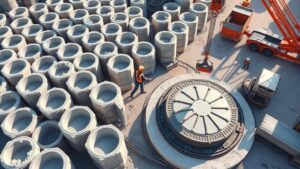
The compressive strength of 60mm paver blocks typically ranges between 30-50 MPa. This strength guarantees they can support heavy vehicular traffic and withstand significant pressures, essential for both residential and commercial paving projects. Factors influencing this strength include the mix design, material quality, and manufacturing processes. High-grade concrete and well-graded aggregates are key components, with a cement to aggregate ratio of 1:6 ideal for maximum durability. You’ll discover that adhering to the right specifications and curing processes increases this capacity, potentially offering further insights into enhancing the longevity and performance of your paving installations.
Key Takeaways
- The compressive strength of 60mm paver blocks typically ranges from 30 to 50 MPa.
- In India, the minimum required compressive strength for these blocks is 50 N/mm².
- Compressive strength is influenced by the cement-to-aggregate ratio, ideally set at 1:6.
- Quality of materials, especially aggregates and cement, significantly affects block strength.
- Proper curing, with a minimum duration of 28 days, is crucial for achieving optimal strength.
Introduction
You must understand that paver blocks, particularly those with a thickness of 60mm, are essential in construction for their durability and versatility.
The compressive strength, typically measured in megapascals (MPa), is a key indicator of the capability of these blocks to withstand loads without failure. This characteristic directly affects the longevity and safety of paved surfaces, making it vital for you to grasp the principles that influence it.
Importance of paver blocks and the significance of compressive strength
Paver blocks, essential for modern paving solutions, require a compressive strength of at least 50 Newtons per square millimetre to guarantee durability and longevity. The compressive strength of 60mm paver blocks is crucial as it directly influences paver block performance under traffic and environmental stressors. The minimum compressive strength guarantees that the blocks can withstand heavy loads and maintain their structural integrity over time. Adhering to paver block standards is essential for ensuring quality and safety in construction applications.
| Feature | Importance |
|---|---|
| Compressive Strength | Ensures durability and safety |
| Size (60mm) | Ideal for various installations |
| Standards Compliance | Ensures performance consistency |
| Load Resistance | Supports heavy vehicular traffic |
| Longevity | Reduces maintenance and replacement costs |
Understanding these properties helps you appreciate why rigorous standards are crucial.
Paver Block Basics

You must understand that paver blocks, typically made of concrete or clay, are essential for numerous paving applications. Commonly, these blocks are available in various thicknesses, especially the 60mm size, which offers a perfect balance between durability and installation ease.
The applications of 60mm paver blocks are extensive, ranging from residential driveways to public walkways, due to their high compressive strength and versatility.
Definition and composition of paver blocks
A paver block’s composition typically comprises a blend of high-grade concrete and aggregate materials crafted to guarantee excellent durability and load-bearing capacity.
When you’re delving into the specifics of concrete paver blocks, it’s important to understand that the standard of the materials used directly influences their structural integrity.
Interlocking paver blocks, which feature unique edges designed to lock together, provide enhanced stability and load distribution.
Each paver block’s thickness and size are meticulously calibrated to meet specific engineering requirements, ensuring a robust performance in varied applications.
The precise formulation of paver block composition ensures that each unit can withstand significant pressures, making them a reliable choice for both aesthetic and functional paving needs.
Common thicknesses and sizes
While exploring the variety of paver blocks, it’s important to note that 60mm pavers are commonly used due to their ideal balance of durability and flexibility in installation.
To give you a clearer picture:
- Paver Block Grades: 60mm blocks often fall into higher strength grades, suitable for varying traffic conditions.
- Compressive Strength Results: These blocks typically show peak compressive strength ranging from 30-50 MPa, adhering to rigorous paver block testing standards.
- Paver Block Durability: Their 60mm thickness contributes to enhanced durability, resisting cracking and damage under loads.
- Paver Block Testing Standards: Each batch undergoes standardized testing to secure consistency in quality and performance metrics, reinforcing their reliability in construction projects.
Applications and advantages of 60mm paver blocks
60mm paver blocks are extensively utilized in both residential and commercial paving projects due to their robustness and adaptability. You’ll find these pavers perfect for driveways, patios, and pedestrian pathways, offering a balance between aesthetic appeal and functional utility. The advantages of 60mm paver blocks include enhanced load-bearing capacity and reduced deformation under pressure, essential for high-traffic areas.
The installation process of these blocks demands precision but results in a durable surface that withstands various weather conditions. Thanks to their interlocking design, paver block longevity is greatly improved, minimizing the need for frequent replacements. Additionally, paver block maintenance is relatively straightforward, involving simple cleaning and occasional sealing, which maintains their appearance and functionality over time.
Compressive Strength Standards and Requirements

You must understand that compressive strength is critical for evaluating paver block performance, particularly in preventing structural failures under load. Various international and regional standards specify the minimum compressive strength required for 60mm paver blocks, often measured in megapascals (MPa).
These standards guarantee that different grades of paver blocks meet specific performance criteria before they’re deemed suitable for construction projects.
Explanation of compressive strength and its importance in paver block performance
Compressive strength measures the ability of 60mm paver blocks to withstand loads without failure, essential for determining their suitability in various paving applications. Here’s why it’s important:
- Compressive Strength Testing: This evaluates how much pressure paver blocks can bear before cracking, ensuring they meet performance standards.
- Testing Methods: Utilize precise equipment to apply uniform pressure and measure the material’s resistance, providing repeatable and reliable results.
- Material Quality: High compressive strength often indicates superior material quality, which contributes to the longevity and durability of the paving.
- Performance Evaluation and Acceptance Criteria: Establish benchmarks for acceptance, ensuring that only paver blocks meeting these rigorous standards are used in construction projects, enhancing safety and functionality.
Overview of relevant international and regional standards
You’ll need to understand IS 15658:2006 if you’re evaluating the compressive strength of 60mm paver blocks in India.
This standard specifies that precast concrete blocks must withstand a minimum compressive strength of 50 N/mm².
Make sure your paver blocks meet or exceed this benchmark to comply with safety and quality requirements.
IS 15658:2006 in India
Builders and civil engineers need to pay attention to IS 15658:2006 when selecting paver blocks for construction projects in India for several reasons:
- Paver Block Specifications: The standard guarantees uniform thickness and dimensions.
- Paver Block Testing: IS 15658:2006 provides methods for evaluating durability and quality.
- Compressive Strength: The standard sets minimum standards at 50 MPa for heavy traffic, ensuring structural integrity.
- Mix Design: IS 15658:2006 specifies the concrete mix for paver blocks to ensure the best performance and longevity of the construction project.
Minimum compressive strength requirements for 60mm paver blocks according to standards
For the longevity and safety of the 60mm paver blocks, they must meet a minimum compressive strength of 50 Newtons per square millimetre as specified by industry standards. This benchmark is important to guarantee that the paver blocks perform adequately under load and environmental stresses. Both international and regional standards dictate rigorous testing protocols to measure this compressive strength, ensuring consistency and quality across productions.
Quality control is paramount, and adherence to these standards ensures that the paver blocks you’re using are up to the task. Regular testing, as part of an analytical approach to quality assurance, involves systematically applying pressure to the paver blocks until they fail, thereby determining their maximum compressive strength. This process helps in maintaining the integrity and reliability of the paving solutions provided.
Comparison of compressive strength requirements for different paver block grades
You’ll find that compressive strength requirements vary greatly among paver block grades such as M30, M35, and M40. Each grade specifies minimum strength values, measured in MegaPascals (MPa), that your paver blocks must meet or exceed under testing conditions.
As you compare these standards, consider how the incremental increases in MPa requirements impact the material selection and manufacturing processes.
M30, M35, M40, etc
In the domain of paver blocks, compressive strength standards such as M30, M35, and M40 specify minimum required pressures of 30 MPa, 35 MPa, and 40 MPa, respectively, guaranteeing structural integrity and durability under various load conditions.
- M30 Blocks: Tested for 30 MPa; suitable for residential areas.
- M35 Blocks: Requires 35 MPa; ideal for commercial settings.
- M40 Blocks: Demands 40 MPa; used in industrial sites.
- Testing Frequency: Regular checks guarantee compliance.
Factors Affecting Compressive Strength of 60mm Paver Blocks

You’ll find that the mix design and proportions greatly influence the compressive strength of 60mm paver blocks.
The quality and type of materials used, from cement to aggregates, play important roles in achieving desired strength levels.
Additionally, the manufacturing process, along with any additives and reinforcements, directly impacts the durability and load-bearing capacity of the finished product.
Mix design and proportions
You’ll find that the compressive strength of 60mm paver blocks is greatly influenced by the specific mix of cement, aggregates, and the water-cement ratio.
It’s essential to maintain a precise water-cement ratio, typically between 0.3 to 0.4, to guarantee ideal hydration without compromising the final strength.
The choice and proportion of fine to coarse aggregates must be meticulously calibrated to achieve the desired density and durability of the paver blocks.
Cement, aggregates, water-cement ratio
Understanding the roles of cement, aggregates, and the water-cement ratio is critical for optimizing the compressive strength of 60mm paver blocks.
- Cement Quality: Utilize OPC 53 for higher early strength.
- Aggregates Size: 3-5mm crushed stones guarantee compactness.
- Water-Cement Ratio: Maintain at 0.4 for best hydration.
- Testing Equipment: Regular calibration of mixers and compression testing machines is necessary.
Quality and type of materials used
You’ll find that the type of cement you choose, along with the size and gradation of aggregates, critically influences the compressive strength of 60mm paver blocks.
For instance, using Portland cement and well-graded, coarse aggregates can enhance the structural integrity of the pavers.
Guaranteeing the materials meet specific industry standards guarantees that your paver blocks perform at their best under load.
Cement type, aggregate size and gradation
The compressive strength of 60mm paver blocks significantly depends on the cement type, aggregate size, and their gradation.
- Cement Type: Ideal performance often uses Portland cement due to its reliable setting times and strengths.
- Aggregate Size: Smaller aggregates can improve the surface smoothness and density.
- Aggregate Gradation: Well-graded aggregates distribute stresses more evenly.
- Experimental Studies: Test results confirm that fine-tuning these factors optimizes strength.
Manufacturing process
You must consider the compaction pressure, which typically ranges from 150 to 200 kg/cm², as it greatly influences the compressive strength of 60mm paver blocks.
The curing conditions, including humidity and temperature, should be precisely controlled, maintaining a humidity of 90-95% and temperature around 20-30°C for best strength development.
Additionally, the duration of curing, generally recommended for at least 14 days, plays an essential role in achieving the desired strength properties of the pavers.
Compaction, curing conditions, and duration
In manufacturing 60mm paver blocks, achieving peak compressive strength depends greatly on precise compaction, specified curing conditions, and carefully timed durations.
- Compaction Pressure: Apply 3000 psi uniformly to guarantee density and strength.
- Curing Temperature: Maintain at 23°C consistently.
- Curing Duration: Minimum 28 days for best hardness.
- Quality Control: Implement a strict quality assurance and control plan throughout the process.
Additives and reinforcements
You’ll find that additives such as fly ash and silica fume greatly enhance the compressive strength of 60mm paver blocks by altering the microstructure of the concrete.
Incorporating fibres, typically steel or polypropylene, can increase tensile strength and crack resistance, facilitating load distribution throughout the block.
Each of these materials plays a crucial role in improving durability and performance under stress.
Fly ash, silica fume, fibres
Adding fly ash, silica fume, and fibres can greatly enhance the compressive strength of 60mm paver blocks by improving their density and durability.
- Fly Ash: Increases the ultimate strength by reducing the water demand.
- Silica Fume: Enhances microstructure through pozzolanic reactions.
- Fibres: Distribute stress, preventing crack propagation.
- Combined Effect: Synergistically increases toughness and load-bearing capacity.
Experimental Studies on Compressive Strength of 60mm Paver Blocks

You’ll find that the experimental studies outlined in this section provide a robust analysis of the compressive strength of 60mm paver blocks.
These studies assess the impact of factors such as material composition and curing time, presenting their findings in a detailed table that compares results across various research efforts.
Summary of key findings from relevant research studies
Several studies have demonstrated that the compressive strength of 60mm paver blocks typically ranges between 30 MPa and 50 MPa, depending on the materials and manufacturing processes used. The research findings highlight critical factors like material selection and paver block specifications which greatly influence the strength outcomes.
- Material Quality: Higher quality aggregates result in better compressive strength.
- Manufacturing Process: Tight control and consistent techniques guarantee superior strength characteristics.
- Curing Age: Paver blocks gain strength over time; peak strength is often reached at 28 days post-manufacture.
- Block Specifications: Specific dimensions and compaction standards are essential for achieving the desired strength levels.
Impact of various factors on compressive strength
You’ll find that the mix ratios, materials used, and curing age have a substantial impact on the compressive strength of 60mm paver blocks.
For instance, altering the cement-to-aggregate ratio can affect the psi rating of the finished product.
Additionally, extending the curing period from 7 to 28 days has been shown to enhance strength by up to 20%.
Mix ratios, materials, curing age
To enhance the compressive strength of 60mm paver blocks, it’s crucial to carefully adjust the mix ratios, select appropriate materials, and control the curing age.
- Mix Ratios: Maintain a cement to aggregate ratio of 1:6 for best density and strength.
- Materials: Use high-quality Portland cement and well-graded aggregates.
- Curing Age: Allow at least 28 days for complete hydration.
- Specifications: Adhere strictly to standard paver block specifications during manufacturing.
Table comparing compressive strength results from different studies
The table below presents a detailed comparison of compressive strength data from various studies on 60mm paver blocks, showcasing specific measurements and analytical insights.
You’ll find that paver block research consistently focuses on optimizing the compressive strength to meet or exceed industry standards. Through precise paver block testing, data accumulated highlights variations in strength outcomes, influenced by different mixtures and curing times.
Each entry in the table adheres to established paver block specifications and presents paver block technical data critical for industry application.
This comparative analysis serves as a cornerstone for ongoing improvements in the paver block industry, ensuring that each block is capable of withstanding necessary load and environmental conditions while maintaining aesthetic and functional integrity.
Achieving Optimal Compressive Strength in 60mm Paver Blocks

To achieve peak compressive strength in 60mm paver blocks, you must meticulously select your mix design and materials. You’ll need to adhere to best practices in manufacturing and guarantee proper curing processes are followed.
Additionally, integrating recycled materials can impact strength, necessitating rigorous quality control and testing to maintain standards.
Recommendations for mix design and material selection
Selecting high-quality materials and adhering to a meticulously designed mix ratio are crucial for enhancing the compressive strength of 60mm paver blocks. Here’s a detailed guide to optimize your paver block material selection and mix proportions:
- Aggregate Quality: Use aggregates with high compressive strength and minimal flakiness index. Ideal particle size distribution ensures better compaction and strength.
- Cement Type: Opt for Portland cement with a low alkali content to prevent efflorescence. The typical ratio for cement to aggregate in paver blocks should be about 1:3.
- Inclusion of Recycled Materials: Incorporate up to 30% of fine recycled concrete as a substitute for natural sand to promote sustainability without compromising strength.
- Water-Cement Ratio: Maintain a water-cement ratio between 0.32 to 0.38 to achieve optimal hydration without reducing the block’s strength.
Best practices for manufacturing and curing processes
Securing precise control over the manufacturing and curing processes is crucial for achieving maximum compressive strength in 60mm paver blocks. As a paver block manufacturer, you should embrace a systematic approach, implementing accurate measurements and strict adherence to paver block innovations. During manufacturing, maintaining consistent pressure and temperature guarantees uniform density and strength across all blocks.
For the curing phase, implement standardized paver block curing processes. This usually involves controlled water retention for a specific duration, which varies depending on environmental conditions but generally spans between 14 to 28 days. Following these paver block installation guidelines, which include proper sub-base preparation and placement techniques, further enhances the overall durability and functionality of the installed blocks.
Potential use of recycled materials and their impact on compressive strength
You should consider the integration of recycled plastics and demolition waste into the production of 60mm paver blocks. Studies indicate that plastic, when processed correctly, can enhance the compressive strength up to a specific threshold of material inclusion.
However, exceeding 25% recycled content may compromise structural integrity, requiring careful formulation adjustments.
Plastic, demolition waste
Incorporating recycled plastics and demolition waste into the production of 60mm paver blocks can greatly enhance their compressive strength. Here’s how:
- Recycled Plastics: Reduction in material cost and enhanced binding properties.
- Demolition Waste: Utilizes concrete and ceramics, increasing load-bearing capacity.
- Quality Control: Guarantees consistent particle size and composition.
- Sustainability: Boosts eco-friendly credentials and reduces landfill use.
Importance of quality control and testing
Rigorously testing and controlling quality often determines the compressive strength of 60mm paver blocks. You’ll need to make sure that each step, from manufacturing to installation, adheres to specific paver block specifications. This isn’t just about preventing paver block failure; it’s essential for maintaining structural integrity and longevity.
| Test Type | Specification |
|---|---|
| Load Testing | 3,500 psi |
| Absorption | < 5% |
| Dimension Check | 60mm ± 2mm |
| Surface Abrasion | < 1.2mm loss |
| Flexural Strength | > 4.5 MPa |
Compressive Strength Testing Methods and Requirements

You’ll need to familiarize yourself with the various compressive strength testing methods and equipment used to evaluate 60mm paver blocks.
Make sure you’re adhering to the specified sampling and testing frequency requirements set forth by industry standards.
You must also accurately interpret test results to determine if the paver blocks meet the necessary acceptance criteria.
Overview of compressive strength testing methods and equipment
To accurately assess the compressive strength of 60mm paver blocks, one must employ specific testing methods and utilize precise equipment designed for this purpose. Understanding the right approach and tools is vital for guaranteeing that paver blocks meet the required specifications and are sampled correctly.
- Hydraulic Compression Testing Machine: Measures the maximum force applied to the paver until it fails.
- Curing Tank: Used for proper curing of paver samples, ensuring they develop adequate strength before testing.
- Callipers and Scales: Essential for verifying dimensions and weight to guarantee samples meet paver block specifications.
- Control Panel with Data Acquisition: Allows precise control and recording of the testing parameters and results, essential for consistent and accurate analysis.
Sampling and testing frequency requirements according to standards
Establishing the appropriate sampling and testing frequency for 60mm paver blocks is crucial to guarantee they meet industry standards for compressive strength. You’ll need to align your testing schedule with the requirements set by governing bodies to guarantee quality and durability.
Typically, paver block specifiers recommend testing a sample from every batch, or at least one sample per 1000 square metres of production. This frequency ensures that any need for paver block repair or replacement due to substandard compressive strength is identified early, minimizing paver block cost overruns and extending the lifecycle of the paved area.
Thorough testing not only validates the manufacturing process but also aids in lifecycle assessment, contributing to more sustainable construction practices.
Interpretation of test results and acceptance criteria
Once you’ve conducted the compressive strength tests on 60mm paver blocks, interpreting the results against established acceptance criteria is crucial to assess compliance with industry standards.
To guide your analysis, consider these factors:
- Minimum Strength Requirements: Refer to the specific paver block certifications for the minimum compressive strength values required by industry standards.
- Consistency Across Samples: Evaluate the uniformity of test results across different samples to identify any deviations that could suggest issues with paver block product selection or manufacturing processes.
- Comparison With Paver Block Trends: Analyze how your results align with current paver block trends in terms of strength and durability.
- Supplier and Manufacturer Compliance: Make sure that your paver block supplier and entries in the paver block manufacturer directory meet or exceed the standards reflected in your test results.
Conclusion

You’ve seen how critical the compressive strength of 60mm paver blocks is; maintaining a minimum of 50 MPa is essential.
You must adhere strictly to established standards and best practices to guarantee durability and safety.
We recommend that manufacturers, designers, and specifiers continuously evaluate and enhance their quality control processes to meet these benchmarks.
Recap of key points regarding compressive strength of 60mm paver blocks
In summarizing the key aspects, 60mm paver blocks typically exhibit a compressive strength ranging from 30 to 35 MPa, guaranteeing durability and load-bearing capacity. This places them as a premier choice in the paver block market, particularly for applications like driveways and patios where high strength is essential. Here’s a breakdown of their significance:
- Design Flexibility: Paver block designers leverage this strength to innovate varied patterns that meet both aesthetic and functional standards.
- Market Compatibility: Fits well within market demands for robust, long-lasting paving solutions.
- Driveway Suitability: Ideal for paver block driveways that require endurance against frequent or heavy vehicular use.
- Patio Durability: Ensures that paver block patios withstand environmental stressors while maintaining their integrity over time.
Adhering to standards and best practices
Adhering strictly to established standards and best practices guarantees that 60mm paver blocks maintain their specified compressive strength of 30 to 35 MPa. You’ll secure their durability and functionality in various applications such as paver block pavements, walkways, pool decks, and stormwater management systems. It’s important you follow precise specifications and regular quality checks.
| Aspect | Importance |
|---|---|
| Material Quality | Ensures structural integrity |
| Installation Technique | Prevents premature failure |
| Regular Testing | Confirms ongoing compliance with standards |
| Design Specifications | Achieves top-notch performance in applications |
Recommendations for manufacturers, designers, and specifiers
To guarantee peak performance and compliance, manufacturers, designers, and specifiers must rigorously apply the latest industry standards and technological advances when developing 60mm paver blocks. Here’s how you can make sure that your paver blocks not only meet but surpass expectations:
- Colour Consistency: Implement controlled dye mixing techniques to achieve uniform paver block colour, enhancing visual coherence in paver block landscaping.
- Texture Precision: Use precise material grading to ensure the surface texture of paver blocks meets slip resistance standards while providing aesthetic appeal.
- Shape Accuracy: Employ high-precision moulds to maintain consistent paver block shape, facilitating easier installation and ideal load distribution.
- Aesthetic Integration: Design paver blocks that complement the surrounding environment, considering both functionality and paver block aesthetics to satisfy diverse design requirements.
Frequently Asked Questions
How Does Weather Impact the Durability of 60MM Paver Blocks?
Weather greatly impacts your 60mm paver blocks’ durability. Frequent temperature fluctuations and moisture can degrade materials, reducing lifespan and necessitating more frequent maintenance or replacement to maintain their structural integrity and appearance.
Can 60MM Paver Blocks Be Recycled or Reused?
Yes, you can recycle or reuse 60mm paver blocks. They’re typically crushed and repurposed for sub-base materials or aggregate, contributing to sustainable construction practices and reducing waste in the environment.
What Are the Aesthetic Variations Available for 60MM Paver Blocks?
You can choose from various colours, textures, and patterns in 60mm paver blocks to enhance your project’s design. Options include smooth, cobblestone, and slate finishes which can dramatically alter the visual appeal.
How Do 60MM Paver Blocks Compare to Other Paving Materials in Cost?
Exploring the cost landscape, you’ll find 60mm paver blocks are generally more budget-friendly than poured concrete or natural stone, offering a cost-effective solution without compromising on durability or aesthetic flexibility.
Are There Any Specific Maintenance Tips for 60MM Paver Blocks?
To maintain your 60mm paver blocks, regularly sweep off debris and wash with a mild detergent solution. Annually, check for joint sand loss and replenish as necessary to guarantee structural integrity and appearance.
Conclusion
In summary, achieving the ideal compressive strength in 60mm paver blocks is vital for their durability and functionality. Precise control over factors like material composition, curing time, and compaction method guarantees that these blocks meet or exceed the required standards, typically around 50 MPa.
Remember, each element in the production process plays a pivotal role. By adhering to rigorous testing methods, you guarantee these pavers perform under pressure, literally supporting the world under our feet with unwavering strength.
Related Articles

Are you ready to learn the secret of efficient concrete transportation? In this article, we will delve into the intriguing Read more

Is it more cost-effective to mix your own concrete or have it delivered? This article examines the factors to consider Read more

Do you want to ensure the structural integrity of your concrete construction project? Then, rebar is a crucial component you Read more