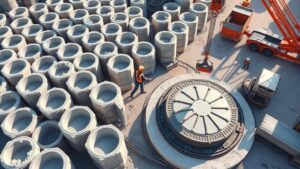
Lightweight concrete is shaking up the construction world with its amazing blend of strength and sustainability. It’s not just lighter; it’s also better for the environment and your wallet. Imagine ancient Roman buildings with modern flair—yes, they used similar materials! This concrete uses light aggregates like pumice, reducing overall weight and improving insulation, which means lower energy bills. It’s a game-changer, driving the shift towards greener, cost-effective building practices. You’ll find it’s used in everything from skyscrapers to cozy homes, setting new standards in efficiency. Stick around, and you’ll find out how it’s revolutionizing building design.
Key Takeaways
- Lightweight concrete significantly reduces the dead load on structures, allowing for innovative and flexible building designs.
- Its excellent insulation properties contribute to energy efficiency and lower heating and cooling costs.
- The use of lightweight concrete supports sustainable building practices and reduces the overall environmental impact of construction.
- Cost savings are achieved through reduced material and transportation costs, as well as decreased labor and foundation requirements.
- Enhanced thermal performance and fire resistance make lightweight concrete ideal for improving the safety and comfort of buildings.
Introduction
You mightn’t realize it, but lightweight concrete has a fascinating history and is becoming increasingly significant in modern construction.
As buildings grow taller and more complex, the demand for this innovative material is skyrocketing.
In this article, you’ll learn about its origins, why it’s so vital today, and what we aim to explore regarding its impact on building design and efficiency.
Definition and brief history of lightweight concrete
Lightweight concrete, a versatile and innovative building material, has been transforming construction practices for decades. You might be surprised to learn that its origins trace back to ancient structures. Historical usage of lightweight materials can be seen in early Roman buildings, where volcanic ash and pumice were used to create lighter concrete. These early experiments laid the groundwork for what we now know as lightweight concrete.
Traditional methods of making concrete often involved heavy, dense materials, but the need for more efficient building techniques led to the initial applications of lightweight concrete. Builders in ancient times noticed that using lighter aggregates not only made construction easier but also improved the durability of their structures.
Fast forward to the 20th century, and you’ll see that these early discoveries inspired more formal research and development. Scientists and engineers started experimenting with new mixtures and methods, which led to the standardized lightweight concrete we use today.
This material has come a long way, evolving from its humble beginnings in historical usage to becoming a staple in modern construction. So, the next time you walk past a building, remember that its history might be lighter than you think!
Importance and growing demand in modern construction
As modern construction pushes the boundaries of innovation, the significance and rising demand for lightweight concrete become increasingly apparent. You might wonder why this material is gaining so much traction. Well, it’s all about efficiency and sustainability.
Lightweight concrete reduces the environmental impact of building projects by using fewer natural resources and emitting less carbon during production. This makes it a greener choice for eco-conscious builders.
In terms of cost analysis, lightweight concrete can save you money in the long run. Its lighter weight means fewer materials and labor are needed to support structures, leading to lower overall costs. Plus, it offers excellent insulation, which can help reduce energy bills.
Market trends show a growing preference for this versatile material. As construction practices evolve, more architects and engineers are turning to lightweight concrete to meet modern demands. Its flexibility and strength make it ideal for a variety of applications, from residential homes to large commercial buildings.
Demand drivers for lightweight concrete include the push for sustainable building practices, the need for cost-effective construction solutions, and the desire for innovative materials that enhance building performance.
Scope and objectives of the article
This article aims to explore how lightweight concrete is transforming building design and efficiency, focusing on its environmental benefits, cost savings, and versatile applications. You’ll discover how this innovative material is making waves in the construction industry.
First, we’ll delve into energy efficiency. Lightweight concrete helps buildings maintain temperature better, reducing the need for excessive heating or cooling. This not only saves energy but also lowers utility bills—who wouldn’t want that?
Next, we’ll address the carbon footprint. Traditional concrete is notorious for its environmental impact, but lightweight concrete offers a greener alternative. By using recycled materials and requiring less cement, it reduces the carbon footprint of construction projects.
Urban planning is another key area. With cities growing rapidly, lightweight concrete offers a solution for creating taller, stronger, and more sustainable structures without adding extra weight. It’s a game-changer for architects and urban planners.
We’ll also conduct a cost analysis to see how lightweight concrete can save money in the long run. From reduced transportation costs to easier installation, the financial benefits are substantial.
Types and Constituents of Lightweight Concrete

When talking about lightweight concrete, you’ll find several types that each offer unique benefits and uses.
These include lightweight aggregate concrete, aerated or foamed concrete, and no-fines concrete, with new types continually emerging.
Understanding what makes up each type helps you see how they can revolutionize building designs and improve efficiency.
Lightweight aggregate concrete
When you contemplate lightweight aggregate concrete, you’ve got two main types to contemplate: natural and synthetic aggregates.
Natural aggregates come from volcanic rocks, while synthetic ones include materials like expanded clay or shale.
Understanding the properties and selection criteria for these aggregates is key to choosing the right type for your building project, ensuring you get the best mix of strength and efficiency.
Natural and synthetic lightweight aggregates
In the domain of lightweight concrete, natural and synthetic lightweight aggregates play a pivotal role in enhancing both structural efficiency and sustainability.
You’ve got natural options like Perlite, which comes from perlite mining, and Vermiculite, known for its expansion properties. Pumice sources are also key.
On the synthetic side, plastic aggregates and geosynthetic materials offer innovative solutions, pushing the envelope in modern construction.
Properties and selection criteria for aggregates
Selecting the right aggregates for lightweight concrete hinges on understanding their properties and how they impact structural performance.
You’ll want to take into account:
- Aggregate moisture: Guarantees proper mix consistency.
- Grading curves: Impacts workability and strength.
- Particle shape: Plays a role in bonding and compaction.
- Bulk density: Dictates overall weight.
- Aggregate reactivity: Helps prevent long-term durability issues.
Choose wisely for the best results!
Aerated/foamed concrete
When talking about aerated or foamed concrete, you’re looking at two main production methods: pre-foam and mixed-foam.
These methods involve air-entraining agents and foaming agents that create tiny air bubbles within the concrete.
This makes the material lighter and more efficient for construction projects.
Production methods (pre-foam, mixed-foam)
Understanding the production methods of lightweight concrete, like pre-foam and mixed-foam, is essential for optimizing building design and efficiency. These methods play a significant role in sustainable production, reducing environmental impact, lowering energy consumption, cost analysis improvements, and effective waste management.
Understanding the production methods of lightweight concrete, like pre-foam and mixed-foam, is essential for optimizing building design and efficiency.
These methods play a significant role in sustainable production, reducing environmental impact, lowering energy consumption, cost analysis improvements, and effective waste management.
Air-entraining agents and foaming agents
To enhance the performance of lightweight concrete, air-entraining agents and foaming agents play a pivotal role in creating aerated or foamed concrete with superior properties.
You’ll find that admixture interactions, foam stability, surface tension, bubble size, and air content are all critical factors.
These elements guarantee the concrete remains strong yet light, with tiny bubbles uniformly distributed for best results.
No-fines concrete
No-fines concrete is an interesting type of lightweight concrete made without fine aggregates like sand. This unique composition gives it a distinct void structure that is beneficial for insulation and drainage. However, it does have limitations, such as lower strength compared to traditional concrete.
Understanding the composition and practical applications of no-fines concrete can help highlight why it is gaining popularity in modern building design.
Composition and void structure
Lightweight concrete, especially the no-fines variety, dramatically reduces building weight without compromising structural integrity. This type of concrete focuses on:
- Pore distribution: Ensuring even spacing of air cavities
- Aggregate interlock: Enhancing strength through particle bonding
- Air cavities: Creating voids that lighten the mix
- Void ratio: Balancing solid and empty spaces
- Microstructure analysis: Studying these elements for best performance
Applications and limitations
When you’re considering building materials, you’ll find that no-fines concrete excels in applications where reduced weight and improved insulation are essential. It’s great for load testing and offers better seismic performance. Plus, it helps with moisture control.
While it’s cost-effective, you should still do a cost analysis. Repair techniques are straightforward, making maintenance easier. This type of concrete has both strengths and limitations.
Emerging types
You’ll find that infra-lightweight concrete and ultra-lightweight cellular concrete are changing the game in building design. These materials aren’t just light; they’re also strong and energy-efficient, making them perfect for modern construction needs.
Let’s explore how these innovative types of lightweight concrete can benefit your projects.
Infra-lightweight concrete
Among the innovative materials transforming modern construction, infra-lightweight concrete stands out for its exceptional combination of strength and reduced weight. It offers impressive benefits:
- Thermal efficiency: Maintains buildings warm in winter and cool in summer.
- Cost analysis: Saves money with reduced material and transportation costs.
- Structural integrity: Guarantees long-lasting durability.
- Load capacity: Handles significant weight.
- Moisture resistance: Prevents water damage.
Ultra-lightweight cellular concrete
As a cutting-edge material in modern construction, ultra-lightweight cellular concrete is gaining traction for its remarkable versatility and efficiency. You’ll love its benefits like superior building insulation and energy efficiency.
It’s a marvel of construction innovation, offering significant weight reduction and contributing to material sustainability. This innovative concrete type is revolutionizing how we think about sustainable and efficient building practices.
Properties and Performance
When you think about lightweight concrete, it’s important to take into account how its properties affect performance.
You’ll want to understand its physical, mechanical, thermal, and acoustic characteristics, as well as its durability.
Each of these aspects plays a vital role in making buildings safer, more efficient, and comfortable.
Physical properties
When you think about building materials, it’s vital to take into account their density and specific gravity because these factors impact how strong and heavy the structure will be.
Porosity and microstructure also play a significant role, as they determine how well the material can insulate and handle moisture.
Understanding these properties helps you make smarter choices for efficient and durable buildings.
Density and specific gravity
Understanding density and specific gravity is essential for optimizing building materials and ensuring structural integrity. Lightweight concrete’s properties depend on:
- Aggregate types
- Density variations
- Specific gravity
- Material composition
- Weight reduction
Porosity and microstructure
Examining porosity and microstructure offers deeper insights into the performance and durability of building materials. When you analyze pore distribution and capillary porosity, you’ll understand how these factors affect strength and insulation. Microstructure analysis and microstructural characterization reveal how tiny voids impact durability.
| Property | Impact | Analysis Method |
|---|---|---|
| Pore distribution | Strength and insulation | Microstructure analysis |
| Capillary porosity | Durability | Microstructural characterization |
| Porosity effects | Overall performance | Various testing methods |
Mechanical properties
When you think about mechanical properties in building materials, you’re looking at how well they can handle different forces and stresses.
Compressive strength measures how much weight a material can bear before it crushes, while tensile and flexural strength gauge its ability to stretch and bend without breaking.
Modulus of elasticity, impact resistance, and abrasion resistance all play vital roles in ensuring buildings are both durable and safe.
Compressive strength
Compressive strength is a critical measure of a material’s ability to withstand loads that reduce its size. It’s essential for understanding stress distribution and fracture mechanics in lightweight concrete.
You’ll need to know its load capacity, failure modes, and how strength testing works.
- Stress distribution
- Fracture mechanics
- Load capacity
- Failure modes
- Strength testing
Tensile and flexural strength
Understanding tensile and flexural strength is vital to grasp how materials resist forces that try to stretch or bend them.
In lightweight concrete, fiber reinforcement and polymer additives enhance stress distribution and crack resistance. This means better load-bearing capacity for your structures.
Imagine your building standing strong and resilient, even under stress, thanks to these innovative elements working together to keep it intact.
Modulus of elasticity
The modulus of elasticity measures how much a material will deform under stress, giving you insight into its stiffness and ability to return to its original shape. It’s also called Young’s modulus and helps in:
- Evaluating elastic deformability
- Appraising stiffness characterization
- Understanding strain behavior
- Predicting load response
- Ensuring structural integrity
With these insights, you can better understand how lightweight concrete will behave under various conditions.
Impact and abrasion resistance
While stiffness and elasticity are key, you also need to take into account how materials like lightweight concrete withstand impact and abrasion. Surface roughness affects wear resistance, and the material’s ability to absorb impact energy is essential.
High abrasion cycles indicate durability, and a good toughness index means it can endure repeated stresses. Ensuring these properties will make your structures last longer and perform better.
Thermal properties
When thinking about thermal properties, you need to take into account how well a building material can conduct heat and insulate against temperature changes.
Materials with high specific heat capacity can store more energy, which helps in maintaining a stable indoor climate.
Additionally, fire resistance and behavior at high temperatures are essential for safety, ensuring the building can withstand extreme conditions.
Thermal conductivity and insulation
Understanding thermal conductivity and insulation is crucial for maximizing a building’s energy efficiency. Lightweight concrete excels in:
- Thermal conductivity: Keeps heat movement slow.
- Insulation efficiency: Reduces energy bills.
- Energy savings: Lowers heating and cooling costs.
- Heat retention: Maintains warmth during cold months.
- Temperature control: Guarantees a comfortable indoor environment.
You’ll love how it transforms your space into a cozy, energy-efficient haven!
Specific heat capacity
Beyond thermal conductivity and insulation, specific heat capacity plays a key role in a building’s thermal performance. It affects heat transfer and thermal storage, helping with temperature regulation.
This material innovation boosts energy efficiency by absorbing and releasing heat slowly. Lightweight concrete’s high specific heat capacity guarantees your building stays comfortable, reducing the need for extra heating and cooling systems.
Fire resistance and high-temperature behavior
Fire resistance and high-temperature behavior are essential for ensuring buildings’ safety and structural integrity during extreme conditions. Lightweight concrete can help you achieve this with:
- Polymer modification to enhance fire resistance
- Reduced thermal degradation for longevity
- Lower smoke production during fires
- Excellent insulation properties to slow heat transfer
- Application of fireproof coatings for added protection
These features make buildings safer and more resilient.
Acoustic properties
When it comes to acoustic properties, you’ll find that sound absorption and transmission loss play vital roles. Sound absorption helps reduce echo and noise within a space, making rooms more comfortable and functional.
Transmission loss, on the other hand, measures how well walls and other structures block sound from traveling between spaces, ensuring privacy and quiet.
Sound absorption and transmission loss
Understanding sound absorption and transmission loss is essential for designing buildings that achieve peak acoustic performance. Lightweight concrete excels in:
- Creating soundproof barriers
- Providing acoustic insulation
- Enhancing noise reduction
- Minimizing echo
- Ensuring sound isolation
You’ll notice how these properties contribute to quieter, more comfortable spaces.
Whether it’s a bustling office or a serene home, lightweight concrete makes a significant difference.
Durability aspects
When contemplating a building’s durability, you need to evaluate how it handles water, resists freeze-thaw cycles, and stands up to carbonation and corrosion. These factors all impact the long-term performance and service life of the structure.
Ensuring your building can withstand these challenges means you’ll have fewer repairs and a longer-lasting, more efficient space.
Permeability and water absorption
Effective building design hinges on understanding how permeability and water absorption impact the durability of materials.
Lightweight concrete’s permeability is influenced by:
- Capillary action: How water moves through tiny pores.
- Moisture retention: The ability to hold water.
- Porosity effects: The size and number of pores.
- Surface tension: How water interacts with surfaces.
- Absorption rates: The speed at which water is absorbed.
Freeze-thaw resistance
Just as permeability and water absorption inform material durability, freeze-thaw resistance plays a pivotal role in a building’s ability to withstand fluctuating temperatures.
Polymer additives help improve this resistance, minimizing saturation effects and freeze damage. Ensuring aggregate stability through these additives means your concrete can better endure repeated moisture cycles, protecting your structure from the harsh impacts of temperature changes.
Carbonation and corrosion resistance
Carbonation and corrosion resistance are essential for maintaining the longevity and integrity of reinforced concrete structures.
You’ll want to keep an eye on:
- Pore structure: It affects how gases and liquids move through concrete.
- Carbonation depth: Measures how far carbonation has progressed.
- Chloride ingress: Determines the extent of chloride penetration.
- Steel protection: Guarantees reinforcement stays intact.
- Alkalinity levels: Helps maintain a protective environment for steel.
Long-term performance and service life
Understanding carbonation and corrosion resistance is a stepping stone towards ensuring the long-term performance and service life of concrete structures.
You’ll need to contemplate repair techniques and maintenance planning to address degradation mechanisms.
Regular performance monitoring and lifecycle assessment will help identify issues early, ensuring the concrete stays strong and durable.
This proactive approach helps maintain the integrity of your building over time.
Mix Design and Optimization
When you’re working on mix design and optimization, you need to focus on key considerations like the proportioning of constituents to create the ideal blend.
Enhancing the strength and durability of your mix involves specific strategies and techniques that can make a big difference.
Don’t forget, quality control and testing methods are essential to guarantee your mix meets all the necessary standards.
Key considerations and design parameters
To revolutionize building design, you must prioritize mix design and optimization to guarantee structural efficiency and sustainability. Crafting the perfect lightweight concrete mix involves balancing several key considerations that directly influence the project’s success.
Firstly, think about the essential environmental impact. Choosing materials that reduce carbon footprint can make your project greener and more sustainable.
Next, conduct a thorough validate analysis. Understanding the expenses associated with lightweight concrete helps in budgeting and avoiding unexpected costs.
Material sourcing is another critical factor. Make sure you’re selecting high-quality, readily available materials to avoid delays and maintain consistency.
Additionally, ponder construction logistics. Efficient planning and coordination can save time and reduce labor costs, making the building process smoother.
Finally, don’t overlook maintenance requirements. Lightweight concrete should be durable and easy to maintain, minimizing long-term upkeep costs.
Here are five key points to consider in your mix design and optimization process:
- Environmental impact: Choose eco-friendly materials.
- Cost analysis: Plan and budget effectively.
- Material sourcing: Ensure high-quality, accessible resources.
- Construction logistics: Streamline planning and coordination.
- Maintenance requirements: Opt for low-maintenance solutions.
Balancing these considerations will help you create a concrete mix that meets both performance and sustainability goals.
Proportioning of constituents
When you’re working on mix design and optimization, getting the right balance of cement, aggregates, water, and admixtures is essential.
Each component plays an important role in the strength, durability, and workability of the concrete.
Cement, aggregates, water, admixtures
Understanding the precise proportioning of cement, aggregates, water, and admixtures is essential for optimizing the strength and durability of concrete in building design. You’ll need to take into account:
- Cement alternatives for sustainability
- Aggregate recycling to reduce waste
- Water demand to guarantee proper hydration
- Admixture benefits for enhanced performance
- Admixture challenges that could impact mix stability
Get these right, and you’re on your way to better concrete!
Strategies for enhancing strength and durability
To boost the strength and durability of your building designs, you can focus on three key strategies.
First, consider particle packing and gradation to guarantee the mix is well-balanced and tightly packed.
Next, using supplementary cementitious materials, chemical admixtures, and fibers will enhance the concrete’s performance, making it stronger and more resilient.
Particle packing and gradation
Optimizing particle packing and gradation can greatly enhance the strength and durability of construction materials. By focusing on:
- Porosity optimization: Reducing voids in the mix.
- Aggregate compatibility: Ensuring materials work well together.
- Packing efficiency: Arranging particles for maximum density.
- Fineness modulus: Measuring the coarseness of aggregates.
- Particle distribution: Balancing sizes for even mixture.
You’ll create a stronger, more durable concrete.
Supplementary cementitious materials
Incorporating supplementary cementitious materials like fly ash, slag, and silica fume can greatly enhance the strength and durability of your concrete mix. These materials, along with rice husk and other natural pozzolans, can improve performance.
| Material | Benefits | Applications |
|---|---|---|
| Fly Ash | Increased workability | Pavements |
| Slag Cement | Enhanced durability | Marine structures |
| Silica Fume | Higher strength | High-rise buildings |
| Rice Husk | Eco-friendly | Lightweight blocks |
| Natural Pozzolans | Cost-effective | General construction |
Chemical admixtures and fibers
You can greatly enhance your concrete’s performance by using chemical admixtures and fibers in your mix design. These additions help boost strength and durability.
Consider using:
- Glass fibers for crack resistance.
- Carbon fibers for high strength.
- Polymer fibers for flexibility.
- Steel fibers for toughness.
- Synthetic fibers for versatility.
Each type brings unique benefits, making your concrete more robust and reliable.
Mix design optimization techniques
When you’re looking to optimize mix designs, you can use statistical methods like response surface methodology and the Taguchi method to fine-tune your materials. These techniques help you find the best combinations for strength and efficiency.
Plus, machine learning and artificial intelligence can predict outcomes and suggest improvements, making the process even smarter.
Statistical methods (response surface methodology, taguchi method)
Imagine harnessing statistical methods like response surface methodology and the Taguchi method to optimize mix design and boost building efficiency. You’ll be engaging in:
- Design optimization to achieve the best results
- Aggregate blending for a perfect mix
- Statistical modeling to predict outcomes
- Experimental design to test various combinations
- Process parameters adjustment for enhanced performance
These techniques can greatly enhance your building projects!
Machine learning and artificial intelligence approaches
Building on the power of statistical methods, machine learning and artificial intelligence offer even more advanced techniques for mix design optimization. You’ll start with data preprocessing and feature extraction. Then, move on to model training and algorithm selection. Finally, predictive analytics help refine the mix design.
| Step | Description | Keywords |
|---|---|---|
| 1 | Data Preprocessing | data preprocessing |
| 2 | Feature Extraction | feature extraction |
| 3 | Model Training | model training |
| 4 | Algorithm Selection | algorithm selection |
| 5 | Predictive Analytics | predictive analytics |
Quality control and testing methods
Effective quality control and testing methods, including mix design and optimization, guarantee that building materials meet stringent performance standards. When dealing with lightweight concrete, several factors come into play that you need to monitor closely.
First, aggregate variability can affect the consistency of your mix. You should regularly check the quality and type of aggregates used. Testing frequency is another vital aspect. Conducting tests at consistent intervals helps you catch any issues early on.
Don’t forget about moisture content, either. Concrete’s water-to-cement ratio is key to its strength and durability, so monitoring the moisture is essential.
Sample preparation is another step you can’t skip. Properly prepared samples ensure that your tests are accurate and reliable. Last but not least, make sure your equipment calibration is up to date. Even the best tools can give faulty readings if they’re not calibrated correctly.
Here’s a quick checklist to keep quality control in check:
- Monitor aggregate variability to maintain mix consistency.
- Schedule regular testing frequency to identify problems early.
- Check moisture content to ensure the correct water-to-cement ratio.
- Prepare samples properly for accurate testing.
- Calibrate equipment regularly to avoid faulty readings.
Production, Placement, and Curing
When you think about building design, you can’t overlook how production methods and equipment play a vital role.
Placement techniques and curing methods are equally significant to guarantee the structure’s strength and durability.
Let’s also not forget quality assurance and in-situ testing, which help ensure everything meets the highest standards.
Production methods and equipment
When you’re thinking about how buildings come together, it all starts with batching and mixing the materials to get the perfect blend.
Next, you need to pump and convey these mixtures to the right spots, ensuring everything is smooth and seamless.
Batching and mixing
Modern batching and mixing techniques streamline the production, placement, and curing of building materials, ensuring efficiency and consistency.
To achieve excellent results, you need to focus on:
- Moisture content control
- Precise mixing sequence
- High batching accuracy
- Proper ingredient storage
- Achieving uniform consistency
These steps help produce high-quality lightweight concrete, making your building projects more efficient and reliable.
Pumping and conveying
Efficient pumping and conveying systems are essential for the seamless production, placement, and curing of building materials.
You’ll face several pumping challenges, like ensuring conveyance efficiency and meeting equipment requirements.
Regular pipeline maintenance is vital to keep concrete pumping smooth and effective.
Placement techniques
When placing concrete, you’ve got to think about formwork and reinforcement to guarantee everything stays in place and strong.
Proper consolidation and finishing are key to a durable and smooth surface. By focusing on these steps, you’ll enhance the structure’s longevity and appearance, making your building project a standout.
Formwork and reinforcement considerations
To guarantee structural integrity, proper placement techniques for formwork and reinforcement are essential in building design and efficiency. You need to take into account:
- Temporary supports to maintain stability during construction.
- Structural integrity to secure the building’s strength.
- Load distribution for even weight spread.
- Assembly techniques that are efficient and reliable.
- Material compatibility to avoid any unexpected reactions.
These elements will make your project successful!
Consolidation and finishing
Proper consolidation and finishing guarantee the durability and aesthetics of your building project. Mastering construction techniques can help you avoid workability issues. Maintain a consistent surface finish by addressing shrinkage behavior and implementing an effective curing process.
These steps are essential for maintaining structural integrity and appearance, so don’t skip them! Your future self will thank you for the extra effort.
Curing methods and regimes
When you’re thinking about curing methods for concrete, it’s important to focus on moisture retention and hydration control. These techniques help the concrete reach its full strength and durability.
You might also consider accelerated curing methods, which can speed up the process and save you time.
Moisture retention and hydration control
Effective moisture retention and hydration control are essential for ensuring the durability and strength of concrete structures.
To enhance these aspects, pay attention to:
- Water content: Keep it at the ideal level.
- Curing duration: Follow recommended times.
- Evaporation rate: Minimize it.
- Admixture effects: Understand their impact.
- Absorption capacity: Monitor closely.
Accelerated curing techniques
Accelerated curing techniques can greatly reduce the time needed for concrete to achieve its desired strength and durability. You can use methods like autoclave curing, steam curing, heat treatment, microwave curing, and infrared curing to speed up this process.
These techniques help concrete set faster, making construction projects more efficient and saving time. Plus, they improve the overall quality and performance of lightweight concrete.
Quality assurance and in-situ testing
Ensuring quality assurance and conducting in-situ testing in the phases of production, placement, and curing is essential for the success of any building project. You’ll need to perform field sampling to get a representative batch of your lightweight concrete. This step guarantees you’ve got the right mix before you proceed.
Next, the slump test helps you check the workability of the concrete, making sure it’s neither too stiff nor too runny.
Once the concrete is placed, it’s critical to maintain proper curing conditions. This means keeping the concrete moist and at the right temperature to achieve the best strength and durability.
You’ll also want to carry out non-destructive testing (NDT) methods, like ultrasound or rebound hammer tests. These let you check the concrete’s integrity without damaging it.
For a more detailed analysis, core extraction allows you to physically remove a sample from the structure and test it in a lab. This can give you a detailed picture of the concrete’s properties.
Applications and Case Studies
Now, let’s look at how these advancements are being used in real-world scenarios.
You’ll see how structural and non-structural applications improve building efficiency and sustainability.
We’ll also explore some innovative projects that are setting trends for the future.
Structural applications
Let’s look at how high-rise buildings and towers, bridges, and overpasses are changing the way we build.
You’ll see how these innovations boost efficiency, improve safety, and make construction faster.
Each of these examples shows the incredible potential of modern building techniques in real-world applications.
High-rise buildings and towers
When constructing high-rise buildings and towers, engineers must prioritize innovative structural applications to guarantee stability and efficiency.
You need to take into account:
- Seismic considerations: Ensuring the building can withstand earthquakes.
- Wind loads: Designing to resist strong winds.
- Vertical transportation: Efficient elevator systems.
- Aesthetic design: Making the building look good.
- Construction logistics: Planning the building process effectively.
Bridges and overpasses
Bridges and overpasses stand as demonstrations of engineering ingenuity, showcasing advanced structural applications to guarantee durability and functionality. By using lightweight concrete, you improve load distribution, seismic performance, and aesthetic appeal, while reducing maintenance costs. Modern construction techniques make these structures not only strong but also visually stunning.
| Benefit | Impact |
|---|---|
| Load distribution | Enhanced stability |
| Seismic performance | Improved safety |
| Maintenance costs | Lower expenses |
Precast and prestressed elements
How do precast and prestressed elements revolutionize modern construction projects with their versatility and efficiency?
They offer:
- Design flexibility: Adapt to various architectural styles.
- Cost effectiveness: Save money on materials and labor.
- Installation efficiency: Speed up the building process.
- Environmental impact: Reduce waste and carbon footprint.
- Material sustainability: Use eco-friendly resources for long-term benefits.
Non-structural applications
When you think about non-structural applications in building design, you’ll find some pretty cool uses like insulating walls, roof decks, and even acoustic panels.
These applications help improve energy efficiency and sound control in buildings.
Plus, there are even floating and marine structures that benefit from these innovative materials!
Insulating walls and roof decks
Insulating walls and roof decks can dramatically improve a building’s energy efficiency and comfort, as demonstrated by numerous non-structural applications and case studies.
You’ll see benefits like:
- Energy savings: Lower utility bills
- Installation cost: More affordable than you think
- Maintenance requirements: Minimal upkeep
- Climate adaptability: Works well in various weather conditions
- Aesthetic appeal: Enhances building design
Acoustic panels and sound barriers
Acoustic panels and sound barriers offer a substantial solution for reducing unwanted noise, greatly enhancing the comfort and functionality of modern buildings. You need to focus on material selection, proper installation techniques, and a solid cost analysis. Keep an eye on market trends and performance metrics to guarantee excellent results.
| Material Selection | Installation Techniques | Cost Analysis |
|---|---|---|
| Eco-friendly | DIY-friendly | Budget-friendly |
| Durable | Professional install | Mid-range |
| Lightweight | Quick setup | High-end |
| Versatile | Modular | Economical |
| Fire-resistant | Easy maintenance | Premium |
Floating and marine structures
Imagine transforming waterfronts with innovative floating gardens and recreational platforms that redefine urban landscapes.
Using lightweight concrete, you can achieve:
- Buoyancy control for stable, floating structures.
- Structural stability ensuring long-lasting durability.
- Efficient material sourcing for sustainable projects.
- Minimizing environmental impact to protect ecosystems.
- Meeting design criteria for creative and functional spaces.
Lightweight concrete makes these designs possible and efficient.
Green building and sustainability
When you think about green building and sustainability, using recycled and waste materials as aggregates can make a big difference in reducing the carbon footprint of new structures.
You’re also helping the planet by increasing energy efficiency in these buildings.
Let’s look at some amazing case studies where these practices have been successfully implemented.
Recycled and waste materials as aggregates
Incorporating recycled and waste materials as aggregates in construction can greatly enhance the sustainability and efficiency of modern buildings. You’ll see benefits like:
- Reduced environmental impact
- Lower construction costs through effective cost analysis
- Alignment with global trends towards green building
- Compliance with regulatory standards
- Innovative uses of materials that would otherwise be waste
You’ll be part of a smarter, greener world!
Energy efficiency and carbon footprint reduction
By implementing energy-efficient technologies and practices, you can greatly reduce a building’s carbon footprint while enhancing its sustainability.
Use renewable energy and high-quality insulation materials to boost efficiency. Conduct energy audits to identify improvement areas.
Lightweight concrete helps with carbon sequestration and can earn green certifications, making your building eco-friendly and efficient.
These steps contribute to a greener future.
Innovations and future trends
You’re probably wondering what the future holds for building design, and it’s pretty exciting. Imagine using 3D printing and digital fabrication to create intricate structures.
Nano-engineered lightweight concrete could lead to stronger and lighter buildings.
Self-healing smart concrete is another innovation that repairs itself. These exciting developments are not just science fiction, as they are already being tested and implemented in real-world projects.
3D printing and digital fabrication
Imagine creating a building with complex geometries and witnessing it materialize layer by layer through 3D printing and digital fabrication. You’re harnessing automation possibilities and integrating robotics for precise material extrusion.
Enhancing your designs with digital twins and parametric modeling, you can:
- Visualize intricate structures
- Reduce material waste
- Speed up construction times
- Improve accuracy
- Explore new architectural forms
Nano-engineered lightweight concrete
With nano-engineered lightweight concrete, you can achieve unparalleled strength and durability while greatly reducing the weight of building materials.
By integrating graphene reinforcement, carbon nanotubes, and nano silica inclusion, you enhance the concrete’s performance.
Nanofiber dispersion and nano clay additives further improve its properties, making your structures more efficient and resilient.
This innovation is setting new standards in modern construction.
Self-healing and smart concrete
As construction technology advances, self-healing and smart concrete are emerging as groundbreaking solutions to enhance infrastructure longevity and performance. Imagine concrete that repairs itself or keeps an eye on its own health. Here’s how it works:
- Bacterial healing
- Conductive concrete
- Crack sensors
- Self-monitoring systems
- Embedded microcapsules
These innovations mean less maintenance and longer-lasting buildings.
Exciting, right?
Challenges and Future Research Directions
When you look at the future of building design, you’ll notice some tough challenges ahead. Technical limitations, economic factors, and environmental impacts all play a big role in shaping what’s possible.
To make real progress, researchers need to explore new ideas and solutions that address these issues.
Technical challenges and limitations
You’ll face several technical challenges when revolutionizing building design, such as variability in aggregate properties, which can affect the strength and durability of materials.
Shrinkage and creep behavior also pose issues, potentially leading to structural deformation over time.
Additionally, keeping up with structural design and code provisions demands constant updates and adjustments to guarantee safety and compliance.
Variability in aggregate properties
Understanding the variability in aggregate properties presents significant technical challenges in building design and efficiency. Factors that must be considered include:
- Aggregate grading: Ensuring the right mix of particle sizes.
- Particle shape: Affecting how well the concrete mixes and sets.
- Moisture content: Influencing the final strength and durability.
- Sieve analysis: For accurate particle size distribution.
- Aggregate testing: Crucial for consistency and quality control.
Shrinkage and creep behavior
Tackling shrinkage and creep behavior in building materials requires addressing several complex technical challenges that impact long-term structural integrity.
You need to focus on shrinkage compensation, creep mitigation, and cracking behavior.
Effective moisture control is vital to manage time-dependent deformation.
Structural design and code provisions
While structural design and code provisions aim to ensure safety and efficiency, they often face technical challenges and limitations that require ongoing research and innovation.
You need to take into account:
- Structural sustainability
- Code compliance
- Safety standards
- Design practices
- Load distribution
These aspects are essential for creating buildings that aren’t only safe but also efficient and environmentally friendly.
Economic and environmental considerations
Balancing economic viability with environmental sustainability presents significant challenges but also opens avenues for innovative research in building design. When you look at lightweight concrete, it’s essential to conduct a thorough cost analysis to understand its financial impact. You’ll also need a sustainability assessment to gauge the ecological benefits and drawbacks. Considering lifecycle costs is essential; while lightweight concrete may have a higher upfront cost, its long-term savings can be substantial due to reduced energy use and maintenance. Resource efficiency is another key factor – using fewer raw materials and less energy during production can make a big difference.
Economic incentives can also play a major role in promoting the use of lightweight concrete. Governments and organizations often offer tax breaks, grants, or subsidies to encourage eco-friendly building practices. By taking advantage of these incentives, you can make the switch to lightweight concrete more financially appealing.
Remember, though, that every project is unique, so it’s important to weigh all these factors carefully.
In the end, achieving a balance between cost and sustainability isn’t just about saving money or the environment – it’s about creating buildings that are efficient, durable, and beneficial for everyone involved.
Research gaps and opportunities
You might be wondering where research can make the biggest impact in building design and efficiency.
Well, there’s a lot of potential in advanced characterization techniques, multi-scale modeling and simulation, and performance-based design approaches.
Let’s explore how these areas can address current challenges and open up new opportunities.
Advanced characterization techniques
Advanced characterization techniques face significant challenges that present numerous opportunities for future research and innovation. Using methods like X-ray diffraction, thermal analysis, neutron imaging, acoustic emission, and scanning electron microscopy, you can investigate thoroughly the properties of lightweight concrete.
Here are some areas where you can make a difference:
- Enhanced imaging resolution
- Material property mapping
- Real-time monitoring
- Microstructural analysis
- Environmental impact assessment
Multi-scale modeling and simulation
Building on the insights gained from advanced characterization techniques, multi-scale modeling and simulation offer a powerful approach to understanding and predicting the behavior of lightweight concrete.
You’ll tackle challenges like material heterogeneity, ensuring computational efficiency, and setting accurate boundary conditions.
Don’t forget about model validation and scale interactions to make sure your predictions match real-world performance.
There’s still much to explore in this exciting field!
Performance-based design approaches
Performance-based design approaches offer a transformative path for enhancing the efficiency and resilience of building structures. These approaches present significant challenges and exciting research opportunities.
You’ll need to explore:
- Structural applications: How lightweight concrete fits in.
- Design methodology: Crafting new strategies.
- Performance metrics: Defining success.
- Advanced analysis: Utilizing modern tools.
- Material optimization: Maximizing benefits.
Conclusion
As we wrap up, let’s review the main points and insights we’ve covered.
You’ve seen how lightweight concrete holds great potential for sustainable construction.
Recap of key points and insights
To wrap up, let’s highlight the key advancements in building design and efficiency that promise to transform the industry. Lightweight concrete is leading the charge with several impressive benefits and applications that make it a game-changer.
- Advancements adoption: More and more builders and architects are embracing lightweight concrete for its versatility and performance.
- Innovative applications: This material is finding its way into diverse projects, from residential homes to skyscrapers, thanks to its adaptability.
- Importance impact: Lightweight concrete greatly reduces the environmental footprint of buildings, making it an essential component of green construction.
- Cost benefits: It’s not just about being eco-friendly; lightweight concrete also offers cost savings in both initial construction and long-term maintenance.
- Market trends: The growing popularity of lightweight concrete is shaping market dynamics, influencing suppliers and builders alike to invest in this promising material.
Potential of lightweight concrete in sustainable construction
The potential of lightweight concrete in sustainable construction lies in its ability to drastically reduce both environmental impact and construction costs. This innovative material transforms the whole building process by using recycling techniques to turn waste materials into valuable resources. This means less garbage in landfills and more efficient use of what we’ve got.
Another benefit is carbon sequestration, where lightweight concrete helps reduce greenhouse gases by trapping carbon dioxide. This dual-purpose approach means you’re not just building; you’re also fighting climate change. Moreover, lightweight concrete is great for resource conservation as it uses fewer raw materials compared to traditional concrete, conserving precious resources.
Eco-friendly binders used in lightweight concrete replace traditional, more harmful ones, making the concrete even greener. Additionally, lightweight concrete supports renewable energy integration due to its improved insulation properties, resulting in buildings requiring less energy for heating and cooling. This not only saves on energy bills but also contributes to a more sustainable future.
In short, lightweight concrete is a game-changer for sustainable construction, offering eco-friendly, cost-effective, and innovative solutions for a better future.
Recommendations for researchers and practitioners
Building on the potential of lightweight concrete, researchers and practitioners should prioritize developing innovative methods to enhance its performance and scalability. By leveraging new technologies and methodologies, you can greatly improve construction efficiency and sustainability.
Here are some key recommendations to get you started:
- Use collaboration platforms: Working together with other experts in the field can lead to groundbreaking discoveries. Online platforms make it easier to share insights and data.
- Seek diverse funding sources: Access to various funding sources can help you undertake ambitious projects. Look into government grants, private investors, and industry partnerships.
- Embrace interdisciplinary approaches: Combining knowledge from different fields can spark new ideas. Collaborate with engineers, material scientists, and environmental experts to push the boundaries of what lightweight concrete can achieve.
- Adhere to research ethics: Ethical practices uphold the integrity and credibility of your work. Always follow guidelines and regulations to maintain high standards.
- Implement effective publication strategies: Publishing your findings in reputable journals and conferences can amplify your impact. Make sure your research is accessible and well-documented to reach a broader audience.
Frequently Asked Questions
What Are the Cost Implications of Using Lightweight Concrete in Construction?
Using lightweight concrete affects material costs, but you’ll save on labor and transportation expenses. Faster project timelines and maintained structural integrity can offset initial costs, making it a cost-effective choice in the long run.
How Does Lightweight Concrete Compare to Traditional Concrete in Terms of Thermal Insulation?
Imagine a warm blanket on a cold night; lightweight concrete offers better heat retention and insulation properties than traditional concrete. You’ll find it enhances energy efficiency, thermal mass, and temperature regulation in your building.
What Safety Measures Should Be Taken When Handling Lightweight Concrete?
When handling lightweight concrete, always wear protective gear, guarantee proper ventilation, and control dust. Practice safe lifting techniques to avoid injury. Store materials securely to prevent accidents and maintain a safe working environment.
Are There Any Environmental Benefits Associated With Lightweight Concrete?
Coincidentally, when you use lightweight concrete, you’ll notice its carbon footprint is lower. You’ll benefit from resource conservation, energy savings, and waste reduction. Plus, it’s made from sustainable materials, making it an eco-friendly choice.
Can Lightweight Concrete Be Used in Seismic-Prone Areas?
You can use lightweight concrete in seismic-prone areas due to its excellent seismic performance. Its material properties and reinforcement techniques enhance structural integrity and earthquake resilience, making it a viable option for such environments.
Conclusion
To sum up, lightweight concrete is like the Swiss Army knife of building materials—versatile, efficient, and innovative. It’s changing how we think about construction, offering solutions that are both strong and eco-friendly.
You’ll find it in everything from high-rise buildings to bridges, showcasing its wide range of applications. As we look to the future, the potential for even more advancements makes lightweight concrete an exciting area to watch.
So, keep an eye out; the revolution is just beginning!
Related Articles

Master the basics of ready mix concrete, its diverse types, and widespread availability to enhance your next construction project.

Get the inside scoop on Ordinary Portland Cement Concrete and discover why it's the backbone of modern construction projects—find out Read more

Mastering the art of high-strength concrete reveals the secrets to crafting resilient structures. Discover how this innovation transforms modern construction.