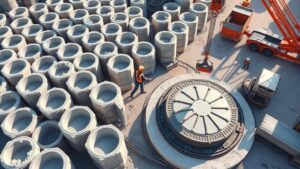
Reinforced concrete bridges are built to last, aiming for a lifespan of 75 to 100 years. To achieve this, high-quality materials and specially formulated concrete mixes are used to boost durability, while careful load distribution helps reduce stress on the structure. Important design features include thick concrete coverings that protect the reinforcement and provisions for easy access during inspections. Regular maintenance, such as routine inspections and timely repairs, plays a crucial role in prolonging the bridge’s service life. Additionally, innovative monitoring methods and corrosion prevention techniques can significantly enhance the longevity of these vital structures.
Key Takeaways
- High-quality concrete mixes and pozzolanic materials improve durability and resistance to environmental factors.
- The design includes thick concrete covers and corrosion-inhibiting additives to protect the reinforcement from degradation.
- Regular maintenance, such as sealing cracks and applying surface treatments, helps to prolong the lifespan of bridges.
- Advanced monitoring technologies offer real-time data on structural health, allowing for early detection of potential issues.
- Effective load distribution and tailored designs address local environmental challenges, enhancing both longevity and performance.
Understanding Service Life Goals for Bridges

When designing a bridge, it’s crucial to understand service life goals to ensure its long-term functionality and safety.
Service life refers to the expected operational period before major maintenance or replacement is needed, typically ranging from 75 to 100 years for new bridges. This expectation highlights the importance of minimising life-cycle costs and aligning design with maintenance strategies.
Clear definitions in project documents help ensure that all stakeholders grasp these goals.
Moreover, incorporating service life considerations from the beginning allows for targeted strategies that address potential deterioration and predict performance under real-world conditions.
The Role of Materials Selection in Durability

Choosing the right materials is crucial for the durability of reinforced concrete bridges, as this directly influences long-term performance and maintenance needs. Opt for high-quality concrete mixes with low water-cement ratios to minimise permeability and boost corrosion resistance. Adding pozzolanic materials like Class F fly ash can enhance concrete uniformity and counteract common durability issues. When it comes to reinforcement, consider options like epoxy-coated steel or stainless steel to significantly slow down corrosion. It’s also important to assess material properties that can withstand freeze-thaw cycles and chemical exposure, ensuring the structure can endure harsh environmental conditions. Incorporating indicators such as reinforcement corrosion potential can further enhance the evaluation of material choices for bridge durability. Additionally, understanding delivery costs can help in budgeting for the materials required for construction.
Key Design Details for Enhanced Longevity
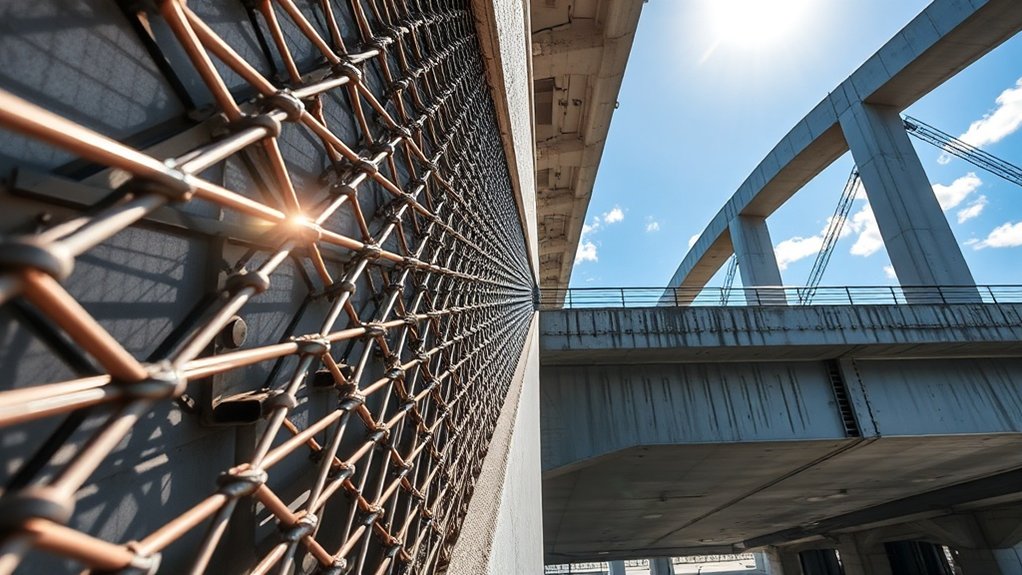
To ensure the longevity of reinforced concrete bridges, it’s crucial to pay attention to key design details. Here are some important aspects to consider:
- Load Distribution: Design the structure to evenly distribute loads, reducing stress concentrations. Incorporate redundant load paths to maintain integrity in case of unexpected loads.
- Corrosion Protection: Utilise thick concrete covers and add corrosion-inhibiting admixtures to protect the reinforcement from environmental damage.
- Maintenance Design: Ensure easy access for inspections and repairs. Use clear documentation and modular components to facilitate straightforward maintenance.
- Environmental Adaptation: Customise concrete mixes to suit local weather conditions and implement protective measures against scour and erosion.
- Innovative Materials: Incorporate advanced monitoring technologies to evaluate the structural health of bridges continuously and ensure long-term durability.
Best Construction Practices for Durability

To ensure durability in reinforced concrete bridges, it’s vital to have a well-thought-out concrete mix design that takes into account local environmental conditions and structural needs. Employing effective construction methods, such as correct placement and curing practices, is crucial for reducing defects and promoting long-term performance. Incorporating Accelerated Bridge Construction techniques can further enhance efficiency and minimize disruptions during the construction process. Additionally, selecting appropriate water-reducing admixtures can significantly lower permeability and improve overall concrete durability.
Proper Concrete Mix Design
Proper concrete mix design is essential for ensuring the durability and longevity of reinforced concrete bridges.
Here are key considerations for an effective mix design:
- Compressive Strength: Aim for a minimum 28-day compressive strength of 27.5 MPa (4,000 psi), especially for structural elements and decks.
- Air-Entrainment: Incorporate 3.5% to 7.0% entrained air to improve freeze-thaw resistance, particularly in regions with harsh winters.
- Water-Cement Ratio: Keep the water-cement ratio below 0.45 to enhance strength and reduce permeability, which is crucial for durability.
- Aggregate Properties: Utilise well-graded coarse aggregates, like 20 mm or 10 mm, to boost density and workability, ensuring a balanced mix that meets quality standards.
Effective Construction Techniques
Effective construction techniques are crucial for ensuring the durability of reinforced concrete bridges. Start by ensuring the specified reinforcement cover is maintained to prevent corrosion.
It’s important to accurately position and secure rebar during concrete placement, and consider using coated or epoxy-coated rebar in areas prone to high risk.
Next, concentrate on concrete consolidation by using low water-cement ratios and appropriate vibration methods to eliminate voids. Continuous concrete placement is key to avoiding cold joints that can compromise strength.
Also, keep an eye on temperature and curing conditions to optimise hydration.
Implement inspection protocols to check the cover and reinforcement arrangements.
Lastly, think about incorporating self-healing concrete or special admixtures to improve impermeability and minimise microcracking.
Following these practices can significantly extend the lifespan of your bridges.
Environmental Factors Influencing Bridge Design

When designing reinforced concrete bridges, several environmental factors significantly affect their performance and lifespan. Key considerations include:
- Temperature Changes: Fluctuations in temperature lead to expansion and contraction, which can cause cracking and structural fatigue over time.
- Chloride Exposure: Chloride ions can penetrate the concrete, increasing the risk of steel corrosion. This necessitates the use of protective measures during construction.
- Pollution: Air and water pollutants can weaken concrete properties, reducing durability. This highlights the importance of choosing sustainable materials to enhance resilience.
- Climate Change: The effects of climate change require adaptation strategies to ensure bridges can withstand evolving environmental conditions.
Maintenance Strategies to Extend Service Life
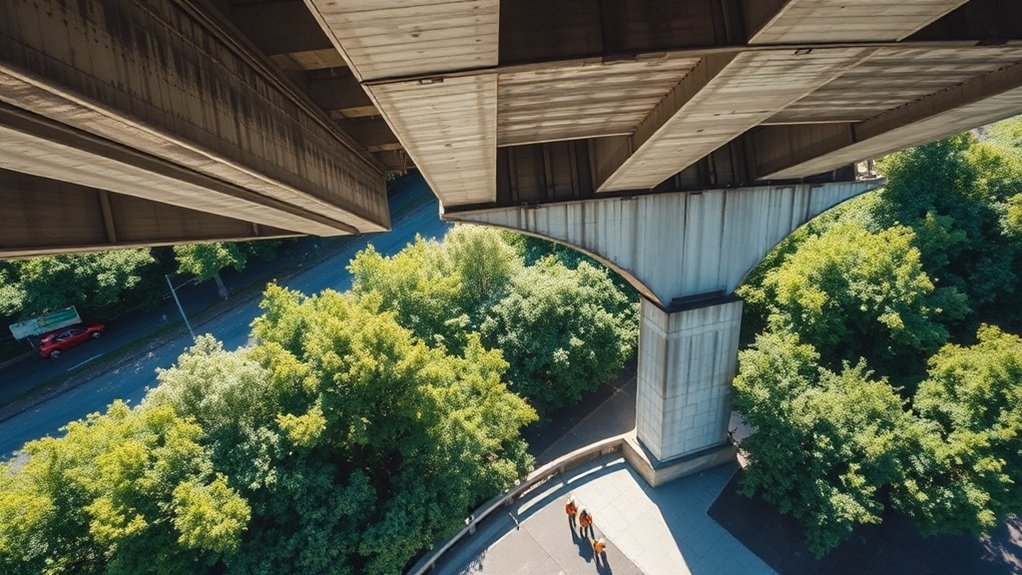
To ensure the longevity of reinforced concrete bridges, it’s crucial to implement effective maintenance strategies. Focus on preventive measures such as crack sealing and surface sealing to guard against moisture intrusion.
Regularly clean the bridge decks and maintain clear drainage systems to minimise corrosion risks. Address any localised defects promptly with repair methods like patching and pressure grouting to restore structural integrity.
Consider applying bridge deck overlays to enhance both longevity and safety. It’s also important to manage traffic during maintenance work to prevent premature damage.
Monitoring Techniques for Structural Integrity

When assessing the structural integrity of reinforced concrete bridges, non-destructive testing methods are essential.
The use of sensor technology allows for real-time monitoring of conditions, enabling prompt action when necessary. By implementing condition monitoring systems, you can effectively observe changes and anticipate potential structural problems before they worsen.
For instance, sensors can detect small cracks or shifts in alignment, providing early warnings that can save time and money on repairs.
Non-Destructive Testing Methods
How can engineers ensure the structural integrity of reinforced concrete bridges without causing damage? They employ non-destructive testing (NDT) methods that provide accurate assessments while preserving the structure.
Here are four key techniques:
- Ground-Penetrating Radar (GPR): This method uses electromagnetic waves to locate rebar and voids, giving insight into the internal conditions of the concrete.
- Impact Echo and Impulse Response Testing: These techniques involve stress waves to efficiently identify delaminations and cracks within the structure.
- Ultrasonic Pulse Velocity (UPV): By sending sound waves through the concrete, engineers can assess internal flaws and material properties.
- Electrical Resistivity and Eddy Currents: These methods measure corrosion potential and help detect cracks in reinforcing steel.
These approaches allow engineers to maintain the safety and reliability of bridges without causing any harm to the structure.
Sensor Technology Applications
As infrastructure demands grow, using sensor technology to monitor the structural integrity of reinforced concrete bridges is vital. Integrating sensors, especially fibre optic systems, allows for embedding them within bridge decks to provide real-time health data. This technology accurately captures strain and deformation over time, enabling continuous monitoring without the need for manual inspections.
Furthermore, accelerometers and laser displacement sensors help detect changes in natural frequencies, alerting us to potential structural issues. The data gathered from these sensors aids in calibrating digital twin models, allowing for proactive risk management.
With wireless data transmission and cloud computing, you can access crucial information remotely, improving your ability to manage aging infrastructure and extend its service life sustainably.
Condition Monitoring Systems
Integrating advanced sensor technology into reinforced concrete bridges enables effective condition monitoring systems that ensure structural integrity.
You can utilise real-time monitoring and data analysis through several techniques, including:
- Visual Inspection: Employ digital imaging to spot surface cracks and spalling.
- Ground-Penetrating Radar (GPR): Identify subsurface defects without damaging the concrete.
- Infrared Thermography: Detect areas of moisture ingress and delamination by observing temperature variations.
- Ultrasonic Methods: Assess internal integrity and locate cracks or delamination.
These systems not only monitor how structures respond under load but also consider environmental conditions, improving maintenance strategies.
Innovative Solutions for Corrosion and Damage Prevention

Corrosion and damage are significant issues for reinforced concrete bridges, but there are effective solutions to enhance their durability and lifespan.
Using epoxy-coated steel bars and galvanised steel can help prevent corrosion, as they provide physical barriers and sacrificial protection. Non-metallic reinforcements, like fibre-reinforced polymer (FRP) bars, completely eliminate the risk of corrosion altogether.
Moreover, employing low permeability concrete, achieved through mineral admixtures, works well alongside protective overlays and sealers to minimise water ingress.
To further combat corrosion, consider implementing cathodic protection systems and electrochemical chloride extraction.
Frequently Asked Questions
What Are the Benefits of Using Corrosion-Resistant Materials in Bridge Construction?
Using corrosion-resistant materials in bridge construction significantly improves durability by preventing corrosion, which helps extend the structure’s lifespan. This careful choice of materials reduces maintenance requirements and lowers overall lifecycle costs. For instance, using stainless steel or galvanised components can save money in the long run compared to traditional materials that may corrode more quickly. Additionally, it enhances safety and reliability, boosting public confidence in infrastructure.
How Do Weather Conditions Affect Concrete Curing During Construction?
Weather conditions significantly influence concrete curing during construction. Temperature changes and humidity impact hydration; high heat accelerates drying, while cold weather can lead to freezing. For example, if it’s too hot, you might need to use curing compounds or shade the concrete to prevent rapid moisture loss. Conversely, in cold conditions, insulation or heated enclosures can help maintain the right temperature for proper curing. Monitoring these factors is essential to ensure strong, durable structures.
What Role Does Soil Composition Play in Bridge Foundation Design?
Soil composition plays a crucial role in bridge foundation design, as it directly affects soil stability. For instance, cohesive soils, like clay, often necessitate deep foundations to ensure adequate support. In contrast, granular soils, such as sand or gravel, typically allow for the use of shallow foundations. Understanding these relationships is essential for achieving the necessary structural integrity and longevity in bridge construction.
Are There Specific Standards for Bridge Design in Seismic Zones?
Have you ever wondered how seismic design affects bridge safety? In the UK, specific bridge standards exist for seismic zones, ensuring that structures are built to withstand seismic forces. This involves thorough analysis and reinforcement tailored to the local risk levels. For example, bridges in areas with higher seismic activity require additional support to ensure they remain safe during an earthquake.
How Often Should Bridges Undergo Inspections for Optimal Longevity?
Bridges should be inspected every 24 months to ensure they remain in good condition. However, it’s important to adjust this frequency based on the bridge’s condition ratings. For instance, if a bridge shows signs of wear or damage, more frequent inspections may be necessary. Incorporating these findings into your maintenance schedule helps guarantee both safety and structural integrity.
Conclusion
When designing reinforced concrete bridges for longevity, consider it similar to planting a tree. Just as a tree needs suitable soil, water, and care to thrive over the years, bridges require careful material selection, precise engineering, and regular maintenance to last. By emphasising durability in every stage—from construction methods to ongoing monitoring—you’re not merely constructing a structure; you’re establishing a lasting connection that can withstand environmental challenges and serve future generations.

Powerful steel reinforcement transforms concrete construction, enhancing strength and durability—discover the remarkable advantages that await in modern applications.

Pre-tensioned reinforced concrete offers unparalleled strength and efficiency, but what are its key benefits and applications in modern construction? Discover Read more

Boost the strength and durability of concrete foundations with rebar and mesh, but discover the key techniques that ensure long-lasting Read more