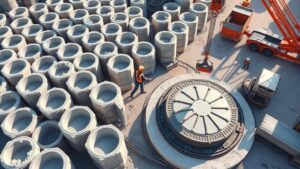
Pre-tensioned reinforced concrete is a construction method where high-strength steel tendons are stretched prior to pouring the concrete. This process significantly improves the strength and efficiency of the structure. It enables longer spans, uses less material, and enhances load-bearing capacity while reducing deflection and the likelihood of cracks. Common applications include bridges, tall buildings, and large industrial spaces. As you delve deeper into this innovative method, you’ll discover its key benefits, material details, and cost implications.
Key Takeaways
Pre-tensioned reinforced concrete employs pre-stretched steel tendons to improve the strength and performance of concrete structures. This technique enhances load-bearing capacity, reduces deflection, and uses less material, making it a cost-effective choice for large-scale projects.
It allows for longer spans without the need for additional support, which promotes architectural flexibility and open floor plans. Common uses include bridge construction, high-rise buildings, and industrial applications, where thinner, lighter slabs can be advantageous.
Although the initial investment may be higher, pre-tensioned concrete often results in long-term savings due to lower maintenance needs and increased durability.
Definition and Process of Pre-Tensioned Reinforced Concrete

Pre-tensioned reinforced concrete uses high-strength steel tendons combined with high-performance concrete to improve structural integrity.
In this method, the tendons are first stretched between supports in a casting bed before any concrete is poured. Once the tendons are in place, fresh concrete is cast around them, allowing it to cure.
As the concrete hardens, it bonds with the tendons, which is crucial for transferring stress. When the concrete reaches the required strength, the tendons are released, compressing the concrete.
This pre-compression counteracts concrete’s naturally weak tensile strength, resulting in a strong structural element that can withstand loads without excessive deflection or cracking. This process of pretensioning before pouring enhances the overall performance of the concrete, making it ideal for large-scale projects.
Key Benefits of Pre-Tensioned Concrete

Pre-tensioned concrete offers notable improvements in structural efficiency and reduced deflection, enhancing overall performance. This method increases load-bearing capacity while using less material, making your designs more cost-effective. For instance, by incorporating pre-tensioned beams in a building, you can achieve longer spans without additional support, which is both economical and visually appealing. Additionally, its durability leads to longer-lasting structures that require less maintenance, ultimately benefiting your projects. Moreover, fewer joints compared to traditional RC structures further reduce maintenance costs. The use of precast concrete beams can also contribute to faster project completion and improved overall efficiency.
Structural Efficiency Improvements
By using pre-tensioned reinforced concrete, you can achieve significant improvements in structural efficiency. This technique enhances load distribution, enabling structures to support heavier weights without sacrificing integrity.
The compressive forces from pre-stressing allow for material optimisation, resulting in thinner sections and less material usage. This not only reduces overall costs but also increases durability, ensuring better performance over time. Additionally, pre-stressed concrete provides superior performance that leads to lower maintenance costs, further enhancing the overall value of the structure. Furthermore, the ability to create longer spans reduces the need for intermediate supports, allowing for more open floor plans and greater architectural flexibility. This method also contributes to enhanced structural performance, making it a preferred choice in modern construction practices.
Reduced Deflection Characteristics
Reduced deflection characteristics in reinforced concrete are crucial for improving structural performance. By using prestressing techniques, we can counter the deflection that occurs under load. For instance, pre-tensioned concrete beams initially curve upwards, known as camber, which helps reduce downward deflection when weight is applied.
The added stiffness from prestressing significantly cuts down deflection compared to non-prestressed beams, thereby ensuring stability. The bond between prestressed steel and concrete maintains structural integrity over time.
Moreover, the design offers flexibility to adjust beam depth and prestress levels, allowing precise control of deflection. Consequently, reduced deflection not only boosts load capacity but also minimises crack formation and enhances the visual appeal of structures.
This makes it an essential consideration for various applications, including high-rise buildings and bridges.
Enhanced Durability Features
Conventional reinforced concrete often struggles with durability issues, but pre-tensioned concrete significantly improves these features, making it a better option for long-lasting structures.
By applying internal compressive stresses, this method reduces the likelihood of cracks, resulting in a watertight and more durable structure. Fewer cracks mean less risk of corrosive agents penetrating, which enhances protection against steel corrosion and extends the lifespan of the material.
Pre-tensioning also boosts load performance, allowing for thinner and lighter sections to support heavier loads without compromising structural integrity.
Additionally, the sustainability benefits of pre-tensioned concrete, such as lower maintenance requirements and greater resistance to environmental damage, highlight its value in modern construction, ensuring longevity and cost-effectiveness for your projects. Furthermore, the incorporation of fiber-reinforced concrete can further enhance the durability and performance of pre-tensioned structures.
Common Applications of Pre-Tensioned Concrete

Pre-tensioned concrete is commonly used in various structural applications due to its strength and durability.
In bridge construction, it allows for long spans, reducing the need for supports and optimising load distribution, which is crucial for meeting height restrictions.
In high-rise buildings, it enables thinner, lighter floor slabs, maximising usable space.
Industrial and warehouse settings benefit from large open areas free of intermediate columns, improving operational efficiency.
Additionally, pre-tensioned concrete is effective for pavements and hardstands, providing resistance to heavy traffic.
It also offers cost-effective solutions for parking structures and sports venues, accommodating dynamic loads and large crowds efficiently.
Materials Used in Pre-Tensioned Concrete Construction

In the construction of pre-tensioned concrete applications, it’s crucial to understand the materials involved. The main materials include high-strength concrete and steel tendons, both essential for maintaining structural integrity. You’ll come across various types of tendons, including steel wires, strands, and bundles, each designed for specific load requirements.
Here’s a summary of the key materials:
| Material Type | Purpose | Characteristics |
|---|---|---|
| High-Strength Concrete | Provides durability and strength | Low permeability and a robust mix |
| Steel Tendons | Prestressing | High strength with various types |
| Formwork | Shape creation | Customisable and reusable |
This combination of materials enhances performance across a range of applications, ensuring the longevity and reliability of pre-tensioned structures.
Techniques for Pre-Tensioning Concrete

Understanding the techniques for pre-tensioning concrete is crucial for optimal structural performance. Key methods include:
- Pre-tensioning Method: This involves tensioning the prestressing steel before the concrete is cast.
- Tendon Anchoring: The tendons are secured to abutments or a stressing bed during the process.
- Tension Application: The tendons are stretched to the required tension prior to casting the concrete.
Once the concrete is poured around the tensioned tendons and hardens, the prestress force is effectively transferred as the tendons are released.
This ensures an even distribution of the prestress force throughout the concrete. Using hydraulic systems for tensioning and ensuring proper tendon alignment are vital for the effectiveness of these techniques, significantly enhancing the structural integrity and performance across various applications.
Ensuring Structural Integrity in Pre-Tensioned Concrete

When ensuring structural integrity in pre-tensioned concrete, it’s important to understand how compressive stresses counteract tensile forces that can cause cracking. This proactive approach boosts load-bearing capacity, allowing for smaller member sizes while still maintaining stability under varying loads.
To ensure this integrity, it’s vital to maintain strict quality control during both the tensioning and curing processes. Implementing thorough inspection protocols can help identify potential problems, such as cracking or tendon corrosion, before they become serious issues.
Non-destructive testing methods, alongside visual inspections, can effectively assess internal stresses and deflections.
Comparison With Other Concrete Methods

When comparing pre-tensioned reinforced concrete to conventional reinforced concrete, you’ll see clear differences in how they handle tensile stress and their overall structural performance.
Furthermore, contrasting pre-tensioned methods with post-tensioned techniques reveals additional insights into efficiency and suitability for different applications.
Recognising these differences will guide you in selecting the right method for your project needs.
Pre-tensioned vs. Reinforced Concrete
Both pre-tensioned and traditional reinforced concrete play vital roles in construction, but their differences significantly influence structural performance and design options. Here are key points to consider:
- Tensile Strength: Pre-tensioned concrete provides greater tensile strength due to internal stresses, which improves its load-bearing capacity.
- Design Flexibility: With pre-tensioned methods, you can create thinner beams and longer spans, making more efficient use of materials.
- Maintenance and Durability: Traditional reinforced concrete may encounter more challenges in terms of maintenance and longevity compared to pre-tensioned alternatives.
These aspects often make pre-tensioned concrete the preferred option for projects that demand strong performance and innovative design.
However, it’s important to consider the higher initial costs and the need for specialised labour against the long-term advantages of better structural integrity and lower maintenance needs.
Pre-tensioned vs. Post-tensioned Concrete
Both pre-tensioned and post-tensioned concrete are essential in modern construction, each with unique characteristics that dictate their use. Pre-tensioned concrete is ideal for precast elements due to its cost-effectiveness and durability. For instance, it’s commonly used in precast beams and panels, which are manufactured in a factory setting and transported as smaller components.
On the other hand, post-tensioned concrete is more adaptable for larger structures, allowing for longer spans without the need for excessive support. This makes it suitable for facilities like bridges and high-rise buildings where flexibility is crucial.
| Feature | Pre-Tensioned Concrete |
|---|---|
| Cost | More affordable |
| Durability | More reliable |
| Construction Method | Factory-based |
| Transport Efficiency | Smaller elements |
| Common Uses | Precast beams, panels |
Ultimately, the choice between pre-tensioning and post-tensioning hinges on the specific project requirements. Pre-tensioning is efficient for smaller components, while post-tensioning provides the flexibility needed for larger, more complex structures.
Structural Efficiency Comparison
The structural efficiency of pre-tensioned concrete offers notable advantages over other concrete methods. Here’s how it enhances performance and design:
- Reduced bending moments: Pre-tensioned concrete can cut bending moments by 44% to 68%, which boosts load-carrying capacity.
- Material optimisation: Thinner sections can use 30-50% less steel without compromising strength, promoting sustainability.
- Improved durability: Better crack control leads to lower maintenance needs and a longer service life.
These innovations facilitate longer spans and creative architectural designs, making pre-tensioned concrete an excellent option for heavy load applications, such as bridges.
Its blend of structural efficiency and sustainability supports more environmentally friendly construction practices.
Cost Considerations for Pre-Tensioned Concrete

When assessing the cost considerations for pre-tensioned concrete, it’s important to note that initial investments can be higher due to the need for specialised equipment and production facilities.
However, labour costs tend to be lower since tensioning is done before pouring. Material costs are generally similar to post-tensioning, with a focus on high-strength steel tendons.
The construction speed of prefabricated elements boosts overall efficiency, which can reduce the cost per unit for larger projects.
Moreover, the durability of pre-tensioned concrete can lead to significant long-term savings by reducing maintenance requirements.
Consequently, pricing strategies should take these factors into account, balancing upfront costs with future economic benefits.
In the end, investing in pre-tensioned concrete can result in better structural performance and lower life-cycle costs.
Frequently Asked Questions
How Long Does the Pre-Tensioning Process Take?
The pre-tensioning process usually takes between 12 to 24 hours, depending on curing conditions such as temperature and humidity. Efficient methods can shorten this timeframe, helping to keep your project on schedule without compromising quality.
What Are the Environmental Impacts of Using Pre-Tensioned Concrete?
Using pre-tensioned concrete significantly lowers your carbon footprint due to its improved material efficiency and durability. However, the energy-intensive manufacturing process can still present environmental challenges. It’s essential to implement effective strategies to minimise these impacts. For instance, sourcing materials locally can reduce transportation emissions and opting for renewable energy in production can further enhance sustainability.
Can Pre-Tensioned Concrete Be Recycled or Reused?
Yes, pre-tensioned concrete can be recycled using various methods. After careful assessment, it can be repurposed in structural components such as beams or used as recycled concrete aggregate in new concrete mixes, which promotes sustainability.
What Maintenance Is Required for Pre-Tensioned Concrete Structures?
Did you know that regular structural inspections can increase the lifespan of pre-tensioned concrete by as much as 30%? To ensure optimal performance and safety, implement preventive measures such as corrosion protection and routine assessments. For instance, regularly checking for signs of wear can help catch issues before they become serious, ultimately saving time and money.
How Does Weather Affect the Curing Process of Pre-Tensioned Concrete?
Weather conditions significantly affect the curing temperature of pre-tensioned concrete. Cold weather can slow down the hydration process, making it difficult for the concrete to gain strength. Conversely, high temperatures can speed up hydration, which may lead to issues like cracking.
It’s essential to monitor these temperature variations to ensure optimal strength development and minimise risks during curing. For instance, if it’s particularly cold, using insulating blankets can help maintain the right temperature. On the other hand, during a heatwave, applying water to keep the surface moist can prevent premature drying. By managing these weather-related factors effectively, you can ensure the longevity and structural integrity of your concrete.
Conclusion
In summary, pre-tensioned reinforced concrete delivers strength, efficiency, flexibility, and durability. By using tensioning techniques, you can create structures that stand the test of time while reducing material usage. This method is ideal for building bridges, car parks, and high-rise buildings, enhancing your construction projects. Adopting pre-tensioning improves structural integrity and optimises performance, ensuring your designs meet modern engineering standards.

Get to know high-strength ready-mix concrete, its remarkable uses, and benefits that could revolutionize your construction projects. What are the Read more

Discover how self-consolidating ready-mix concrete revolutionizes construction with its unique applications and benefits, creating possibilities you won't want to miss.
Mysterious yet essential, lightweight ready-mix concrete offers unique benefits for construction; discover how it can transform your building projects today.