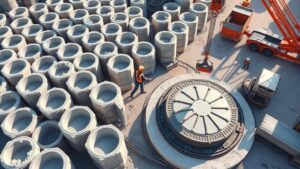
Concrete's versatility includes various types such as plain concrete for foundations, reinforced concrete for added strength, lightweight concrete for insulation, and ready-mix concrete for consistent quality. Asphalt concrete is ideal for road surfaces, while prestressed concrete is used in bridges and tall buildings. High-density concrete serves as effective radiation shielding, air-entrained concrete provides durability against freeze-thaw cycles, and rapid-set concrete is perfect for quick repairs. Each type has specific applications that enhance performance and safety in construction. Explore their unique features and uses further.
Key Takeaways
- Plain concrete is perfect for pavements and foundations due to its high compressive strength and cost-effectiveness, although it has low tensile strength.
- Reinforced concrete, which incorporates steel rebar, is widely used in structures that require enhanced durability and resistance to cracking.
- Lightweight concrete is ideal for projects that need thermal insulation and reduced weight, though it may come with durability concerns and higher costs.
- High-density concrete is crucial for nuclear facilities as it provides radiation shielding and can support heavy loads.
- Precast concrete allows for efficient off-site production, making it suitable for structural components like walls, flooring, and bridge beams.
Plain Concrete

Plain concrete is a fundamental material in construction, made up of cement, aggregates, and water. It boasts high compressive strength but low tensile strength, making it ideal for situations where tensile forces are minimal. Common uses include pavements, foundations, footings, and walls. It serves well as a sub-floor layer and as a damp-proof course to prevent moisture ingress. While it's affordable and straightforward to work with, it has limitations; it can crack under heavy loads and is unsuitable for areas subject to high tension. Being aware of these characteristics helps you make better material choices for your building projects. Additionally, its durability ensures that structures made with plain concrete can withstand various environmental factors over time. The water-cement ratio plays a crucial role in achieving the desired strength and performance of plain concrete, with an ideal ratio of around 0.4.
Reinforced Concrete

Reinforced Concrete
Concrete is well-known for its compressive strength, but it often struggles under tension. This is where reinforced concrete comes into play, combining the best of both worlds by incorporating steel reinforcement, usually in the form of rebar. This combination allows structures to bear significant tensile loads, making reinforced concrete essential in contemporary construction. The synergy between concrete and steel enhances overall structural performance, enabling a wider range of structural stress endurance, which is critical for structural integrity in construction. Additionally, concrete reinforcement enhances crack resistance and load-bearing capacity, contributing to the durability of various applications.
| Component | Role in Reinforced Concrete |
|---|---|
| Cement | Acts as a binder for cohesion |
| Aggregates | Provides bulk and overall strength |
| Water | Crucial for hydration |
| Steel Reinforcement | Effectively manages tensile strain |
| Forms/Moulds | Shapes the concrete during curing |
Innovations such as pre-stressed concrete continue to enhance reinforced concrete, ensuring its durability and versatility for both residential and commercial projects.
Lightweight Concrete

Lightweight concrete is a popular choice in modern construction due to its lower weight and improved thermal insulation. By incorporating lightweight aggregates such as expanded clay, shale, or pumice, it achieves a density of 90 to 115 lb/ft³. This not only reduces the overall weight but also enhances thermal efficiency, making it suitable for energy-conscious designs. Lightweight concrete is classified based on its production method, including lightweight aggregate concrete, which is commonly used in structural applications. Notably, LYTAG Lightweight Concrete is favoured for sustainability and versatility in large projects, reducing weight by up to 50%.
Lightweight concrete can be divided into structural and insulating types, used in applications like beams, foundations, and roof insulation. While it provides benefits such as reduced dead load and increased fire resistance, it's important to consider potential durability issues and higher production costs. Careful selection and handling of materials are crucial to ensure optimal performance in your projects.
Ready-mix Concrete

Ready-mix concrete ensures consistent quality through precise mixing at batching plants, so every batch meets specific requirements.
This method saves time and money by reducing on-site labour and minimising waste.
Its versatility allows for use in everything from structural elements to decorative features, making it ideal for a wide range of construction projects.
Consistent Quality Assurance
To ensure consistent quality in ready-mix concrete, a strong Quality Assurance Framework is vital.
Integrating advanced batching systems can reduce human error and improve consistency. It's crucial to accurately measure and mix cement, aggregates, water, and admixtures while adhering to ASTM and ACI testing standards. Using sensors for real-time monitoring allows for ongoing adjustments to achieve optimal mix performance.
Conducting slump tests helps evaluate workability, while checking air content and temperature enhances durability. Additionally, testing for density and compressive strength assesses the physical properties of the concrete.
Keeping detailed records and traceability of production processes supports continuous quality assessments, helping to pinpoint areas for improvement and ensure all materials meet project specifications.
Time and Cost Efficiency
Using ready-mix concrete can significantly improve time and cost efficiencies in construction projects. It removes the need for on-site mixing, allowing work to commence immediately upon delivery and reducing the need for additional labour.
With better delivery schedules and quicker curing times, projects can finish sooner and with fewer delays.
Moreover, precise batching minimises material waste, supporting sustainability while cutting costs. By eliminating on-site mixing, you also reduce labour and maintenance expenses.
Advanced logistics techniques allow for real-time tracking, ensuring a smooth supply chain and better management of resources.
In short, ready-mix concrete not only speeds up project completion but also helps allocate resources more efficiently.
Versatile Application Uses
The versatility of ready-mix concrete makes it an excellent choice for various construction projects.
It's ideal for residential use, such as foundations, driveways, and garden paths, providing strength and durability.
In commercial settings, it ensures consistent quality, which is crucial for high-traffic areas, while also reducing waste.
Infrastructure projects, like bridges and dams, benefit from its high compressive strength and ability to withstand environmental stresses.
Additionally, ready-mix concrete allows for creative solutions, including custom mixes for decorative elements.
Asphalt Concrete

Asphalt concrete is a popular choice for its cost-effectiveness and durability. This composite material mainly consists of aggregates, bitumen, and mineral fillers, with aggregates making up 90% to 95% of its weight, providing crucial strength and stability. The bitumen acts as a binder, adding flexibility to the mix.
Different types, such as Hot Mix Asphalt (HMA) and Warm Mix Asphalt (WMA), are tailored for various uses, including roads and airport runways. Its capacity to bear heavy loads while remaining durable makes it ideal for high-traffic areas.
Furthermore, its low maintenance requirements and ability to adapt to different weather conditions ensure that asphalt concrete is a reliable choice for numerous construction projects, delivering consistent performance in diverse environments.
Precast Concrete

Precast concrete presents several advantages in construction, such as durability, cost-effectiveness, and energy efficiency.
Its applications range from building frameworks to infrastructure projects, highlighting its versatility.
Recognising these benefits can aid you in choosing the right materials for your next project.
Benefits of Precast Concrete
Precast concrete is a standout choice in construction due to its efficiency and consistent quality. By manufacturing components off-site, projects can start immediately without the delays of on-site curing. This controlled environment ensures uniform standards, reducing variability.
Additionally, precast concrete is environmentally friendly, minimising waste and incorporating recycled materials, which supports contemporary sustainability goals. It also offers great design flexibility, allowing for customisation in various materials, colours, and thicknesses to meet different aesthetic and structural needs.
Moreover, its durability means it requires little maintenance, leading to long-term cost savings. Choosing precast concrete not only boosts performance but also aligns with sustainable building practices.
Common Applications and Uses
In various construction scenarios, precast concrete is highly valued for its versatility and efficiency. It can be used for load-bearing walls to provide crucial structural support.
Precast panels are also excellent for flooring systems, ensuring durability and ease of installation. For rapid assembly with solid structural integrity, precast concrete staircases are a great choice.
In infrastructure, precast concrete is used for bridge beams and sound barriers, enhancing safety and minimising noise pollution.
In agriculture, it's ideal for robust slurry channels and feed troughs, while utility projects benefit from precast components like stormwater management systems.
Prestressed Concrete
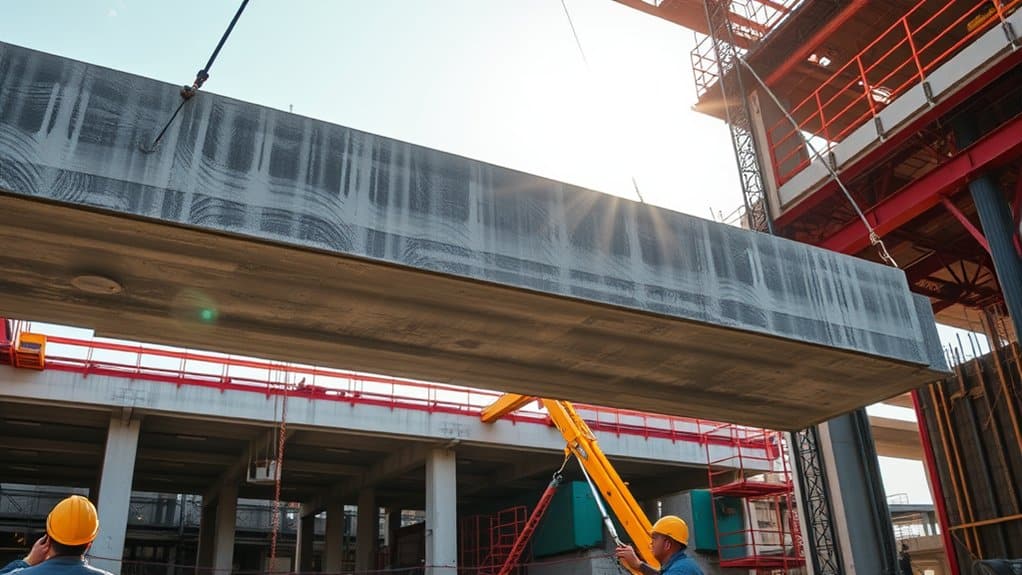
Prestressed concrete is a notable advancement in construction technology, improving the performance of concrete by counteracting tensile forces with pre-applied compressive stresses. This method employs high-strength steel, carbon fibre, and aramid fibres as tendon materials, providing exceptional durability and longevity.
There are two main methods of prestressing: pre-tensioning and post-tensioning. In pre-tensioning, tendons are stressed before the concrete sets, ensuring a strong bond. Conversely, post-tensioning involves stressing the tendons after the concrete has cured, allowing for greater flexibility in structural designs.
This technique is particularly advantageous for long-span structures, such as bridges and tall buildings, due to its efficient use of materials and enhanced structural integrity.
High-Density Concrete

High-density concrete is crucial for effective radiation shielding, especially in settings like nuclear facilities.
Its robust structural properties enable it to bear heavy loads while ensuring stability in demanding situations.
Familiarising yourself with its composition and characteristics will aid in making informed choices for construction projects that require enhanced protection and durability.
Radiation Shielding Applications
While standard concrete may be adequate for many building projects, high-density concrete is exceptional for its radiation shielding properties.
With a density of 6000 to 6400 kg/m³, it significantly reduces radiation exposure, making it ideal for areas with gamma rays and neutrons. This concrete uses aggregates such as iron ore and magnetite to improve its shielding effectiveness.
High-density concrete blocks are also space-efficient, providing strong protection without taking up too much room. Custom options allow for adjustments in density and size, ensuring that specific radiation shielding requirements are met.
In settings like nuclear power stations, high-density concrete is essential for ensuring safety and regulatory compliance.
Structural Strength Characteristics
Concrete's structural strength characteristics make it a vital material in construction, especially high-density variants. High-density concrete provides enhanced performance due to its distinct features:
- Higher Compressive Strength: It surpasses standard concrete in compressive strength, making it suitable for load-bearing applications.
- Increased Durability: The dense aggregate composition boosts durability, enabling it to endure significant structural stresses without substantial wear.
- Better Flexural and Split Tensile Strength: High-density concrete also offers improved flexural and split tensile strength, ensuring stability under dynamic loads.
These qualities make high-density concrete a top choice for critical infrastructure, such as high-rise buildings and foundations for heavy machinery, where compressive strength and durability are essential.
Air Entrained Concrete

Air-entrained concrete is designed to improve durability in freeze-thaw conditions by including tiny air bubbles in the mix. These bubbles act as expansion chambers, relieving the internal pressure that occurs when water freezes.
With an air content of around 5-7%, this type of concrete effectively protects against scaling and cracking, making it ideal for pavements and structures exposed to harsh winter weather.
Additionally, it improves workability by reducing friction between aggregates, which enhances cohesion and overall durability.
However, it's crucial to control the water-cement ratio and monitor air content during mixing to achieve the desired strength.
This concrete is a reliable choice for ensuring longevity in fluctuating temperatures.
Rapid-Set Concrete
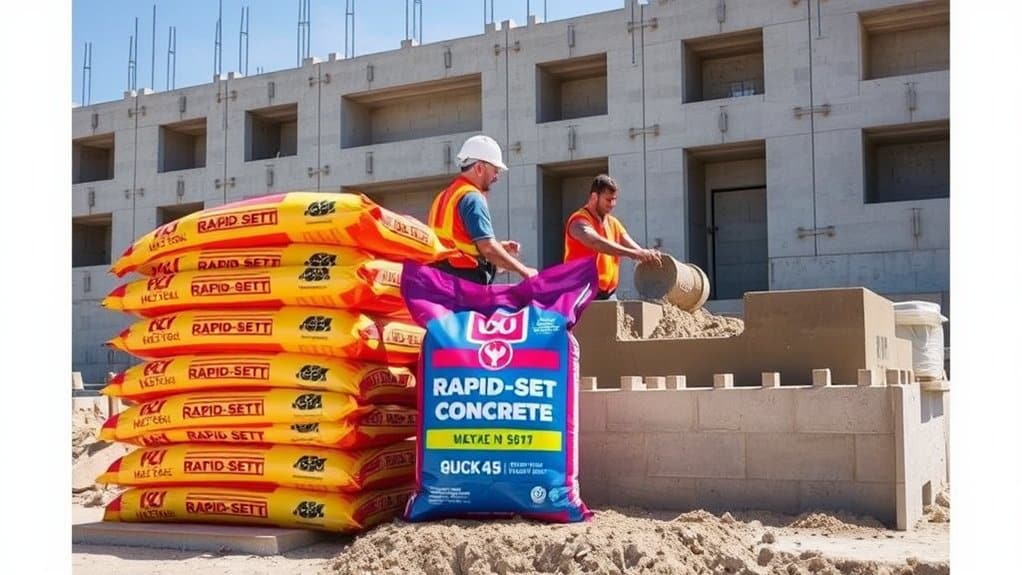
In construction, rapid-set concrete provides an effective solution for projects that require quick completion. Its unique formulation, featuring a higher cement content and specific additives, speeds up hydration and hardens within an hour.
Here are some key benefits and uses:
- Time Efficiency: Gains strength quickly, reducing project delays.
- Versatile Applications: Perfect for infrastructure repairs, overlays, and urgent situations.
- Weather Resilience: Functions well in colder conditions, suitable for year-round use.
With its strength and durability, rapid-set concrete is especially useful for patching and resurfacing, enabling you to carry out essential repairs swiftly.
This makes it an ideal choice when time and reliability are paramount in construction projects.
Frequently Asked Questions
What Is the Lifespan of Different Concrete Types?
The lifespan of different types of concrete can vary significantly, depending on factors such as environmental conditions, maintenance, and the quality of materials used. Ensuring concrete durability is essential for longevity; some types can last over 100 years if maintained properly. For example, reinforced concrete is often used in bridges and buildings due to its strength and durability, while less robust types may be better suited for driveways or garden paths. Prioritising the right type and care can make all the difference.
How Does Weather Affect Concrete Curing?
Weather plays a crucial role in concrete curing. Temperature can either speed up or slow down the curing process, while humidity affects how well the concrete hydrates. For instance, hot weather can lead to rapid evaporation, which may require using curing compounds or covering the surface to retain moisture. On the other hand, cold weather can slow down the curing time, making it essential to insulate the concrete or use additives to encourage proper setting. It's important to adjust your methods based on the weather to ensure the concrete remains strong and durable.
Can Concrete Be Recycled After Use?
Yes, concrete can be recycled after use. The recycling process turns waste into Recycled Concrete Aggregate (RCA), which is useful in various construction projects. This not only reduces the amount of waste sent to landfills but also lessens the environmental impact of producing new materials. For example, RCA can be used in road construction or as a base for new buildings, making it a practical choice for sustainable building practices.
What Are the Costs Associated With Each Concrete Type?
When assessing costs, you'll notice price differences based on your location, materials used, and the size of the project. Key factors affecting costs include labour, reinforcement options, and local material prices, all of which can significantly impact your overall concrete project expenses. For example, using premium aggregates in London may drive up costs compared to using standard materials in a smaller town.
How Do You Choose the Right Concrete for a Project?
Choosing the right concrete is much like selecting the ideal paint; you need to consider strength, sustainability, and additives. Opting for sustainable concrete with appropriate additives can improve performance and longevity, ensuring your project stands the test of time. For instance, if you're working on a driveway, selecting a concrete mix that includes fibres can enhance its durability against cracking.
Conclusion
In summary, knowing the various types of concrete allows you to make better choices for your construction projects. Not all concrete is created equal; for instance, reinforced concrete is essential for supporting high-rise buildings, while lightweight concrete is ideal for creating elegant archways. Each type has its specific purpose, ensuring your structure remains durable and efficient. Choosing the right concrete isn't just about construction; it's about building something that lasts.

Learn about the diverse types of concrete used in construction and discover which mix can transform your next project.

For a long-lasting driveway that laughs in the face of the UK's unpredictable weather, the C20 concrete mix is your Read more

In the UK, you've got a a lot of lightweight concrete types to choose from, each with its unique perks. Read more