The secret to the strongest concrete mix lies in a perfect blend of elements. You’ll need a high-grade cement, a low water-to-cement ratio, and top-quality aggregates. Add some special admixtures like superplasticizers or silica fume, and don’t forget proper curing. For heavy-duty projects, try a C40 mix. Ultra-High-Performance Concrete (UHPC) is an amazing option for projects like bridges and high-rise buildings, offering exceptional strength and durability. It’s not just about the ingredients, though. Proper mixing, placement, and curing make all the difference. Stick around, and you’ll uncover specifics that make concrete virtually indestructible.
Key Takeaways
- Ultra-High Performance Concrete (UHPC) exceeds 120 MPa, offering exceptional strength and durability.
- UHPC utilizes optimized mix elements, including high-quality aggregates, silica fume, and superplasticizers.
- Low water-to-cement ratios improve hydration and strength, essential for high-performance mixes.
- Incorporating fiber reinforcements like steel or synthetic fibers enhances durability and resistance.
- Proper curing techniques, including controlled temperature and moisture, ensure full strength development.
Introduction
Concrete is a mixture of cement, water, sand, and gravel, and it’s essential to design different mixes to achieve various strength levels.
Understanding how to create the strongest concrete is important for building safe and durable structures.
In this article, we’ll explore what affects concrete strength and highlight the most effective mixes to use.
Definition of concrete and its composition
When you’re working on a construction project, understanding that concrete is a composite material made from cement, water, aggregates, and sometimes admixtures, is vital. Cement acts as the binder, holding everything together, while water triggers the hydration process, causing the cement to harden and gain strength. Aggregates, like sand, gravel, or crushed stone, provide bulk and stability. These materials create a mix with various properties based on their proportions and types.
Concrete reinforcement, often using steel bars or mesh, helps the material withstand tension and adds an extra layer of strength. You might be surprised to learn how much the type of aggregate affects the concrete’s final properties. Different aggregate types can change the mixture’s density, durability, and even its appearance.
Understanding the hydration process is also essential. When water and cement mix, they create a chemical reaction that forms a hard matrix, binding the aggregates together. Cement properties play a significant role too; the quality and type of cement influence how strong and durable the concrete becomes. Mixture variations, like adjusting the water-to-cement ratio or adding admixtures, let you tailor the concrete for specific needs, like faster setting times or increased resistance to weather.
Importance of designing concrete mixes for different strengths
Designing concrete mixes for different strengths is essential because it guarantees the material meets the specific demands of various construction projects. You need to take into account several factors to make sure your concrete mix is up to the task. These factors not only impact the strength but also the overall performance and suitability of the mix for its intended environment.
When you design concrete mixes, think about:
- Mix durability: Ensuring your concrete can withstand wear and tear is vital. A durable mix will last longer and require less maintenance.
- Freeze-thaw resistance: If the concrete will be exposed to freezing and thawing cycles, it needs to resist cracking and other damage.
- Environmental impact: Opting for eco-friendly materials and methods can reduce the environmental footprint of your project.
- Cost considerations: Balancing quality and budget is key. High-strength mixes might be more expensive, so you need to weigh the benefits against the costs.
Additionally, you might face workability challenges. Some high-strength mixes can be tough to work with, requiring special techniques or additives.
Purpose of the article: discussing factors affecting concrete strength and identifying the strongest mixes
Understanding the factors that affect concrete strength is essential for identifying the strongest mixes and ensuring your construction project stands the test of time. In this article, we’ll explore the key elements that influence concrete strength so you can make informed choices.
First off, environmental impact is something you can’t ignore. Choosing materials that are eco-friendly not only helps the planet but also can impact the durability and longevity of your concrete.
Cost considerations come next. While you might be tempted to go for the cheapest option, remember that skimping on quality can lead to costly repairs down the line.
Mixing equipment plays an important role, too. The right tools ensure a consistent blend, which is crucial for achieving maximum strength.
Workability challenges are another aspect to think about. A mix that’s too stiff or too runny can cause problems during application, impacting the final strength.
Factors Affecting Concrete Strength

When you’re aiming for strong concrete, several key factors come into play.
You’ll need to take into account the type and amount of cement, the water-to-cement ratio, and the quality and proportions of the aggregates.
Adding the right admixtures and ensuring proper curing conditions also greatly impact the final strength.
Cement type and content
Selecting the appropriate cement type and content is vital for producing strong concrete. Utilizing more cement and choosing high-early-strength cement (Type III) can greatly enhance the concrete’s strength.
Therefore, if you’re striving for a robust mix, pay close attention to these factors to achieve optimal outcomes.
Higher cement content and use of high-early-strength cement (Type III) for increased strength
Boosting concrete strength considerably can be achieved by increasing the cement content and using high-early-strength cement (Type III).
However, you should consider:
- Environmental impact
- Cost analysis
- Workability issues
- Shrinkage control
Though it leads to stronger concrete, it may affect sustainability considerations and increase costs.
Balancing these factors will help you make an informed decision for your project.
Water-to-cement ratio
You might be surprised, but the water-to-cement ratio is super important for concrete strength. Lower ratios, like 0.25 to 0.35, help create stronger concrete because there’s less water to weaken the mixture.
Lower water-to-cement ratios (0.25 to 0.35) for higher strength
A lower water-to-cement ratio, typically between 0.25 and 0.35, directly enhances the strength of concrete. By reducing water, you improve:
- Concrete permeability: Less water means fewer pores.
- Hydration process: More efficient, resulting in stronger bonds.
- Compaction methods: Easier to achieve a dense mix.
- Shrinkage control: Reduces the risk of cracking.
This balance guarantees the best mix consistency.
Aggregate quality and proportions
You can’t overlook the importance of high-quality aggregates in your concrete mix. Strong, well-graded aggregates provide the foundation for robust concrete, and getting the proportions right guarantees maximum strength.
Strong, well-graded aggregates and optimized proportions for strength
High-quality, well-graded aggregates play a significant role in enhancing concrete strength by ensuring ideal particle packing and reduced voids.
To optimize strength, you should focus on:
- Aggregate gradation for better mix consistency
- Strength optimization through balanced proportions
- Cement hydration to improve bonding
- Concrete workability for easier application
Admixtures
When you’re looking to boost concrete strength, admixtures like superplasticizers, silica fume, and fly ash are your best friends. These ingredients help you achieve high strength even with lower water content, which is key for strong, durable concrete.
Superplasticizers, silica fume, fly ash, and others for high strength at low water contents
Incorporating superplasticizers, silica fume, and fly ash into concrete mixes greatly enhances strength while maintaining low water content.
You can use:
- Polycarboxylate superplasticizers for better flow and reduced water.
- Densified silica for added density and strength.
- Fly ash admixtures to improve workability and durability.
- Chemical admixtures and supplementary materials to tailor your mix for ultimate performance.
These ingredients are your secret weapon for robust concrete.
Curing conditions
To make your concrete as strong as possible, you need to focus on the curing conditions. Keep an eye on the moisture levels and temperature, as both are essential for strength development.
If you manage these factors well, you’ll end up with concrete that’s not just strong, but also durable and long-lasting.
Proper moisture and temperature during curing for strength development
Maintaining the appropriate moisture and temperature levels during curing is essential for ensuring the concrete reaches its maximum strength. You need to focus on:
- Moisture retention to keep the mix hydrated.
- Temperature control to avoid extreme conditions.
- Curing duration for proper strength development.
- Various curing methods like wet curing or using curing compounds.
Strongest Standard Concrete Mixes

When you’re looking at the strongest standard concrete mixes, you’ll notice different grades like C20 and C30, each with its own strength.
For heavy-duty applications, C40 stands out as the top choice.
Don’t forget, the way you mix, place, and cure the concrete is just as crucial to guarantee it reaches its full potential.
Concrete grades (C20, C30, etc.) and their corresponding strengths
Concrete grades like C20 and C30 indicate the mix’s strength and suitability for various construction projects. Understanding these grades helps you choose the right mix based on your needs. The numbers in these grades represent the concrete’s compressive strength—how much weight it can bear per square millimeter before it fails. For example, C20 has a compressive strength of 20 MPa, and C30 has 30 MPa.
Concrete grades affect more than just strength. They also influence:
- Concrete durability: Higher grades usually provide better durability, making them ideal for more demanding environments.
- Grade variations: Different projects require different grades. Residential projects might use C20, while commercial projects could need C30 or higher.
- Strength testing: Each grade undergoes rigorous testing to make certain it meets specific standards.
- Mix performance: Higher grades often have better performance characteristics, like reduced permeability and increased resistance to weathering.
C40 as the strongest standard mix for heavy-duty applications
When you’re looking for the strongest standard concrete mix for heavy-duty applications, C40 is your go-to choice.
For this mix, you’d typically use a proportion of 1 part cement, 1.5 parts sand, and 3 parts gravel, with a water-cement ratio of about 0.35.
This combination guarantees the concrete can handle intense loads and maintain durability over time.
Recommended mix proportions for C40 concrete (e.g., 1:1.5:3 cement:sand:gravel, water-cement ratio 0.35)
To achieve the strongest standard concrete mix for heavy-duty applications, use a C40 mix with a 1:1.5:3 ratio of cement, sand, and gravel, along with a water-cement ratio of 0.35.
- Guarantees mix consistency
- Assists in performing a Slump test
- Enhances surface finish
- Prevents workability issues and pumping challenges
You’re set to create a reliable, robust mixture!
Importance of proper mixing, placement, and curing techniques
Guaranteeing the proper mixing, placement, and curing techniques is essential for achieving the strongest standard concrete mixes. Mixing techniques are critical; you need to blend the cement, sand, gravel, and water evenly. If you don’t, the concrete’s strength can be compromised.
Placement challenges come next. You’ve got to move quickly and efficiently to pour the mix into forms before it hardens. Improper placement can lead to weak spots and voids.
Curing methods are just as important. Curing isn’t just letting concrete dry; it’s a controlled process that ensures the mix reaches its full strength. Temperature control and moisture management play big roles here. If it’s too hot, the water can evaporate too quickly, weakening the concrete. If it’s too cold, the mix mightn’t set correctly.
You’ll want to keep the concrete moist by using wet coverings or spraying water on it.
High-Strength Specialty Concrete Mixes
When you’re looking for the toughest concrete around, high-strength specialty mixes like ultra-high-performance concrete (UHPC) are the way to go, boasting strengths over 120 MPa.
You’ll also find other impressive options like reactive powder concrete (RPC) and macro-defect-free (MDF) concrete, which offer unique properties for specific applications.
These mixes might sound fancy, but they’re designed to handle the most demanding construction needs.
Ultra-high-performance concrete (UHPC) with strengths exceeding 120 MPa
Ultra-high-performance concrete (UHPC) achieves its incredible strength through optimized particle packing, high cement content, and the use of silica fume and superplasticizers.
You might see an example mix with proportions like 1:1:1 for cement, sand, and silica fume, paired with a low water-cement ratio of 0.2 and a high-range water reducer.
These elements work together to create a concrete mix that’s not just strong, but ultra-strong.
Optimized particle packing, high cement content, silica fume, and superplasticizers
Achieving ultra-high-performance concrete (UHPC) involves meticulously optimizing particle packing, using high cement content, incorporating silica fume, and adding superplasticizers to exceed strengths of 120 MPa.
You can enhance UHPC with:
- Polymer modifiers
- Curing accelerators
- Air entrainment
- Shrinkage reducers
Adding fiber reinforcements improves durability and toughness, making your concrete mix even more robust.
Example UHPC mix proportions (e.g., 1:1:1 cement:sand:silica fume, water-cement ratio 0.2, high-range water reducer)
What makes a UHPC mix truly exceptional is its precise proportions. For instance, using a 1:1:1 ratio of cement, sand, and silica fume, combined with a water-cement ratio of 0.2 and a high-range water reducer.
You’ll need to take into account cost analysis, environmental impact, and material sourcing.
Proper mixing techniques and quality assurance guarantee you get the best strength and durability.
Other specialty mixes: reactive powder concrete (RPC) and macro-defect-free (MDF) concrete
You’ll be amazed to know that reactive powder concrete (RPC) and macro-defect-free (MDF) concrete can boast strengths over 200 MPa. These specialty mixes push the boundaries of what’s possible, offering incredible durability and performance for demanding projects.
Imagine building structures that can withstand extreme conditions—RPC and MDF make that a reality.
Strengths over 200 MPa
With the advent of high-strength specialty concrete mixes like reactive powder concrete (RPC) and macro-defect-free (MDF) concrete, achieving strengths over 200 MPa is now a tangible reality.
By enhancing:
- Compressive strength
- Tensile strength
- Stress distribution
- Concrete durability
these mixes revolutionize construction.
Understanding fracture mechanics helps too, ensuring that high-stress applications benefit from these advanced materials.
You’re looking at the future of concrete!
Applications of High-Strength Concrete
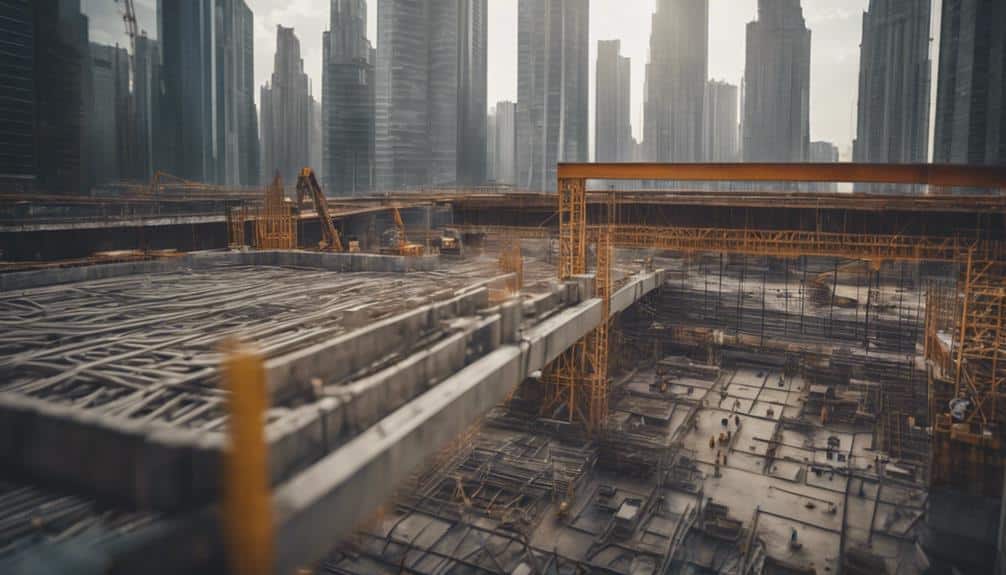
When you think about high-strength concrete, imagine it being used in places where normal concrete just wouldn’t cut it, like skyscrapers and bridges.
C40 and higher-strength mixes are perfect for these demanding structural applications because they offer exceptional durability and strength.
Ultra-High Performance Concrete (UHPC) and other specialty mixes take it a step further, providing unmatched abrasion resistance and longevity for the toughest projects.
C40 and higher-strength concretes in demanding structural applications
When you’re constructing high-rise buildings, bridges, or offshore structures, you need concrete that can handle extreme conditions and heavy loads.
That’s where C40 and higher-strength concretes come in, offering the durability and strength necessary for these demanding applications.
Using the correct mix guarantees your structure stands strong and lasts long, even in the toughest environments.
High-rise buildings, bridges, and offshore structures
High-strength concrete, such as C40 and higher, plays a crucial role in the structural integrity of high-rise buildings, bridges, and offshore structures. It guarantees:
- Load distribution for balanced stability
- Seismic performance to withstand earthquakes
- Material fatigue resistance for long-term durability
- Environmental impact reduction for sustainability
UHPC and specialty mixes for exceptional strength, durability, and abrasion resistance
When you need concrete that’s incredibly strong and durable, UHPC and specialty mixes are your go-to options.
These are perfect for blast-resistant structures and industrial floors because they can handle extreme conditions without cracking or wearing down.
Blast-resistant structures and industrial floors
Engineers and architects are increasingly turning to Ultra-High Performance Concrete (UHPC) and specialty mixes for constructing blast-resistant structures and durable industrial floors. These materials offer:
- Seismic resistance
- Thermal insulation
- Sound attenuation
- Chemical resistance
By utilizing eco-friendly materials, you can achieve exceptional strength, durability, and abrasion resistance.
These innovative concretes guarantee safety and longevity in your structures, making them the go-to choice.
Conclusion

To sum up, producing the strongest concrete mix requires grasping a few key factors. You need to prioritize the right mix design, select high-quality ingredients, and maintain strict quality control.
While C40 is a strong standard mix, specialty mixes like UHPC can enhance strength even more.
Summary of key factors in achieving high-strength concrete
To make the strongest concrete, you need to focus on a few key factors.
Keep the water-cement ratio low, use high-quality aggregates, and guarantee the cement content is high.
Adding the right admixtures and curing the concrete properly will also help you achieve excellent strength.
Low water-cement ratio, high cement content, quality aggregates, admixtures, proper curing
Achieving the strongest concrete mix involves maintaining a low water-cement ratio, using high cement content, selecting quality aggregates, incorporating admixtures, and ensuring proper curing.
Keep an eye on:
- Water content for best cement hydration
- Aggregate shape to enhance bonding
- Proper mixing time for uniformity
- Air entrainment to improve durability
C40 as the strongest standard mix; specialty mixes like UHPC for even higher strengths
While C40 concrete stands as the strongest standard mix, specialty blends like Ultra-High Performance Concrete (UHPC) take strength to an entirely new level. UHPC uses alternative binders and fiber reinforcements to achieve its remarkable durability and performance. This mix isn’t just about strength; it also addresses environmental impact and sustainability considerations. By incorporating materials such as fly ash or slag, UHPC can reduce the carbon footprint associated with traditional cement production.
When you look at UHPC, you’ll notice that it also includes fiber reinforcements, like steel or synthetic fibers, which help increase tensile strength and crack resistance. These fibers make the concrete tougher and more durable, ideal for demanding applications like bridges or high-rise buildings.
However, it’s not all sunshine and rainbows—there’s a cost analysis to take into account. UHPC is considerably more expensive than standard mixes like C40. The specialized materials and manufacturing processes contribute to its higher price tag. But if you’re after the ultimate in strength and longevity, UHPC might be worth the investment.
Importance of proper mix design, ingredient selection, and quality control
Ensuring the best strength and durability of your concrete mix hinges on meticulous mix design, careful ingredient selection, and rigorous quality control. When you’re aiming for the ultimate concrete durability and strength optimization, every detail matters.
First, mix design is your blueprint. It determines the proportions of each ingredient, ensuring they work harmoniously. A well-thought-out mix design can make a world of difference.
Next, ingredient selection is vital. Choose high-quality materials to avoid weaknesses and guarantee your concrete stands the test of time. The right aggregates, cement, and admixtures enhance both strength and workability.
Then, there’s quality control. This step ensures that your mix design and ingredient choices perform as expected. Regular testing and adjustments are key to maintaining consistency and reliability.
Finally, keep in mind:
- Proper water-cement ratio: Too much water can weaken the mix.
- Consistent mixing: Ensures all components are evenly distributed.
- Curing: Properly curing the concrete prevents cracks and enhances strength.
- Environmental considerations: Adjust the mix for temperature and humidity variations.
Frequently Asked Questions
How Does Curing Time Impact Concrete Strength?
Curing time’s vital for concrete strength. You should use moist curing or curing membranes to control the hydration process. Different curing methods help minimize drying shrinkage, ensuring the concrete reaches its full potential strength.
Are There Eco-Friendly Options for High-Strength Concrete Mixes?
You won’t believe it, but eco-friendly high-strength concrete mixes exist! Using recycled materials, green cement, carbon capture, sustainable aggregates, and alternative binders, you can achieve incredible strength while being kind to the planet.
What Additives Can Increase the Strength of Concrete?
You can increase concrete strength by using additives like silica fume, fly ash, steel fibers, polymer additives, and carbon nanotubes. These materials enhance durability, reduce cracking, and improve overall performance, making your concrete mix exceptionally strong.
Can High-Strength Concrete Be Used in Residential Construction?
Did you know high-strength concrete can exceed 20,000 psi? You can use it in residential construction, but consider cost analysis, building regulations, foundation requirements, and structural integrity to make sure it’s the best choice for your application.
How Does Temperature Affect the Curing Process of High-Strength Concrete?
Temperature gradients impact the hydration rates of high-strength concrete, potentially causing thermal cracking. High heat evolution can accelerate curing, while cold temperatures slow it down. Use curing blankets to control temperature and guarantee proper strength development.
Conclusion
So, there you have it! By comprehending the factors that affect concrete strength and exploring various mixes, you’ve tapped into the potential to create some seriously strong concrete.
Whether you’re working with standard or high-strength specialty mixes, the key is in the details. Imagine building a foundation that stands the test of time; now that’s powerful!
So, roll up your sleeves and get mixing—your next project is about to reach new heights.

Looking for reliable ready mix concrete services in Manchester? Visit our homepage for more information.
Related Articles
Looking to order ready-mix concrete in any grade? Barrow Mix supplies every grade from C10 to C40, mixed fresh on-site across Greater Manchester & Cheshire.
Get a free quote →Need concrete mixed & delivered?
Barrow Mix delivers volumetric ready-mix concrete across Greater Manchester & Cheshire — mixed fresh on site, barrowed or pumped to the pour, from as little as ½m³. You only pay for what you use.
Ordering concrete in Greater Manchester or Cheshire? Need a specific strength on your job? See the concrete grades we supply and order the right mix, mixed fresh on site.

Learn about the diverse types of concrete used in construction and discover which mix can transform your next project.

For a long-lasting driveway that laughs in the face of the UK's unpredictable weather, the C20 concrete mix is your Read more

In the UK, you've got a a lot of lightweight concrete types to choose from, each with its unique perks. Read more