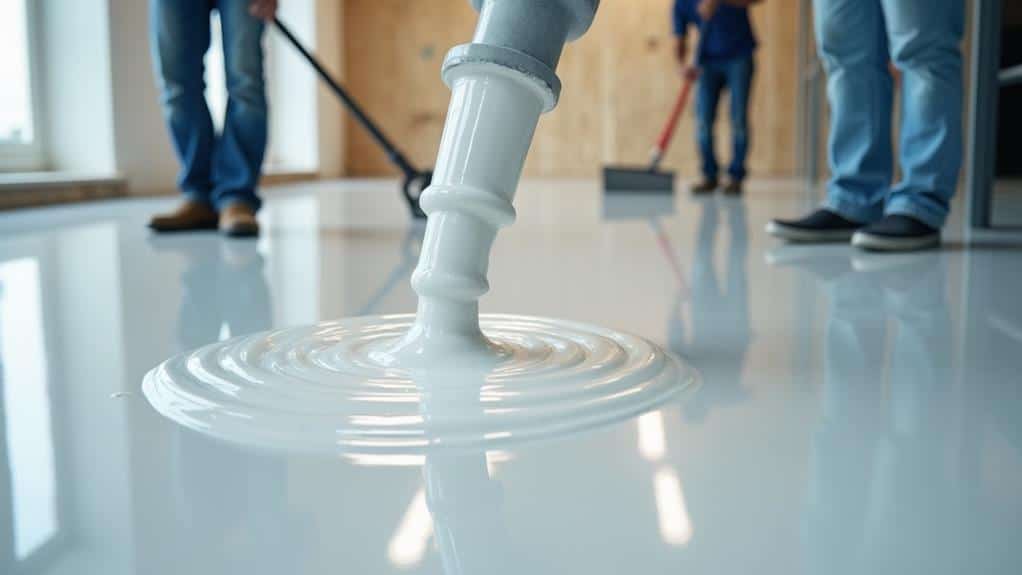
Liquid screed offers numerous advantages over traditional screeding methods.
It provides rapid installation, with coverage of up to 2000m² per day. It's highly compatible with underfloor heating systems, enhancing thermal performance and energy efficiency.
The self-levelling properties guarantee a perfectly flat finish without extensive manual labour, reducing costs and time.
It's versatile, working well with various flooring types, and exhibits minimal shrinkage and cracking.
The thin application depth (as low as 35mm) allows for increased insulation thickness whilst maintaining structural integrity.
These benefits are just the tip of the iceberg when it comes to liquid screed's capabilities.
Key Takeaways
- Rapid installation process allows coverage of up to 2000m² per day, reducing project timelines.
- Enhanced thermal performance improves energy efficiency and optimises underfloor heating systems.
- Self-levelling properties create a perfectly flat finish without extensive manual labour.
- Minimal shrinkage and cracking risk ensures long-lasting, durable flooring solutions.
- Versatile application compatible with various floor types and suitable for both small and large projects.
Rapid Installation Process
In the realm of construction, liquid screed stands out for its rapid installation process. We've observed that this innovative material can be applied up to ten times faster than traditional screeds, revolutionising project timelines. The efficiency stems from advanced installation techniques that require minimal preparation, making it suitable for both small domestic and large-scale industrial projects.
Proper mixing ratios and the use of additives can further enhance the workability and curing speed of liquid screed, contributing to its rapid installation benefits.
We've found that machine application is a key factor in the speed of liquid screed installation. Under ideal conditions, we can cover up to 2000m² per day, a rate that considerably outpaces conventional methods. This rapid coverage is particularly advantageous for large-scale projects where time is of the essence.
What's more, liquid screed achieves walkable strength within 24 hours of application. We can access the site early, reducing project delays and allowing subsequent trades to begin their work sooner.
The self-levelling properties of liquid screed further expedite the process by eliminating the need for extensive finishing work post-installation. This precision in levelling not only saves time but also guarantees a high-quality surface for subsequent flooring applications.
Enhanced Thermal Performance
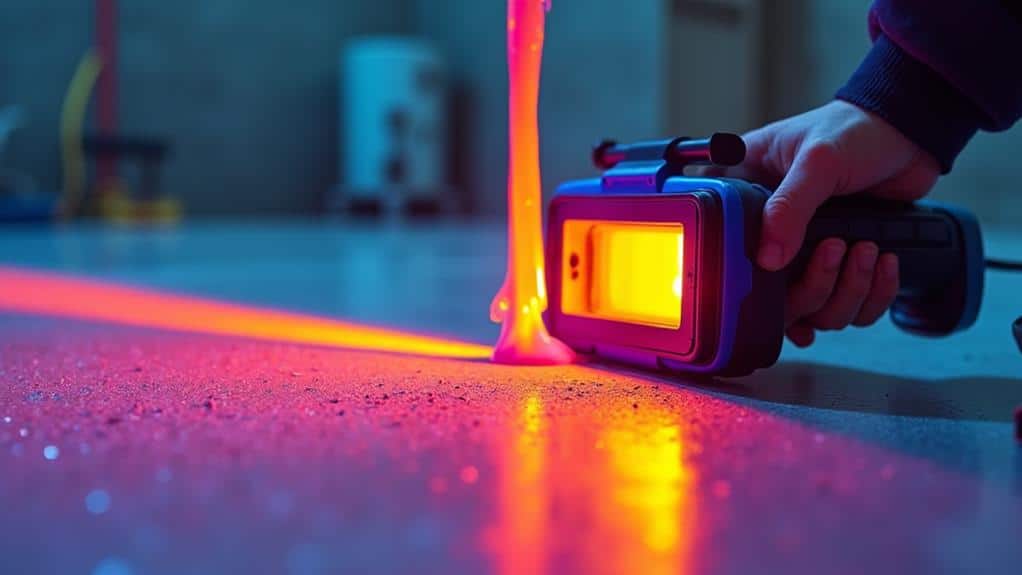
We shall now examine how liquid screed enhances thermal performance through improved heat distribution and energy efficiency.
As green construction innovations gain traction, liquid screed stands out for its environmental benefits. The high thermal conductivity of liquid screed, twice that of traditional screeds, guarantees even heat distribution in underfloor heating systems.
This improved thermal efficiency, coupled with the ability to incorporate thicker floor insulation, leads to significant energy savings and better overall building sustainability.
Improved Heat Distribution
Thermal efficiency stands at the forefront of modern construction priorities, and liquid screed excels in this area.
We've found that its high thermal conductivity, twice that of traditional screeds, guarantees efficient heat transfer, making it ideal for underfloor heating systems. This superior conductivity, coupled with the fluid nature of liquid screed, allows for seamless flow around heating pipes, effectively filling gaps and guaranteeing even heat distribution across the entire floor surface.
Much like the shell concrete innovation designed to mitigate flooding, liquid screed offers a sustainable solution to improve thermal performance in buildings.
We've observed that by minimising air pockets and uneven surfaces, liquid screed enhances the overall thermal efficiency of heating solutions, leading to improved comfort levels in the space.
The reduced thickness of liquid screed applications, which can be as low as 35mm, allows for greater effective insulation beneath, further boosting thermal performance and energy efficiency.
When we properly install liquid screed, it can considerably lower heating bills by maintaining consistent and controlled temperatures throughout the property.
This combination of improved heat distribution and effective insulation results in a more comfortable living environment whilst simultaneously reducing energy consumption, making liquid screed an excellent choice for modern, energy-conscious construction projects.
Energy Efficiency Boost
Boosting energy efficiency stands as a paramount benefit of liquid screed, particularly in its enhanced thermal performance capabilities.
We've observed that its reduced volume allows for decreased screed depth, enabling thicker floor insulation and improving overall thermal efficiency. This increased insulation thickness translates to significant reductions in heating bills, offering long-term energy savings for both residential and commercial properties.
Similar to concrete's thermal mass properties, liquid screed can effectively absorb and disperse heat, further enhancing energy efficiency in homes.
The high thermal conductivity of liquid screed, twice that of traditional screeds, optimises underfloor heating systems by ensuring even heat distribution.
This efficiency boost extends beyond immediate comfort, addressing installation challenges and contributing to sustainability impact.
We've identified four key advantages:
- Reduced energy consumption due to improved insulation
- Enhanced performance of underfloor heating systems
- Quicker drying times, minimising downtime during installation
- Lower risk of flooring issues, leading to sustained energy efficiency
Self-Leveling Properties
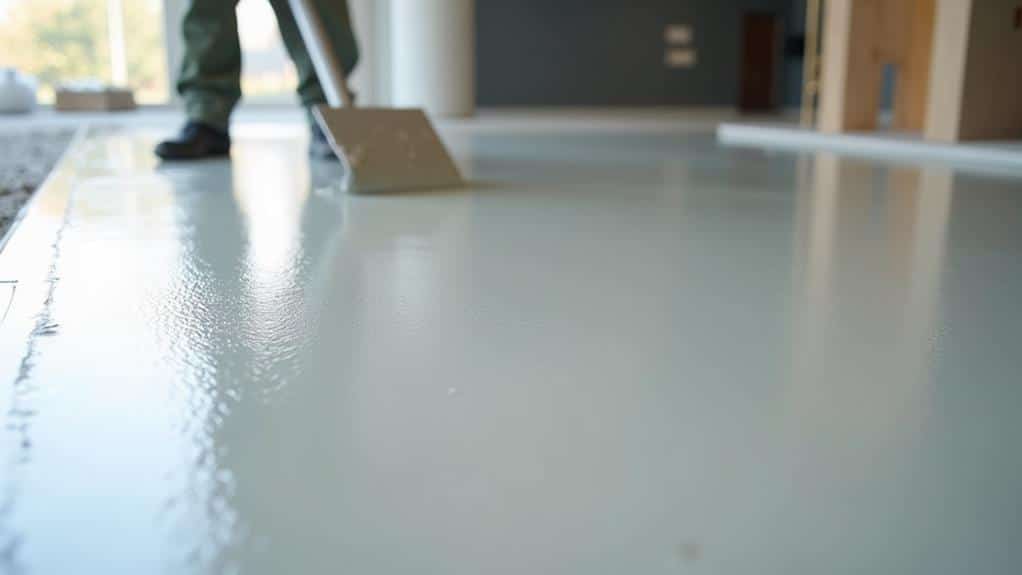
Liquid screed stands out for its remarkable self-levelling properties, which set it apart from traditional flooring solutions. Its unique flow characteristics allow it to spread evenly across surfaces, creating a perfectly flat finish without extensive manual labour. This self-levelling ability minimises the risk of uneven surfaces, an essential factor when installing various flooring types like tiles or carpets.
Similar to polished concrete flooring, liquid screed offers enhanced slip resistance and durability, making it an excellent choice for both residential and commercial applications.
We've found that liquid screed's self-levelling nature considerably reduces the need for additional finishing work, leading to time and cost savings in flooring projects. It can be applied in layers as thin as 35mm whilst still achieving a smooth surface finish across large areas, making it ideal for expansive installations.
By flowing into and filling gaps and imperfections in the subfloor, liquid screed guarantees a solid foundation for subsequent flooring materials.
The self-levelling properties of liquid screed offer multiple advantages in flooring applications. It not only simplifies the installation process but also enhances the overall quality and durability of the final floor.
For professionals seeking mastery in flooring solutions, understanding and utilising liquid screed's self-levelling capabilities can lead to superior results and increased efficiency in projects of all scales.
Reduced Labor Costs
Through its innovative application process, liquid screed dramatically reduces labour costs associated with flooring installation. We can install liquid screed up to 10 times faster than traditional screeds, considerably decreasing on-site labour time and expenses.
This rapid application allows us to cover large areas quickly, optimising workforce utilisation and enhancing cost management strategies. Similar to volumetric lorry delivery, liquid screed offers on-site mixing capabilities, further streamlining the installation process and reducing potential waste.
The self-levelling nature of liquid screed eliminates the need for extensive manual levelling, further reducing labour requirements. We've found that this property, combined with the simplified installation process, minimises preparation work and allows crews to operate more efficiently.
As a result, we can achieve substantial cost savings through workforce optimisation.
Key benefits of liquid screed for labour cost reduction include:
- Faster installation, reducing overall project duration
- Decreased manual labour intensity, lowering workforce needs
- Simplified preparation and application processes
- Enhanced efficiency through self-levelling properties
Compatibility With Underfloor Heating
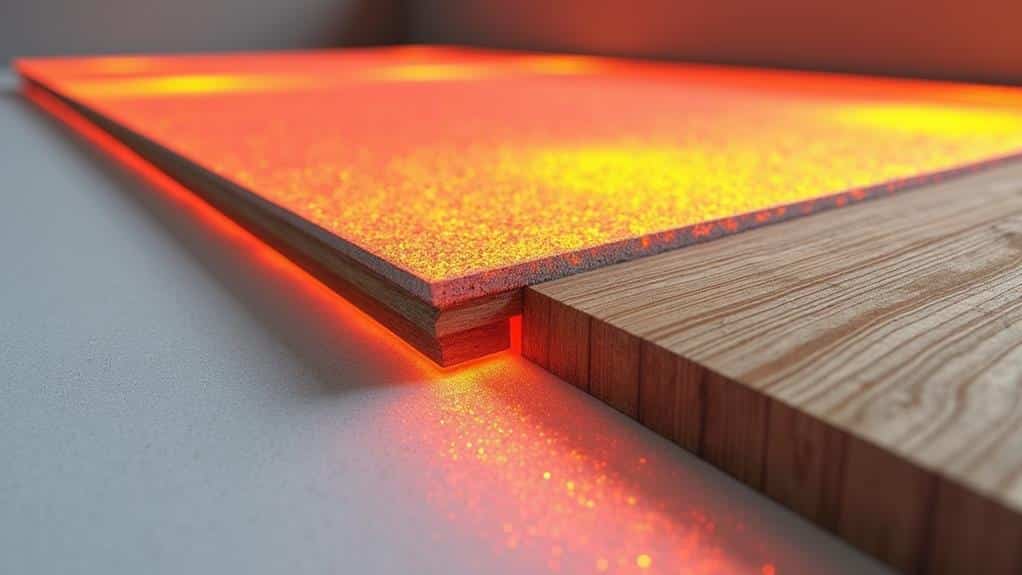
Beyond its cost-saving advantages, liquid screed excels in its compatibility with underfloor heating systems. We've found that its unique properties make it an ideal choice for this application.
The screed's exceptional flow characteristics guarantee complete coverage around underfloor heating pipes, eliminating gaps and optimising heat distribution. Its thermal conductivity, twice that of traditional screeds, greatly enhances the efficiency of these systems. Like innovative concrete technologies, liquid screed contributes to energy efficiency in construction, aligning with sustainable building practices.
We can't overstate the importance of the screed's self-levelling properties. They create a smooth, even surface that promotes effective heat transfer throughout the flooring. This uniformity is essential for maintaining consistent temperatures across the entire space.
When it comes to installation techniques, liquid screed simplifies the process by eliminating the need for additional priming over underfloor heating systems. This streamlined approach not only saves time but also reduces the potential for errors during application.
Maintenance tips for liquid screed with underfloor heating are straightforward. We recommend regular inspections to verify the integrity of the surface remains intact.
The quicker heating response times afforded by properly installed liquid screed translate to improved comfort levels and energy efficiency, making it an excellent choice for modern, high-performance buildings.
Minimal Shrinkage and Cracking
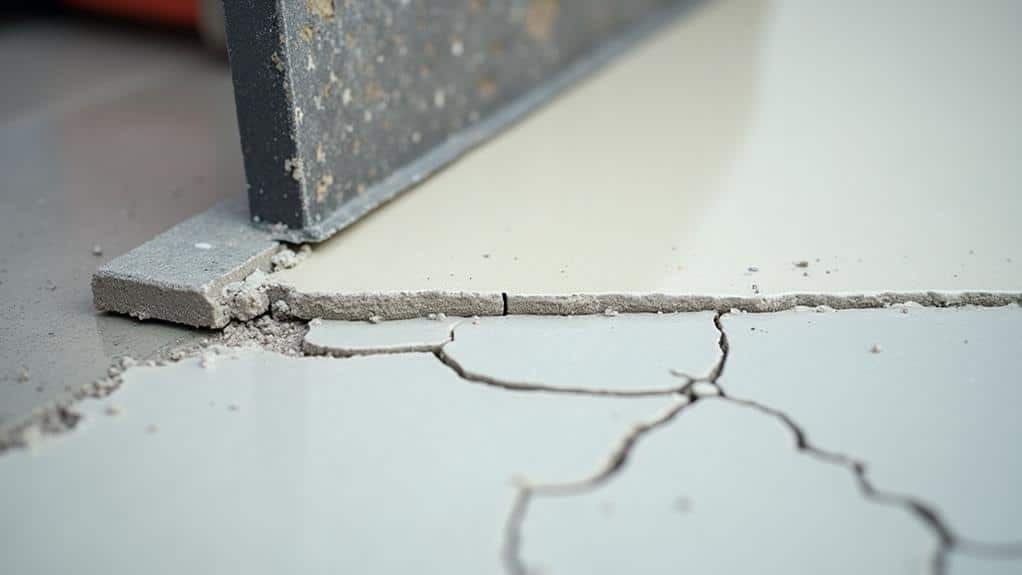
We shall now examine how liquid screed offers reduced thermal expansion and enhanced structural integrity.
Much like the self-healing concrete developed by Drexel University researchers, liquid screed provides innovative solutions for construction durability.
These properties contribute greatly to the minimal shrinkage and cracking characteristics of liquid screed installations.
Reduced Thermal Expansion
Stability is a hallmark of liquid screed when it comes to thermal expansion. Its unique material composition allows for minimal thermal contraction and expansion, guaranteeing a more consistent floor surface over time.
We've found that liquid screed's self-levelling properties contribute greatly to this stability, creating a uniform layer that distributes thermal stresses evenly across the entire floor area. Similar to self-healing concrete, liquid screed offers dynamic properties that enhance its durability and longevity, adapting to environmental stresses over time.
The reduced volume of material required for liquid screed applications, compared to traditional methods, further enhances its resistance to thermal expansion. This thinner application results in less overall material movement, minimising the risk of cracking or warping due to temperature fluctuations.
When paired with underfloor heating systems, liquid screed truly excels. Its compatibility with these systems guarantees:
- Even heat distribution
- Reduced thermal stress points
- Enhanced overall durability
- Improved energy efficiency
Enhanced Structural Integrity
Structural integrity stands as a cornerstone benefit of liquid screed, particularly in its ability to minimise shrinkage and cracking. We've observed that liquid screed's design greatly reduces the risk of cracking compared to traditional screeds. This enhanced stability is due to its self-levelling properties, which guarantee uniform thickness and prevent weak points that could compromise the floor's load-bearing capacity.
The thin application depth of liquid screed, as low as 35mm, effectively reduces weight on structural elements, contributing to overall stability. Furthermore, the use of calcium sulphate enhances durability and resistance to deformation, providing a robust surface that withstands heavy loads without compromising integrity.
| Property | Liquid Screed | Traditional Screed |
|---|---|---|
| Shrinkage | Minimal | Moderate to High |
| Thickness | Uniform | Variable |
| Depth | As low as 35mm | Typically 50mm+ |
| Cracking Risk | Low | Higher |
| Moisture Resistance | High | Moderate |
We've found that the minimal risk of surface cracks in liquid screed leads to longer-lasting flooring solutions. This makes it a reliable choice for both residential and commercial applications where structural integrity and moisture resistance are paramount.
Versatility in Application
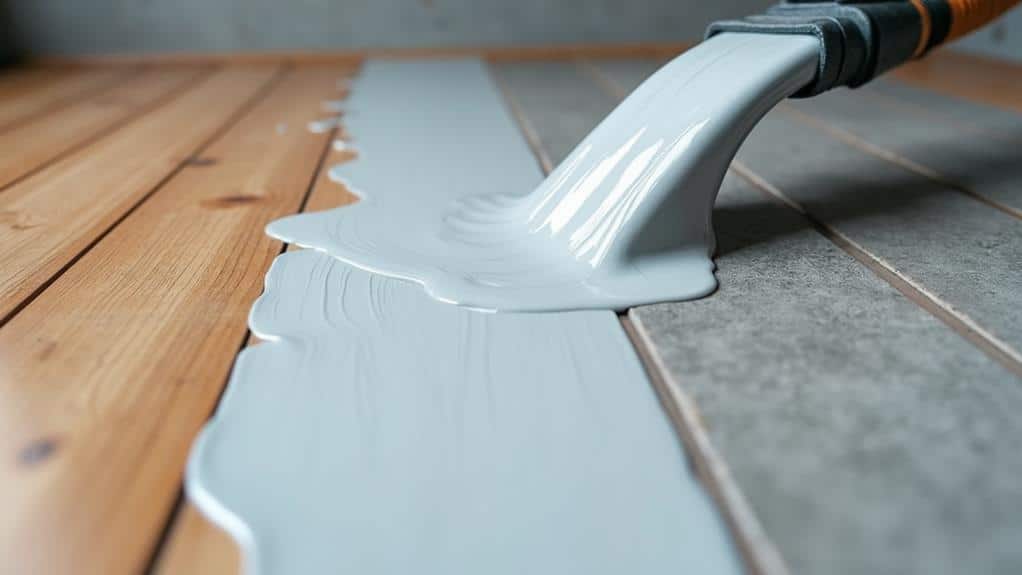
Liquid screed's versatility in application makes it a standout choice for various flooring projects. One can seamlessly apply it over multiple floor types, including wood, carpet, tile, vinyl, and linoleum, accommodating diverse interior design preferences.
Its self-levelling properties guarantee a smooth, even surface, vital for installing any flooring type and enhancing overall aesthetics and functionality. Aesthetic versatility is a key advantage of liquid screed, similar to concrete flooring, as it can be enhanced with various finishes and coatings to achieve desired looks.
This versatile material offers numerous advantages:
- Compatible with underfloor heating systems
- Thin application capabilities (as low as 35mm)
- Fast installation process, covering up to 2000m² per day
- Suitable for both small domestic and extensive industrial applications
Liquid screed is particularly beneficial when working with underfloor heating systems. It effectively fills gaps around heating pipes, guaranteeing efficient heat distribution and peak performance.
The material's thin application capabilities allow for increased insulation thickness beneath the surface, contributing to improved thermal efficiency in buildings.
Moreover, liquid screed's versatility extends to decorative finishes and acoustic properties. Its smooth surface provides an excellent base for various floor coverings, whilst its density can contribute to improved sound insulation.
This adaptability makes liquid screed an ideal choice for projects requiring both aesthetic appeal and technical performance.
Improved Energy Efficiency
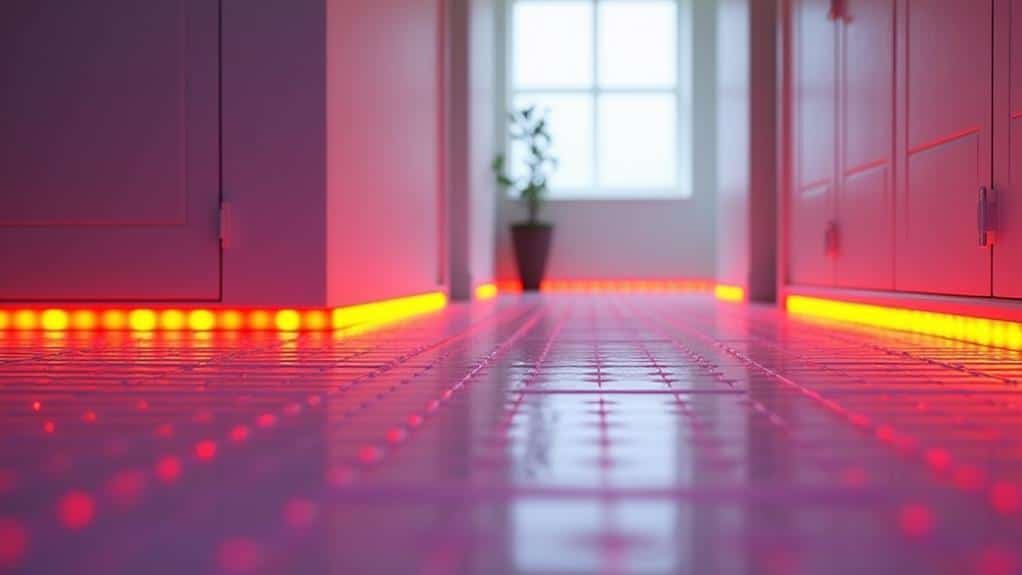
Three key factors contribute to the improved energy efficiency of liquid screed: reduced volume, high thermal conductivity, and compatibility with underfloor heating systems.
The decreased screed depth, resulting from its reduced volume, allows for thicker floor insulation. This enhancement in thermal efficiency leads to lower heating bills and significant energy savings for properties.
Liquid screed's high thermal conductivity, twice that of traditional screeds, optimises underfloor heating system performance. By enabling even heat distribution throughout the floor, it maximises comfort and energy efficiency.
This compatibility with underfloor heating makes liquid screed an ideal choice for those seeking sustainable materials and long-term cost savings.
The reduced screed depth and rapid drying times of liquid screed support quicker project completion.
This efficiency in installation allows for timely integration of energy-efficient flooring solutions, further enhancing the overall sustainability of the building.
Frequently Asked Questions
Why Use Liquid Screed?
We use liquid screed for its superior screed applications and streamlined installation process. It offers faster drying times, improved thermal efficiency, and excellent compatibility with underfloor heating systems. We benefit from its self-levelling properties and reduced labour costs.
What Are the Benefits of Screeding?
As we pour liquid screed, we witness its advantages unfold. We gain faster installation, precise levelling, and improved thermal efficiency. Screeding advantages include enhanced flooring solutions, quicker project completion, and ideal underfloor heating performance for energy-conscious properties.
What Is the Difference Between Dry Screed and Liquid Screed?
We'll find that dry screed and liquid screed differ considerably in their applications and installation techniques. Dry screed requires manual levelling, whilst liquid screed self-levels. Liquid screed's faster installation and thinner application make it increasingly popular for modern construction projects in the UK.
How Long Does It Take for Liquid Screed to Cure?
Typically, we observe liquid screed cure times of approximately 7 days, although walkable strength is achieved within 24 hours. We must carefully monitor moisture levels, as complete drying can vary based on thickness and environmental conditions.
Conclusion
We've explored the numerous advantages of liquid screed, from its rapid installation to its energy efficiency benefits. It's worth noting that liquid screed can be installed at a rate of up to 2,000 square metres per day, considerably outpacing traditional methods. This efficiency, combined with its self-levelling properties and compatibility with underfloor heating, makes liquid screed an increasingly popular choice in modern construction. As we continue to seek innovative solutions, liquid screed stands out as a versatile and high-performing option.

Learn about the diverse types of concrete used in construction and discover which mix can transform your next project.

For a long-lasting driveway that laughs in the face of the UK's unpredictable weather, the C20 concrete mix is your Read more

In the UK, you've got a a lot of lightweight concrete types to choose from, each with its unique perks. Read more