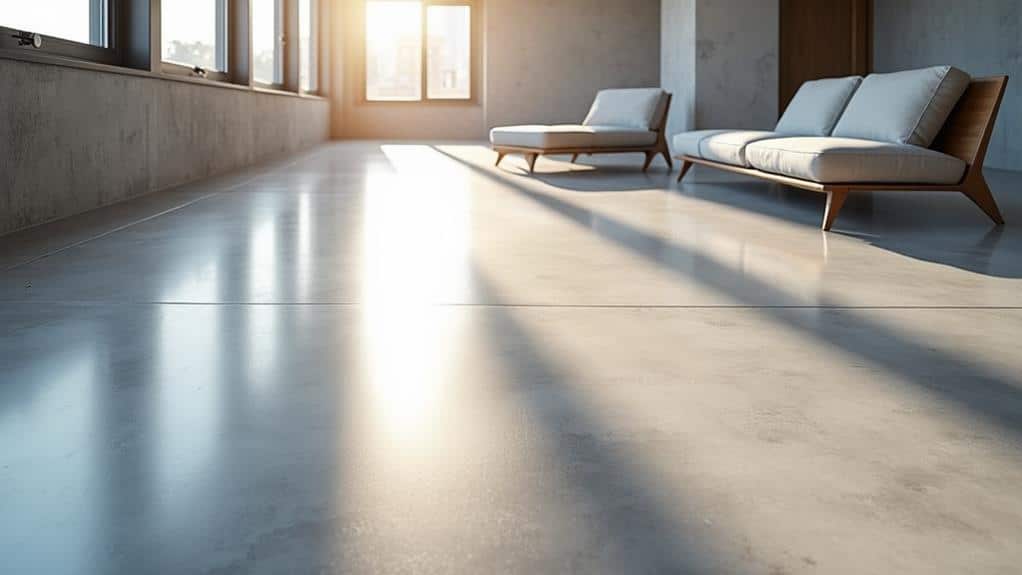
Polished concrete flooring combines durability and aesthetic appeal, achieved through a multi-step grinding process using diamond tools.
It requires a minimum concrete grade of C35 and 100mm thickness, offering a luxurious look similar to granite or marble at lower costs (£130-£160 per m²).
We'll explore its versatility for indoor and outdoor applications, compatibility with underfloor heating, and eco-friendly options.
The installation process involves pouring, curing, and polishing, typically spanning 4-6 weeks.
We'll cover design factors, including colour options, seamless shifts, and control joint placement.
Understanding the full scope of polished concrete flooring will help you make an informed decision for your space.
Key Takeaways
- Polished concrete floors combine durability and aesthetic appeal, achieved through a multi-step grinding process with diamond tools.
- Installation requires a minimum concrete grade of C35, 100mm thickness, and involves pouring, curing, and polishing phases.
- Benefits include low maintenance, compatibility with underfloor heating, and versatility for indoor and outdoor applications.
- Costs range from £130 to £160 per m², offering a luxurious appearance similar to granite or marble at lower prices.
- Design options include various finishes (cream, salt-and-pepper, full grind), colours, and textures, with control joints placed every 5 metres to minimise cracking.
Understanding Polished Concrete Floors
Polished concrete floors represent a sophisticated flooring solution that combines durability with aesthetic appeal. We create these stunning surfaces through a meticulous process involving multiple grinding passes with industrial diamond tools. This technique not only achieves a sleek, reflective finish but also exposes the underlying aggregates, contributing to the floor's unique character.
Diamond abrasives are used in a multi-step process to achieve a high-gloss finish, with initial grinding followed by honing and the application of a concrete densifier.
To guarantee ideal results, we recommend using concrete with a minimum grade of C35 and a thickness of at least 100mm, especially when installing over underfloor heating systems. The final appearance is influenced by the grinding depth and aggregate type, allowing for customisation to suit various aesthetic preferences.
Contrary to polished concrete myths, these floors are remarkably low-maintenance. Regular dust mopping and occasional damp mopping are typically sufficient to maintain their appearance.
We enhance the floor's durability and stain resistance by applying densifiers and sealants post-polishing, extending its lifespan and preserving its aesthetic quality.
Understanding polished concrete maintenance is vital for long-term satisfaction. With proper care, these floors offer an unparalleled combination of functionality and visual appeal, making them an excellent choice for both residential and commercial spaces.
Benefits and Characteristics
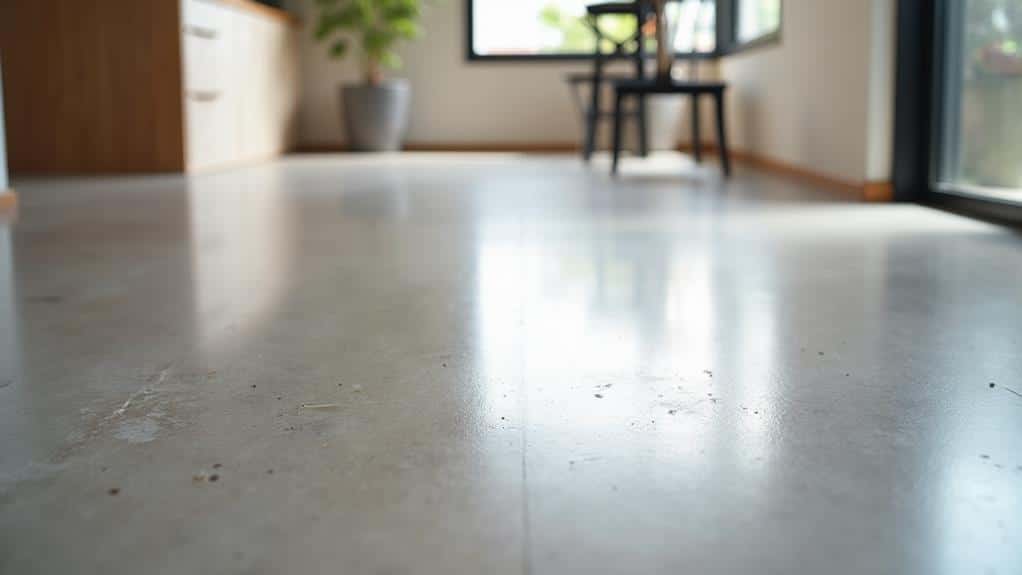
Through their remarkable combination of durability and aesthetics, polished concrete floors offer numerous benefits and distinctive characteristics.
We've found that these floors provide a luxurious appearance similar to granite or marble but at a notably lower cost, ranging from £130 to £160 per m². They're not only cost-effective but also highly versatile, allowing for seamless shifts between indoor and outdoor spaces, making them ideal for areas like kitchens leading to gardens.
Aesthetic versatility is further enhanced with various sealants, stains, polishes, and coatings, allowing for customisation to suit any design preference.
Polished concrete floors boast several key advantages:
- Enhanced safety with non-slip finish options
- Compatibility with underfloor heating systems
- High thermal mass for efficient heat retention
- Eco-friendly options for retrofitting existing concrete floors
We've observed that polished concrete's durability extends its lifespan, reducing the need for frequent replacements.
This characteristic, coupled with its low maintenance requirements, makes it an attractive option for those seeking long-term flooring solutions.
For maintenance tips, we recommend regular sweeping and occasional damp mopping to preserve the floor's appearance.
Additionally, the ability to revitalise existing concrete floors through polishing at approximately £50 per m² offers an appealing and cost-effective option for renovations.
Installation Process and Timeline

The installation process for polished concrete flooring involves several significant steps and requires careful planning and execution. We begin by pouring a mixture of cement, gravel, sand, and water onto a reinforced mesh, guaranteeing a minimum concrete thickness of 100mm for ideal results. Prior to pouring, we install underfloor heating pipes beneath the concrete layer, enhancing heat retention once the floor is finished.
After pouring, we allow for a vital 28-day curing period before commencing the polishing process. During this time, we carefully monitor the concrete to prevent cracks caused by sudden temperature changes—one of the primary installation challenges. Once cured, we perform multiple grinding passes (typically 4-8) using diamond tools to achieve the desired polish, followed by the application of a hardener for the final finish.
| Phase | Duration | Key Activities |
|---|---|---|
| Preparation | 1-2 days | Mesh installation, underfloor heating setup |
| Pouring | 1 day | Concrete mixture application |
| Curing | 28 days | Monitoring, temperature control |
| Polishing | 3-5 days | Multiple grinding passes, hardener application |
To promote longevity and maintain the floor's appearance, we recommend implementing regular maintenance tips, including proper cleaning techniques and periodic resealing.
Ideal Locations and Applications

Versatile and durable, polished concrete flooring finds its ideal applications across a wide range of settings. In commercial environments, it's particularly well-suited for high-traffic areas like retail spaces and warehouses. Its resistance to wear from constant foot traffic makes it an excellent choice for these demanding locations. The slip resistance benefits of polished concrete, which offers 20-50% higher slip resistance than national standards, further enhance its suitability for commercial spaces.
For residential applications, polished concrete offers seamless shifts between indoor and outdoor spaces, making it perfect for kitchens that open to gardens. We've found it's also an excellent option for cellar conversions and renovations, as existing concrete floors in good condition can be retrofitted with polished finishes.
Polished concrete flooring excels in the following scenarios:
- New builds or extensions, where concrete can be poured to guarantee proper weight support and level surfaces
- Environments with underfloor heating, capitalising on its high thermal mass for enhanced heat retention and energy efficiency
- Retail spaces requiring a durable, low-maintenance flooring solution
- Modern homes seeking a sleek, contemporary aesthetic
In both commercial and residential settings, polished concrete's adaptability shines. Its ability to withstand heavy use whilst maintaining its appearance makes it an ideal choice for those seeking a long-lasting, visually appealing flooring option.
Design Factors to Consider

When considering polished concrete flooring, we shall examine essential design factors that impact the final result.
We shall explore the range of colour and texture options available, from standard shades to custom bespoke colours, and discuss how to achieve seamless indoor-outdoor shifts for a cohesive aesthetic.
Smooth trowelled finishes provide an excellent base for polishing, offering a flat, even surface that's highly resistant to weathering and abrasion.
The polishing process involves multiple steps using diamond abrasives to achieve a high-gloss finish, resulting in a durable and low-maintenance flooring option.
We shall also address the strategic placement of control joints every 5 metres to minimise unsightly cracks and guarantee structural integrity.
Color and Texture Options
Selecting colour and texture options for polished concrete flooring opens up a world of design possibilities. We offer 15 standard colours, ranging from Off-White to Black, with custom bespoke options available to meet specific design preferences. The colour is applied and power floated, creating a mottled, textured appearance that complements various interior styles.
Exposed aggregate floors can provide a modern speckled appearance similar to traditional terrazzo flooring, enhancing visual depth and texture. This versatility allows for seamless integration with various flooring styles, creating distinct zones within a space.
Our grinding and polishing process can expose aggregate, resulting in distinct finishes:
- Cream: Minimal aggregate exposure
- Salt-and-Pepper: Moderate aggregate visibility
- Full Grind: Maximum aggregate exposure
- Custom: Tailored to client specifications
These texture effects, combined with current colour trends, allow for unique aesthetic outcomes. We strategically place crack control joints every 5 metres, serving both functional and design purposes by introducing subtle lines in the flooring.
The final appearance is further enhanced by multiple finish options, including matt, satin, or gloss. The depth of polishing determines the gloss level, enabling us to achieve the desired look and functionality.
Seamless Indoor-Outdoor Transitions
Bridging the gap between indoor and outdoor spaces, polished concrete flooring offers a seamless shift that enhances both aesthetics and functionality.
We'll explore key design factors to evaluate when implementing this versatile material for indoor-outdoor transitions.
Utilising polished concrete for both interior and exterior surfaces creates visual cohesion whilst simplifying design complexities.
This continuity serves as a powerful design inspiration, allowing for a fluid spatial experience.
The high durability of polished concrete makes it ideal for high-traffic areas, ensuring longevity in both indoor and outdoor settings.
When planning transitions, we must account for structural integrity.
Strategic placement of control joints every 5 metres is vital to minimise cracking, particularly in areas exposed to varying weather conditions.
This maintenance tip is essential for preserving the seamless aesthetic over time.
Compatibility with underfloor heating systems is another advantage, enabling consistent temperature control across indoor and outdoor spaces.
This feature enhances comfort and usability year-round.
Control Joint Placement
Control joints serve as the invisible guardians of polished concrete flooring integrity. When we design polished concrete floors, we must strategically place these joints every 5 metres to minimise cracking by creating predetermined weak points. This careful planning allows for controlled crack formation, preserving the floor's aesthetic appeal.
To guarantee effective crack control, we cut joints into the concrete slab during installation. These cuts should reach a depth of at least 25% of the slab thickness, effectively reducing tensile stress and preventing surface cracking. By guiding potential cracks along these predetermined lines, we maintain the floor's visual integrity.
Consider these vital factors when planning control joint placement:
- Joint spacing: Adhere to the 5-metre rule for ideal crack prevention
- Depth consistency: Maintain a minimum depth of 25% of slab thickness
- Visual impact: Integrate joint patterns into the overall floor design
- Timing: Cut joints during installation for maximum effectiveness
We emphasise the importance of addressing control joint placement during the design phase. Their location and appearance greatly impact the overall visual design of the polished concrete floor.
Alternatives and Budget Considerations
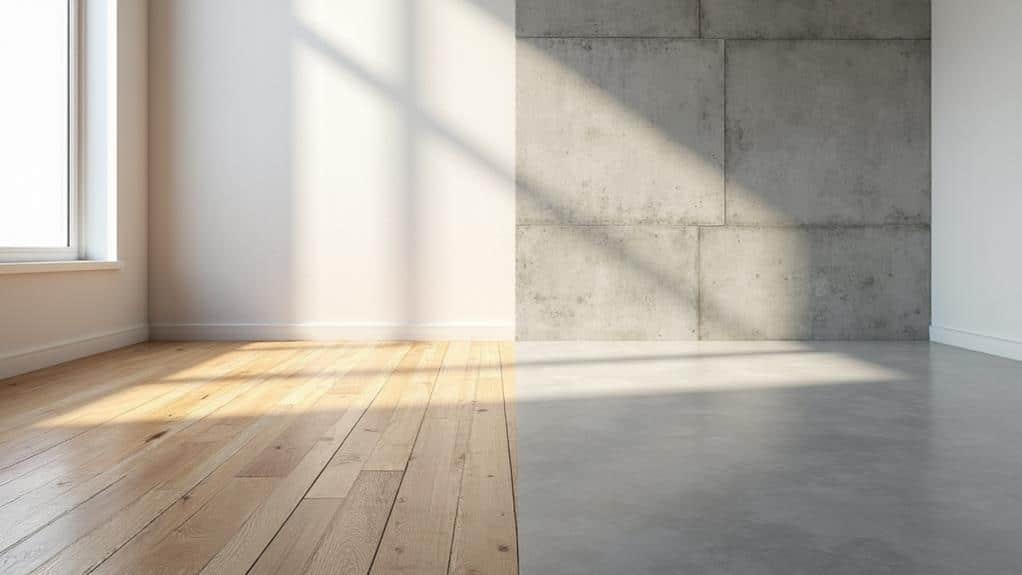
We shall explore cost-effective alternatives to polished concrete that can replicate its aesthetic appeal.
Large-format tiles, vinyl flooring and microcement offer similar looks at varying price points, with options starting from £18 per m².
When considering these alternatives, we shall factor in long-term maintenance costs to provide a thorough budget analysis for your flooring project.
Cost-Effective Concrete Alternatives
Several cost-effective alternatives can mimic the sleek appearance of polished concrete flooring whilst offering potential budget savings.
When considering budget-friendly options, large-format tiles emerge as a viable solution, with costs ranging from £18 to £100+ per m² depending on size and quality. These tiles effectively replicate the polished concrete aesthetic, providing a cost-effective alternative for discerning property owners.
For those seeking the ultimate in affordability, vinyl flooring presents an attractive option. This versatile material convincingly emulates the look of polished concrete at a fraction of the cost.
Microcement, another contemporary choice, offers a seamless, waterproof finish that closely resembles polished concrete, striking a balance between aesthetics and economy.
When conducting flooring comparisons, consider these alternatives:
- Large-format tiles: £18-£100+ per m²
- Vinyl flooring: Budget-friendly option
- Microcement: Seamless, waterproof finish
- Porcelain and non-slip ceramic tiles: Durable for high-traffic areas
Whilst polished concrete installation typically costs between £40 and £80 per m², exploring these alternatives can yield substantial savings without compromising on style or durability.
Each option presents unique advantages, allowing for tailored solutions that meet both aesthetic preferences and budgetary constraints.
Replicating Polished Concrete Look
Seeking to replicate the polished concrete look without the associated costs, homeowners and designers can explore a range of alternatives that offer comparable aesthetics and potential budget savings.
Large-format tiles emerge as a prime option, effectively mimicking polished concrete's reflective surfaces with costs ranging from £18 to £100+ per m². For those prioritising affordability, vinyl flooring presents a budget-friendly solution, delivering similar visual appeal whilst considerably reducing expenses.
Microcement stands out as a versatile alternative, providing a seamless, waterproof finish that closely resembles polished concrete. Starting at approximately £80 per m², it offers a balance between cost-effectiveness and authentic appearance.
In high-traffic areas, porcelain and non-slip ceramic tiles prove ideal, combining durability with the desired polished concrete aesthetic.
When evaluating these alternatives, we must consider long-term maintenance costs. Whilst initial expenses may be lower, some options might require more frequent replacements or repairs compared to polished concrete.
By carefully weighing the upfront costs against potential future expenditures, we can make informed decisions that align with both aesthetic preferences and budget constraints.
Each alternative presents unique textured finishes and reflective qualities, allowing for customised solutions that cater to specific project requirements.
Long-Term Budget Considerations
Evaluating long-term budget considerations is essential when weighing polished concrete against its alternatives. While initial installation costs for polished concrete range from £40 to £80 per square metre, we must factor in ongoing maintenance strategies to preserve its appearance and durability. Regular sealing and cleaning are necessary, potentially increasing long-term expenses.
When comparing alternatives, consider:
- Microcement: Starting at £80+ per square metre, offers a seamless finish with potentially lower maintenance costs
- Large-format tiles: £18 to £100+ per square metre, varying maintenance requirements
- Vinyl flooring: Budget-friendly option replicating concrete's look, with different upkeep needs
- Structural support: Polished concrete's weight (200kg/m²) may necessitate additional reinforcement
We must assess these factors alongside initial costs to make an informed decision. For instance, whilst vinyl flooring may seem cost-effective upfront, its lifespan and replacement frequency could impact long-term budgets.
Similarly, the potential need for structural support with polished concrete should be factored into renovation plans. By thoroughly examining maintenance strategies, structural requirements, and lifecycle costs of each option, we can determine the most cost-effective flooring solution for our specific needs and budget constraints.
Frequently Asked Questions
Can Polished Concrete Floors Be Installed Over Existing Tile or Hardwood?
We can install polished concrete over existing tile or hardwood, but it's a rather complex process. Proper surface preparation is absolutely essential. We'll need to assess the condition of the substrate and utilise specific installation methods to ensure adhesion and durability for a successful outcome. It's important to bear in mind that this type of work requires considerable expertise and specialised equipment to achieve the desired results for British homes and businesses.
How Long Does It Take for Newly Polished Concrete to Fully Cure?
We typically see newly polished concrete fully cure in 28 days under ideal conditions. However, the curing process can extend to 90 days depending on environmental factors. We recommend avoiding heavy traffic and maintaining consistent temperature and humidity throughout. It's worth noting that whilst the concrete may appear dry and hard after a few days, the internal chemical reactions continue for some time. For best results, consult with your local concrete specialist to ensure proper curing for the specific climate and conditions in your area of the UK.
Are Polished Concrete Floors Suitable for Homes With Pets?
We're chuffed to bits to say polished concrete floors are a pet owner's dream! They're indestructible against claws. Durability concerns? Nonexistent. For maintenance tips, we recommend regular sweeping and the odd damp mopping to keep your floors spick and span. They're truly a masterclass in pet-friendly flooring.
Can Cracks in Existing Concrete Be Repaired Before Polishing?
We can repair cracks before polishing, but it's vital to perform a thorough crack assessment first. We'll employ specific repair techniques based on crack type and severity, ensuring a seamless finish. It's essential for achieving ideal polishing results.
Is It Possible to Change the Color of Polished Concrete Later?
Did you know 85% of homeowners prefer customisable flooring? We can change polished concrete colour later through colour staining or dye application. These techniques penetrate the concrete's surface, allowing for precise, long-lasting colour alterations that meet exacting standards.
Conclusion
As we've explored polished concrete flooring, we've coincidentally discovered its versatility and durability. We've detailed the intricate installation process, best applications and design considerations. We've analysed the benefits, from low maintenance to aesthetic appeal. Whilst alternatives exist, we've found polished concrete offers a unique blend of functionality and style. We've provided the technical knowledge needed to make an informed decision, ensuring you're equipped to choose the ideal flooring solution for your specific needs.

Learn about the diverse types of concrete used in construction and discover which mix can transform your next project.

For a long-lasting driveway that laughs in the face of the UK's unpredictable weather, the C20 concrete mix is your Read more

In the UK, you've got a a lot of lightweight concrete types to choose from, each with its unique perks. Read more