Water-reducing admixtures are vital in concrete mixes, allowing for a reduction in water content while improving workability and strength. These additives enhance hydration, lower internal friction, and help maintain a consistent mix, resulting in greater durability and reduced permeability. They are especially useful in high-strength concrete, large-scale projects, and difficult conditions. By using these admixtures, you can optimise both performance and cost. If you’re interested in their mechanisms and future uses, further exploration is recommended.
Key Takeaways
- Water-reducing admixtures optimise the water-cement ratio, improving strength and durability in concrete mixes.
- They enhance workability, making it easier to handle and place concrete in reinforced structures.
- These admixtures decrease porosity, resulting in better resistance to environmental factors.
- Adhering to standards such as ASTM C494 ensures the quality and performance of these admixtures in concrete.
- Future trends are leaning towards sustainable practices and innovations, including high-range and shrinkage-reducing admixtures for more eco-friendly solutions.
Types of Water-Reducing Admixtures

There are various types of water-reducing admixtures (WRAs) used in concrete mixes, each tailored for specific performance outcomes.
- Conventional WRAs (Type A) reduce water content by 5-12%, improving workability without compromising strength. For instance, if you’re pouring a slab in a residential project, this could make the job easier without risking durability. Additionally, water reduction helps achieve a lower water-cement ratio, which is crucial for enhancing the concrete’s overall strength.
- Mid-Range WRAs achieve similar reductions and are perfect for moderate applications, such as driveways or pavements that require a balance of ease of use and strength.
- High-Range WRAs, also known as superplasticisers (Types F/G), allow for substantial water reduction of 12-30%, significantly enhancing flowability. This is particularly useful in complex placements, like intricate designs or densely reinforced structures.
- Types D and E offer unique benefits: Type D combines water reduction with a longer set time, useful for larger projects where workability is key, while Type E speeds up the setting process, beneficial in colder conditions or when fast turnaround is needed.
Understanding these classifications helps you choose the right admixture to optimise concrete performance and meet specific construction needs.
Benefits of Water-Reducing Admixtures

When you add water-reducing admixtures (WRAs) to your concrete mixes, you’ll benefit from several key advantages that improve performance and efficiency.
These admixtures enhance concrete properties, including:
- Increased Strength: A lower water-cement ratio leads to stronger, more durable concrete.
- Improved Workability: Enhanced flow makes handling easier, especially in reinforced structures. Additionally, these admixtures significantly enhance workability and performance, ensuring smoother placement.
- Greater Durability: Lower permeability and porosity boost resistance to environmental factors. By lowering the water-cementitious ratio, WRAs contribute to the overall strength and longevity of the concrete.
By using WRAs, you can produce concrete more cost-effectively.
They help optimise cement content without compromising strength, which results in longer-lasting structures and a reduced environmental footprint.
Applications of Water-Reducing Admixtures

Water-reducing admixtures play a crucial role in producing high-strength concrete and meeting the demands of mass concrete applications. They’re particularly useful in challenging placement conditions, as they help maintain consistent workability and performance. Additionally, these admixtures are essential for reducing water content, which enhances the overall durability and strength of the concrete.
High-Strength Concrete Production
In high-strength concrete production, water-reducing admixtures are essential for boosting the performance and durability of concrete mixes.
These additives help optimise the mix design, enabling you to achieve higher compressive strengths while preserving workability.
- Improved Durability: By using lower water-to-cement ratios, you reduce permeability, which enhances resistance to environmental factors such as freeze-thaw cycles and chemical attacks.
- Enhanced Workability: Water-reducing admixtures make handling and placement easier without sacrificing strength.
- Increased Strength: Maintaining ideal ratios allows these admixtures to provide superior mechanical properties.
Utilising water-reducing admixtures in high-strength concrete not only strengthens structural integrity but also promotes sustainable construction by minimising water and cement usage, while improving labour efficiency. Additionally, these admixtures contribute to lower permeability, protecting reinforcing steel from rust and enhancing the longevity of concrete structures.
Mass Concrete Applications
Mass concrete applications greatly benefit from water-reducing admixtures, which enhance performance and efficiency.
These admixtures lower the heat of hydration, helping to prevent thermal cracking—a common issue in mass concrete. By reducing the water-cement ratio, they improve durability and decrease permeability, offering better protection against environmental factors.
Enhanced flowability allows for efficient placement and finishing of large volumes, saving time and labour costs. Moreover, using less cement cuts costs and lowers CO2 emissions, promoting sustainable construction practices.
With proper hydration control, you can achieve higher strength and workability, ensuring a consistent mix that meets the demands of large structures. Additionally, the use of water-reducing admixtures can lead to significant improvements in concrete quality and lifespan.
Challenging Placement Conditions
Water-reducing admixtures are essential for ensuring concrete quality in difficult placement conditions. They improve workability, particularly in extreme weather or tight spaces. The right admixture can enhance your concrete’s flow, ensuring efficient placement and minimising the risk of segregation.
- Better slump retention keeps your concrete workable for longer.
- Less segregation ensures a consistent mix, which is crucial for strength.
- Improved flow makes it easier to handle complex shapes.
Selecting the right type—such as Type A, B, or D—and managing the dosage carefully can help you achieve optimal results and avoid complications with setting times.
In challenging situations, water-reducing admixtures are invaluable for successful concrete placement.
Mechanism of Action

To grasp the mechanism of action in water-reducing admixtures, consider how they influence water release, surface tension, and slump retention.
These admixtures modify the interaction between particles, improving the workability and flowability of concrete. By lowering surface tension, they promote an even distribution of water throughout the mix, which helps achieve optimal performance.
For instance, when using these admixtures, you may notice a smoother pour and easier handling, leading to better results in your concrete projects.
Water Liberation Process
As cement particles spread apart due to water-reducing additives, bound water within clumped groups is released. This boosts hydration and flow properties of the mix, enhancing workability and optimising water binding. It enables lower water-cement ratios without compromising performance.
- Improved particle interaction minimises internal friction, leading to a smoother flow.
- Released water aids in more effective hydration, resulting in stronger concrete.
- Better dispersion ensures consistent behaviour during mixing and placement.
Surface Tension Reduction
Surface tension reduction is crucial for improving the performance of concrete mixes by enhancing the interaction between cement particles and water.
Water-reducing admixtures lower surface tension through surfactant interactions, which allows for better wetting of cement particles. This better wetting leads to improved particle dispersion and creates a charged layer on the surfaces, causing electrostatic repulsion. This repulsion breaks apart flocculated clusters, resulting in a more uniform mix.
Moreover, the creation of solvated water films acts as a protective barrier, preventing agglomeration and enhancing stability.
Slump Maintenance Techniques
Maintaining slump is vital for effective concrete placement, and several techniques can help achieve this. Key strategies include:
- Optimising the dosage of water-reducing admixtures to improve initial slump and extend slump retention.
- Interacting with cement particles to prevent flocculation, ensuring a well-dispersed mix that retains its flow.
- Using high-range water-reducing admixtures, which provide excellent slump retention while maintaining low water-cement ratios.
These methods work together to sustain workability, minimise premature stiffening, and enhance placement efficiency.
Advantages Over Traditional Methods

Water-reducing admixtures offer clear benefits over traditional concrete mixing methods, improving strength, workability, durability, cost-effectiveness, and environmental sustainability. In performance tests, these admixtures consistently produce higher compressive and tensile strength, leading to better load-bearing capabilities and reduced shrinkage.
| Advantage | Traditional Methods | Water-Reducing Admixtures |
|---|---|---|
| Strength | Lower compressive strength | Enhanced strength |
| Workability | Challenging to handle | Easier to work with |
| Durability | Higher porosity | Reduced porosity |
Using water reducers allows for a reduction in cement content, making construction more resource-efficient and lowering overall costs. Additionally, by minimising water and energy use, you support more sustainable building practices while achieving durable, high-performance concrete.
Compliance and Standards
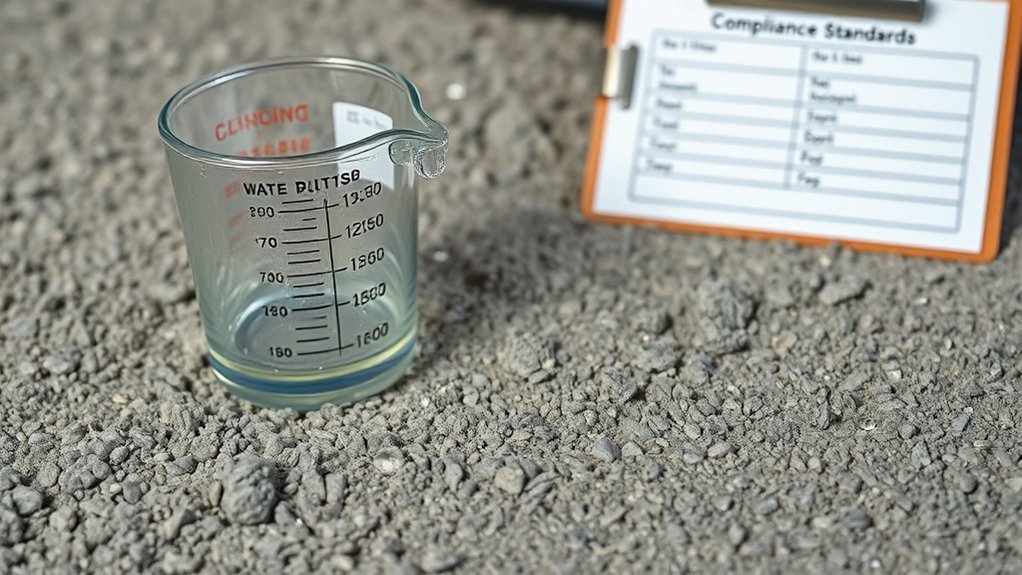
Ensuring compliance with established standards is crucial for the effective use of water-reducing admixtures in concrete mixes. Following regulatory requirements not only guarantees quality but also improves the performance of concrete in structural applications.
Key standards to be aware of include:
- ASTM C494, which outlines types of chemical admixtures.
- BS EN 934-2, the European standard covering conformity and marking requirements.
- AASHTO M194, relevant for transportation infrastructure.
These standards require thorough testing of admixtures for properties such as slump and compressive strength, ensuring they meet defined performance criteria.
Compliance ensures consistency and durability in concrete while promoting sustainability by allowing lower water-cement ratios without compromising workability.
Future Trends in Water-Reducing Admixtures

As the concrete industry progresses, advancements in water-reducing admixtures are becoming essential for improving performance and sustainability.
Future developments are likely to centre on high-range water-reducing admixtures that enhance workability without compromising concrete strength.
Expect to see an increase in shrinkage-reducing admixtures aimed at creating shrinkage-neutral concrete, which tackles durability issues.
The focus on sustainable practices will drive the use of admixtures containing recycled materials, reducing the environmental impact of concrete production.
With the global market projected to reach £23.6 billion by 2030, these innovations will be crucial for meeting the demand for high-performance, eco-friendly concrete solutions.
Embracing these trends will significantly improve the efficiency and sustainability of your concrete projects.
Frequently Asked Questions
Can Water-Reducing Admixtures Affect the Setting Time of Concrete?
Yes, water-reducing admixtures can affect the setting time of concrete. They can speed up setting by improving hydration, but using too much may delay it. It’s important to carefully manage the dosage to achieve the desired results. For instance, if you’re pouring a slab and need it to set quickly, the right amount of admixture can help.
Are There Any Compatibility Issues With Specific Types of Cement?
Yes, certain types of cement can cause compatibility issues. It’s important to carry out compatibility testing to see how different cements work with water-reducing admixtures. This can impact factors like workability, strength, and overall performance of concrete mixes. For example, using a specific type of cement with an incompatible admixture might lead to poor mixing or reduced strength in the finished product.
How Do Temperature Changes Influence Admixture Performance?
Consider your concrete mix as a finely tuned performance; changes in temperature can throw it off balance. As temperatures rise or fall, the effectiveness of admixtures can vary, necessitating precise adjustments to ensure your project meets the required strength and durability. For instance, in colder weather, you may need to use accelerators to speed up setting times, while in warmer conditions, retarders can help prevent premature setting.
Can These Admixtures Be Used in Cold Weather Conditions?
Yes, you can use water-reducing admixtures in cold weather. However, it’s important to monitor their performance closely, as excessive use might cause over-retardation. This can delay setting times and hinder early strength gain, particularly in lower temperatures. For instance, if you’re working on a concrete pour during winter, be cautious with the amount of admixture you add to avoid these issues.
What Are the Long-Term Effects of Using Water-Reducing Admixtures?
Picture a sturdy fortress, built to withstand the test of time. By incorporating water-reducing admixtures, you improve its durability and decrease permeability. This not only increases strength but also helps prevent moisture from penetrating, which can compromise structural integrity in the long run.
Conclusion
Incorporating water-reducing admixtures into your concrete mixes can significantly enhance your projects, much like adding a crucial ingredient to a favourite recipe. These admixtures improve workability and allow for a reduction in water content without sacrificing strength, providing clear advantages. As you look towards future trends and innovations, you’ll discover that these additives not only comply with industry standards but also contribute to more sustainable construction methods. Embrace this technology, and you’ll see your concrete performance improve noticeably.

Just how can fly ash transform your concrete mix for superior performance? Discover the compelling benefits and innovative applications waiting Read more

In hot weather concrete projects, retarders play a vital role in managing hydration, but their effectiveness can be challenged by Read more

Consistently achieving superior concrete performance requires understanding hydration stabilizers—discover how the right techniques can transform your projects dramatically.