Screed, a versatile construction material, finds extensive use across residential, commercial and industrial sectors.
We apply it as a thin layer over concrete subfloors to create smooth, stable surfaces for various flooring finishes. In homes, it's ideal for underfloor heating and sound insulation.
Commercial applications include warehouse flooring, high-traffic retail areas and industrial kitchens, where durability is paramount.
Screed comes in different types: bonded, unbonded, floating, liquid and reinforced, each suited for specific needs.
It offers advantages over concrete in certain scenarios, providing smoother finishes and faster drying times.
Understanding screed's diverse applications can greatly enhance construction project outcomes.
Key Takeaways
- Screed creates smooth, level surfaces for various flooring types in residential and commercial settings.
- It enhances thermal efficiency when used with underfloor heating systems.
- Screed provides durable flooring solutions for high-traffic areas in retail and industrial environments.
- It offers hygienic and easy-to-clean surfaces for industrial kitchen applications.
- Screed can be used to cover underfloor pipes and prevent structural integrity issues in buildings.
What Is Screed?
Understanding screed is fundamental for anyone involved in construction or flooring projects. We're talking about a thin layer applied over concrete subfloors, composed primarily of cement, sharp sand, and water. Its purpose? To create a smooth, stable surface for various flooring finishes.
Proper screed application is vital for maintaining structural integrity and requires careful consideration of soil conditions and climate factors, much like concrete foundations.
Screed's benefits are numerous. It enhances floor durability and appearance, making it suitable for laminates, tiles, vinyl, and carpets. We've found it effectively covers underfloor pipes and provides level surfaces, preventing structural integrity issues in uneven floors.
Let's explore the technicalities. The typical mixture ratio for screed ranges from 1:3 to 1:4.5 (cement to sand). Curing times vary from 16 hours to 2 days, depending on conditions.
Whilst screed history isn't explicitly detailed in our facts, its continued use in modern construction speaks to its enduring value.
We've identified different types of screed: bonded, unbonded, floating, and reinforced. Each caters to specific applications and environmental conditions, enhancing overall floor performance.
Types of Screed

In light of the diverse applications for screed, we've identified several distinct types, each tailored to specific construction requirements.
Bonded screed, applied directly to concrete substrates with a bonding agent, offers thickness versatility from 15mm to 50mm, making it ideal for high-traffic areas.
Unbonded screed, laid over a damp-proof membrane, requires a minimum 50mm thickness and provides flexibility in damp-prone environments. These types of screed can be enhanced with various finishes to improve aesthetic versatility and durability, similar to concrete flooring options.
Floating screed, installed over insulation layers at 65mm or thicker, enhances thermal efficiency and is often used with underfloor heating systems.
Liquid or flowing screed, made from calcium sulphate or cement, offers rapid installation and self-levelling properties, becoming load-bearing after about a week.
Reinforced screed incorporates fibres or metal mesh for increased strength and durability in high-wear settings.
Throughout screed history, these variations have evolved to address specific construction challenges.
The screed benefits of each type are clear: bonded for direct application, unbonded for moisture resistance, floating for insulation, liquid for speed, and reinforced for strength.
Residential Applications
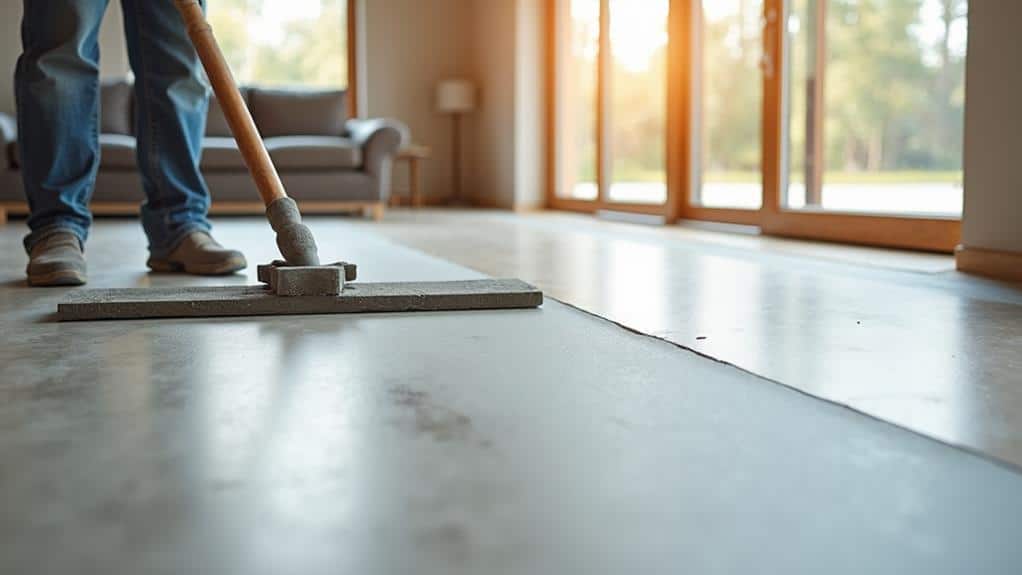
Delving into residential applications, we find screed to be an indispensable component in modern home construction. Its primary function is to create a smooth, level surface that serves as an ideal base for various flooring types, including tiles, laminates, and carpets.
One of the key residential benefits of screed is its compatibility with underfloor heating systems. When installed as a floating layer over insulation, screed enhances thermal efficiency, maximising the performance of these heating solutions. Screed also offers long-term cost benefits due to its durability and low maintenance requirements, making it an attractive option for homeowners seeking both functionality and value.
The mixture ratio for residential screed typically ranges from 1:3 to 1:4.5 (cement to sand), ensuring a durable and stable floor finish. This composition not only provides structural integrity but also offers excellent sound insulation between floors in multi-storey buildings, contributing to a quieter living environment.
We mustn't overlook the aesthetic options that screed presents in residential settings. During the curing process, decorative finishes can be applied, allowing for creative enhancements such as painting or stamping.
This versatility enables homeowners to achieve both functional and visually appealing floor surfaces, tailored to their specific design preferences and requirements.
Commercial and Industrial Uses

We shall now examine screed's applications in commercial and industrial settings, focusing on warehouse flooring solutions, high-traffic retail areas, and industrial kitchen applications.
These environments demand robust, durable surfaces capable of withstanding heavy loads, constant foot traffic, and potentially harsh conditions.
Screed's versatility and strength make it an ideal choice for these challenging applications, offering long-lasting performance and cost-effective solutions for businesses across various sectors.
Much like reinforced concrete structures, screed applications in commercial and industrial settings often require additional reinforcement to enhance their load-bearing capacity and overall durability, ensuring they can withstand the demands of these high-stress environments.
Warehouse Flooring Solutions
Warehouse flooring solutions represent a critical aspect of commercial and industrial facility design, with screed playing a pivotal role in creating durable and functional surfaces.
We've found that bonded screeds, typically 25-40mm thick, are particularly well-suited for warehouse environments due to their ability to withstand heavy loads and high traffic. These screeds bond directly to the concrete substrate, enhancing structural integrity and providing lasting performance.
Whilst concrete is commonly used, sustainable alternatives like recycled materials or innovative cement-free options are gaining traction in the construction industry, offering environmentally friendly solutions for warehouse flooring.
One of the key screed benefits in warehouse applications is the versatility in customisation. We can incorporate anti-slip finishes to improve safety and reduce accident risks in high-use areas.
Furthermore, wearing screeds applied as a final layer offer exceptional durability against machinery and foot traffic wear and tear.
When considering installation techniques, we recommend the following steps:
- Prepare the concrete substrate thoroughly
- Apply a bonding agent to guarantee proper adhesion
- Install the screed mixture at the appropriate thickness
- Allow for proper curing time before applying final finishes
High-Traffic Retail Areas
Whilst high-traffic retail areas present unique flooring challenges, screed has emerged as a versatile and durable solution for commercial and industrial applications.
We've found that screed's ability to withstand heavy foot traffic and maintain structural integrity over time makes it an ideal choice for these demanding environments.
One of the key screed benefits in retail settings is its adaptability.
We often employ bonded screed, which adheres strongly to the concrete substrate, ensuring exceptional durability and resistance against wear and tear. The thickness typically ranges from 25 to 40 mm, providing a robust surface capable of enduring constant use.
When it comes to installation techniques, we prefer flowing screeds for their quick application and self-levelling properties.
This approach minimises disruption to business operations during the flooring process, a vital consideration for retail spaces.
Additionally, we can apply decorative finishes to the screed, enhancing aesthetic appeal without compromising on strength and resilience.
Industrial Kitchen Applications
Industrial kitchens demand flooring solutions that can withstand extreme conditions, and screed has emerged as a frontrunner in meeting these rigorous requirements.
We've found that bonded screeds are particularly well-suited for commercial kitchens due to their durability and ability to maintain structural integrity under constant use and cleaning processes. The screed benefits in these environments are numerous, including the creation of smooth, level surfaces that can support heavy foot traffic and equipment movement.
When considering installation techniques, we've observed that liquid screeds offer rapid application and drying times, minimising operational downtime during renovations or new construction.
Furthermore, screed surfaces can be engineered to enhance safety through slip-resistant properties, addressing the inherent risks of spills and moisture in kitchen environments.
Let's visualise the key components of an industrial kitchen where screed plays a vital role:
- Food preparation areas with seamless, hygienic flooring
- Heavy equipment zones with level, load-bearing surfaces
- High-traffic pathways resistant to wear and tear
- Drainage systems integrated into sloped screed surfaces
We've also noted that properly installed screed provides excellent thermal insulation, particularly beneficial in kitchens utilising underfloor heating systems, contributing to both comfort and energy efficiency.
Underfloor Heating Systems
Underfloor heating systems benefit greatly from the application of screed, particularly floating screed. This type of screed is laid over insulation layers, enhancing thermal efficiency and preventing heat loss. The screed benefits are twofold: it guarantees even heat distribution across the floor and eliminates hot or cold spots, improving overall comfort.
When it comes to installation techniques, we typically use a thickness ranging from 65 mm to 75 mm for floating screed in underfloor heating applications. However, calcium sulphate screeds can be applied as thinly as 20 mm over heating pipes.
We often employ liquid or flow screeds due to their self-levelling properties and quick drying times, allowing for light pedestrian traffic within 24 to 48 hours.
Proper installation and thickness specification are vital for peak performance. We sometimes add fibres to reduce thickness and enhance strength.
It's important to note that screed specifically designed for underfloor heating is essential to maximise efficiency. By carefully considering these factors, we can guarantee that the screed application effectively supports the underfloor heating system, providing consistent warmth and energy efficiency.
Screed vs. Concrete
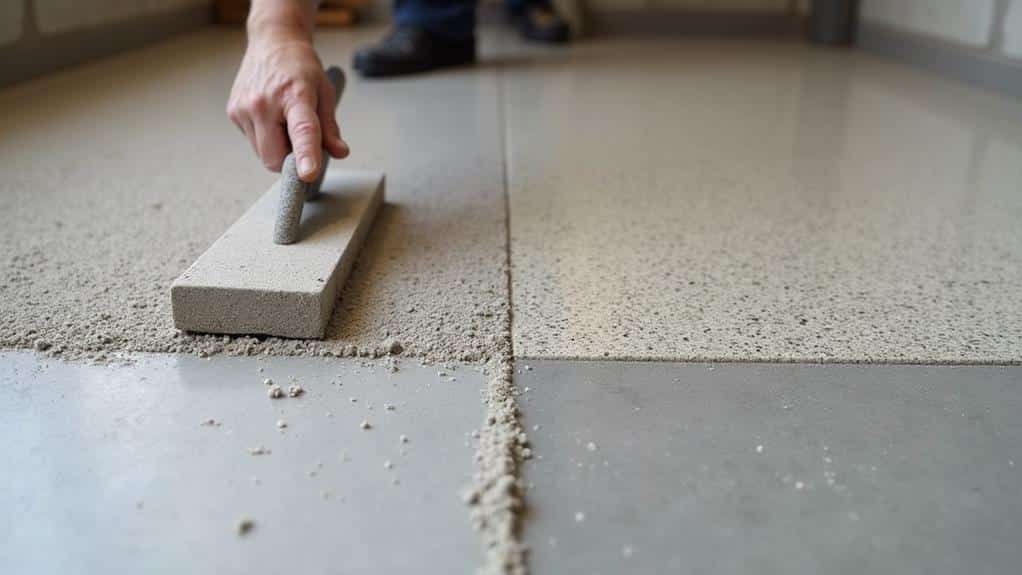
We shall examine the key differences betwixt screed and concrete to understand their distinct applications in construction.
Firstly, we shall compare their composition and texture, highlighting how screed's finer blend results in a smoother finish compared to concrete's coarser aggregate mix.
We shall then analyse their respective strength and durability characteristics, followed by a discussion of their divergent purposes in construction projects.
Composition and Texture Differences
Two key factors distinguish screed from concrete: composition and texture. Screed's composition primarily consists of a finer mix of cement and sand, typically in ratios ranging from 1:3 to 1:4.5. This composition contributes to screed's smoother texture, a significant property that differentiates it from concrete.
Concrete, on the other hand, incorporates coarser aggregates like gravel and sand, resulting in a rougher texture and higher structural strength.
The distinct composition and texture of screed offer several benefits:
- Enhanced levelling capabilities for flooring applications
- Improved surface finish for aesthetic purposes
- Better workability for creating smooth, even surfaces
- Increased compatibility with various flooring materials
One must understand that whilst concrete is designed for load-bearing applications, providing durability and stability, screed's primary function is to create a smooth, even surface for flooring.
This distinction in purpose is reflected in their respective compressive strengths, with concrete generally exhibiting higher strength due to its reinforced structure.
Strength and Durability Comparison
Whilst both screed and concrete are cement-based materials, their strength and durability characteristics differ markedly due to their composition and intended purposes. We shall examine these differences to understand their implications for construction applications.
Concrete's superior strength is evident in its compressive strength range of 20-40 MPa, considerably outperforming screed's typical 10-20 MPa. This disparity in strength is primarily due to concrete's inclusion of larger aggregates, which contribute to its robust structure. Consequently, concrete excels in load-bearing applications, making it the go-to choice for foundations, walls, and other structural elements that must withstand substantial weight and environmental stresses.
In contrast, screed performance is optimised for surface finishing rather than structural integrity. Its smoother, finer texture results from a reduced coarse aggregate content, which limits its load-bearing capacity.
When considering screed applications, we must acknowledge its primary function as a levelling layer for flooring finishes. It's not designed to bear heavy loads or provide the same level of durability as concrete.
Understanding these strength and durability differences is essential for proper material selection in construction projects, ensuring that each component fulfils its intended role effectively and safely.
Application and Purpose Distinctions
Screed and concrete serve distinct purposes in construction, with their applications clearly delineated by their unique properties and functions. We utilise screed primarily as a finishing layer, applying it in thin coats over concrete substrates to achieve a smooth, level surface. This application method allows us to enhance flooring aesthetics and prepare the surface for various finishes.
In contrast, concrete forms the structural backbone of our projects, providing the necessary strength and stability for load-bearing elements. The differences in their compositions and applications are evident in their respective roles:
- Screed as a thin, smooth top layer (12-75mm)
- Concrete as thick, robust structural foundations
- Screed for precise surface levelling and finishing
- Concrete for creating solid, durable building frameworks
We leverage screed benefits beyond mere aesthetics. Its finer composition allows for improved thermal and acoustic insulation, making it ideal for underfloor heating systems.
Whilst concrete focuses on structural integrity, screed enhances the overall performance and comfort of flooring surfaces. By understanding these distinctions, we can optimise our material choices for each specific construction need, ensuring both functionality and quality in our projects.
Installation and Maintenance
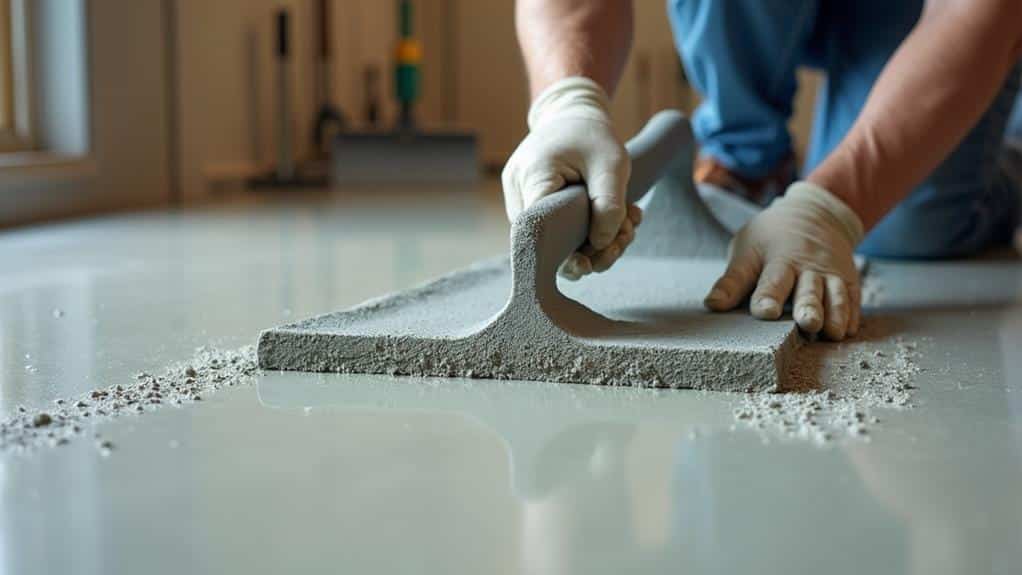
Installation and Maintenance
Ensuring proper installation and maintenance of screed is vital for its long-term performance and durability. We begin with meticulous screed preparation, focusing on the concrete substrate. It's essential to achieve a clean, dry, and level surface to promote ideal adhesion and prevent future cracking. This foundational step sets the stage for successful screed application.
Once applied, screed curing becomes our primary focus. The curing process typically spans 16 hours to 2 days, with extended curing periods enhancing the screed's durability and performance. For projects requiring rapid turnaround, we can employ fast-drying screed solutions, which can achieve under 75% relative humidity within 3-4 days.
In applications involving underfloor heating systems, we maintain a recommended screed thickness of 65 to 75 mm. This guarantees effective heat distribution and eliminates cold spots.
Post-installation, we implement a rigorous maintenance regime, including regular inspections for cracks or damage. Prompt repairs are essential to prevent further deterioration and maintain floor integrity.
Frequently Asked Questions
What Is the Application of Floor Screed?
We apply floor screed to create smooth, level surfaces over concrete subfloors. It offers numerous benefits, including insulation and structural support. Our installation techniques vary, accommodating different requirements such as underfloor heating systems and moisture resistance in damp areas. The process involves laying a layer of screed over the concrete base, which can be tailored to suit various needs. For instance, in areas prone to moisture, we utilise specialised screeds that offer enhanced water resistance. When installing underfloor heating, we ensure the screed is compatible with the heating system, providing optimal heat distribution. Our skilled tradesmen employ precise levelling techniques to achieve a perfectly flat surface, essential for subsequent flooring installations. The type of screed used can also contribute to the overall thermal efficiency of a building, making it a crucial component in modern construction practices across the UK.
What Are the Uses of Screed?
We utilise screed for its numerous benefits. It levels floors, enhances thermal efficiency, protects concrete, and allows for decorative finishes. Screed materials vary, offering solutions for different environments, from moisture-prone areas to high-traffic commercial spaces. It's essential for flooring excellence in British construction projects.
What Are the Different Types of Self Leveling Screeds?
From thin polymer screeds to thick anhydrite screeds, we've got options. We'll encounter cementitious, anhydrite, polymer-modified, flowing, and thick self-levelling screeds. Each type offers unique properties, catering to diverse project requirements and installation conditions in the construction industry.
What Are Some Examples of Screed?
We encounter various screed examples, including cement-based, anhydrite, and polymer-modified screeds. These materials offer benefits such as improved levelling, enhanced durability, and faster drying times. We'll find them in residential, commercial, and industrial applications, meeting diverse flooring needs.
Conclusion
We've explored the versatile world of screed, from its various types to its applications in residential, commercial and industrial settings. Much like a chameleon adapting to its environment, screed proves indispensable across diverse construction scenarios. We've analysed its role in underfloor heating systems and compared it to concrete. Understanding screed's properties, installation methods and maintenance requirements is essential for peak performance. As construction technology evolves, screed's importance in creating smooth, durable surfaces will likely continue to grow.

Learn about the diverse types of concrete used in construction and discover which mix can transform your next project.

For a long-lasting driveway that laughs in the face of the UK's unpredictable weather, the C20 concrete mix is your Read more

In the UK, you've got a a lot of lightweight concrete types to choose from, each with its unique perks. Read more