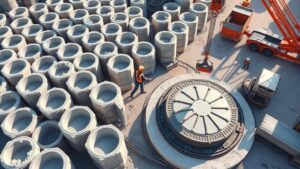
Concrete and mortar are both cement-based materials, but they serve different purposes in construction.
Concrete, a mixture of cement, water, sand, and coarse aggregates, offers high compressive strength (about 27.6 MPa) and is used for structural elements like foundations and slabs.
Mortar, composed of cement, water, and fine sand, has lower strength (around 5.2 MPa) and primarily binds masonry units.
We mix concrete in larger batches with a 1:2:4 ratio, whilst mortar uses a 1:2-3 ratio.
Concrete requires more extensive curing and finishing processes, whereas mortar sets faster.
Understanding these distinctions is essential for choosing the right material for your project.
Key Takeaways
- Concrete contains coarse aggregates and is stronger, reaching 27.6 MPa after 28 days, whilst mortar lacks coarse aggregates and reaches 5.2 MPa.
- Concrete is used for heavy-duty applications like foundations and slabs, whilst mortar primarily binds masonry elements and fills gaps.
- Concrete typically uses a 1:2:4 ratio (cement:sand:gravel), whilst mortar follows a 1:2-3 ratio (cement:sand) for mixing.
- Concrete requires longer curing (minimum 7 days) compared to mortar (minimum 48 hours) for proper strength development.
- Concrete is more expensive, costing £80-£120 per cubic metre, whilst mortar is cheaper at £8-£12 per 36-kilogramme bag.
Composition and Ingredients
Fundamentally, concrete and mortar differ in their composition and ingredients, despite both relying on cement as a binding agent. We shall explore these differences to understand their distinct properties and applications.
Concrete's composition includes cement, water, sand, and coarse aggregates like gravel or crushed stone. This dense aggregate structure contributes to concrete's high strength, typically around 27.6 MPa after 28 days of curing.
Recent advancements in concrete technology, such as concrete nitrogenation, have shown potential for notable environmental and health benefits by reducing NOx emissions.
In contrast, mortar's ingredient sources are more limited, consisting primarily of cement, water, and fine sand. This composition variation results in a creamier mixture with lower strength, approximately 5.2 MPa at 28 days.
The water-to-cement ratio plays an essential role in determining the properties of both materials. Mortar generally has a higher water-to-cement ratio, enhancing its workability but reducing its overall strength compared to concrete.
The absence of coarse aggregates in mortar further distinguishes it from concrete, as these larger particles notably contribute to concrete's structural integrity.
Understanding these composition variations is vital for selecting the appropriate material for specific construction applications, whether it's structural support or masonry work.
Strength and Durability

The backbone of construction, strength and durability are key factors differentiating concrete from mortar. We shall examine these essential aspects to understand their impact on building performance.
Concrete's superior compressive strength, typically reaching 4000 PSI after 28 days, markedly outperforms mortar's 750 PSI under similar conditions. This stark difference explains concrete's prevalence in load-bearing applications and foundational support.
We often reinforce concrete with steel to enhance its tensile strength, a property mortar lacks due to its inherent weakness. For even greater strength and durability, high-strength concrete can be used, which achieves compressive strengths exceeding 6,000 PSI and offers enhanced resistance to cracking and environmental factors.
Durability-wise, concrete excels in withstanding harsh environmental conditions, including freeze-thaw cycles. Mortar, whilst more flexible and workable, is prone to cracking under extreme conditions if not properly formulated.
This flexibility, however, allows mortar to accommodate slight structural movements, a trait concrete doesn't share.
We must consider the long-term implications of these differences. Concrete structures, when properly maintained, can last for decades. Mortar, being less durable, may require more frequent repairs.
This trade-off between strength and workability shapes the specific applications for each material in construction projects, highlighting the importance of selecting the right material for each job.
Applications in Construction
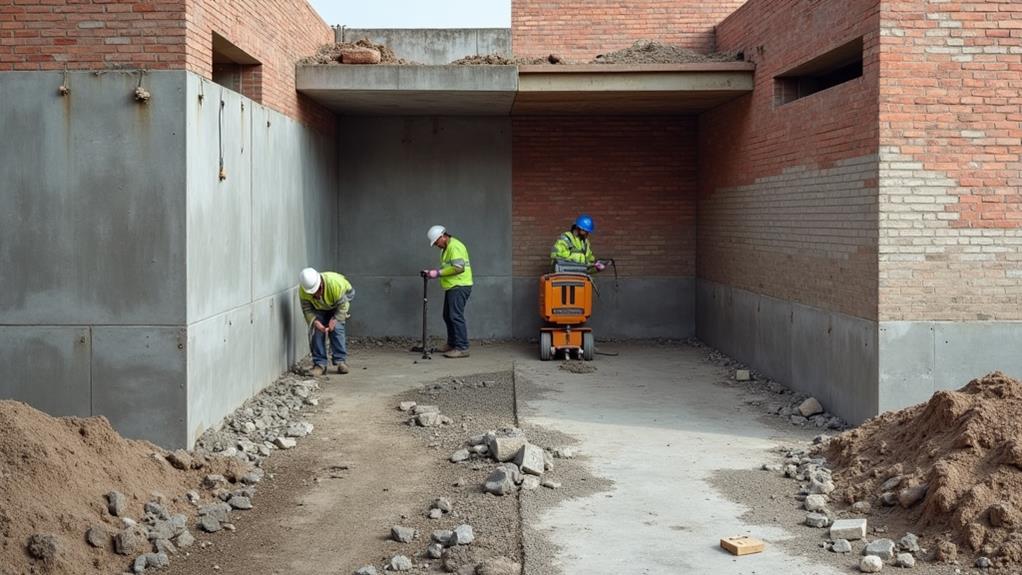
With strength and durability differences established, we'll now explore how these characteristics shape concrete and mortar's roles in construction.
Concrete's high compressive strength makes it the go-to material for heavy-duty structural applications. We primarily use it for foundations, slabs, and pavements where its 4000 PSI strength at 28 days provides the necessary support for substantial loads.
In situations requiring rapid deployment, fast-setting concrete mixes offer a solution, setting in 20-40 minutes for urgent repairs or quick installations like posts and pavements. However, the environmental impact of concrete use is significant, leading to calls for a cement tax to incentivise cleaner practices in the industry.
Mortar applications, on the other hand, focus on bonding and flexibility. With a compressive strength of about 750 PSI at 28 days, mortar excels as a binding agent in masonry construction. We use it for laying bricks and stones, allowing for slight structural movements without compromising integrity.
Mortar's versatility extends to repointing repairs, where it fills gaps in existing brickwork to prevent moisture infiltration and extend wall longevity.
Both materials offer waterproof variants for specialised uses. We employ waterproof concrete in foundations and waterproof mortar in exterior brickwork, enhancing resistance to water penetration in these critical areas.
This adaptability allows us to tailor our material choices to specific construction requirements, optimising performance and durability.
Mixing and Preparation Techniques
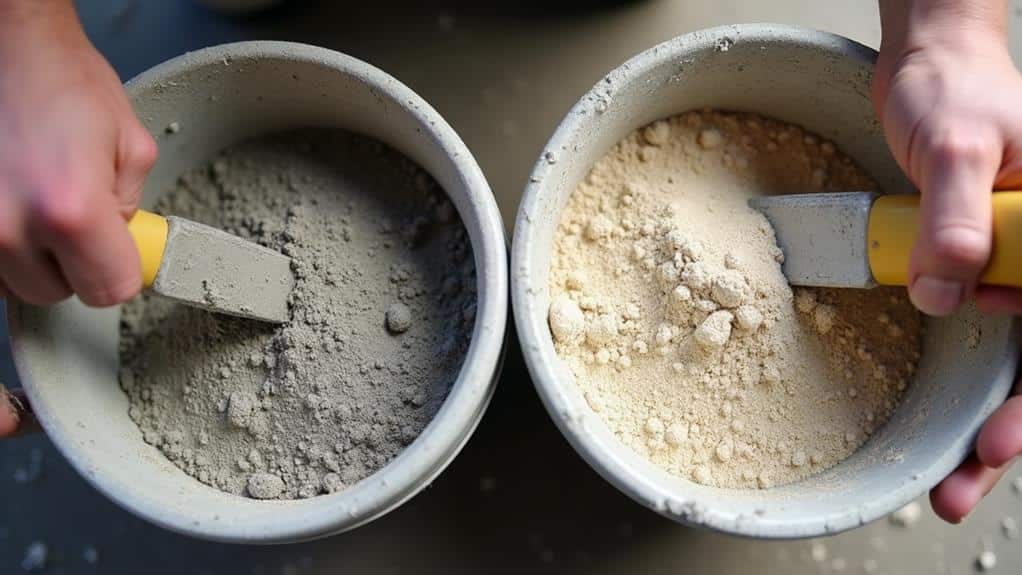
When comparing concrete and mortar mixing techniques, we shall examine the essential aspects of proper proportions, necessary equipment and curing methods.
We must first consider the precise ratios required for each material, with concrete typically using a 0.5 water-to-cement ratio and mortar ranging from 0.6 to 0.8.
We shall then explore the tools needed for effective mixing, such as concrete mixers or wheelbarrows, and discuss the critical curing processes that guarantee ideal strength and durability for both materials.
Proper Proportions and Ratios
Achieving ideal strength and durability in concrete and mortar hinges on precise ingredient proportions and mixing techniques. We shall examine the critical ratios and measurements that guarantee optimal results for both materials.
For concrete, we typically adhere to a 1:2:4 ratio by volume: one part cement, two parts sand, and four parts gravel. This mixture requires a water-to-cement ratio between 0.4 and 0.6 for maximum strength.
Mortar, on the other hand, follows a 1:2-3 ratio of Portland cement to fine sand, with a higher water content (0.6 to 0.8 ratio) for enhanced workability.
Measuring accuracy is paramount in both cases. We must guarantee thorough and uniform mixing, eliminating dry pockets that could compromise the integrity of the finished product.
For smaller projects, pre-blended options can assure consistency in mortar mixtures, whilst pre-mixed concrete offers convenience for DIY endeavours.
Equipment and Tools Required
Proper proportions alone don't guarantee successful concrete or mortar projects. We must also have the right equipment and tools for mixing and preparation. Let's examine the essential items needed for both materials:
| Equipment/Tool | Concrete | Mortar |
|---|---|---|
| Mixer | Concrete mixer | Mixing bucket |
| Manual Tool | Spade or hoe | Trowel |
| Transport | Wheelbarrow | N/A |
| Measurement | Bucket or scales | Bucket or scales |
| Finishing | Float | Trowel |
For concrete, we'll need a concrete mixer or mixing tub for larger projects, whilst a mixing bucket suffices for mortar. Mixing techniques differ: concrete requires vigorous agitation with a spade or hoe, whereas mortar can be mixed with a trowel. We'll transport concrete in a wheelbarrow, but mortar is typically mixed at the application site.
Accurate measurements are vital for both materials, so we'll use a bucket or scales to proportion ingredients precisely. For finishing, we'll use a float for concrete and a trowel for mortar application.
Safety equipment is non-negotiable. We'll wear gloves, goggles, and dust masks to protect against dust and splashes during mixing and preparation. These precautions guarantee a safe working environment whilst we achieve the desired strength and workability in our mixes.
Curing and Finishing Methods
The curing process stands as a vital differentiator between concrete and mortar applications. We shall explore the distinct curing techniques and finishing methods for each material to highlight their unique requirements.
For concrete, we maintain moisture for a minimum of 7 days to guarantee proper hydration and strength development. Common curing techniques include covering with wet hessian or plastic sheeting, or applying curing compounds. These methods retain moisture, facilitating peak strength gain.
Mortar, conversely, requires a shorter curing period of at least 48 hours. We typically mist with water or cover with damp cloths to prevent rapid drying, guaranteeing proper adhesion and durability.
Finishing methods also differ greatly. For concrete, we employ techniques like trowelling for smooth surfaces, brushing for texture, or stamping for decorative patterns. These must be executed within 1-2 hours of initial set.
Mortar finishing often involves tool jointing or pointing, which can be performed over a longer period but should be completed before hardening begins.
Proper mixing is essential for both materials. We aim for a 0.5 water-to-cement ratio in concrete to achieve 4000 PSI strength, whilst mortar typically uses a 1:3-6 cement-to-sand ratio, depending on the application's requirements.
Cost and Availability
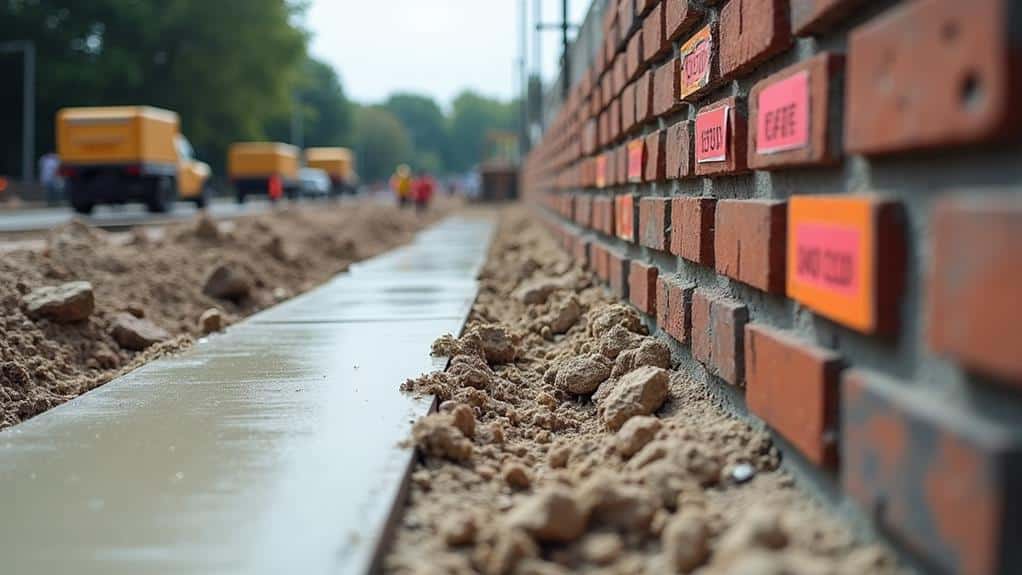
When it comes to cost and availability, concrete and mortar present distinct profiles. In our price comparison, we find that concrete is generally more cost-effective, ranging from £80 to £120 per cubic metre. Mortar, sold in smaller quantities, costs £8 to £12 per 36-kilogram bag. This pricing structure makes mortar more accessible for small projects, whilst concrete is often the go-to for larger construction tasks.
Supply sources for these materials differ notably. We observe that concrete's availability is widespread, with ready-mix options offered by numerous suppliers. Mortar, however, is more commonly found in DIY shops or specialised masonry supply merchants.
It's important to note that concrete mixes can vary considerably in price due to additives and specific formulations, whereas mortar types generally maintain a more uniform pricing structure.
We must consider that seasonal demand affects both materials' availability and pricing. Concrete often experiences increased costs during peak construction periods, while mortar pricing tends to follow local building trends.
This variability requires careful planning and budgeting for construction projects, especially those with specific timing or scale requirements.
Environmental Impact and Sustainability

Examining the environmental impact and sustainability of concrete and mortar reveals notable challenges and opportunities.
We must acknowledge that cement production, essential for both materials, contributes substantially to global carbon dioxide emissions. However, we're not without options to mitigate this impact. By implementing sustainable practices, we can greatly reduce the carbon footprint of concrete and mortar.
We can achieve this through:
- Utilising recycled aggregates and supplementary cementitious materials
- Enhancing durability to extend structure lifespans
- Implementing permeable concrete for improved stormwater management
- Incorporating additives like fly ash to reduce virgin cement usage
These strategies not only address environmental concerns but also offer performance benefits.
For instance, fly ash and silica fume can improve material properties whilst promoting sustainability. Additionally, permeable concrete helps combat urban heat island effects, demonstrating how sustainable practices can yield multiple advantages.
As we aim for mastery in construction, it's imperative to reflect on the long-term environmental impact of our material choices.
Frequently Asked Questions
Should I Use Mortar or Concrete?
We'll determine the best choice based on your project's requirements. For masonry bonding and non-structural mortar applications, we'll use mortar. For load-bearing structures requiring concrete durability and high strength, we'll opt for concrete. Do consider environmental factors as well.
Can Mortar Be Used to Fill Cracks in Concrete?
One can use mortar for minor concrete crack repair, but one must consider material properties. It's suitable for surface-level, non-structural cracks. However, for larger or structural cracks, one will need specialised concrete repair products with higher compressive strength.
Is Mortar or Concrete Better for Pavers?
We recommend mortar for paver installation due to its superior flexibility and adhesion properties. Whilst concrete offers greater material durability, mortar's ability to accommodate movement and provide a strong bond makes it the ideal choice for pavers.
Can Mortar Be Turned Into Concrete?
Like Sisyphus's eternal task, we cannot transform mortar into concrete. The fundamental properties of mortar lack the necessary aggregates for concrete applications. We are dealing with distinct materials, each engineered for specific purposes in construction. Let us explore their differences.
Conclusion
We've explored the key differences between concrete and mortar, from their composition to their environmental impact. Whilst both are essential in construction, their applications vary greatly. Notably, concrete's global production reaches approximately 30 billion tonnes annually, highlighting its widespread use. As we continue to innovate in construction materials, understanding these distinctions becomes vital for optimising structural integrity, cost-effectiveness, and sustainability in our built environment. Future developments may further blur the lines between these versatile materials.

Learn about the diverse types of concrete used in construction and discover which mix can transform your next project.

For a long-lasting driveway that laughs in the face of the UK's unpredictable weather, the C20 concrete mix is your Read more

In the UK, you've got a a lot of lightweight concrete types to choose from, each with its unique perks. Read more