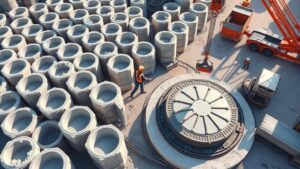
High-strength concrete is an essential construction material, characterised by a compressive strength of over 40 MPa. This advanced type of concrete is specifically designed for demanding structures such as skyscrapers and long-span bridges, providing exceptional load-bearing capacity. It typically has a low water-cement ratio and often includes additives like silica fume to boost its durability and performance.
The advantages of high-strength concrete are significant: it requires less maintenance, offers improved fire resistance, and allows for more efficient use of space. In the following sections, we will explore its applications and future trends in more detail.
Key Takeaways
High-strength concrete exceeds 40 MPa in compressive strength, making it ideal for demanding structures such as tall buildings and bridges. It features a low water-cement ratio and often includes additives like silica fume, which enhance its durability and fire resistance while reducing maintenance requirements.
This type of concrete is particularly useful in high-rise and long-span constructions, allowing for slimmer columns and larger spaces, which improves both efficiency and design flexibility. Additionally, supplementary cementitious materials like fly ash and silica fume boost the performance and sustainability of high-strength concrete.
Looking ahead, trends such as low-carbon cements and smart concrete with self-healing properties aim to minimise environmental impact and extend the lifespan of structures.
Definition and Key Characteristics of High-Strength Concrete

High-strength concrete (HSC) is notable in the construction sector for its impressive compressive strength, which exceeds 40 MPa (5800 psi).
It's specifically designed for demanding structural applications, offering superior load-bearing capacity and durability compared to standard concrete.
HSC incorporates crushed rock aggregates, a low water-cement ratio of between 0.23 and 0.35, and additives like silica fume and superplasticisers. This high PSI concrete improves performance while ensuring the material remains workable.
The production process involves stringent quality control and specialised mixing techniques to guarantee consistent outcomes.
As a result, HSC offers enhanced fire resistance and lowers maintenance needs, making it an excellent choice for heavy-duty construction projects where durability and structural integrity are essential. Moreover, its high strength allows for a reduction in the size of compression elements and longitudinal reinforcement, optimizing design efficiency.
Common Applications of High-Strength Concrete

High-strength concrete is vital in various construction projects, such as tall buildings, long-span bridges, and robust industrial facilities. Its excellent compressive strength allows for slimmer columns and extended spans, improving both space efficiency and structural stability. High-strength concrete ensures sturdiness, durability, and longevity, making it an ideal choice for demanding applications. Additionally, its enhanced resistance to environmental factors contributes to a safer and more reliable infrastructure. When considering these applications, it's clear that high-strength concrete not only satisfies load-bearing needs but also offers economic advantages and enhanced durability.
High-Rise Building Structures
As architects and engineers push the boundaries of vertical construction, the use of high-strength concrete has become vital for developing high-rise buildings. This material not only enhances the aesthetics of tall structures but also supports sustainability.
The key advantages include:
- Smaller column sizes, which create more spacious floor layouts
- Improved structural integrity for buildings over 30 storeys
- Innovative open-plan designs due to greater load-bearing capacity
- Lower maintenance costs, thanks to durability against environmental factors
- Reduced raw material use, helping to minimise the carbon footprint
- C40 concrete's high load-bearing capacity is fundamental to advancements in high-rise construction, allowing for taller and more resilient buildings.
These benefits allow for the creation of resilient and efficient high-rise buildings that maximise space and sustainability, meeting contemporary architectural needs.
Long-Span Bridge Construction
When constructing long-span bridges, high-strength concrete significantly enhances design options and structural performance.
This material enables longer spans and wider girder spacings, which reduces the number of girders needed. As a result, high-strength concrete leads to lighter bridge designs, offering economic benefits and improved durability against environmental challenges.
Its higher modulus of elasticity also increases structural stiffness, which is crucial for designs limited by deflection. Furthermore, using thinner wall members for piers optimises material efficiency.
Heavy-Duty Industrial Applications
In heavy-duty industrial applications, high-strength concrete is vital for structural reliability and efficiency. Its remarkable properties support heavy machinery and enhance resilience across various sectors.
Key applications include:
- Manufacturing Facilities: Provides support for heavy machinery and overhead cranes.
- Heavy-Duty Warehouses: Capable of handling large inventories and constant traffic.
- Storage Silos: Withstands the immense weight of stored materials.
- Chemical Plants: Minimises permeability, protecting against chemical exposure.
- Power Stations: Maintains integrity under dynamic loads.
These examples highlight high-strength concrete's durability, load-bearing capacity, and wear resistance, making it essential in today's industrial landscape.
Essential Materials Used in High-Strength Concrete

High-strength concrete is made from a carefully chosen mix of essential materials to achieve its impressive performance.
The main binder, cement, works with fine aggregates like sand to enhance both workability and strength. Coarse aggregates, such as gravel or crushed stone, add bulk and support high compressive strength.
While water should be kept to a minimum, it's crucial for hydration. Supplementary cementitious materials, like silica fume and fly ash, improve durability and reduce porosity.
It's important to select aggregate types that match the strength and stiffness of the cement paste to avoid differential stresses. By prioritising material compatibility and durability, you can enhance the performance of high-strength concrete for challenging applications.
The Importance of Mix Design and Quality Control

To achieve high-strength concrete, effective mix design and rigorous quality control are crucial. Here are key aspects to consider:
- Mix Design Requirements: Use specific admixtures and select suitable aggregates.
- Trial Mixes: Carry out trial mixes to ensure desired strength and workability.
- Quality Assurance: Follow ACI guidelines to meet strength specifications.
- Laboratory Testing: Regularly conduct tests to track strength development.
- Moisture Control: Measure aggregate moisture accurately to maintain proper proportions.
These components are vital for producing high-strength concrete that meets performance standards.
Benefits of Utilizing High-Strength Concrete

High-strength concrete offers significant advantages that improve both structural efficiency and sustainability in construction. A detailed strength analysis shows that it allows for smaller column sizes, which maximises usable space in buildings and facilitates the construction of taller structures using less material.
This efficiency leads to cost-effective methods for transferring vertical loads to foundations and provides greater architectural flexibility.
Moreover, reducing concrete usage by 25% can result in approximately 20% savings on raw materials. Its durability and resistance to harsh environmental conditions ensure longevity, thereby reducing maintenance costs.
Challenges in Producing High-Strength Concrete

High-strength concrete offers significant advantages, but its production comes with notable challenges. To achieve optimal results, several technical issues must be addressed:
- Cost and Accessibility: High-strength concrete is generally more expensive than standard concrete.
- Materials and Composition: Achieving a low water-to-cement ratio requires precise mixing and batching.
- Quality Control Issues: Finding high-quality aggregates can be a challenge.
- Sensitivity to Conditions: Environmental factors can significantly impact production and curing.
- Training and Expertise: Skilled workers and specialised equipment are crucial for successful application.
Tackling these challenges is vital for reaping the benefits of high-strength concrete while ensuring structural integrity and performance.
The Role of Supplementary Cementitious Materials

Supplementary cementitious materials (SCMs) are crucial for improving both the performance and sustainability of high-strength concrete. By using SCMs such as fly ash and silica fume, you can decrease the reliance on Portland cement, which supports environmentally friendly practices while boosting durability. These materials engage in pozzolanic reactions, producing compounds that enhance strength and lower permeability.
| Type of SCM | Benefits |
|---|---|
| Fly Ash | Reduces water demand, improves durability |
| Silica Fume | Increases strength, lowers permeability |
| GGBFS | Boosts durability and sustainability |
| Metakaolin | Enhances chemical resistance |
| Nanosilica | Improves durability in harsh conditions |
Incorporating these materials not only optimises concrete properties but also fosters a more sustainable construction industry.
Testing Methods for High-Strength Concrete

Ensuring the performance of high-strength concrete requires effective testing methods. Choosing the right approach is crucial due to various testing challenges.
Here are some key methods to consider:
- Rebound Hammer Test (ASTM C805): A quick way to assess strength on-site.
- Penetration Resistance Test (ASTM C803): Measures surface hardness but needs calibration for accuracy.
- Ultrasonic Pulse Velocity (ASTM C597): A non-destructive method that evaluates internal strength and identifies defects.
- Pullout Test (ASTM C900): A partially destructive test that helps assess early strength in both new and existing structures.
- Compressive Strength Test on Cylinders: This involves crushing specimens to determine compressive strength, usually at 56 or 90 days.
Choosing the appropriate method can significantly impact the reliability of your results.
Impact on Construction Timelines and Efficiency

High-strength concrete speeds up project completion by reducing curing times and promoting early strength development.
This efficiency limits downtime for structures, allowing quicker transitions between construction phases.
For instance, using this concrete can enable a builder to start work on the next level of a building sooner, ultimately enhancing overall project timelines.
Faster Project Completion
Using high-strength concrete can significantly shorten construction timelines, allowing projects to be completed more quickly than with traditional methods.
This advanced material offers several advantages while ensuring safety and reducing environmental impact.
Key benefits include:
- Sidewalks can be opened just 3 days after curing.
- Early loading of high-strength concrete speeds up the completion of essential components.
- Less material usage simplifies logistics and supply chains.
- Improved workability with advanced admixtures reduces labour time and costs.
- Complex architectural designs can be executed more efficiently.
These benefits together create a more streamlined construction process, helping you deliver projects on time without compromising on quality or sustainability.
Reduced Downtime for Structures
As construction projects progress, reducing downtime for structures is crucial for improving efficiency and timelines.
High-strength concrete offers significant durability benefits, enabling the use of thinner structural elements that cut down on material waste. Its excellent load-bearing capacity allows for quicker completion of buildings without sacrificing strength.
Additionally, this type of concrete is resistant to harsh conditions, resulting in lower maintenance needs as it stands up to weathering and erosion, leading to fewer repairs over time.
Its lower permeability also helps prevent reinforcement corrosion, which speeds up installation and optimises construction schedules.
Streamlined Construction Processes
Streamlining construction processes has a significant impact on timelines and efficiency, particularly when utilising high-strength concrete. By incorporating high-strength concrete, you can create smoother workflows and optimise logistics, ultimately improving project delivery.
The key advantages include:
- Early strength gain, which allows quicker access and use of structures.
- Thinner structural elements, reducing material usage while upholding structural integrity.
- Rapid formwork removal, speeding up subsequent construction phases.
- Simplified design, lowering complexity and shortening design time.
- Enhanced workability, leading to smoother finishes and less labour effort.
Together, these factors lead to a more efficient construction timeline, helping you meet deadlines while minimising costs and resource use.
Embracing high-strength concrete is a strategic choice for boosting construction efficiency.
Future Trends in High-Strength Concrete Development

As the construction industry evolves, future trends in high-strength concrete are set to enhance structural performance and sustainability. Innovations like low-carbon cements and recycled aggregates will reduce environmental impact while improving concrete properties.
The use of nanomaterials, such as carbon nanotubes, will optimise microstructures, resulting in stronger, more durable concrete. Furthermore, smart concrete with self-healing properties will transform maintenance practices, prolonging the lifespan of structures.
Advanced admixtures will improve workability and decrease water content, making construction processes more efficient.
With urbanisation on the rise, high-strength concrete is expected to lead infrastructure developments, supporting taller buildings and robust transport systems that meet contemporary demands. Embracing these trends in concrete technology will keep you ahead in the field.
Frequently Asked Questions
How Does High-Strength Concrete Compare to Regular Concrete in Performance?
High-strength concrete significantly outperforms regular concrete in terms of durability, boasting lower permeability and improved resistance to environmental factors. While it does come at a higher cost, the long-term advantages often make it a worthwhile investment for structural projects. For instance, in areas prone to harsh weather or heavy loads, opting for high-strength concrete can lead to lower maintenance costs and extended lifespan.
What Are Typical Compressive Strength Ranges for High-Strength Concrete?
Typical compressive strength ranges for high-strength concrete start at around 40 MPa (6,000 psi) and can often exceed 70 MPa (10,000 psi) for demanding applications. These properties ensure greater durability and structural integrity in challenging conditions, making it suitable for various construction projects, such as bridges and high-rise buildings.
Can High-Strength Concrete Be Recycled After Its Life Cycle?
Yes, high-strength concrete can be recycled using specific processes. This helps conserve resources and reduce waste, but there are challenges to consider, such as ensuring structural integrity and meeting quality standards for reuse. For example, crushed concrete can be repurposed as aggregate in new concrete mixes or as a base material for roads.
How Does Temperature Affect High-Strength Concrete Setting Times?
Temperature significantly affects setting times in high-strength concrete. Warmer conditions accelerate hydration, leading to quicker setting, while colder temperatures slow it down. For instance, on a hot summer day, concrete may set within a few hours, whereas in winter, it could take much longer. It's essential to monitor these temperature changes to ensure the concrete achieves optimal strength and durability during the curing process.
What Innovations Are Emerging in High-Strength Concrete Technology?
Smart materials and nano additives are transforming high-strength concrete technology. These innovations improve durability and strength, allowing structures to endure higher stresses while reducing environmental impact. For instance, using nano-silica can enhance the concrete's compressive strength, making it ideal for high-rise buildings and bridges. Overall, these advancements optimise performance across various applications, ensuring safer and more sustainable construction.
Conclusion
In conclusion, high-strength concrete is transforming modern construction. Its enhanced durability and load-bearing capacity allow architects and engineers to explore new possibilities. A prime example is the Burj Khalifa in Dubai, which used high-strength concrete to achieve remarkable heights while maintaining structural integrity. As you consider its applications, think about how incorporating high-strength concrete can optimise your projects, boost efficiency, and foster innovation in your construction work. Embrace this material for a stronger, more resilient future.

Learn about the diverse types of concrete used in construction and discover which mix can transform your next project.

For a long-lasting driveway that laughs in the face of the UK's unpredictable weather, the C20 concrete mix is your Read more

In the UK, you've got a a lot of lightweight concrete types to choose from, each with its unique perks. Read more