Concrete cube tests are vital for assessing the strength and durability of concrete in construction projects. These tests measure compressive strength and ensure compliance with standards like BS EN. By conducting these tests regularly, you can spot weaknesses early, avoiding expensive repairs and improving structural safety.
Key aspects such as proper moulding, curing, and following protocols are crucial for obtaining accurate results. Maintaining quality control throughout the testing process is also essential for the long-term reliability of your structures. Understanding these factors is important for your project's integrity, and there's a lot to consider when exploring effective concrete testing methods.
Key Takeaways
Concrete cube testing measures the compressive strength of concrete, ensuring that structures can safely support loads and remain durable over time. Adhering to British Standards (BS) and American Concrete Institute (ACI) guidelines during testing confirms the quality of materials and compliance with safety regulations.
Testing is typically performed at 7 and 28 days, providing valuable insights for adjusting the concrete mix and identifying any early weaknesses. Maintaining controlled curing conditions and following precise testing protocols are crucial for accurate strength measurements and reliable results.
Accredited laboratories carry out concrete tests, ensuring consistent quality and compliance with industry standards essential for construction projects.
Purpose of Concrete Cube Tests
Concrete cube tests are crucial for ensuring the quality and safety of construction projects. These tests assess the strength of concrete to ensure it meets required standards, which is vital for maintaining structural integrity.
By using standardised testing methods, you can confirm that your concrete mix complies with guidelines from organisations such as the British Standards (BS) and the American Concrete Institute (ACI).
The cube design used in these tests provides a consistent way to evaluate compressive strength, helping to identify any potential issues with the concrete mix early on. This process also ensures compliance with safety regulations. Additionally, the compressive strength is influenced by the water-cement ratio, which is critical in determining the overall quality of the concrete.
These tests are valuable for project planning, as they provide accurate strength data that informs construction timelines and readiness for subsequent phases. If the test results are inadequate, adjustments can be made to the mix to prevent future structural problems. Furthermore, adherence to BS EN 12390 standards enhances the reliability of test outcomes.
Ultimately, concrete cube tests are essential for verifying that the concrete can bear the intended loads, thereby enhancing the longevity and safety of construction projects. Regular testing ensures that materials meet high-quality standards, protecting both the project and its future users.
Compressive Strength Assessment
Understanding compressive strength is vital for ensuring your concrete meets project specifications and safety standards. The compressive strength of materials like paver blocks typically ranges from 30 to 50 MPa, which is essential for their load-bearing capabilities. Adhere to established testing protocols to accurately assess the concrete's performance. For instance, if you're pouring a foundation, testing for compressive strength can reveal any weaknesses, allowing you to adjust your mix design accordingly. This ensures your structure is safe and robust. Additionally, the application of compression testing can provide critical insights into the material's integrity under load, enhancing overall construction reliability. Regular testing ensures compliance with strength standards, which is crucial for construction suitability.
Importance of Compressive Strength
The importance of compressive strength in concrete structures is crucial, as it directly affects their durability and load-bearing capacity. Understanding this factor ensures your projects adhere to safety standards and function effectively over time. Here are three key reasons why compressive strength matters:
- Load-bearing Capacity: Compressive strength indicates the maximum weight a structure can support without deforming or failing, which is vital for maintaining structural integrity.
- Material Durability: Generally, higher compressive strength leads to improved durability of materials, resulting in longer-lasting concrete structures. This is influenced by elements like particle packing and the water-cement ratio, which affect concrete's compressive strength.
- Quality Control: Regular checks of compressive strength are essential to maintain consistency and compliance with project specifications, helping to avoid costly repairs and ensuring safety.
Testing Standards and Protocols
Testing standards and protocols are crucial for assessing the compressive strength of concrete, ensuring the safety and reliability of structures. In the UK, you'll mainly refer to BS EN standards, such as BS EN 12390-1:2000, which outlines the required shape and dimensions for test specimens. Proper preparation of these specimens is essential; consult BS EN 12390-2:2009 for guidance on moulding and curing. Typically, concrete cubes are tested at 7 and 28 days, although earlier tests may be necessary for certain projects. Continuous monitoring during this process is vital for ensuring that the concrete meets quality control standards.
When performing tests, use a calibrated compression machine as specified in BS EN 12390-4:2009. This machine applies a controlled load until the specimen fails, with a loading rate of 0.6 ± 0.2 M/Pas (N/mm²/s). Ensuring compliance with testing standards is vital for maintaining concrete quality and safety. Ensure that the testing face is perpendicular to the casting face for accurate results. Always wear appropriate Personal Protective Equipment (PPE) and ensure that personnel are trained in testing methods.
Conduct a thorough risk assessment before beginning any tests. The results will indicate the maximum compressive strength, which can then be compared to client specifications to confirm compliance.
Quality Standards Maintenance
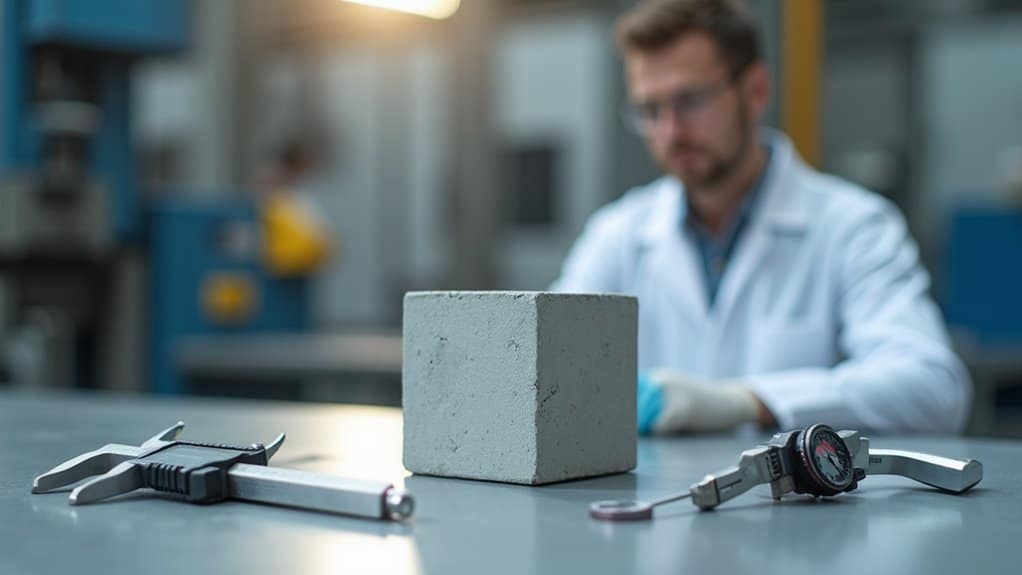
Maintaining quality standards in concrete cube tests is crucial for ensuring structural integrity and compliance with specified requirements. Adhering to established standards, such as those set by the British Standards Institution (BSI), is essential for quality assurance in your construction projects. Regular testing not only verifies that concrete meets strength specifications but also offers valuable insights into production quality and consistency.
Here are three key areas to focus on:
- Material Quality: Always use high-grade materials and follow strict quality standards during concrete production.
- Curing Conditions: Ensure controlled curing environments, like water baths, to optimise the curing process for your test cubes.
- Advanced Testing Innovations: Consider using smart sensors for real-time monitoring, which can improve efficiency and reduce the time needed for traditional testing methods. The use of concrete cube tests is a primary method for assessing concrete strength, ensuring long-term durability in construction.
Early Problem Identification
Identifying problems early in concrete cube tests is vital for preserving structural integrity.
By spotting common mix failures at an early stage, you can implement timely preventive measures, saving both time and resources. For instance, if you notice inconsistent air content or water-cement ratio, addressing these issues promptly can prevent costly repairs later on. Prioritising early testing ultimately enhances the quality and lifespan of your construction projects. Additionally, ensuring compliance with standard testing procedures guarantees the reliability of your results.
Early Testing Benefits
How can early problem identification through concrete cube tests revolutionise your construction project? By using early testing technology, you can ensure that concrete strength monitoring is proactive rather than reactive. Identifying issues at an early stage means you can make timely adjustments, protecting your project's integrity.
Here are three key benefits:
- Fewer Delays: Spotting material problems early prevents potential slowdowns, keeping your project on schedule.
- Quick Corrections: You can promptly address any defects or inconsistencies in the mix, ensuring that materials meet the required strength from the start. This is crucial for compliance with safety codes.
- Improved Structural Integrity: Ongoing monitoring of concrete curing allows for immediate adjustments, reinforcing your project's foundation.
Techniques like the maturity method, which estimates strength growth using temperature data, provide reliable results.
Incorporating smart sensors for real-time updates further enhances the efficiency of your construction operations.
Common Mix Failures
Early identification of problems through concrete cube tests not only improves project integrity but also reveals common mix failures that can hinder construction efforts. Recognising these failures is crucial for ensuring a robust structure.
A key issue is the water-cement ratio. Excess water weakens concrete, while insufficient water affects its workability. Poor mixing techniques can also lead to weak concrete, particularly if the mixing time is inadequate. The quality and distribution of materials matter too; using low-grade aggregates or unevenly mixed materials can result in inconsistent strength. Furthermore, issues after mixing, such as improper curing and inadequate compaction, can significantly compromise the final product.
Here's a brief overview of common mix failures:
| Mix Failure | Impact |
|---|---|
| Incorrect Water-Cement Ratio | Weakened concrete, reduced workability |
| Poor Mixing Techniques | Reduced strength and durability |
| Material Quality and Distribution | Inconsistent strength and appearance |
Preventive Measures Implemented
Implementing preventive measures through concrete cube testing significantly improves the early identification of potential issues in the construction process.
By adopting proactive testing strategies, you ensure compliance with standards and protect the integrity of your structures. Early detection is essential for mitigating risks associated with concrete mix failures, which can result in expensive repairs or even the need for reconstruction.
Consider these three vital preventive strategies:
- 7-Day Testing: Conducting tests within the first week helps pinpoint any issues with the concrete mix before the structure is finalised.
- Regular Quality Assurance: Ongoing testing ensures your concrete meets the necessary strength specifications, promoting structural reliability.
- Timely Adjustments: Spotting problems early allows for quick modifications to the concrete mix, improving durability and longevity.
Safety Assurance for Structures

Effective safety assurance for structures is vital in reducing risks during construction activities. To achieve this, implement systematic processes for hazard identification and safety protocols.
Regular safety audits are crucial; they ensure compliance with health and safety regulations and highlight areas for improvement. Conduct thorough risk assessments to identify potential hazards on site, allowing for proactive hazard mitigation strategies.
Develop and maintain emergency plans to effectively address potential accidents. This includes training workers on safety procedures and ensuring clear communication among all parties involved. By fostering a culture of safety, you empower team members to recognise hazards and respond appropriately.
Ongoing monitoring and review of safety protocols are essential to adapt to new challenges in the construction environment. Use performance metrics to assess the effectiveness of your safety management systems, facilitating continuous improvements.
Project Progress Guidance
To ensure smooth project progress, it's essential to understand the timing and requirements for concrete cube tests. These tests can significantly influence construction schedules, so integrating them into your project milestones is crucial. Delays in receiving test results can halt construction and extend timelines.
Here are three key points to keep in mind:
- Standard Testing Times: Concrete cubes are typically tested at 7 and 28 days, but testing at 3 or 14 days can help avoid delays.
- Early Testing Opportunities: If certain criteria are met, you might be able to remove concrete shutters before the 7-day mark, allowing other work to continue.
- Innovative Alternatives: Consider using the Maturity Method, which offers quicker assessments of concrete strength, reducing downtime compared to traditional testing methods.
Concrete Cube Test Procedure

The concrete cube test procedure is crucial for assessing the compressive strength of concrete in construction.
Begin with mould preparation, using moulds that measure 150mm x 150mm x 150mm, which are appropriate for aggregates no larger than 20mm. Pour fresh concrete into the moulds, ensuring thorough compaction to remove any voids. Store the moulds in a controlled environment for 24 hours before moving them to curing baths.
After curing for the designated period—commonly 7, 14, or 28 days—remove the cubes and dry their surfaces. Smooth out any irregularities before testing.
Place the cubes in a calibrated compression machine, ensuring the face being tested is perpendicular to the casting face. The machine will apply load gradually at a rate of 0.6 ± 0.2 MPa/s until the cube fails. Examine the failure shape to check if it meets standards.
Finally, compare the tested compressive strength with the specified requirements, ensuring it meets or exceeds the minimum standards, such as C40/50.
Importance of Curing Process
Understanding the curing process is crucial for achieving optimal concrete strength and quality. Factors like temperature and humidity significantly affect the hydration and hardening of the concrete.
For instance, if it's too hot, the concrete can dry out too quickly, leading to cracks. Similarly, inadequate humidity can hinder proper curing.
The duration of the curing process is also vital; longer curing times generally enhance the durability and performance of your concrete structures.
Prioritising these elements will ensure your projects stand the test of time.
Curing Conditions Impact Strength
Proper curing is essential for achieving optimal concrete strength, as it directly affects hydration and the material's overall performance. The conditions under which you cure concrete significantly influence its properties, particularly compressive strength. Understanding the main hydration factors and employing effective curing techniques can lead to substantial improvements.
Consider these three key aspects:
- Temperature Control: While higher temperatures can speed up hydration, they may also induce thermal stress. Aim for moderate temperatures to enhance strength.
- Humidity Maintenance: Ensuring adequate humidity prevents moisture loss, which is vital for complete hydration. Covering the concrete with wet hessian or polythene sheets can help maintain moisture levels.
- Curing Methods: Various techniques impact strength differently. Immersion in water usually results in higher compressive strength, whereas steam curing can diminish it.
Inadequate curing can lead to reduced strength and increased vulnerability to cracking and durability problems.
By prioritising proper curing conditions, you ensure not only immediate strength but also long-term performance and structural integrity.
Therefore, focusing on the right curing techniques and understanding hydration factors is crucial for any concrete project.
Duration Influences Concrete Quality
Curing duration is crucial for the quality and performance of concrete. The time spent curing directly affects its strength and durability. Ideally, the curing period should match the project requirements, typically set at 7, 14, or 28 days.
| Curing Duration | Expected Compressive Strength |
|---|---|
| 7 days | ~70% |
| 14 days | ~85% |
| 28 days | ~100% |
| Longer | Enhanced durability |
Longer curing times generally result in higher compressive strength due to better hydration and moisture retention. Conversely, inadequate curing can weaken concrete, leading to issues like shrinkage and cracking. While high temperatures can speed up hydration, they may also introduce thermal stress.
Using effective curing methods—such as water immersion or curing compounds—helps maintain moisture for complete hydration. By following the recommended curing durations, you can significantly improve the structural integrity of your concrete, ensuring it can withstand various environmental conditions.
Standard Cube Sizes

The standard cube sizes used in concrete testing are essential for achieving consistent and reliable results. Typically, the standard dimensions are 150 x 150 x 150 mm. These dimensions are dictated by various regulations, including BS EN 12390-1:2000 and IS 456:2000, which also stipulate a maximum aggregate size of 20 mm.
Adhering to these standards ensures uniformity across tests, enabling accurate comparisons of compressive strength.
Here are three important points regarding standard cube sizes:
- Mould Materials: Cubes can be cast in moulds made from steel, heavy-duty steel, or plastic. The choice of material significantly influences the durability and surface finish of the cubes.
- Regulatory Compliance: Following these established dimensions ensures compliance with construction regulations and supports quality control measures.
- Curing Protocols: Sticking to the specified cube sizes facilitates proper curing and testing intervals, typically at 7, 14, and 28 days, to effectively assess concrete strength.
Testing Ages Explained
Understanding testing ages is crucial for accurately assessing concrete strength and ensuring structural integrity.
Typically, you'll concentrate on standard periods of 7 and 28 days, although alternative ages may be required based on specific project needs.
The timing of these tests significantly influences your evaluation of strength development and the overall performance of the concrete.
For instance, if you're working on a project that demands rapid strength gain, you might opt to test at 3 days as well.
Importance of Testing Ages
Testing ages are crucial for assessing concrete strength and ensuring structural integrity throughout a project. Recognising the significance of various testing ages allows for effective methodologies and informed decisions based on age comparisons.
1. Early Testing Ages: Conducting tests shortly after pouring concrete helps forecast its potential strength. This enables prompt adjustments and efficient management when placing large volumes of concrete.
Identifying problems early can prevent costly delays and keep projects on schedule.
2. Standard Testing Ages: Tests are commonly performed at 7 and 28 days to determine if the concrete achieves the specified compressive strength.
This information is vital for ensuring safety and durability, supporting long-term assessments of structural integrity.
3. Extended Testing Ages: Testing beyond the standard ages—such as at 3, 5, or 14 days—offers valuable insights into the concrete's strength development over time.
This is particularly important for projects with specific strength requirements, providing a comprehensive understanding of how concrete behaves under different conditions.
Typical Testing Timeframes
Concrete testing timeframes are set intervals that help assess strength development as the material cures. Standard testing usually occurs at 7 and 28 days, with additional assessments at 3, 5, or 14 days based on project needs. Testing at 7 days is particularly important for determining when to remove formwork, while the 28-day test is primarily for acceptance testing, ensuring compliance with industry standards.
Environmental factors, such as temperature and humidity, significantly influence these timeframes. Weather conditions can affect the curing process, impacting the concrete's strength and durability. It's crucial to maintain consistent curing conditions; for instance, a curing tank should ideally be kept at 20 ± 2 degrees Celsius for accurate results.
Controlling humidity is also vital to avoid unexpected variations in strength. When determining your testing frequency, consider these environmental influences to enhance the reliability of your results.
Impact on Strength Evaluation
When assessing how testing ages affect strength evaluation, it's important to consider how the timing of tests shapes the interpretation of results. The strength of concrete specimens can vary significantly based on their shape, size, and the size of the aggregate used.
Testing at different ages—commonly at 7 and 28 days—offers crucial insights into the concrete's compressive strength.
Here are three key factors to consider:
- Specimen Shape and Size: Different cube sizes can produce varying strength results. For example, a 10 cm cube might demonstrate up to 10% less strength than a 15 cm cube.
- Aggregate Size: The maximum size of aggregates affects the necessary cube size, which in turn influences test results.
- Curing Conditions: Consistent curing practices are vital, as variations in moisture content can lead to discrepancies in strength measurements.
Factors Influencing Test Results

Numerous factors can significantly influence the results of concrete cube tests, affecting both the accuracy and reliability of the outcomes. Understanding these factors ensures that your tests genuinely reflect the concrete's performance.
| Factor | Description | Impact on Results |
|---|---|---|
| Specimen Variability | Differences in size and shape can yield varied results | Affects compressive strength |
| Load Application | The speed at which load is applied can influence strength values | Slow application may lower strength |
| Curing Conditions | Adequate curing is crucial for strength development | Inadequate curing leads to lower strength |
| Material Quality | The quality of materials affects overall concrete strength | Poor materials result in inconsistent outcomes |
Be mindful that specimen variability can lead to marked differences in results. For example, cube dimensions should be consistent with standard sizes (150 x 150 x 150 mm) for reliable results. The rate of load application is also key; applying load too slowly can cause creep, distorting your strength assessment. Ensure consistency across all factors, from compaction methods to machine calibration, to improve the reliability of your results.
Applications in Construction
In construction, concrete cube testing is crucial for ensuring that structures meet safety and performance standards. This testing is essential across various sectors and employs innovative techniques to verify the integrity of concrete, particularly when using sustainable materials.
Here are three key applications of concrete cube testing in construction:
- General Construction: Cube tests ensure that concrete used in building projects meets strength requirements, which is vital for structural safety.
- Infrastructure Development: For projects such as bridges and roads, testing confirms that concrete can withstand heavy loads and harsh environmental conditions, thus enhancing durability and longevity.
- Quality Control: Concrete cube testing plays a vital role in quality control. It checks that the concrete mix, often containing sustainable materials, complies with specified guidelines, leading to high-quality results.
Regulatory Compliance Standards

Concrete cube testing is vital in the construction industry, ensuring compliance with stringent regulatory standards. Adhering to guidelines such as BS EN 12390-2 and BS EN 12390-3 is crucial for accurate and dependable test results. These standards specify how concrete cubes should be prepared and cast, including their dimensions.
However, keeping up with regular updates to these regulations can be challenging, so it's essential to stay informed.
Testing facilities must have UKAS accreditation, which confirms they meet the required technical and quality assurance standards. This accreditation helps mitigate risks associated with subpar construction, giving you confidence in the results you receive.
Regulatory bodies like the British Standards Institute (BSI) play a key role in setting these standards, ensuring safety and performance in your construction projects.
Quality Control Measures
Quality control measures are crucial for ensuring the reliability and durability of concrete through effective testing and assessment practices. Implementing strong quality assurance protocols allows you to monitor the concrete's performance at different stages.
Here are three essential aspects of quality control measures:
- Sampling and Preparation: Use two or three cube moulds as per customer requirements. Ensure proper preparation by pouring concrete in layers, compacting it to eliminate air pockets, and curing the cubes submerged in water for 7 and 28 days.
- Testing Methodologies: Carry out compression testing at 7 and 28 days to assess early strength and overall durability. Adhere to established standards, such as BS EN 12390-1:2000 and BS EN 12390-2:2009, to ensure compliance and dependable results.
- Continuous Monitoring: Employ nondestructive testing (NDT) techniques for ongoing assessments of concrete strength. Involve construction engineers and quality control specialists to oversee the process and uphold strict quality standards.
Calibration and Certification

Reliable concrete testing relies on effective calibration and certification processes to ensure accurate assessments of strength and durability. Proper calibration techniques are essential for testing concrete cubes, which are usually 150mm x 150mm, under standardised conditions.
Calibration boxes are crucial for accurately measuring strength development as cubes are cured and tested at different intervals. Certification standards must be upheld, with accredited laboratories performing and certifying concrete cube tests to ensure compliance with industry regulations.
Following standard testing protocols is vital for delivering consistent and reliable results, which are key for quality control. Regular calibration of testing equipment and boxes is necessary to maintain accuracy and prevent discrepancies that could lead to incorrect predictions about concrete strength.
Be mindful of challenges such as variations in aggregate size and environmental factors that can impact test outcomes. By adhering to strong calibration and certification processes, you can improve the reliability of concrete tests, ensuring your construction projects meet all necessary specifications and standards.
Frequently Asked Questions
What Materials Are Typically Used for Concrete Cube Testing?
For concrete cube testing, you'll usually use moulds made from steel, polyurethane, or plastic. It's essential to prepare the samples properly by cleaning and oiling the moulds to ensure accurate and reliable results during your assessments.
How Often Should Concrete Cube Tests Be Conducted During a Project?
Concrete cube tests should be carried out in line with established testing frequency guidelines to ensure quality assurance. Typically, you should sample every 100 cubic metres of concrete, or adjust based on the specific requirements of your project. For example, if you're working on a large commercial build, you might need to test more frequently to maintain high standards. This approach helps confirm that the concrete meets the necessary strength criteria.
Can Concrete Cubes Fail Without Visible Cracks?
Yes, concrete cubes can fail without any visible cracks. This can happen due to internal defects or issues like poor mix design, improper sampling, or substandard materials. For example, if the concrete wasn't mixed properly, it might not achieve the expected strength, leading to unexpected failures during testing.
What Is the Role of Temperature During Curing?
Temperature during curing is crucial; it can either speed up strength development or cause long-term issues like cracking and reduced durability. For instance, high temperatures can accelerate hydration, leading to quicker strength gains, but if not managed properly, it can compromise the material's integrity. It's essential to monitor curing conditions closely to achieve optimal results.
Are There Alternative Methods to Assess Concrete Strength?
Yes, there are alternative methods to assess concrete strength, such as non-destructive testing techniques like rebound hammer tests and ultrasonic pulse velocity. These methods allow for effective evaluation without damaging the structure. They improve accuracy and efficiency, making it easier to assess concrete in construction projects. For instance, a rebound hammer can quickly give an indication of surface hardness, while ultrasonic tests can measure internal quality.
Conclusion
In summary, concrete cube tests are essential in the construction industry, ensuring that your structures have the required strength and durability. These tests help maintain quality standards and identify potential problems before they become serious. For instance, a foundation that appears solid may have hidden weaknesses. By prioritising these assessments, you protect your investment and ensure safety. The integrity of your construction depends on these vital evaluations—don't take chances with it.

Learn about the diverse types of concrete used in construction and discover which mix can transform your next project.

For a long-lasting driveway that laughs in the face of the UK's unpredictable weather, the C20 concrete mix is your Read more

In the UK, you've got a a lot of lightweight concrete types to choose from, each with its unique perks. Read more