To optimise water content in concrete mixes, start by understanding the water-to-cement ratio, which should ideally be between 0.40 and 0.60. Water is crucial for cement hydration, creating strength-enhancing compounds like C-S-H gel. Consider factors such as aggregate properties, environmental conditions, and desired workability.
You can improve the mix by adjusting aggregate gradation, using high-range water reducers, and adding supplementary materials. These methods not only enhance strength and durability but also support sustainability. For best results, explore various techniques and insights that can help refine your concrete mixes.
Key Takeaways
- Establish an optimal water-to-cement ratio (w/c) between 0.40 and 0.60 to achieve the desired strength and durability in your concrete mixes.
- Evaluate the moisture content and shape of aggregates to accurately adjust the water demand for the mix.
- Use high-range water reducers (HRWRAs) to improve workability while reducing water usage, ensuring strength remains uncompromised.
- Add supplementary cementitious materials (SCMs) to enhance fluidity and lower the overall water content needed.
- Perform thorough testing to monitor and optimise water content, guaranteeing consistency and performance in the final concrete product.
Understanding the Water-to-Cement Ratio

When designing a concrete mix, understanding the water-to-cement ratio (w/c) is crucial as it significantly impacts the material’s strength and durability.
This ratio, expressed as the mass of water divided by the mass of cement, typically falls between 0.40 and 0.60. For example, a w/c ratio of 0.4 means mixing 40 kg of water with every 100 kg of cement.
A lower w/c ratio improves compressive strength and durability by minimising porosity, while a higher ratio can weaken these properties. Lower w/c ratios are essential for achieving higher strength and durability in concrete.
It’s important to balance mix consistency with strength; too much water can lead to weaker concrete.
Therefore, making careful adjustments within practical limits is key for optimal performance and longevity of your concrete structures.
The Role of Water in Cement Hydration
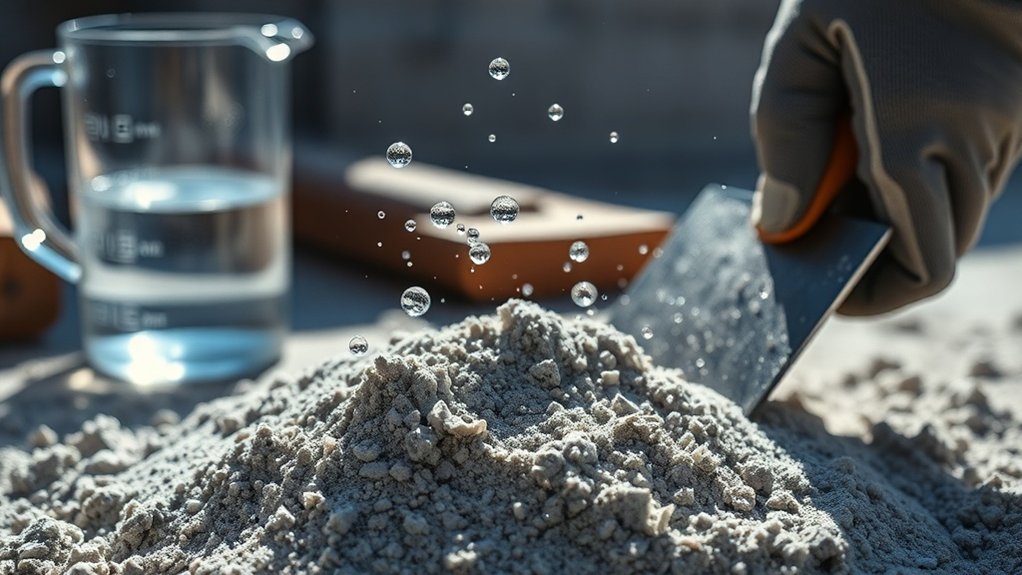
Water is crucial in cement hydration, kickstarting a series of heat-producing reactions that turn cement into a strong, cohesive material. The chemistry of hydration is vital for developing the microstructure of concrete, which directly affects its strength and durability.
- It triggers rapid chemical reactions when mixed.
- It forms essential hydration products, such as calcium silicate hydrate (C-S-H) gel.
- The amount of water influences how quickly and thoroughly hydration occurs.
- It’s essential for creating a dense crystal matrix in the concrete.
- It affects compressive strength and the concrete’s ability to withstand environmental challenges.
Using too little or too much water can disrupt the hydration process, resulting in weak, porous concrete. Additionally, the presence of hydration products such as ettringite and C-S-H is heavily dependent on the water-to-cement ratio used.
Therefore, optimizing water content is key to achieving the desired properties and performance of concrete.
Factors Influencing Water Content in Concrete

Several key factors affect the water content in concrete mixes, which in turn influences workability, strength, and durability. For instance, if you require high workability—such as for complex placements or pumpable concrete—more water is necessary. It’s also important to consider the moisture content of aggregates; dry aggregates can soak up more water, increasing the overall demand. The shape and size of aggregates matter too; angular particles typically need more water to achieve the same workability as rounded ones. Environmental factors, like high temperatures or low humidity, can speed up evaporation, requiring adjustments to the water content. Additionally, the type and fineness of cement can affect water needs, often increasing demand unless you use admixtures to counterbalance this. Maintaining strict quality control during batching is vital to avoid excessive water additions, which could compromise the integrity of the concrete. Moreover, ensuring a proper water-cement ratio is essential for achieving the desired strength levels in the final concrete product.
Methods for Optimizing Water Content
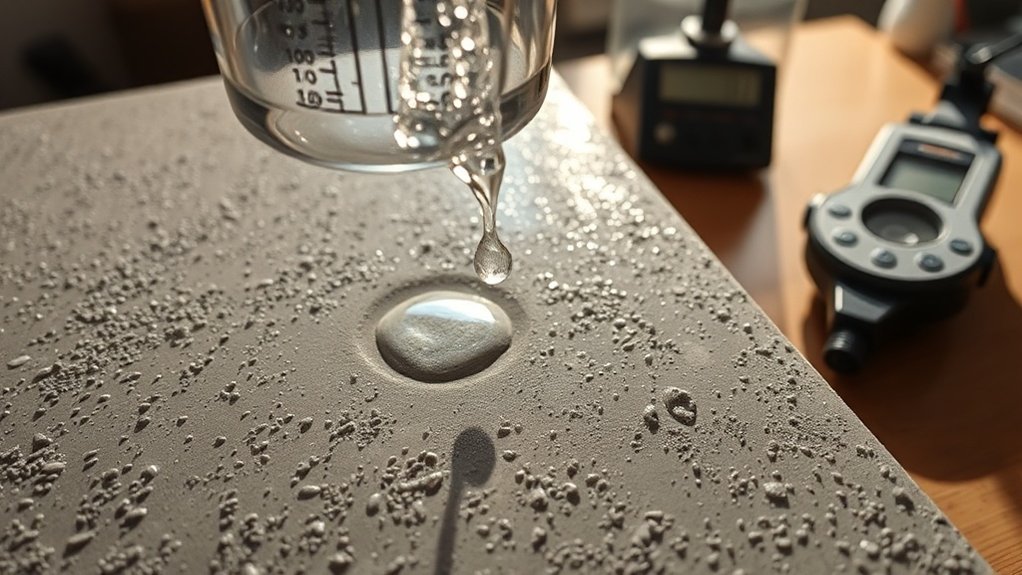
Optimising water content in concrete mixes is essential for achieving the desired characteristics like strength, workability, and durability.
Here are some effective methods to strike the right balance:
- Utilise advanced testing systems for accurate measurement of the water/cement (w/cm) ratio.
- Optimise aggregate gradation to reduce voids, minimizing excess flowability.
- Adjust the volume of paste by balancing the amounts of cementitious materials and mixing water.
- Incorporate supplementary cementitious materials to enhance fluidity while reducing water content.
- Use high-range water reducers (HRWRAs) to maintain workability with less water.
These approaches can significantly improve the performance of your concrete mixes.
Sustainability and Performance in Concrete Mix Design
As the push for sustainable construction grows, integrating sustainability into concrete mix design is vital for both environmental performance and structural integrity.
Using sustainable materials, such as supplementary cementitious materials (SCMs) like fly ash and slag cement, can significantly reduce CO₂ emissions while enhancing the long-term strength and durability of concrete.
Recycled concrete aggregates help conserve natural resources and cut down on landfill waste.
Optimising your mix design not only reduces the amount of concrete needed—lowering material consumption by 10-15%—but also improves workability and resistance to damage.
This leads to longer-lasting structures with reduced maintenance needs, aligning with eco-friendly goals and promoting a more sustainable construction industry.
Frequently Asked Questions
How Does Water Content Affect Concrete Setting Time?
Water content significantly influences the setting time of concrete by affecting how water is retained during hydration. When there is too much water, it can slow down the hydration process, leading to delays in both the initial and final setting times. In contrast, lower water levels can encourage quicker setting, but this may compromise the workability of the mix. For instance, if you’re mixing concrete for a patio, too much water could mean a longer wait before you can walk on it, while too little might make it difficult to spread evenly. Balancing water content is crucial for achieving the desired results.
Can High Water Content Lead to Cracking?
Yes, high water content can cause cracking. Poor water quality in your mix design creates weak points, similar to dry riverbeds during a storm, which increases tensile stress and ultimately leads to unsightly plastic and drying cracks.
What Is the Ideal Slump Value for Different Applications?
For slump testing, the ideal values differ depending on the application: 25-75 mm for foundations, 75-100 mm for beams, 25-50 mm for pavements, and 75-125 mm for retaining walls. These ranges ensure the right workability and structural strength for each use.
How Do Temperature Changes Impact Water Requirements?
Temperature changes can significantly affect the water requirements for concrete. When temperatures rise, the rate of evaporation increases, which means you’ll need to adjust the water content to keep the mix workable. For instance, on a hot day, you might find that your concrete sets too quickly or shrinks if you don’t add enough water. It’s important to consider humidity as well, as it can further influence how much moisture your concrete needs.
What Tests Assess Water Content in Concrete Mixes?
To assess water content in concrete mixes, you can use direct methods like oven drying and microwave drying. Alternatively, hand-held moisture meters provide an indirect measurement. These tests are essential for ensuring the durability and performance of concrete. For instance, using a moisture meter can quickly give you an idea of the mix’s moisture level without the need for extensive drying processes.
Conclusion
In summary, optimising water content in concrete mixes is crucial for achieving durability and strength. Some may think that adding more water always improves workability, but this is a misconception; excess water can compromise the final product. By carefully balancing the water-to-cement ratio and taking environmental factors into account, you can improve both performance and sustainability. It’s not just about adding water—it’s about recognising its role in hydration and the overall concrete mix design for lasting results.

Learn about the diverse types of concrete used in construction and discover which mix can transform your next project.

For a long-lasting driveway that laughs in the face of the UK's unpredictable weather, the C20 concrete mix is your Read more

In the UK, you've got a a lot of lightweight concrete types to choose from, each with its unique perks. Read more