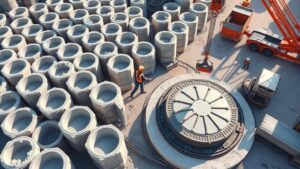
The development of Portland cement transformed construction. Originating in 18th-century Britain, Joseph Aspdin patented it in 1824, which was a pivotal moment for building technology. Figures like William Aspdin and Isaac Johnson improved its production, making it stronger and more versatile. By the late 19th century, its global use soared thanks to innovative manufacturing methods and large infrastructure projects, shaping cities and driving economic growth. The impact of Portland cement on society is significant and far-reaching.
Key Takeaways
- Joseph Aspdin patented Portland cement in 1824, naming it after Portland stone because of their similar appearance.
- Innovations by William Aspdin and Isaac Johnson enhanced the quality and strength of cement through higher-temperature processing and improved production techniques.
- By the late 19th century, Portland cement gained worldwide popularity, thanks to rotary kilns that made production more efficient for large infrastructure projects.
- The Portland Cement Association established standards that supported local production and ensured consistent quality in cement manufacturing.
- The introduction of Portland cement revolutionised construction, leading to rapid housing development and creative architectural designs that transformed urban areas.
Early Beginnings of Portland Cement

The origins of Portland cement can be traced back to natural cements in 18th-century Britain, but its transformation into a crucial construction material involved several significant developments.
Initially, ancient materials like limestone and clay were mixed to create natural cements, which set the stage for future innovations. A major breakthrough came in 1824 when Joseph Aspdin patented a hydraulic cement by heating a blend of these materials, resulting in a strong, durable product. Portland cement is defined as a hydraulic cement made from pulverizing clinker, which consists mainly of crystalline hydraulic calcium silicates. James Frost’s British cement in 1811 also played a role in this evolution. By the 1850s, Portland cement—named for its similarity to Portland stone—surpassed Roman cement in both strength and versatility, becoming the preferred material for construction and driving further improvements in manufacturing methods.
Key Figures in Portland Cement History

As you delve into the key figures in the history of Portland cement, you’ll discover the groundbreaking experiments and innovations that have shaped its evolution.
Joseph Aspdin’s patent in 1824 was a pivotal moment, while his son William pushed the technology further with higher-temperature processing. Cement usage dates back to 12,000 years ago, showcasing the long-standing importance of this material in construction.
Each individual not only made significant contributions but also left a lasting impact on modern construction practices.
Pioneering Early Experiments
The development of Portland cement features several key figures whose early experiments laid the groundwork for modern construction materials.
Their innovative techniques significantly transformed the industry:
- Joseph Aspdin (1824): He experimented by burning limestone and clay, naming his creation after Portland stone.
- William Aspdin (Mid-19th Century): He refined the manufacturing process, producing alite and standardising cement production.
- Isaac Johnson (1845): He increased firing temperatures, resulting in stronger, more reliable cement through clinkering.
- David O. Saylor (1875): He created the first U.S. Portland cement using local materials, gaining recognition at the Centennial Exhibition. This achievement was made possible due to the suitability of Lehigh deposits for producing high-quality cement.
These early experiments highlighted their dedication to innovation, ultimately leading to stronger and more consistent construction materials.
Key Patents and Innovations
Key patents and innovations have significantly influenced the evolution of Portland cement, making it essential in modern construction. Joseph Aspdin’s 1824 patent was a turning point, as he named the product “Portland cement” to highlight its superior quality. This marked the beginning of a series of important developments, such as Louis Vicat’s creation of hydraulic binders in 1817, which were crucial for underwater applications.
In 1843, William Aspdin improved the production process by using higher temperatures for clinker, resulting in better cement quality. Edgar Dobbs’ patent in 1811 showcased the competitive nature of the industry, while James Frost established a British cement factory in 1826, further underscoring the importance of these innovations.
Collectively, these advancements have formed the foundation of the durable materials we use today.
Lasting Influence on Construction
The construction industry has seen many innovations, but the impact of key figures in the development of Portland cement is particularly significant. Their contributions not only changed building materials but also set the stage for sustainable practices and future advancements.
Here are four major influences:
- Durability: Portland cement is known for its exceptional strength and longevity, setting new standards in construction.
- Standardisation: Early initiatives established quality standards, ensuring consistency across the sector.
- Infrastructure: The use of cement in large-scale projects spurred urban development and modernization.
- Accessibility: The availability of inexpensive raw materials allowed for mass production, leading to widespread use.
These advancements continue to shape modern practices and innovations, making Portland cement an essential element of contemporary construction. Additionally, the carbon footprint associated with cement production highlights the need for ongoing innovations to promote environmental sustainability.
The Spread of Portland Cement Use

As infrastructure needs grew in the late 19th and early 20th centuries, Portland cement became the preferred material for construction.
The advent of reinforced concrete enabled innovative designs and larger buildings, leading to its widespread use worldwide.
This shift not only changed urban environments but also positioned cement as a fundamental element of modern engineering. Additionally, the development of precast concrete panels facilitated quicker assembly and improved construction efficiency, further solidifying cement’s role in contemporary projects.
Infrastructure Project Demands
By the mid-19th century, the demand for Portland cement increased significantly as its superior hydraulic properties began to replace earlier cements in construction. This transition tackled various infrastructure challenges and broadened the applications of cement.
Key factors driving this change include:
- Versatility: Portland cement’s adaptability made it ideal for a range of projects, from bridges to sewage systems.
- Durability: Its long-lasting nature ensures that structures can endure the test of time and environmental pressures.
- Technological Advances: Innovations in production methods, such as the rotary kiln, enhanced efficiency and quality.
- Global Adoption: By the early 20th century, it emerged as the primary material in the UK, cementing its role in modern construction.
These aspects highlight why Portland cement is crucial for today’s infrastructure projects. Additionally, the focus on sustainable concrete materials is becoming increasingly important as the construction industry seeks to reduce its environmental impact.
Reinforced Concrete Impact
Reinforced concrete has transformed the construction industry, significantly increasing the use of Portland cement in various applications. By combining the compressive strength of concrete with the tensile strength of steel reinforcement, reinforced concrete has facilitated numerous structural advancements. Its impact is evident in many construction projects that rely on reinforced concrete for durability and resilience.
| Reinforced Concrete Applications | Benefits |
|---|---|
| Bridge decks | Enhanced load-bearing capacity |
| Industrial floors | Improved fatigue resistance |
| Earthquake-resistant structures | Increased safety |
| Large-scale infrastructure | Long lifespan |
| Underwater construction | Excellent hydraulic properties |
The versatility of reinforced concrete has driven the demand for Portland cement, enabling it to perform well in diverse environments and meet the needs of growing urban areas.
Global Adoption Trends
The rapid global adoption of Portland cement, especially from the late 19th century, marks a significant change in construction practices driven by technological advancements and urgent infrastructural demands.
Here are some key trends and adoption patterns from this period:
- The introduction of the rotary kiln improved production efficiency, making cement more widely available.
- Major infrastructure projects, such as sewage systems in London and Paris, increased demand.
- By the end of the century, hollow concrete blocks revolutionised housing construction.
- The establishment of standards by the Portland Cement Association boosted domestic production in the UK.
Technological Advancements in Production

Technological advancements have significantly transformed cement production, with innovations such as the rotary kiln and the Hoffmann kiln playing pivotal roles.
The rotary kiln, patented by Frederick Ransome in the late 19th century, allowed for continuous production and enabled precise temperature control, which is crucial for forming strong clinker. This innovation increased production efficiency and reduced fuel consumption compared to earlier static kilns.
On the other hand, the Hoffmann kiln featured an endless design that improved combustion control and ensured uniform clinker burning.
Together, these technologies enhanced the quality of Portland cement and established the foundation for modern manufacturing practices, enabling the industry to meet growing demands while upholding high standards of durability and performance.
Industrialization and Production Expansion

With advancements in kiln technology, the industrialisation of Portland cement production accelerated in the late 19th century.
Significant changes in production techniques emerged, particularly with the expansion of plants like Coplay.
Key developments included:
- The introduction of continuous kilns in the 1890s, allowing for uninterrupted production.
- The transition from vertical shaft to rotary kilns, which improved efficiency and product consistency.
- The involvement of chemists in quality control, who adjusted mixture proportions several times a day.
- The rapid growth of regional plants across the UK, meeting domestic demand and reducing reliance on imports.
These innovations not only increased output but also revolutionised industrial practices, laying the foundation for the modern cement industry.
Impact on Construction and Society

Portland cement has not only changed the face of construction but has also had a significant impact on societal development. Its capacity to accommodate rapid urbanisation has transformed cities, paving the way for mass housing projects and modern infrastructure that enhance public health and safety. The material’s durability and affordability have driven economic changes, resulting in millions of jobs and contributing to a multi-trillion-pound global construction industry. The transition from load-bearing walls to skeletal structures has enabled innovative architectural designs, fostering creativity and modernisation across various sectors.
| Urbanisation Effects | Economic Transformations | Societal Improvements |
|---|---|---|
| Accelerated housing development | Reduced building costs | Improved public health systems |
| Enhanced sanitation | Job creation | Better community facilities |
| Upgraded infrastructure | Increased trade | Greater disaster resilience |
| Connected remote regions | Stimulated local economies | Safer public spaces |
| Encouraged regional integration | Boosted investment returns | Enhanced educational facilities |
Environmental Considerations

The environmental impact of Portland cement production underscores the pressing need for sustainable practices in an industry responsible for around 8% of global CO2 emissions.
To tackle these issues effectively, consider the following:
- Energy Efficiency: Using energy-efficient kilns can significantly cut down the carbon footprint.
- Alternative Materials: Investigating green cement alternatives can help reduce resource use and emissions.
- Water Management: Implementing water-saving technologies addresses the high water consumption linked to cement production.
- Regulatory Compliance: Adhering to stricter emissions standards can greatly reduce pollutants such as sulphur dioxide and nitrogen oxides.
Historical Significance of Portland Cement

Portland cement may seem like a modern construction essential, but its historical significance is profound. Originating from innovations in the 18th century, it played a crucial role in architectural development, enabling the construction of sturdy buildings that shaped urban environments.
The transition from natural to artificial hydraulic cements not only improved material properties but also had significant socioeconomic effects, driving industrial growth and large-scale infrastructure projects. By standardising production and increasing availability, Portland cement became a key component of contemporary building methods.
This adaptability led to the rise of reinforced concrete, transforming construction practices and supporting the rapid urbanisation we see today. Its legacy is a fundamental part of modern engineering.
Frequently Asked Questions
What Are the Main Ingredients in Portland Cement?
The main ingredients in Portland cement are limestone, clay, and iron ore. These materials provide essential calcium oxide and silica. Typically, its chemical composition contains 61-67% CaO and 19-23% SiO2, which are crucial for the strength and durability of the cement.
How Does Portland Cement Differ From Other Types of Cement?
Portland cement stands out for its strength and reliability, much like a robust oak among delicate saplings. While alternative cements, such as slag and pozzolanic types, offer their own advantages, they often can’t match the consistent performance of Portland cement. If you’re looking for durability in construction, Portland cement remains the go-to choice.
What Are the Health Risks Associated With Cement Production?
Cement production poses serious air pollution risks, which can lead to respiratory issues such as chronic bronchitis and lung cancer. Inhaling cement dust regularly can result in severe health complications, highlighting the need for strict safety measures and ongoing monitoring.
How Is Portland Cement Transported and Stored?
Portland cement is transported in bulk using pneumatic systems for efficient unloading. It is stored in silos or airtight containers to prevent moisture exposure. Proper coordination during transport and storage is essential, as it significantly affects the quality of the cement and, consequently, the performance of the concrete.
What Are the Future Trends in Cement Technology?
As the saying goes, “The future belongs to those who prepare for it.” In the coming years, we can expect sustainable practices and innovative formulations to shape cement technology. This will enhance efficiency, reduce emissions, and support global decarbonisation efforts. For instance, the use of alternative raw materials and carbon capture technologies will play a significant role in making cement production more environmentally friendly.
Conclusion
Understanding the journey of Portland cement reveals that it is more than just a building material; it is fundamental to modern society. As the saying goes, “Rome wasn’t built in a day,” and our infrastructure has similarly evolved over time. The innovations and widespread use of Portland cement have transformed our cities and everyday lives. As we consider its historical importance, we must also think about how to balance progress with environmental responsibility for future generations.

Journey through the fascinating evolution of concrete, from ancient Roman innovations to modern sustainable practices, and discover what lies ahead Read more

Advancing construction techniques, Ultra-High-Performance Concrete (UHPC) promises unmatched durability and efficiency, but what groundbreaking innovations lie ahead?

Mastering Ultra-High-Performance Concrete (UHPC) reveals groundbreaking advantages in construction, but what secrets lie behind its remarkable strength and versatility?