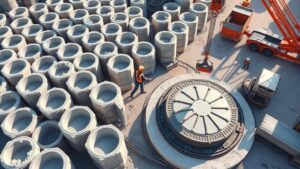
You’ll find C40 concrete essential for structures requiring high durability and strength. Its mix, characterised by a high compressive strength of 40 megapascals, is tailored for heavy-duty applications. This includes commercial and industrial construction where safety and longevity under extreme conditions are paramount. Importantly, its resistance to chemical attacks and severe weather makes it ideal for heavy-duty flooring, secure foundations, and even blast-resistant structures. Additionally, the robust nature of C40 reduces maintenance needs, enhancing its cost-effectiveness over the long term. Understanding its mix design and specific applications ensures you leverage its advantages for demanding projects, paving the way to explore even more of its capabilities.
Key Takeaways
- C40 concrete is used for heavy-duty foundations and infrastructure projects.
- Ideal for commercial and industrial construction due to its high strength.
- Suitable for environments requiring chemical and environmental resistance.
- Applied in specialised industrial uses, including heavy-duty flooring and blast-resistant structures.
- Utilised in projects demanding extreme weather resistance and high load-bearing capacity.
Introduction
Understanding concrete grades is essential as they determine the material’s strength and durability for various construction applications.
C40 concrete stands out due to its high-grade characteristics, offering enhanced strength and resilience compared to lower grade concretes.
You’ll find its unique properties make it suitable for a range of demanding environments and structural requirements.
Brief explanation of concrete grades and their importance
In the domain of construction, concrete grades, including C40, serve as crucial indicators of the material’s strength and suitability for various applications. These grades gauge the concrete’s compressive strength, fundamentally determining its ability to withstand loads. Specifically, the grade like C40 reflects a particular mix design, achieving a specified 28-day strength, essential for structural support and foundations requiring high load-bearing capacity. The water/cement ratio plays a critical role in defining these grades, directly influencing the concrete’s final strength.
| Concrete Grade | Primary Use |
|---|---|
| C10 | Non-structural, light-duty applications |
| C25 | Light foundations, footings, residential floors |
| C40 | Heavy-duty foundations, structures with high load requirements |
| C60 | Specialised applications requiring extreme strength |
Specific focus on C40 concrete and its unique characteristics
C40 concrete, known for its exceptional strength and durability, is specifically designed to meet the rigorous demands of heavy-duty construction projects. This grade of concrete stands out for its:
- Chemical resistance, making it ideal for industrial environments where exposure to corrosive substances is common.
- Environmental resistance, guaranteeing longevity and maintaining structural integrity despite harsh conditions.
- Extreme weather resistance, offering reliability in climates that experience severe changes.
C40 concrete’s unique blend provides a robust foundation for heavy-duty flooring, loading docks, blast-resistant structures, and high-security barriers. Its superior performance with regards to chemical and environmental resistance not only enhances durability but also ensures the safety and longevity of structures designed to withstand or operate in extreme conditions.
Technical Specifications of C40 Concrete

You’ll find that the technical specifications of C40 concrete pivot on its composition and mix design, which directly influence its compressive strength. This grade of concrete boasts a robust framework, providing high durability and resistance against various environmental stressors.
Understanding these core attributes is essential for optimising its application in demanding construction scenarios.
Composition and mix design
You’ll find that the composition and mix design of C40 concrete hinge critically on its cement content and water/cement ratio, as well as the aggregate size and proportions. These elements are finely balanced to achieve the high strength and durability characteristics required of C40 concrete.
Adjusting these parameters can greatly impact the concrete’s performance, making precision in their specification essential.
Cement content and water/cement ratio
To achieve the desired strength and durability of C40 concrete, it’s crucial to carefully balance the cement content with the water/cement ratio in its mix design.
- Cement content: Ideal levels guarantee higher performance compared to C20 or C30 concrete.
- Water/cement ratio: Vital for quality control, influencing durability.
- Supplementary cementitious materials: Improve performance, offering sustainable alternatives to high-cement mixes.
Aggregate size and proportions
After addressing the cement content and water/cement ratio, it’s important to focus on the aggregate size and proportions, which play a significant role in the composition and mix design of C40 concrete. Optimising these parameters guarantees the material meets the high performance requirements of commercial, industrial, and infrastructure projects.
Proper aggregate size and proportions enhance placement, finishing, and curing techniques, crucial for large-scale projects’ success.
Compressive strength
You must understand that compressive strength defines the capacity of C40 concrete to resist forces pushing it together before failing. Specifically, C40 achieves its designated strength of 40 MPa (megapascals) or 40 N/mm² after 28 days of curing.
This characteristic distinguishes it from other common grades like C20 and C30, offering insights into its superior performance in demanding applications.
Definition of compressive strength
Understanding compressive strength is vital as it defines the ability of C40 concrete to withstand loads without failing. This characteristic is essential for:
- Ensuring concrete durability and extending its lifecycle
- Supporting structural integrity in footings, beams, and columns
- Facilitating innovative construction of highways and bridges
C40 concrete’s compressive strength enhances cost-effectiveness, sustainability, and innovative possibilities in construction projects.
C40’s strength at 28 days (40 MPa/40 N/mm2)
C40 concrete achieves its characteristic compressive strength of 40 MPa, or 40 N/mm², at 28 days, a key indicator of its robustness and durability for structural applications.
Its superior strength makes it ideal for demanding environments like wastewater treatment, agricultural facilities, chemical plants, and coastal defences, including seawalls and roads.
You’ll find it in industrial factories too, where its freeze-thaw and fire resistance minimise environmental impact.
Comparison to other common grades (C20, C30, etc.)
When comparing C40 concrete to other common grades, such as C20 and C30, it’s important to note its significantly higher compressive strength which marks it as superior for certain structural applications.
- Increased temperature resistance and reduced curing time cater to efficient construction of airport runways and taxiways.
- Lower material costs and reduced maintenance over time, ideal for pavements and overpasses.
- Adaptability with emerging technologies guarantees durability in tunnels.
Durability and resistance properties
You’ll find that C40 concrete’s durability and resistance properties are essential for its applications. It’s resistant to chemical corrosion and environmental factors, ensuring structures withstand harsh conditions.
Additionally, the longevity and lifecycle of C40 concrete structures are greatly enhanced, attributing to its robust composition.
Resistance to chemical corrosion and environmental factors
Among its various technical specifications, C40 concrete’s resistance to chemical corrosion and environmental factors stands out as a key attribute for its durability and reliability in harsh conditions.
- Septic tanks and manure pits benefit from its robustness against aggressive chemicals.
- Barns and silos leverage its environmental resilience, meeting diverse project requirements.
- Ideal for 3D printing and precast elements, where concrete specialists seek precise, durable solutions.
Longevity and lifecycle of C40 concrete structures
C40 concrete structures are designed to achieve an extended lifespan, thanks to their enhanced durability and resistance to various stressors. This high-strength mix withstands significant mechanical stress and harsh environmental conditions, ensuring longevity.
Its composition reduces permeability, protecting against corrosion and freeze-thaw cycles. You’ll find C40’s robustness ideal for demanding engineering projects, offering a lifecycle that surpasses standard concrete grades.
Primary Applications of C40 Concrete

You’ll find that C40 concrete is integral to commercial and industrial construction due to its high strength and durability.
It’s also essential in infrastructure projects, where its robustness meets the demands of heavy loads and environmental stressors.
Additionally, specialised industrial uses and other heavy-duty applications benefit from its superior performance characteristics.
Commercial and industrial construction
In commercial and industrial construction, you’ll find C40 concrete at the core of multi-story buildings, particularly in their foundations and footings. It provides the essential structural support for beams and columns, ensuring stability and durability.
Additionally, its application extends to heavy-duty flooring and loading docks, accommodating high traffic and loads with unparalleled strength.
Foundations and footings for multi-story buildings
For constructing the robust foundations and footings required by multi-story buildings in commercial and industrial projects, architects and engineers often specify C40 concrete due to its high strength and durability.
- High Compressive Strength: Guarantees longevity under heavy loads.
- Resistance to Weathering: Withstands harsh environmental conditions.
- Versatility in Application: Adaptable for complex foundation geometries.
Structural support beams and columns
Building on the foundation of C40 concrete‘s use in multi-story construction, its application extends to creating robust structural support beams and columns in commercial and industrial projects.
This high-strength mix guarantees durability and withstands significant loads, essential for the structural integrity of large buildings.
Its resistance to environmental stressors makes it an ideal choice for supporting frameworks that demand long-term reliability and safety.
Heavy-duty flooring and loading docks
Why should you consider C40 concrete for heavy-duty flooring and loading docks?
- High load-bearing capacity: C40 concrete’s strength makes it ideal for areas subjected to heavy loads.
- Durability under extreme conditions: It withstands mechanical wear and environmental factors, guaranteeing longevity.
- Enhanced safety: Its resistance to crack propagation minimises the risk of accidents, providing a safer workplace environment.
C40’s technical properties guarantee reliability in demanding commercial and industrial settings.
Infrastructure projects
In the domain of infrastructure projects, C40 concrete‘s robust characteristics make it ideal for highways, roads, and pavements subjected to heavy traffic. Its high durability and strength guarantee long-term performance in bridges, overpasses, and tunnels, where structural integrity is paramount.
Additionally, airport runways and taxiways benefit from C40 concrete’s ability to withstand the intense loads and stress from aircraft operations.
Highways, roads, and pavements with heavy traffic
C40 concrete’s high strength and durability make it an essential choice for constructing highways, roads, and pavements subjected to heavy traffic.
- Withstands Heavy Loads: Ideal for areas experiencing frequent heavy vehicle traffic.
- Longevity: Offers enhanced resistance to weathering and wear, ensuring a longer lifespan.
- Maintenance Reduction: Its robustness reduces the need for frequent repairs, cutting down maintenance costs and disruptions.
Bridges, overpasses, and tunnels
Bridges, overpasses, and tunnels, critical to modern infrastructure, rely heavily on C40 concrete for their construction due to its superior strength and durability.
This concrete grade withstands extreme loads and environmental conditions, ensuring long-term stability and safety.
Its robustness makes it ideal for supporting the significant weight and traffic these structures bear, offering a reliable solution for complex engineering challenges in infrastructure development.
Airport runways and taxiways
For airport runways and taxiways, the resilience and strength of C40 concrete prove essential, accommodating the immense pressures from aircraft landings and takeoffs.
- Durability: Withstands heavy, repetitive loads without significant degradation.
- Longevity: Offers extended service life under harsh weather conditions and jet fuel exposure.
- Safety: Enhances skid resistance, reducing the risk of accidents during critical landing and takeoff phases.
Specialised industrial uses
You’ll find C40 concrete’s resilience pivotal in specialised industrial applications, where its strength and durability are non-negotiable.
For wastewater treatment plants and septic tanks, it guarantees structural integrity against harsh chemicals and heavy loads.
Similarly, agricultural facilities and chemical plants benefit from its robustness, safeguarding against environmental and operational stresses.
Wastewater treatment plants and septic tanks
In wastewater treatment plants and septic tanks, C40 concrete serves as a fundamental component due to its high strength and durability, ensuring these facilities can withstand harsh chemical environments and high loads.
- High Load Capacity: Essential for supporting the weight of water and equipment.
- Chemical Resistance: Shields against corrosive substances.
- Durability: Offers longevity in demanding conditions, reducing maintenance and replacement costs.
Agricultural facilities (barns, silos, manure pits)
Several agricultural facilities, including barns, silos, and manure pits, rely on C40 concrete for its exceptional strength and resilience.
This high-grade material withstands the aggressive conditions often found in these environments, such as heavy loads, chemical exposures, and extreme weather.
Its durability guarantees long-term structural integrity, minimising maintenance and repair costs.
Utilising C40 concrete in these applications secures efficiency and reliability in agricultural operations.
Chemical plants and industrial factories
Chemical plants and industrial factories often select C40 concrete for its superior resistance to harsh chemicals and extreme industrial conditions. Its properties make it an ideal choice for:
- Containment areas where spillage might occur
- Foundations requiring exceptional strength and durability
- Structures exposed to aggressive industrial atmospheres
This concrete’s robustness guarantees reliability and longevity in environments where standard concrete would rapidly deteriorate.
Other heavy-duty applications
You’ll find that C40 concrete is essential for constructing seawalls and coastal defences, as it offers the resilience needed against harsh marine environments.
Its strength also makes it ideal for high-security barriers and blast-resistant structures, where durability is paramount.
These applications underscore C40’s role in safeguarding infrastructure against extreme forces.
Seawalls and coastal defences
C40 concrete serves as a critical component in constructing seawalls and coastal defences, offering superior strength and durability against harsh marine environments.
- Enhanced Durability: Resists the corrosive effects of saltwater and weathering.
- Structural Integrity: Provides the necessary strength to withstand powerful ocean waves and storms.
- Longevity: Guarantees long-term performance and reduces the need for frequent repairs or replacements, making it a cost-effective solution for coastal protection.
High-security barriers and blast-resistant structures
In high-security environments, C40 concrete is essential for constructing barriers and structures resistant to blasts, providing unmatched protection and resilience. Its high compressive strength guarantees that critical infrastructure withstands extreme forces, from terrorist attacks to accidental explosions.
You’ll find it in military installations, governmental buildings, and anywhere requiring elevated security measures. This concrete’s durability and robustness make it the go-to choice for safeguarding lives and assets.
Advantages of Using C40 Concrete in These Applications

You’ll find that C40 concrete offers unparalleled advantages for demanding construction projects. Its exceptional load-bearing capacity guarantees structural integrity under significant stress, while its resistance to severe weather and temperature changes minimises maintenance needs over time.
Additionally, the cost-effectiveness of C40 concrete in large-scale applications can’t be overstated, providing both enhanced fire resistance and long-term durability.
Exceptional load-bearing capacity and structural integrity
Typically, construction projects requiring high strength and durability greatly benefit from the use of C40 concrete, known for its exceptional load-bearing capacity and structural integrity. This specific type of concrete guarantees that structures can withstand significant stresses over time without compromising their stability or safety.
- High compressive strength: C40 concrete can resist up to 40 megapascals of pressure, making it ideal for heavy-load applications such as foundations, beams, and columns.
- Enhanced stiffness and rigidity: This property minimises deformation under load, ensuring structural elements maintain their shape and functionality under heavy use or stress.
- Superior resistance to cracking: Its robust composition reduces the likelihood of failure under tensile stress, safeguarding the structural integrity over time.
These characteristics make C40 concrete a preferred choice for projects demanding utmost reliability and strength.
Long-term durability and reduced maintenance requirements
Considering the long-term performance of construction materials, C40 concrete‘s enhanced durability greatly reduces the need for frequent maintenance, ensuring structures remain operational and safe over extended periods.
This high-strength mix exhibits superior resistance to mechanical stresses and chemical attacks, such as carbonation and chloride ingress, which are common in aggressive environments. As a result, you’ll find that structures made with C40 concrete demand less repair and refurbishment work, translating into lower lifecycle costs.
Additionally, its robustness means that components like beams, columns, and slabs can withstand higher loads without compromising their integrity or performance. This not only extends the lifespan of the construction but also optimises resource use, making it a sustainable choice for projects prioritising longevity and minimal maintenance.
Resistance to extreme weather, temperature fluctuations, and freeze-thaw cycles
Given its composition, C40 concrete exhibits exceptional resistance to extreme weather conditions, temperature fluctuations, and freeze-thaw cycles, offering significant advantages in diverse applications. This resilience guarantees structures remain intact and functional over prolonged periods, even in the most challenging environments.
- Enhanced Durability: C40’s dense matrix minimises water permeation, vital in preventing damage from freeze-thaw cycles.
- Stability Under Temperature Variations: It maintains structural integrity across a wide range of temperatures, resisting cracks and other forms of degradation.
- Resistance to Weathering: Its robustness against harsh weather conditions prevents deterioration, extending the lifespan of concrete structures.
These characteristics make C40 concrete a preferred choice for projects requiring materials that can withstand severe conditions without compromising on performance or safety.
Improved fire resistance compared to lower-strength concretes
Beyond its ability to endure severe weather and temperatures, C40 concrete also offers superior fire resistance when compared to lower-strength concretes, enhancing safety in fire-prone applications.
This enhanced fire resistance is due to its denser microstructure, which limits the pathways for heat to penetrate and damage the internal structure of the concrete. In technical terms, C40 concrete exhibits a lower thermal conductivity compared to its lower-strength counterparts. This property notably slows down the rate at which heat is transferred through the concrete during a fire, providing more time for occupants to evacuate and for emergency services to respond.
Additionally, the integrity of the structure is maintained for a longer period under fire conditions, reducing the likelihood of catastrophic structural failure.
Cost-effectiveness for large-scale projects with demanding performance requirements
When evaluating the cost-effectiveness of materials for large-scale constructions with demanding performance requirements, C40 concrete emerges as a particularly efficient choice. Its attributes not only guarantee structural integrity but also lead to significant cost savings over the project’s lifecycle. Here’s why:
- Reduced Maintenance Costs: C40 concrete’s superior strength and durability minimise the need for frequent repairs, resulting in lower long-term maintenance expenses.
- Longevity: Its ability to withstand harsh environmental conditions and heavy loads means structures last longer before needing significant refurbishment or replacement.
- Efficiency in Material Use: The high-performance characteristics of C40 concrete allow for thinner, more efficient structural elements, reducing the overall volume of material needed and therefore, the project costs.
Opting for C40 concrete in demanding projects not only meets performance requirements but also offers a financially savvy solution.
Considerations and Best Practices for Using C40 Concrete
When you’re working with C40 concrete, it’s vital to make sure the mix design is precise and quality control measures are stringent. You’ll need skilled labour for its placement, finishing, and curing, given its specific requirements, including longer curing times and higher costs.
Additionally, considering the sustainability aspects and environmental impacts of high-cement mixes is essential for responsible use.
Importance of proper mix design and quality control
Achieving the desired strength and durability of C40 concrete hinges on meticulous mix design and stringent quality control measures. You must understand that the composition of C40 concrete plays a pivotal role in its performance characteristics. Precise proportions of cement, aggregates, and water, combined with suitable admixtures, are critical for hitting the target strength and guaranteeing longevity.
- Accurate Proportioning: Ensuring the correct ratio of components to avoid weak or overly rigid mixtures.
- Quality of Materials: Selecting high-grade materials to prevent impurities that can compromise the concrete’s integrity.
- Consistent Testing: Implementing regular tests for slump, strength, and durability to guarantee each batch meets the specified standards.
Adhering to these guidelines guarantees the structural integrity and sustainability of your C40 concrete application, making it imperative to not cut corners in the process.
Skilled placement, finishing, and curing techniques
To guarantee the peak performance of C40 concrete, you must employ skilled placement, meticulous finishing, and rigorous curing techniques. Proper placement involves making sure the concrete mix is uniformly distributed to avoid segregation, which could weaken the structure. This step requires proficiency in using vibrators to eliminate air pockets without over-consolidating, which can lead to water segregation.
Finishing demands a delicate balance; it’s essential to smooth the surface to the desired texture while avoiding overworking, which might bring excess water to the surface, weakening the concrete.
Curing, a critical phase, necessitates maintaining the right moisture and temperature conditions to ensure the concrete achieves its designed strength. Implementing these practices requires a deep understanding of the material’s properties and a precise execution strategy.
Potential challenges (longer curing time, higher material costs)
While you’ve mastered the art of placing, finishing, and curing C40 concrete, you’ll now face challenges such as longer curing times and higher material costs. These potential setbacks necessitate a strategic approach to guarantee your project remains on schedule and budget.
- Longer Curing Times: C40 concrete requires an extended period to achieve full strength, potentially delaying subsequent construction phases.
- Higher Material Costs: The premium components of C40 concrete, including its cementitious materials, contribute to its higher price point.
- Strategic Planning Required: Efficient use of resources and accurate scheduling become paramount to mitigate these challenges.
Adopting a meticulous planning process and budget management strategy is essential. By anticipating these hurdles, you can devise solutions that minimise impact, ensuring your project’s success despite the complexities of working with high-performance concrete like C40.
Sustainability aspects and environmental impact of high-cement mixes
How does the environmental footprint of high-cement mixes like C40 concrete compare to traditional options, and what sustainable practices can mitigate their impacts?
High-cement mixes, including C40, typically have a larger carbon footprint due to the intensive energy consumption and CO2 emissions associated with cement production. However, you can adopt sustainable practices to offset these impacts.
First, integrating supplementary cementitious materials (SCMs) such as fly ash or slag reduces the cement content without compromising the concrete’s performance.
Second, leveraging advanced mixing technologies can enhance the efficiency of material use, minimising waste.
Lastly, considering the lifecycle assessment of projects enables the selection of materials that, despite their initial environmental cost, offer durability and longevity, ultimately reducing the need for replacements and additional resources.
Future Developments and Research
You’ll find that ongoing research focuses on enhancing C40 concrete performance through emerging technologies.
Sustainable alternatives and supplementary cementitious materials are being evaluated for their viability and environmental benefits.
Additionally, the potential of C40 concrete in innovative construction techniques, such as 3D printing and precast elements, is under exploration, promising to revolutionise construction methodologies.
Emerging technologies for enhancing C40 concrete performance
In the domain of construction, emerging technologies are revolutionising the way we enhance the performance of C40 concrete, offering promising avenues for future developments and research. These advancements are aimed at increasing durability, strength, and environmental sustainability. As you explore these innovations, you’ll find they greatly impact the efficiency and longevity of construction projects:
- Nanotechnology: Incorporating nano-sized particles to improve mechanical properties and durability.
- Self-healing concrete: Utilising bacteria or embedded healing agents that activate upon cracking, effectively sealing the crack and preventing further deterioration.
- Fibre reinforcement: Adding synthetic or natural fibres to the concrete mix to enhance tensile strength and reduce crack formation.
These technologies not only promise to extend the life cycle of structures but also contribute to the reduction of maintenance costs and resources.
Sustainable alternatives and supplementary cementitious materials
Several sustainable alternatives and supplementary cementitious materials are currently under research, promising substantial enhancements in the environmental footprint of C40 concrete. You’re seeing developments in the use of fly ash, silica fume, and slag, which not only reduce the reliance on traditional cement but also improve the durability and longevity of concrete structures. These materials, being by-products of industrial processes, offer a dual benefit: they markedly lower greenhouse gas emissions associated with cement production and provide a purpose for industrial waste, thereby contributing to a circular economy.
Researchers are exploring the precise blending ratios of these materials to optimise the strength and workability of C40 concrete. This focus guarantees that the environmental benefits don’t compromise the concrete’s performance standards, paving the way for a sustainable yet robust construction material.
Potential applications in innovative construction techniques (3D printing, precast elements)
Exploring the potential of C40 concrete in innovative construction techniques, such as 3D printing and precast elements, presents a promising avenue for future developments and research in the field. By leveraging its high strength and durability, you can greatly enhance the efficiency and sustainability of modern construction methods.
- Rapid Prototyping: Utilise C40 concrete in 3D printing for swift creation of complex structural components, reducing both time and labour costs.
- Enhanced Durability of Precast Elements: Employ C40 in precast construction to achieve structures with superior strength and longevity, essential for high-demand environments.
- Innovative Architectural Designs: Leverage its properties to push the boundaries of architectural design, enabling the realisation of intricate shapes and forms that were previously challenging to construct.
Conclusion

You’ve seen how C40 concrete‘s unique properties and primary uses make it a standout choice for demanding construction projects.
It’s essential to select the right concrete grade to meet your project’s specific requirements.
We encourage you to consult with concrete specialists to guarantee the success of your project.
Recap of C40 concrete’s unique properties and primary uses
C40 concrete’s high strength and durability make it an indispensable material for demanding construction projects. Its exceptional properties cater to a variety of applications, ensuring structures are built to last and withstand substantial stress. Here’s a concise overview:
- High compressive strength: Enables it to support heavy loads, making it ideal for industrial flooring and foundations.
- Enhanced durability: Offers resistance against harsh environmental conditions, reducing the need for frequent repairs.
- Versatility: Suitable for a wide range of construction needs, from bridges and roadways to reinforced concrete structures.
Importance of selecting the appropriate concrete grade for specific project requirements
Selecting the appropriate concrete grade for your project is crucial, as it greatly influences the structure’s integrity and longevity. The right choice guarantees your construction meets both current needs and future demands, optimising performance and safety. Consider the table below for a quick reference on concrete grade selection:
| Grade | Compressive Strength | Ideal Use |
|---|---|---|
| C25 | Moderate strength | Residential projects, pathways |
| C30 | Good strength | External work, driveways |
| C40 | High strength | Commercial buildings, bridges |
Understanding the technical specifications and environmental conditions your project will face is critical. The selection process must take into account factors such as load-bearing requirements, exposure conditions, and the desired lifespan of the structure. Precision in this decision directly correlates to the project’s success, emphasising the need for a thorough analysis of all potential variables.
Encouragement for readers to consult with concrete specialists for their projects
To guarantee your project’s success, it’s crucial to consult with concrete specialists who can provide tailored advice on the best grade for your specific needs. Concrete specialists bring a wealth of knowledge and expertise that’s essential for selecting the right materials and methods for your construction or renovation projects. Their guidance ensures that your project not only meets but exceeds the required standards.
- Material Compatibility: Ensure the concrete grade matches the environmental and structural demands of your project.
- Cost Efficiency: Optimise your budget by selecting materials that offer the best value without compromising quality.
- Regulatory Compliance: Navigate building codes and regulations with expert advice to avoid costly penalties and delays.
Drawing on their insights can greatly enhance the durability, safety, and sustainability of your construction endeavours.
Frequently Asked Questions
Can C40 Concrete Be Dyed or Colored?
Yes, you can dye or color C40 concrete. It’s important to select high-quality pigments and mix them thoroughly to achieve uniform coloration. Consider the pigment’s compatibility with the concrete mix for best results.
Is C40 Suitable for DIY Projects?
You’re considering C40 for DIY projects, right? While it’s highly durable, its strength might be overkill for general home use. Carefully assess your project’s requirements; you might find a less intense option more suitable.
How Does Weather Affect C40 Concrete Curing?
Weather greatly impacts C40 concrete’s curing process. In cold conditions, it’ll cure slower, possibly weakening its structure. Conversely, hot, dry weather can cause too quick drying, leading to cracks. You’ll need to adjust your approach accordingly.
Are There Eco-Friendly Alternatives to C40 Concrete?
Looking for a greener option? You’ll find eco-friendly alternatives to C40 concrete, like fly ash, slag cement, and recycled aggregates. These options reduce carbon footprint and conserve resources without compromising on strength and durability.
How Does C40 Concrete Impact Construction Costs?
C40 concrete notably impacts construction costs due to its high strength, requiring less material for certain applications. However, its premium properties can increase expenses, balancing initial costs with long-term durability and reduced maintenance.

Looking for reliable ready mix concrete services in Manchester? Visit our homepage for more information.
Related Articles
Looking to order high-strength structural concrete? Barrow Mix mixes structural-grade concrete fresh on-site across Greater Manchester & Cheshire.
Get a free quote →Ordering concrete in Greater Manchester or Cheshire? Specifying C40? We supply high-strength concrete grades including C40, mixed fresh on site to spec.

Are you ready to learn the secret of efficient concrete transportation? In this article, we will delve into the intriguing Read more

Is it more cost-effective to mix your own concrete or have it delivered? This article examines the factors to consider Read more

Do you want to ensure the structural integrity of your concrete construction project? Then, rebar is a crucial component you Read more