The importance of a concrete anchor bolt depends on several factors. You’ll find that material composition, geometric parameters such as diameter and embedment depth, and loading conditions like tension or shear impact its capacity. Additionally, environmental conditions such as temperature fluctuations and moisture can degrade its performance. The specific type of anchor—whether cast-in-place or post-installed—also plays a vital role in determining its suitability and strength for particular applications. Understanding these aspects helps guarantee you select the right anchor for your needs, and further exploration can provide deeper insights into optimizing your selection for specific scenarios.
Key Takeaways
- Concrete anchor bolt strength depends on material composition and geometric parameters like diameter and embedment depth.
- Environmental factors such as temperature fluctuations and moisture can degrade the bolt’s material, reducing strength.
- Loading conditions, including static, dynamic, and cyclic loads, significantly affect the anchor’s performance and durability.
- The design method, such as Concrete Capacity Design, predicts how well an anchor can handle stress and prevent crack propagation.
- Advances in materials and coatings enhance the strength and corrosion resistance of concrete anchor bolts, improving their longevity and reliability.
Introduction
In the construction of concrete structures, you must recognize the critical role that anchor bolts play in ensuring stability and safety.
You’ll explore how various factors, including material properties and environmental conditions, impact the strength of these bolts.
Understanding these variables allows you to optimize their performance, ensuring the longevity and integrity of the structure.
Importance of anchor bolts in concrete structures
Anchor bolts play an important role in guaranteeing the structural integrity and safety of concrete constructions. These bolts, significant in both residential and commercial buildings, link structural and non-structural elements to concrete. You’ll find two main types: cast-in-place anchors and post-installed anchors. Cast-in-place anchors are embedded in wet concrete, setting as the concrete cures. In contrast, post-installed anchors are inserted into already cured concrete.
Understanding the tensile capacity of anchor bolts is essential, as it determines how much load the bolt can support without failing. This capacity ensures that concrete structures can withstand various stresses without compromising their stability or causing safety concerns. Without adequate anchoring, structures are vulnerable to mechanical failures and environmental stresses.
Overview of factors affecting anchor bolt strength
Several factors influence the strength of concrete anchor bolts. Material composition, installation method, and environmental conditions all play a role. The material properties of the bolts, such as tensile strength and corrosion resistance, are crucial. Geometric parameters like diameter and length also affect load distribution and anchorage depth. Loading conditions, including static or dynamic forces, greatly impact performance. Environmental factors like moisture, temperature fluctuations, and chemical exposure can degrade the material over time. Design methods, like mechanical and chemical anchor systems, determine how effectively the bolts handle stress. Understanding these factors helps predict and enhance the reliability and longevity of anchor bolts.
Types of Concrete Anchors and Their Applications
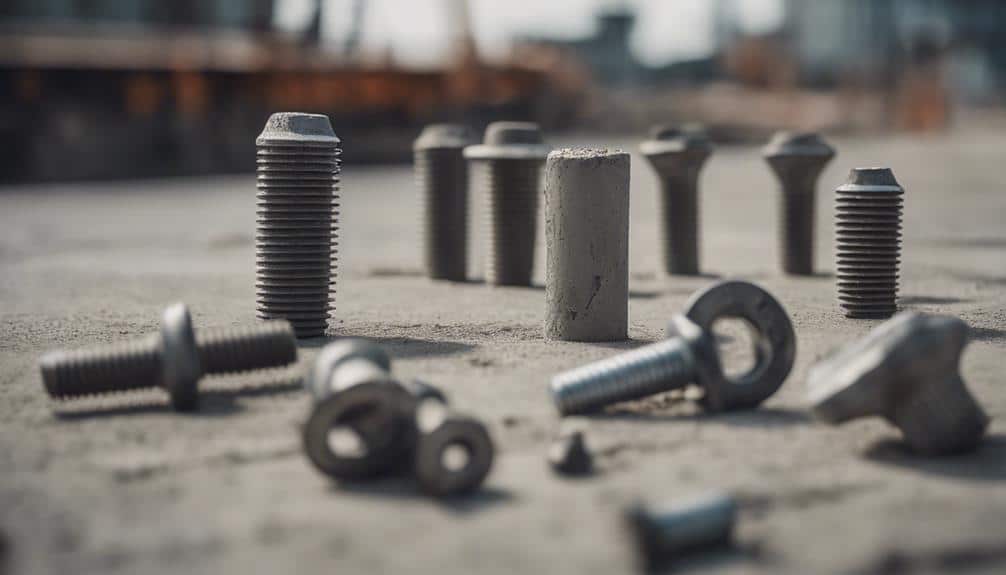
You’ll encounter two primary categories when selecting concrete anchors: cast-in-place and post-installed anchors. Each type has distinct characteristics suited for specific applications.
We’ll compare them to help you choose the most effective solution. Understanding their differences is essential for ensuring the safety and durability of your construction projects.
Cast-in-place anchors
In your exploration of cast-in-place concrete anchors, you’ll encounter three primary types: headed studs, hooked bars, and threaded rods.
Each of these anchors serves a unique function in construction, offering various strengths and limitations based on their design and the forces they must withstand.
Understanding the specific applications and installation techniques of these anchors is essential for ensuring their effectiveness and longevity in concrete structures.
Headed studs
Headed studs are a type of cast-in-place anchor that securely embed into concrete to provide robust load-bearing capabilities. They are designed for both shear and tension forces in concrete applications.
Embedment depth directly influences load capacity.
Shear tests assess lateral load resistance.
Pull-out tests evaluate tensile strength.
Concrete compressive strength enhances anchor performance.
Hooked bars
While headed studs offer reliable load support, hooked bars provide an alternative anchoring method with distinct advantages in concrete applications.
Hooked bars enhance ductility and improve bond strength due to their shape, facilitating better load transfer.
They’re designed following concrete capacity design (CCD) guidelines and anchoring provisions, ensuring top-notch performance in critical applications where both load capacity and safety are paramount.
Threaded rods
Threaded rods, another form of cast-in-place anchors, provide versatile and strong anchoring solutions in concrete structures. They’re designed to withstand:
- Tension: effectively managing pull-out forces.
- Shear: resisting lateral loads.
- Static loads: supporting fixed, steady forces.
- Dynamic loads: tolerating movement and vibrations.
- Adjustability: allowing precise alignment and positioning.
Utilize threaded rods for reliable, durable anchoring in your concrete applications.
Post-installed anchors
As you delve into post-installed anchors, it’s essential to understand the distinct categories they fall into: mechanical and bonded anchors.
Mechanical anchors, including expansion and undercut types, rely on physical force to secure themselves within concrete. Conversely, bonded anchors use chemical adhesives or grout to achieve fixation, offering a different set of strengths and limitations.
Mechanical anchors (expansion, undercut, etc.)
Mechanical anchors, such as expansion and undercut types, securely fasten materials to concrete surfaces by mechanically engaging with the base material. Here’s what you need to know:
- Expansion anchors: Expand against concrete when tightened.
- Undercut anchors: Lock into pre-drilled holes.
- Anchor diameter: Critical for load capacity.
- Failure modes: Include pull-out or concrete splitting.
- Installation precision: Essential for peak performance.
Bonded anchors (adhesive, grouted)
While mechanical anchors rely on physical expansion or undercuts, bonded anchors, including adhesive and grouted types, use chemical adhesion to secure materials to concrete.
You’ll need precise hole drilling for installation. Cleaning techniques are essential for effective bonding.
Adhesive anchors are ideal for high-load applications, while grouted anchors suit irregular or hollow spaces, ensuring a robust and reliable fix in your concrete structures.
Comparison of anchor types and their suitable applications
When choosing a concrete anchor, it’s essential to take into account the specific type and its corresponding applications to guarantee peak performance and safety. Concrete anchor bolt strength varies based on factors like steel grade, spacing, and edge distance. Bonded anchors, for instance, are ideal for structural applications due to their strong adhesion properties.
- Wedge Anchors: Best for high-tensile load applications, require precise hole drilling.
- Sleeve Anchors: Versatile in various materials, adjustable installation depth.
- Drop-in Anchors: Suitable for solid concrete, used in overhead installations.
- Concrete Screws: Good for temporary installations, easy to remove and reuse.
- Bonded Anchors: Excellent for high-load applications, dependent on the adhesive quality and curing time.
Factors Influencing Anchor Bolt Strength
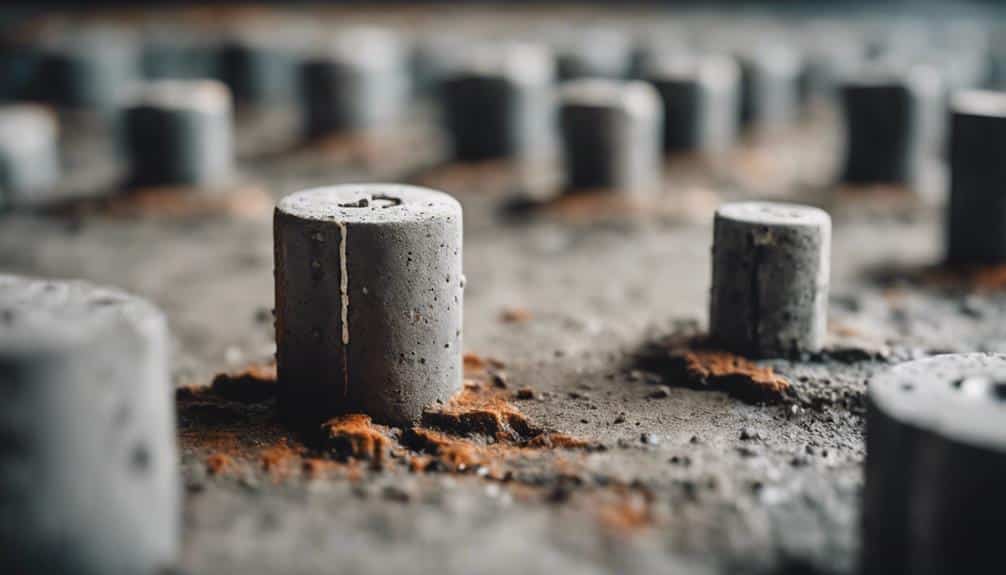
When you assess the strength of concrete anchor bolts, you must consider several critical factors.
Material properties, geometric parameters, loading conditions, and environmental factors each play a distinct role in determining the overall performance and reliability of these anchors.
Understanding how these elements interact will help you predict and enhance anchor bolt effectiveness in your applications.
Material properties
When you choose anchor bolts, it’s essential to take into account the steel grade and its ductility.
The concrete’s compressive strength and tensile capacity also play pivotal roles in the overall strength and longevity of the anchor system.
These factors determine how well the anchor can withstand load and stress over time.
Steel grade and ductility
The steel grade and its ductility greatly influence the strength and performance of concrete anchor bolts. Here’s why:
- Steel Grade: Higher grades typically withstand more stress.
- Ductility: Allows deformation without breaking under stress.
- Corrosion Resistance: Essential for longevity and reliability.
- Fatigue Loading: High ductility reduces failure under cyclic loads.
- Experimental Investigations: Provide insights on performance under varying conditions.
Concrete compressive strength and tensile capacity
Understanding the role of concrete’s compressive strength and tensile capacity is essential when evaluating the overall strength of anchor bolts. Concrete capacity design (CCD) methods, aided by finite element analysis (FEA) and numerical simulations, effectively predict crack propagation.
These techniques utilize constitutive models to detail concrete behavior under stress, enhancing the precision of anchor bolt capacity predictions in varied structural scenarios.
Geometric parameters
As you explore the geometric parameters impacting the strength of concrete anchor bolts, consider how the diameter and embedment depth of the anchor affect its load capacity.
It’s important to evaluate the edge distance and spacing between anchors to prevent cracking in the concrete.
Additionally, the thickness of the concrete member itself plays a significant role in the system’s overall stability and strength.
Anchor diameter and embedment depth
Anchor diameter and embedment depth greatly impact the strength and load capacity of concrete anchor bolts. Here’s why:
- Increased Diameter: Enhances durability; distributes load more efficiently.
- Deeper Embedment: Improves grip in high-strength concrete; essential for seismic design.
- Finite Element Analysis (FEA): Optimizes design by predicting performance.
- Concrete Capacity Design (CCD): Guarantees compatibility and safety.
- Geometric Tailoring: Customizes bolts for specific applications, maximizing efficacy.
Edge distance and spacing
To guarantee peak performance, you must carefully consider the edge distance and spacing between concrete anchor bolts. Proper placement and alignment, guided by established standards, are critical.
Meticulous detailing guarantees that spacing adheres to these standards, enhancing the structural integrity. Regular inspection verifies alignment and adherence to safety norms.
Therefore, precise implementation of these parameters is crucial for top anchor performance.
Concrete member thickness
You must also consider the thickness of the concrete member, as it greatly influences the strength and stability of anchor bolts. Here are key factors:
- Concrete Member Thickness: Critical for resisting combined loading.
- Combined Loading: Evaluates tension and shear.
- Concrete Capacity Design (CCD): Guarantees safety against failure.
- Finite Element Analysis (FEA): Predicts performance under stress.
- Deep Embedments: Enhance load capacity through deeper insertion into concrete.
Loading conditions
Understanding the impact of loading conditions on anchor bolt strength is vital for your project’s success.
You’ll need to contemplate how static and dynamic loads affect the bolt’s performance, as well as how tension, shear, and combined loading can influence the integrity of the anchorage.
Additionally, it’s important to evaluate the effects of cyclic and fatigue loading to guarantee long-term durability and safety.
Static and dynamic loads
Anchor bolt strength is significantly influenced by whether the load applied is static or dynamic. Here’s how different factors influence anchor bolt performance under these conditions:
- Cyclic loading: can lead to fatigue failures.
- Concrete capacity design (CCD): essential for static load analysis.
- European standards: provide guidelines on load types.
- Test setups: differ for static and dynamic evaluations.
- Finite Element Analysis (FEA): helps predict responses under varied loads.
Tension, shear, and combined loading
When evaluating the strength of concrete anchor bolts, it’s essential to consider how they react under tension, shear, and combined loading conditions. Concrete capacity design (CCD) methods and finite element analysis (FEA) offer predictions, while empirical models provide historical validation.
Preload application guarantees stability, and rigorous quality control is imperative for consistent performance. Understanding these factors helps you optimize the durability and reliability of anchor bolt installations.
Cyclic and fatigue loading
Cyclic and fatigue loading greatly impact the performance and longevity of concrete anchor bolts under repetitive stress conditions. Here’s how you can address these challenges:
- Utilize finite element analysis (FEA) for precise stress evaluation.
- Apply advanced modeling techniques for accurate predictions.
- Focus on performance-based design principles.
- Implement seismic retrofitting to enhance durability.
- Regularly assess for fatigue loading to preempt failure.
Environmental factors
You must consider how temperature fluctuations and exposure to corrosive environments impact the strength and longevity of your concrete anchor bolts.
Temperature variations can cause expansion and contraction in the bolt material, potentially affecting its load-bearing capacity.
Similarly, corrosion due to environmental exposure can greatly reduce both the durability and effectiveness of anchor bolts over time.
Temperature effects
Temperature variations greatly impact the tensile strength and durability of concrete anchor bolts. You’ll find that several standardized approaches, including concrete capacity design (CCD) and finite element analysis (FEA), assess these impacts.
- EN 1992-4 Guidelines: Addresses temperature’s role
- EOTA TR 029: Provides testing standards
- CCD Methodology: Helps predict failure modes
- FEA Techniques: Models temperature effects accurately
- Thermal Expansion: Alters bolt tension and load distribution
Corrosion and durability
Corrosion greatly reduces the lifespan and load-bearing capacity of concrete anchor bolts, particularly in harsh environmental conditions. You need to focus on advanced materials and coatings for better corrosion resistance. Regular maintenance is essential for optimizing durability. Don’t overlook these factors!
| Environment | Effect on Bolts | Response Strategy |
|---|---|---|
| Marine | High Corrosion | Use advanced coatings |
| Industrial | Chemical Exposure | Schedule maintenance |
| Urban | Moderate Wear | Regular inspections |
| Rural | Low Impact | Minimal intervention |
| Coastal | Salt Damage | Apply protective coatings |
Design Methods and Standards

You’ll find that the ACI 318 Anchoring Provisions provide a thorough framework for the design and installation of anchor bolts in concrete.
On the other hand, European Standards, specifically EN 1992-4 and EOTA TR 029, offer alternative methodologies that might align better with specific project requirements.
It’s important to compare these design methods and their underlying assumptions to select the most suitable approach for your project.
ACI 318 Anchoring Provisions
You’ll find that the ACI 318 guidelines meticulously outline the Concrete Capacity Design (CCD) method, which is fundamental for predicting the load capacities of anchor bolts in concrete.
These standards also incorporate specific seismic design requirements, ensuring that anchoring systems remain effective under seismic activity.
It’s essential to understand how these provisions influence the safety and stability of modern structures.
Concrete Capacity Design (CCD) method
The Concrete Capacity Design (CCD) method, delineated in the ACI 318 Anchoring Provisions, provides a framework for evaluating the necessary strength of anchor bolts in concrete under tensile loads.
- Concrete Capacity Design (CCD): Utilizes key parameters for strength assessment
- Procedures: Clearly outlined in ACI 318
- Key Parameters: Anchor size, embedment depth, edge distance
- Finite Element Analysis (FEA): Used for theoretical validation
- Validation: Guarantees accuracy through empirical data and FEA results
Seismic design requirements
Seismic design requirements, as stipulated in ACI 318 Anchoring Provisions, often require special considerations for anchor bolts in earthquake-prone areas.
You’ll need to apply concrete capacity design (CCD) and finite element analysis (FEA) to guarantee robustness.
ACI 318 addresses these practical considerations to optimize the resilience of structures.
Adhering strictly to these guidelines guarantees your installations withstand seismic forces effectively.
European Standards (EN 1992-4, EOTA TR 029)
Addressing the design of concrete anchor bolts, European Standards such as EN 1992-4 and EOTA TR 029 provide detailed methodologies and criteria for guaranteeing structural integrity and safety. These standards incorporate the latest advancements in concrete capacity design (CCD) and finite element analysis (FEA), essential for the precise evaluation of anchor bolts in varied structural scenarios, including those involving fiber-reinforced concrete. Future research will likely refine these methodologies further.
Here are key aspects covered by these standards:
- Load capacity calculations
- Stress distribution analysis
- Durability assessment guidelines
- Installation procedures and quality control
- Safety factors and design recommendations
These guidelines help you guarantee that your projects not only meet current engineering standards but are also prepared for future advancements and challenges in construction technology.
Comparison of design methods and their assumptions
When comparing design methods for concrete anchor bolts, it’s important to understand the underlying assumptions and their impact on structural safety and performance. Two prominent methods are Concrete Capacity Design (CCD) and Finite Element Analysis (FEA). CCD focuses on concrete’s failure modes, while FEA provides a detailed simulation of bolt behavior under various loads.
Here’s a quick comparison:
| Method | Key Focus |
|---|---|
| CCD | Concrete failure modes |
| FEA | Detailed bolt behavior |
You’ll find that torque control is essential in both methods to guarantee accuracy. The findings from both approaches offer valuable recommendations for designing safer, more reliable anchor systems. Always weigh these methods against your project’s specific needs to choose the most suitable one.
Experimental Investigations and Numerical Simulations
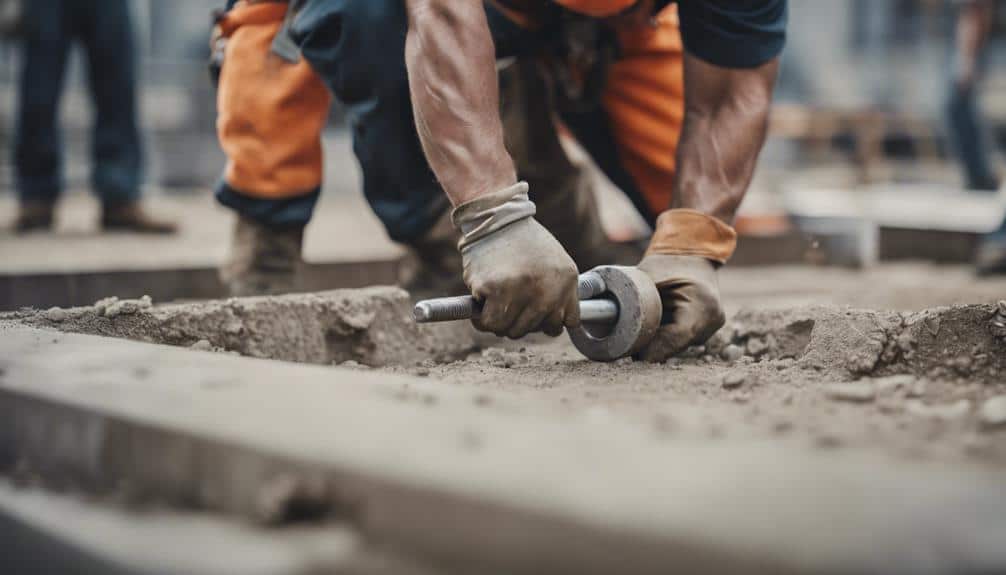
You’ll find that experimental investigations such as pull-out and shear tests are critical for evaluating the actual performance of anchor bolts in concrete.
Through Finite Element Analysis (FEA), you can simulate the complex behavior of anchor bolts under various stress conditions.
These approaches are essential for validating design methods and refining empirical models to guarantee they accurately predict real-world performance.
Pull-out and shear tests on anchor bolts
You’ll first need to understand the test setups and procedures utilized in evaluating the performance of concrete anchor bolts.
These tests assess how various factors, such as embedment depth and concrete strength, influence the anchor’s capacity to withstand loads.
Test setups and procedures
How do engineers accurately assess the strength of concrete anchor bolts? Through meticulous test setups and procedures, including both experimental investigations and numerical simulations. Here’s a concise outline:
- Concrete Capacity Design (CCD)
- Finite Element Analysis (FEA)
- Detailed case studies
- Standardized pull-out and shear tests
- Innovative applications validation
Each component is essential for ensuring the reliability and safety of anchor bolts in varied construction scenarios.
Influence of key parameters on anchor strength
In evaluating the strength of concrete anchor bolts, key parameters such as embedment depth, bolt diameter, and concrete quality greatly impact the outcomes of pull-out and shear tests.
Utilizing Finite Element Analysis (FEA) and Concrete Capacity Design (CCD) methods, you can accurately predict these results.
Additionally, the layout in mass concrete and the technology applied are essential to optimizing the performance and reliability of anchor installations.
Finite Element Analysis (FEA) of anchor bolt behavior
You’ll find that Finite Element Analysis (FEA) offers sophisticated modeling techniques and constitutive models important for understanding anchor bolt behavior in concrete.
These simulations accurately predict crack propagation and the resulting failure modes, enhancing reliability in design.
It’s essential to integrate these tools to guarantee your anchor installations meet rigorous safety standards.
Modeling techniques and constitutive models
To understand anchor bolt behavior, researchers employ modeling techniques and constitutive models, integrating experimental investigations with numerical simulations like Finite Element Analysis (FEA).
- Stress-Strain Relationships: Captures material behavior under load.
- Damage Mechanics: Models deterioration over time.
- Material Nonlinearity: Accounts for plastic deformation.
- Load Application: Simulates real-world forces.
- Boundary Conditions: Defines constraints in simulations.
Simulation of crack propagation and failure modes
Building on the understanding of material behavior, let’s examine how Finite Element Analysis (FEA) is used to simulate crack propagation and failure modes in anchor bolts.
FEA models stress distribution and deformation under load, predicting where cracks might initiate and propagate. This simulation helps in understanding different failure scenarios, optimizing bolt design to prevent premature failures, and enhancing overall structural integrity.
Validation of design methods and empirical models
Numerous studies rigorously test and validate design methods and empirical models for concrete anchor bolts through experimental investigations and numerical simulations. These methods greatly enhance the predictability and reliability of anchor bolt performance in various concrete conditions.
Specifically, these validations focus on:
- Load Capacity: Determining the maximum load that can be safely supported.
- Embedment Depth: Analyzing how depth influences anchor strength.
- Edge Distance: Evaluating effects of proximity to edges on anchor performance.
- Material Properties: Examining the influence of concrete and steel qualities.
- Failure Modes: Identifying different failure scenarios and their precursors.
Practical Considerations for Anchor Bolt Installation
When installing anchor bolts, it’s important you adhere to specific techniques for drilling and cleaning holes in concrete to guarantee a secure fit.
You must also pay close attention to bolt placement and alignment, which are essential in maintaining structural integrity.
Proper hole drilling and cleaning techniques
To guarantee peak anchor bolt performance, you must drill holes to precise specifications and thoroughly clean them before installation. Here’s how you can secure the best results:
- Select the Right Drill Bit: Use a drill bit that matches the diameter specified for your anchor bolts.
- Maintain the Correct Depth: Drill the hole slightly deeper than the length of the anchor to accommodate debris.
- Check for Accuracy: Periodically measure the depth as you drill to guarantee consistency.
- Clean the Hole: Remove all drilling dust and debris to secure proper anchor setting. Use compressed air or a vacuum.
- Inspect the Hole: Before installation, inspect the hole for any irregularities or leftover debris to prevent compromising the anchor’s hold.
Anchor bolt placement and alignment
Guaranteeing precise placement and proper alignment of anchor bolts is crucial for peak performance and structural integrity. When you’re setting up anchor bolts, it’s important to follow the specified layout and spacing as outlined in the design plans. Incorrect spacing can lead to uneven load distribution and potential structural failures.
You’ll also need to make sure that the bolts are vertically aligned and set at the correct depth. Use a template or jig to maintain consistent placement among bolts, especially in repetitive applications. Check alignment with a level or laser tool to verify that each bolt is positioned correctly relative to the structure’s geometry.
This meticulous attention to placement and alignment during installation significantly enhances the reliability and effectiveness of the anchoring system.
Torque control and preload application
After securing proper placement and alignment of anchor bolts, you must apply the correct torque to guarantee they function effectively under load. Precise torque application ensures peak preload, which is essential for the anchor’s performance and longevity. Here’s how to get it right:
- Use a calibrated torque wrench: This ensures accurate torque application.
- Follow manufacturer’s specifications: Always adhere to the recommended torque values.
- Consider material compatibility: Different materials may require different torque settings.
- Apply torque in stages: Gradually increase the torque to avoid material stress.
- Check tool calibration regularly: This prevents inaccuracies due to tool wear.
Inspection and quality control measures
You must conduct thorough inspections and adhere strictly to quality control protocols when installing anchor bolts to guarantee their reliability and performance. Each bolt’s installation must be meticulously documented, including torque values and environmental conditions at the time of installation. It’s vital to verify the concrete’s maturity and strength, ensuring it meets the specifications for your project.
| Inspection Step | Importance |
|---|---|
| Torque Testing | Ensures the bolt is tightened to the specified requirement, preventing structural failures. |
| Material Check | Confirms the bolt and concrete quality, avoiding compatibility issues. |
| Alignment Verification | Guarantees the bolt is positioned correctly for efficient load distribution. |
These measures prevent future complications and ensure the anchor bolts perform as expected in your structure.
Case Studies and Innovative Applications

You’ll find that anchoring in high-strength and fiber-reinforced concrete enhances load-bearing capabilities and resistance to environmental stressors.
Seismic retrofitting with anchor bolts greatly improves the structural integrity of older buildings in earthquake-prone areas.
When dealing with mass concrete and deep embedments, precise calculations and robust design are essential for ensuring long-term stability and safety.
Anchoring in high-strength and fiber-reinforced concrete
Exploring case studies and innovative applications reveals that anchoring in high-strength and fiber-reinforced concrete greatly enhances bolt performance and durability. You’ll find this technology particularly advantageous in demanding construction environments. Here are key benefits documented in recent studies:
- Increased Load Capacity: Anchors in high-strength concrete bear greater loads, reducing failure risks.
- Improved Crack Resistance: Fiber-reinforced concrete reduces the likelihood of crack propagation, enhancing anchor stability.
- Longer Lifespan: These materials resist environmental degradation better, prolonging the life of the anchors.
- Enhanced Elasticity: Provides flexibility under stress, preventing premature breakage.
- Cost Efficiency: Long-term durability and maintenance savings make it a cost-effective choice for large-scale projects.
These advancements make high-strength and fiber-reinforced concrete a top choice for critical anchoring applications.
Seismic retrofitting using anchor bolts
Building on the benefits of using advanced concrete, let’s now examine how anchor bolts are applied in seismic retrofitting, highlighting key case studies and innovative applications.
In regions prone to earthquakes, these bolts are essential for enhancing the structural integrity of buildings. For instance, in the retrofit of the historic San Francisco City Hall, engineers used anchor bolts to secure the structure to its foundation, greatly increasing its resistance to seismic forces. This application not only preserved a landmark but also set a benchmark in retrofitting techniques.
Similarly, in Tokyo, innovative shock-absorbing anchor bolts have been developed that not only anchor but also dissipate energy, reducing potential damage during an earthquake. These examples showcase how anchor bolts are pivotal in modern seismic retrofit strategies.
Anchoring in mass concrete and deep embedments
Exploring the domain of mass concrete and deep embedments, several case studies highlight the critical role of anchor bolts in ensuring structural stability and resilience. When you’re dealing with large-scale constructions, such as dams or high-load buildings, the specifics of anchor bolt application can have a substantial impact on the outcome. These bolts must be robust enough to handle immense pressures and environmental challenges.
- Highway Bridges: Deeply embedded anchor bolts counteract seismic forces.
- Hydroelectric Dams: Anchors maintain structural integrity against water pressures.
- Skyscrapers: Bolts support vertical loads and resist wind.
- Offshore Platforms: Critical for withstanding oceanic environmental stresses.
- Large Industrial Equipment: Ensures machinery stays anchored during operation.
These applications show how significant precise anchoring strategies are in complex, heavy-duty construction scenarios.
Future Research Directions
As you explore future research directions, consider the potential of performance-based design approaches to enhance the strength and reliability of anchor bolts.
Investigate the application of advanced materials and coatings that could greatly increase the durability of these components.
Additionally, you should examine how the optimization of anchor bolt layout and detailing can improve overall structural integrity.
Performance-based design of anchor bolts
Significant advancements in the performance-based design of anchor bolts can be achieved by focusing future research on the dynamic response of these components under varied load conditions. As you explore further into this field, you’ll need to examine several critical areas:
- Modeling of Realistic Load Scenarios: Develop models that accurately simulate real-world forces, including seismic, wind, and dynamic loads.
- Material Behavior Analysis: Study how different materials respond under stress to optimize anchor bolt performance.
- Scale Modeling: Create scale models to test theories before full-scale implementation.
- Longitudinal Studies: Conduct long-term studies to understand aging effects on anchor bolt performance.
- Regulatory Impact: Assess how evolving building codes influence anchor bolt design and requirements.
Advanced materials and coatings for improved durability
Research into advanced materials and coatings aims to greatly enhance the durability of concrete anchor bolts. The focus on nano-coatings and corrosion-resistant alloys can considerably prolong the lifecycle of these pivotal components. Stainless steel variants, especially those enhanced with chromium, offer increased resistance to oxidation and rust.
Moreover, the application of epoxy coatings provides a protective barrier against chemical attacks and moisture ingress, which are common in harsh environments.
Developing these materials involves rigorous testing for tensile strength, adherence, and long-term stability under variable loads and conditions. Potential breakthroughs in material science could redefine standards in construction safety and longevity, ensuring anchor bolts hold up under stress without premature failure.
Optimization of anchor bolt layout and detailing
Building on these material advancements, future research will focus on optimizing the layout and detailing of anchor bolts to enhance structural integrity and load distribution. You’ll see how important these factors are in ensuring the effectiveness of anchor bolts in various construction scenarios.
Here are key areas you should consider:
- Spatial Arrangement: Optimizing distances between bolts to prevent stress concentration.
- Edge Distances: Ensuring sufficient clearance from edges to minimize the risk of cracking.
- Load Paths: Designing for direct load transfer to improve stability and reduce shear stress.
- Installation Accuracy: Developing techniques for precise placement to maximize load-bearing capacity.
- Detailing for Seismic Activity: Tailoring layouts to withstand seismic forces by accommodating dynamic loads and movements.
Conclusion
In this conclusion, you’ll find a cohesive summary of the essential findings and recommendations that have emerged from our analysis of concrete anchor bolt strength.
It’s important that you understand the significance of meticulously designing, installing, and maintaining these bolts to guarantee structural integrity.
Additionally, we’ll explore the promising outlook for future advancements in anchor bolt technology, highlighting how these developments could enhance safety and efficiency.
Summary of key findings and recommendations
Our study conclusively demonstrates that improved concrete anchor bolt designs greatly enhance structural integrity and safety. Here’s a concise summary of our key findings and the recommendations we’ve formulated based on these insights:
- Material Quality: High-grade steel notably increases bolt lifespan and load-bearing capacity.
- Design Innovation: Geometric enhancements in bolt design contribute to better stress distribution.
- Testing Rigor: Rigorous pre-installation testing predicts performance under variable loads.
- Scale of Use: Larger bolts show enhanced performance in high-stress applications.
- Environmental Factors: Bolts designed with corrosion resistance prolong structural integrity in diverse environments.
Implementing these findings guarantees that your projects not only meet but exceed the required safety standards.
Importance of proper design, installation, and maintenance of anchor bolts
Ensuring that anchor bolts are properly designed, installed, and maintained is vital for maximizing their effectiveness and safety in structural applications.
You need to take into account the specific load requirements and environmental conditions to determine the appropriate material and design. Proper installation is essential; even the best-designed anchor bolts can fail if they’re not installed correctly.
This involves making sure that the bolt is placed at the correct depth and angle, and that the concrete has cured properly before any load is applied. Regular maintenance is also important to prevent failures due to wear and tear or corrosion.
You should regularly inspect anchor bolts for signs of distress, such as rust or loosening, and take corrective action promptly to ensure ongoing reliability and safety.
Outlook for future advancements in anchor bolt technology
Advancements in anchor bolt technology are expected to enhance both performance and safety across various construction applications. As you look forward to these innovations, you’ll see improvements that leverage new materials and smarter design methodologies. Here are key advancements to anticipate:
- Increased Load Capacity: Utilizing high-performance materials to withstand greater stresses.
- Corrosion Resistance: Development of coatings and materials that resist environmental degradation.
- Smart Sensors: Integration of sensors to monitor stress and predict failure points.
- Eco-friendly Materials: Focus on sustainability through the use of recycled or greener materials.
- Enhanced Design Software: More sophisticated software tools for precise and efficient anchor bolt placement.
These advancements will certainly transform how you approach securing structures, ensuring greater reliability and efficiency in your projects.
Frequently Asked Questions
How Do Weather Conditions Affect Concrete Anchor Bolt Longevity?
Weather conditions greatly impact concrete anchor bolt longevity. Moisture, temperature fluctuations, and chemical exposure can all degrade the bolt’s material, reducing its effectiveness and potentially compromising the structural integrity of attached elements.
Can Anchor Bolts Be Reused in Different Installations?
You can’t always teach an old dog new tricks; generally, you shouldn’t reuse anchor bolts in different installations due to potential compromise in structural integrity and alignment, which is critical for safety and performance.
What Are the Costs of Various Types of Anchor Bolts?
The costs of anchor bolts vary widely based on type, size, and material. You’ll find stainless steel options pricier than galvanized steel, with specialty bolts like undercut anchors typically costing more due to their design.
How Do Concrete Anchor Bolts Impact Environmental Sustainability?
Concrete anchor bolts can influence environmental sustainability by their production and disposal methods. If you choose sustainably sourced materials and recyclable options, you’ll reduce their environmental impact to a large extent.
Are There Any Recycling Practices for Used Anchor Bolts?
Imagine reusing steel from skyscrapers! Used anchor bolts can be recycled through specialized metal recovery processes, ensuring they’re melted down and repurposed, reducing waste and promoting sustainable construction practices in a circular economy.
Conclusion
To wrap up, as you navigate the landscape of concrete anchor bolts, remember the wisdom of Archimedes: ‘Give me a lever long enough and a fulcrum on which to place it, and I’ll move the world.’
Just as the right lever magnifies force, the appropriate anchor, when expertly chosen and installed, guarantees the integrity and strength of modern structures.
Stay abreast of evolving standards and innovations to harness the full potential of these pivotal components in your architectural endeavors.
Related Articles

Are you ready to learn the secret of efficient concrete transportation? In this article, we will delve into the intriguing Read more

Is it more cost-effective to mix your own concrete or have it delivered? This article examines the factors to consider Read more

Do you want to ensure the structural integrity of your concrete construction project? Then, rebar is a crucial component you Read more