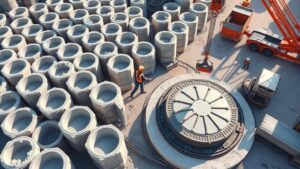
Roman concrete is an ancient building material renowned for its strength and durability. It consists mainly of lime mortar, volcanic ash, and seawater. This distinctive blend contributes to its remarkable longevity, allowing structures like the Pantheon to endure for almost 2,000 years.
Key to its resilience are self-healing properties and pozzolanic reactions, which improve strength over time. Compared to modern concrete, this ancient technique, which relies on natural ingredients, offers significant benefits and could inspire innovative construction methods today. Explore its fascinating characteristics further.
Key Takeaways
Roman concrete, made from lime, volcanic ash, and seawater, is famous for its strength and durability in ancient buildings. Its unique mix allows it to self-repair, filling cracks with calcium carbonate. This material is highly resistant to seawater, which helps it remain intact even in tough environments.
The impressive longevity of Roman concrete comes from ongoing pozzolanic reactions that continue to enhance its strength over time. In comparison, modern concrete tends to have a higher carbon footprint, while Roman concrete benefits from its natural ingredients and better thermal performance.
Composition of Roman Concrete

The composition of Roman concrete is a fascinating mix of materials that contributes to its remarkable durability. At its core, the hydraulic binder mainly consists of lime, sourced from limestone, and quicklime, which is enhanced through a hot-mixing process to boost its reactivity.
Sometimes, gypsum is added to modify how it sets.
One of the key ingredients is volcanic ash, known as pozzolana, which creates a highly reactive binder that significantly increases strength and durability. This pozzolana, abundant in silica and alumina, reacts with lime and water, forming cement-like compounds that resist corrosion from saltwater. Hydraulic concrete was first used in coastal underwater structures, demonstrating the versatility of Roman concrete in various environments.
These ancient techniques ensure that the binder develops rare crystalline compounds, improving the concrete’s toughness and self-healing properties.
This results in structures that have stood the test of time in Roman architecture.
The Role of Aggregate in Durability

In Roman concrete, the choice of aggregate significantly impacts its strength and durability. For example, volcanic aggregates improve the material’s ability to self-heal, effectively filling cracks through reactive interactions. Recognising the role of these aggregates is crucial for assessing the longevity and resilience of Roman concrete structures. The incorporation of volcanic materials not only enhances the concrete’s durability but also contributes to its unique ability to withstand the harsh effects of seawater over time.
Types of Aggregate Used
When examining the durability of Roman concrete, the types of aggregate used are key to its structural integrity.
Roman builders sourced aggregates from quarries, riverbeds, and local deposits, utilising materials like tuff, volcanic rock, and brick rubble. They often incorporated recycled aggregates, such as crushed brick and ceramic shards, which not only improved resource efficiency but also enhanced bonding properties.
Occasionally, lightweight aggregates were used in specific mixes for particular structural purposes. The careful selection of aggregates ensured chemical compatibility with lime and pozzolana binders, which promoted durability under various conditions. This thoughtful approach to sourcing aggregates significantly contributed to the longevity and resilience of Roman concrete, enhancing strength in wet conditions distinguishing it from modern alternatives.
Impact on Strength
The role of aggregate in the strength of Roman concrete is crucial for its durability.
In ancient engineering, the chemical reactions between coarse aggregates and hydraulic binders form a strong matrix. For instance, volcanic ash combined with quicklime creates binding compounds that resist wear and tear.
Using well-graded aggregates optimises packing, reduces voids, and improves load distribution. This arrangement helps control porosity, which reduces crack formation and encourages self-healing.
Over time, ongoing pozzolanic reactions enhance the concrete’s strength. By balancing mechanical strength with durability, Roman engineers developed a concrete that has stood the test of time, showcasing their remarkable construction techniques.
Role in Self-Healing
The self-healing properties of Roman concrete are largely due to the role of aggregates, especially lime clasts, in its make-up.
These lime clasts serve as reactive sources of calcium, breaking apart when cracks develop, which aids in the healing process. When cracks intersect with lime clasts, water reacts with the quicklime, creating a calcium-saturated solution that crystallises into calcium carbonate, effectively sealing the cracks.
Moreover, the volcanic ash within the aggregate boosts pozzolanic activity, reinforcing the concrete structure. The varied composition of the aggregate fosters microstructural interactions that enhance long-term stability.
Thus, the combination of lime clasts and volcanic ash not only improves durability but also allows cracks to heal on their own, preserving the integrity of Roman concrete structures over time.
Hydraulic Properties of Roman Mortar

In examining the hydraulic properties of Roman mortar, it’s clear that pozzolana is essential for activating hydraulic reactions.
This activation not only improves the mortar’s durability but also supports self-healing, enabling cracks to reseal over time.
Understanding these characteristics helps us appreciate how Roman engineers created structures with such impressive longevity.
Pozzolana’s Hydraulic Activation
Pozzolana activates hydraulically when mixed with lime and water, triggering chemical reactions that produce durable cementitious compounds. This process boosts hydraulic efficiency, enabling the mortar to set and harden even underwater—crucial for marine structures.
Sourced from volcanic regions, pozzolana’s high levels of amorphous silica and alumina play a key role in forming calcium silicate hydrates and aluminates. The traditional Roman mix of two parts pozzolana to one part lime creates a denser matrix, enhancing durability and resistance to environmental wear.
Using pozzolana ensures greater tensile strength and compatibility with different aggregates, making it vital for Roman construction methods and the longevity of their monumental buildings.
Self-Healing Mechanisms Explained
While cracks are often viewed as a threat to structural integrity, Roman concrete utilises clever self-healing mechanisms that actually enhance its durability over time.
The self-healing properties come from lime clasts embedded in the material. When water seeps into cracks, it dissolves these brittle lime clasts, releasing reactive calcium ions.
These ions then react with seawater or atmospheric CO2 to form calcium carbonate crystals, effectively sealing the cracks. This process not only repairs the damage but also preserves the structural integrity for centuries.
The unique chemistry of the hydraulic mortar, along with hot-mixing techniques, optimises this self-healing process, ensuring Roman concrete remains robust even in harsh conditions.
Enhanced Durability Factors
The hydraulic properties of Roman mortar significantly enhance its durability, thanks to its unique composition of lime and volcanic ash.
Ancient Roman builders developed a hydraulic mortar that showed remarkable resistance to seawater and mechanical stress. The pozzolana’s high silica and alumina content reacted with lime to form calcium-aluminium-silicate-hydrate (C-A-S-H) phases, which increased strength.
Lime clasts in the mortar acted as reactive sources of calcium, enabling self-healing after cracks formed. These clasts allowed cracks to propagate through themselves, facilitating dynamic repair.
Additionally, crystalline phases like aluminium-tobermorite and strätlingite added to the mortar’s toughness and cohesion, resulting in exceptional material properties that have lasted for centuries in Roman structures.
Chemical Reactions and Strength Enhancement

Examining the chemical reactions in Roman concrete highlights its exceptional durability and strength enhancement. The combination of lime clasts and pozzolana creates a mixture that’s highly reactive, leading to the formation of beneficial minerals.
Key processes include:
- Self-healing properties: When microcracks form, lime clasts react with water to produce calcium carbonate, which fills the cracks and preserves the structure’s integrity.
- Crystal growth: Exposure to saltwater encourages the development of Tobermorite crystals, which improve flexibility and toughness, helping to prevent breakage under pressure.
- Hydraulic mortar characteristics: The chemical hydration of the hydraulic binder leads to stable mineral formations, enhancing the concrete’s resistance to tension.
These chemical processes are fundamental to the remarkable longevity and strength of Roman concrete, showcasing an impressive grasp of material science in ancient engineering.
The Unique Benefits of Pozzolana

Pozzolana provides distinct advantages that significantly boost the durability and performance of Roman concrete, especially in marine environments.
Its volcanic origin supplies silica and alumina, which react with lime and seawater to form aluminous tobermorite crystals. These crystals enhance resistance to saltwater and allow for flexibility under stress, effectively reducing brittleness. As a result, Roman marine concrete outlasts modern alternatives, which often deteriorate within decades. This ongoing reaction strengthens the concrete over time, as seawater promotes further crystal growth.
Moreover, the use of pozzolana lowers the heat of hydration during curing, which helps minimise thermal stress damage.
Self-Healing Mechanisms in Roman Concrete
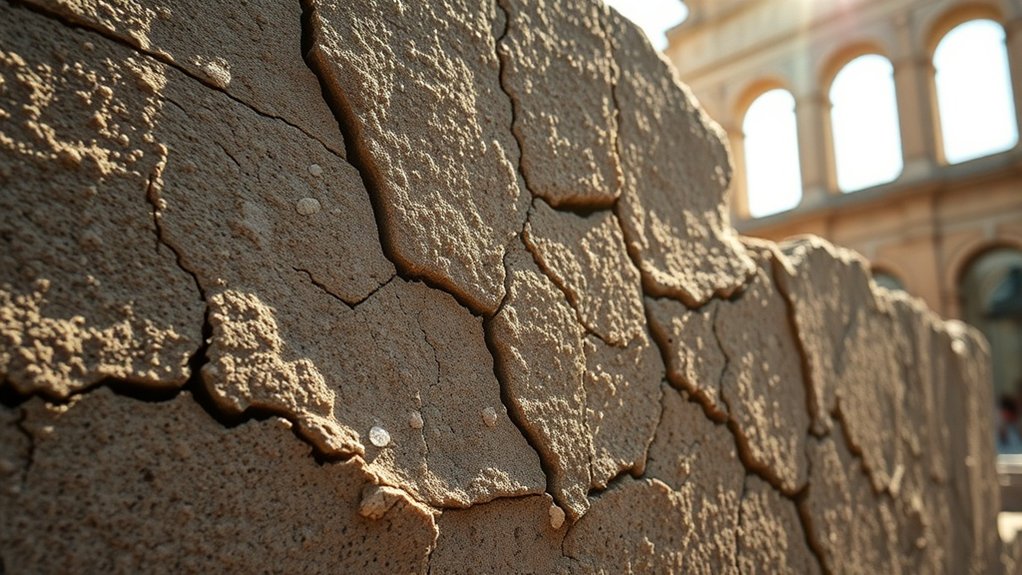
Roman concrete’s remarkable durability isn’t just due to pozzolana; it also features impressive self-healing mechanisms that enhance its lifespan. The lime clasts within the mixture play a vital role here. When water penetrates cracks, it dissolves these lime clasts, releasing reactive calcium ions. This process leads to the formation of new calcium carbonate crystals, which effectively seal the cracks.
- Lime clasts serve as self-healing agents in the concrete.
- Their brittle nature means that cracks tend to form through them, improving self-healing efficiency.
- This ongoing mineral recrystallisation boosts the overall strength of the material.
These mechanisms not only reduce structural damage but also support the enduring durability of Roman concrete, even in challenging conditions.
The Hot-Mixing Technique Explained

The hot-mixing technique used in ancient concrete production is a notable advancement in material science. By adding quicklime directly to dry mortar, an exothermic reaction occurs, raising the mixture’s temperature. This process enhances chemical interactions that traditional slaked-lime pastes can’t achieve.
Hot mixing leads to faster hydration, improving curing and setting times, which ultimately shortens construction periods. Additionally, this method encourages the formation of robust mineral phases, resulting in long-lasting structures.
The unique nanoparticulate structure of lime clasts boosts mechanical strength and offers self-healing properties that help prevent cracks.
Understanding these ancient methods highlights the impressive durability of Roman concrete and can inform modern engineering practices focused on sustainability and resilience.
Comparison With Modern Concrete

When comparing ancient Roman concrete to modern concrete, notable differences in composition and performance emerge.
Roman concrete was made from volcanic ash, quicklime, and volcanic rock, resulting in a reactive binding matrix. This approach not only enhances durability but also demonstrates ancient methods that promote sustainability.
In contrast, modern concrete, primarily composed of Portland cement, is chemically inert and tends to deteriorate more quickly in harsh conditions.
- Roman concrete has the ability to self-repair through mineral growth.
- Modern concrete is susceptible to chemical damage.
- Ancient techniques prioritise environmental interaction for longevity.
The unique chemistry of Roman concrete enables it to resist cracking and spalling, making it more durable than modern concrete, which often relies on steel reinforcement to counteract its brittleness.
Historical Significance of Roman Concrete

Emerging around 200–150 BC, Roman concrete, or *opus caementicium*, was crucial in shaping the architectural landscape of ancient Rome. Its introduction marked a significant shift in construction methods, allowing for innovative designs. The cultural impact of Roman concrete is clear in the monumental structures that still inform our understanding of Roman engineering.
| Aspect | Significance | Examples |
|---|---|---|
| Innovation | Enabled complex forms | Pantheon’s dome |
| Durability | Long-lasting infrastructure | Functional aqueducts |
| Economic Efficiency | Reduced building time | Rapid urban expansion |
| Cultural Identity | Defined Roman architecture | Iconic landmarks |
| Engineering Skill | Advanced material science | Hydraulic structures |
This combination of durability and creativity ensured that Roman heritage has endured through the ages.
Modern Applications and Research Efforts

There’s a growing interest in sustainable construction materials inspired by Roman concrete.
Researchers are exploring ancient techniques, particularly the use of volcanic ash, to cut carbon emissions and improve durability.
Sustainable Construction Materials
As the construction industry faces the pressing need for sustainable practices, innovative materials are transforming building design and construction.
Modern sustainable materials blend ancient techniques to minimize environmental impact while improving durability. Here are some notable advancements:
- Carbon-negative concrete: This material captures more CO₂ than it emits, significantly reducing the carbon footprint of buildings.
- Hempcrete: A lightweight and renewable option that sequesters carbon and provides excellent insulation.
- Recycled steel: This material cuts down on energy use and the impact of mining, all while keeping the strength and durability that steel is known for.
These materials not only foster sustainability but also support global efforts to reduce concrete’s traditionally large carbon footprint, paving the way for a more responsible future in construction. Additionally, incorporating sustainable aggregates into concrete mixes not only reduces waste but also enhances the overall performance of the material.
Replicating Ancient Techniques
The revival of Roman concrete techniques in modern construction highlights a renewed interest in ancient materials known for their exceptional durability. Researchers are now focusing on replicating these techniques, particularly by using volcanic ash and lime to produce strong cement compounds.
By studying the mineral phases in ancient samples, it’s possible to recreate the self-healing properties that come from unhydrated lime reacting with moisture in the environment.
Modern adaptations, such as “hot mixing,” enhance the early performance and longevity of concrete. Additionally, mimicking the layered aggregate placement used by the Romans helps optimise packing density.
These approaches aim to create concrete capable of withstanding chemical and physical weathering, ultimately prolonging structural lifetimes and reducing maintenance, which aligns with sustainable building practices. Furthermore, utilizing lightweight concrete offers additional benefits such as reduced structural load and enhanced thermal performance.
Frequently Asked Questions
How Did Romans Transport Materials for Concrete Construction?
The Romans sourced materials locally, using horse-drawn carts on well-maintained roads for efficient transport. For larger shipments, they relied on maritime transport, ensuring precise delivery of aggregates, lime, and pozzolanic ash to construction sites.
What Tools Did Romans Use to Work With Concrete?
Romans used hammers, chisels, and mallets for shaping stone and concrete. They mixed materials in wooden mortars and applied concrete with trowels. To ensure durability, they employed specific curing methods. This showcases their impressive engineering skills in concrete construction.
Were There Any Specific Architectural Styles Using Roman Concrete?
Yes, Roman architecture made extensive use of concrete, particularly in the construction of amphitheatres. This strong material enabled the creation of large seating areas and intricate designs, enhancing the public’s entertainment experience across the Roman Empire. A prime example is the Colosseum in Rome, which showcases the durability and versatility of Roman concrete in monumental structures.
How Did Roman Concrete Influence Modern Construction Practices?
Roman concrete has a significant impact on modern construction by encouraging sustainable practices through its durable materials and innovative compositions. The use of volcanic ash and natural binders in Roman concrete serves as a model for today’s material innovations, enhancing the durability of structures while minimising environmental impact. For instance, modern buildings that incorporate similar eco-friendly materials can last longer and require less frequent repairs, benefiting both the environment and the economy.
What Challenges Did Romans Face When Using Concrete?
Romans encountered notable durability issues due to inconsistent sourcing of materials and poor mixing methods. For instance, exposure to seawater weakened concrete, making it challenging to ensure reliable structural integrity across different projects. This meant that structures like piers and harbours were particularly vulnerable to erosion and damage over time.
Conclusion
The remarkable durability of Roman concrete stems from a clever combination of materials and techniques that continue to impress modern scientists. The notion that ancient Romans had a sophisticated grasp of chemistry and engineering is fascinating. This expertise not only led to their impressive structures but also provides valuable lessons for sustainable building practices today. Current research suggests that the secrets behind Roman concrete could pave the way for a new era in construction, linking the wisdom of the past with the needs of the future.

Journey through the fascinating evolution of concrete, from ancient Roman innovations to modern sustainable practices, and discover what lies ahead Read more

In exploring the historical milestone of Portland cement, discover how this innovation transformed construction and reshaped urban landscapes forever. What Read more
Moisture prevention is crucial for concrete surfaces; discover how sealed finishes can safeguard your structures and enhance durability in surprising Read more