When comparing concrete and wooden fence posts, we’ve found that concrete offers superior durability, often lasting over 30 years with minimal maintenance.
Wooden posts typically last 10-15 years and require regular upkeep.
Whilst concrete posts have a higher initial cost, they’re more cost-effective long-term due to their longevity.
Wooden posts provide greater aesthetic flexibility and easier installation, but they’re more susceptible to weather damage and pests.
Environmentally, wooden posts have a lower carbon footprint, whilst concrete production contributes considerably to CO2 emissions.
Each option has its strengths, and the best choice depends on specific project needs and priorities.
Our thorough analysis reveals essential factors that will guide your decision.
Key Takeaways
- Concrete posts last over 30 years, whilst wooden posts typically last 10-15 years without maintenance.
- Wooden posts have lower upfront costs but higher long-term expenses due to maintenance and replacements.
- Concrete posts offer superior weather resistance and stability, especially in high-wind areas.
- Wooden posts provide greater aesthetic flexibility and easier customisation options.
- Concrete has a larger environmental impact, whilst wooden posts are more sustainable and biodegradable.
Durability and Lifespan Comparison
Comparing the durability and lifespan of concrete and wooden fence posts reveals considerable differences in their long-term performance.
We’ve observed that concrete posts consistently outlast their wooden counterparts, with a lifespan exceeding 30 years when properly maintained. In contrast, wooden posts typically endure only 10 to 15 years without ongoing care.
The superior longevity of concrete posts stems from their material composition. Unlike wood, concrete resists rot, warping, and insect damage due to its non-degradable nature. This inherent weather resistance allows concrete posts to maintain their integrity in exposed environments where untreated wooden posts rapidly deteriorate.
The high durability in environments of concrete extends beyond fencing, making it suitable for various outdoor applications, including high-traffic areas and wet zones.
We’ve found that the substantial weight of concrete posts, averaging over 40 kg each, contributes notably to their stability in high-wind areas. Wooden posts, being lighter, often require more frequent replacement under similar conditions.
Additionally, even treated wooden posts demand regular maintenance to prevent cracking and splitting, which can dramatically reduce their effective lifespan.
In our analysis, concrete posts demonstrate exceptional durability and weather resistance, offering a low-maintenance solution that outperforms wooden alternatives in longevity and structural integrity across various environmental conditions.
Cost Analysis: Short-Term Vs Long-Term
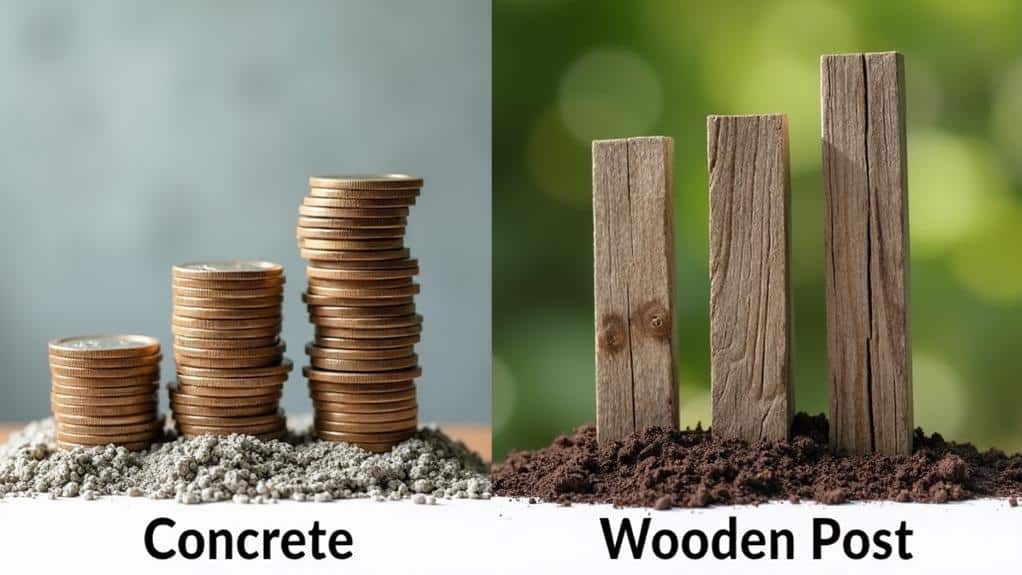
We shall examine the cost dynamics of concrete and wooden fence posts, considering both initial investments and long-term financial implications.
Whilst wooden posts offer a 30%-50% lower upfront cost, their ongoing maintenance requirements and shorter lifespan can lead to higher cumulative expenses over time.
Conversely, concrete posts’ durability and minimal upkeep needs may offset their higher initial investment, potentially resulting in greater cost-effectiveness over decades of use.
Recent innovations in eco-friendly concrete development, such as using crushed shells, may further enhance the sustainability and cost-effectiveness of concrete options.
These advancements could potentially reduce long-term costs whilst also providing environmental benefits.
Initial Investment Comparison
When evaluating the initial investment for fence posts, it’s essential to reflect on both short-term and long-term financial implications.
We find that concrete fence posts typically command a 30%-50% higher upfront cost compared to their wooden counterparts, a factor that notably influences budget considerations for immediate projects. Recent innovations in low-carbon concrete have the potential to reduce environmental impact and possibly affect future pricing, though current costs remain higher than wood.
For those prioritising lower initial expenses, wooden posts present an attractive option due to their reduced purchase price and more economical installation techniques.
The lighter weight of wood facilitates easier handling, translating to reduced labour costs during setup. However, we must consider that this short-term saving may be offset by long-term expenditures.
Analysing the cost-effectiveness over time, we observe that concrete posts often provide superior value despite their higher initial investment.
Their remarkable durability, often spanning decades with minimal maintenance requirements, contrasts sharply with wooden posts’ frequent upkeep and potential replacements.
This longevity effectively mitigates the higher upfront costs, potentially resulting in considerable savings over the fence’s lifetime.
Long-Term Financial Implications
The long-term financial implications of choosing between concrete and wooden fence posts extend far beyond the initial investment. We must evaluate cost forecasting and financial planning to make an informed decision. Similar to carbon removal credits in the climate tech sector, the fence post market requires careful analysis of long-term value versus upfront costs.
Whilst concrete posts require a 30%-50% higher upfront cost, they offer significant long-term savings. Their durability and minimal maintenance needs translate into decades of service, potentially outweighing the initial expense.
In contrast, wooden posts, though more budget-friendly initially, incur ongoing maintenance costs and may require frequent repairs or replacements.
When analysing the total cost of ownership, we must factor in installation expenses. Wooden posts generally have lower installation costs due to their lighter weight and simpler setup. However, concrete posts’ longevity may offset this advantage over time.
To accurately assess the financial implications, we need to evaluate the expected lifespan of each option. Untreated wooden posts have a shorter lifespan compared to concrete, which can last for decades.
This longevity, combined with reduced maintenance needs, positions concrete posts as potentially more cost-effective in the long run, despite their higher initial investment.
Aesthetic Appeal and Design Flexibility

We shall now examine the aesthetic appeal and design flexibility of wooden and concrete fence posts, focusing on their visual impact in gardens, customisation options, and ability to blend with surroundings.
Wooden posts offer a natural, warm appearance that complements various garden styles and can be easily customised through staining or painting to match specific design preferences.
In contrast, concrete posts typically provide a more limited range of colour options and are less adaptable to diverse landscaping needs, potentially making wooden posts a more versatile choice for homeowners seeking to create a cohesive garden aesthetic.
Visual Impact on Gardens
Choosing between concrete and wooden fence posts greatly impacts a garden’s visual appeal and design flexibility.
Wooden posts offer superior visual harmony and garden integration due to their natural aesthetic. The warm, inviting appearance of timber complements garden features like trees and decking, enhancing overall visual appeal.
Wooden posts provide unparalleled customisation options:
- Natural grain and colour variations allow for easy staining or painting
- Decorative post caps can be added for personalisation
- Lighter weight facilitates creative designs and adaptability to unique layouts
In contrast, concrete posts typically offer limited colour options, potentially clashing with natural surroundings or traditional garden styles. Their rigid nature also restricts design flexibility, making it challenging to achieve seamless garden integration.
We’ve found that wooden posts’ adaptability extends beyond aesthetics. Their flexibility allows for easier adjustments during installation, accommodating irregular garden contours and enabling more creative fencing solutions.
This versatility, combined with their natural appearance, makes wooden posts the superior choice for achieving visual harmony in garden settings. By selecting wooden posts, we can ensure our fencing complements rather than detracts from the overall garden design.
Customisation and Color Options
Delving into customisation and colour options reveals stark differences between wooden and concrete fence posts.
Wooden posts offer unparalleled flexibility, aligning with current colour trends and post styles. We can stain or paint these posts in a vast array of hues, enabling seamless integration with diverse garden designs and personal aesthetics. This adaptability extends to the addition of decorative elements like post caps, further enhancing visual appeal and personalisation.
In contrast, concrete posts present significant limitations in customisation. They typically come in a restricted palette—white, grey, or buff—which may not harmonise with all garden styles. Unlike their wooden counterparts, concrete posts resist effective staining or painting, severely constraining design options.
The natural appearance of wooden posts provides a warm, classic aesthetic that complements various garden features. This inherent quality makes them particularly suitable for traditional décor schemes.
Conversely, the rigid appearance of concrete posts may clash with certain garden styles, potentially disrupting the overall visual cohesion. When considering fence post materials, it’s essential to weigh these aesthetic implications against other factors such as durability and maintenance requirements.
Blending With Surroundings
A majority of homeowners prioritise aesthetics when selecting fence posts, making the ability to blend with surroundings a crucial factor. Wooden posts excel in natural integration, offering a warmer aesthetic that harmonises with garden features. Their inherent flexibility in design allows for seamless landscape harmony, enhancing the overall visual appeal of outdoor spaces.
The customisation options for timber posts are extensive, enabling homeowners to achieve precise colour matching and design coherence. This versatility is particularly advantageous when considering:
- Seasonal décor changes
- Specific architectural themes
- Evolving landscaping designs
In contrast, concrete posts typically present a limited colour palette, potentially disrupting the visual flow of natural surroundings. The stark appearance of concrete may clash with the organic elements of a garden or landscape.
Wooden posts’ adaptability extends beyond colour, encompassing various decorative features such as ornamental caps. These elements further elevate the aesthetic, transforming functional barriers into design statements.
For those seeking mastery in outdoor design, wooden posts offer unparalleled potential for creating cohesive, visually appealing environments that seamlessly integrate with existing landscape elements.
Installation Process and Requirements
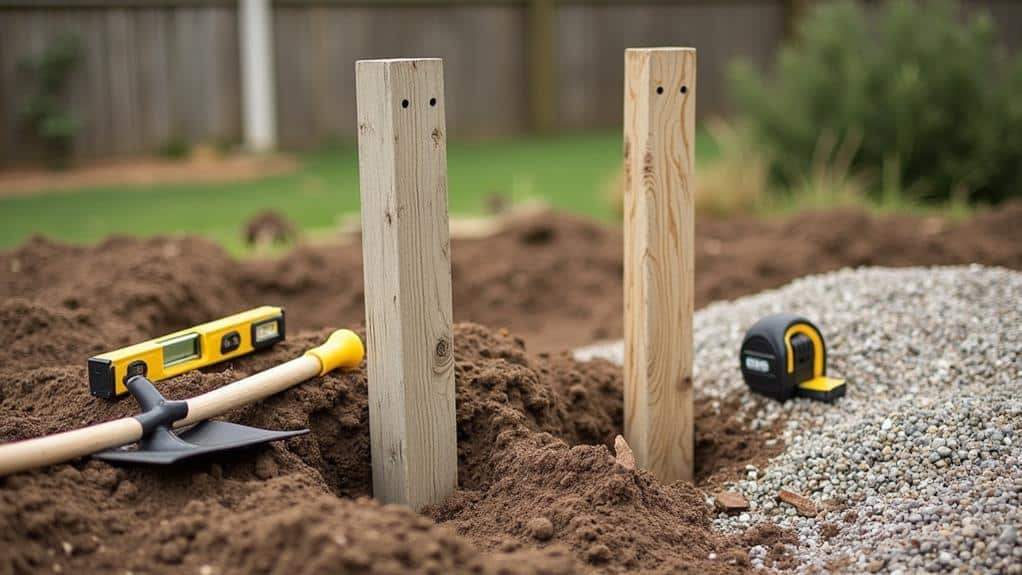
The installation process and requirements for concrete and wooden fence posts differ greatly, often influencing a homeowner’s choice between the two materials.
We’ll examine the key factors that set these options apart regarding installation tools and labour requirements.
Concrete posts demand a more complex setup, typically requiring deeper foundations for stability. This necessitates specialised installation tools to manage the greater depth and weight of these posts, which can exceed 40 kg each.
The sheer mass of concrete posts often calls for multiple workers to handle and position them correctly, increasing labour requirements and associated costs.
In contrast, wooden posts offer a more straightforward installation process. Their lighter weight allows for easier manipulation, often enabling a single person to complete the job with basic tools.
The anchoring methods for wooden posts are generally simpler, facilitating quicker installation and easier adjustments or replacements if needed.
We must consider that the installation of wooden posts is less time-consuming and typically incurs lower labour costs due to reduced handling complexity and fewer specialised tools.
This efficiency in the installation process can be a significant factor when choosing between concrete and wooden fence posts.
Maintenance and Repair Considerations
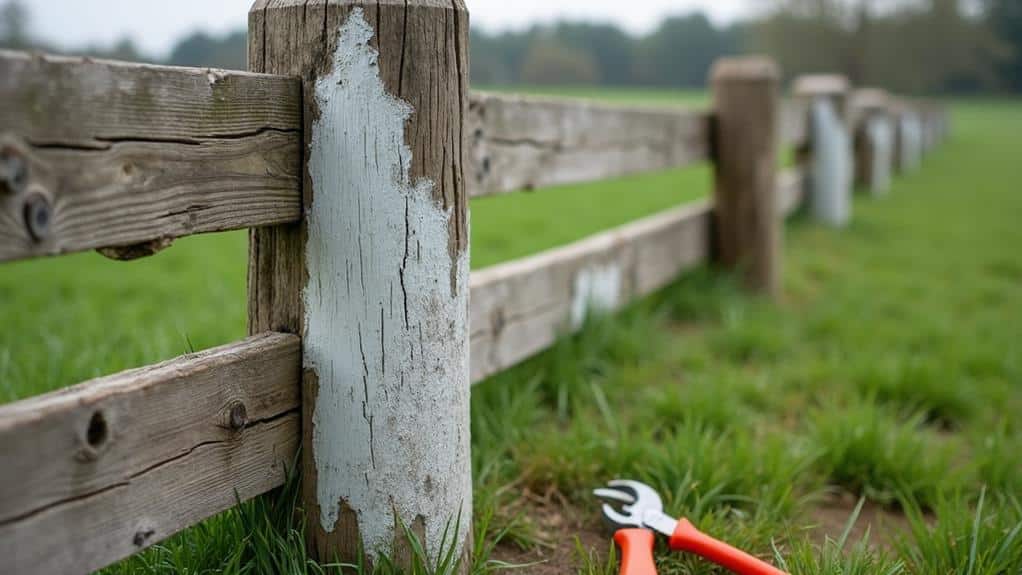
Maintenance and repair considerations form a crucial aspect of the fence post decision-making process. We must weigh the long-term implications of our choice between concrete and wooden posts.
Concrete posts offer significant advantages regarding durability and minimal upkeep, resisting weathering, rot, and insect damage. Their installation techniques yield a structure that requires little attention post-setup, saving time and resources on seasonal maintenance.
Wooden posts, whilst easier to repair, demand consistent care to maintain their integrity. We should consider the following factors:
- Annual staining and treating to prevent rot and insect infestation
- Regular inspections for splitting, warping, and structural compromise
- Potential for frequent replacements due to environmental exposure
Concrete posts, conversely, primarily require cosmetic maintenance. They resist mould and rot, simplifying cleaning processes and preserving appearance.
However, when structural damage occurs, repairs often necessitate complete replacement—a more challenging task than wooden post repairs.
In evaluating maintenance and repair considerations, we must balance the ease of wooden post repairs against the long-term durability and minimal upkeep of concrete posts. This analysis informs our decision-making process, ensuring we select the most suitable option for our specific needs and resources.
Environmental Impact Assessment

Evaluating the environmental impact of concrete versus wooden fence posts is a critical component of our decision-making process. We must consider several key factors, including carbon emissions and resource management, to make an informed choice.
Concrete production contributes greatly to global CO2 emissions, accounting for approximately 8% of the total. In contrast, wooden posts from sustainably managed forests act as carbon sinks during growth. This stark difference in carbon footprint is further compounded by concrete’s reliance on non-renewable resources and energy-intensive manufacturing processes.
We should also consider the end-of-life implications. Concrete’s durability becomes a liability at disposal, with limited recycling options and non-biodegradability. Wooden posts, however, can be repurposed or naturally decompose. Additionally, timber’s renewability through responsible forestry practices, often validated by certifications like FSC or PEFC, stands in sharp contrast to concrete’s depletion of finite resources.
Water usage presents another critical consideration. Concrete manufacturing’s substantial water requirements can exacerbate local scarcity issues, whilst sustainable timber production generally maintains a lower water footprint.
These factors collectively indicate that wooden fence posts offer a more environmentally sound option when sourced responsibly.
Weather Resistance and Performance

Weather resistance and performance stand as crucial factors in our evaluation of concrete versus wooden fence posts.
We’ve found that concrete posts excel in moisture resistance and pest protection, maintaining their structural integrity for decades even in harsh conditions. Their ability to withstand weathering, rot, and insect damage far surpasses that of wooden alternatives.
In contrast, wooden posts, especially when untreated, are vulnerable to moisture-induced issues like splitting and rotting. This susceptibility is particularly pronounced in wet or humid climates.
Whilst treated wooden posts can last 15 to 20 years with proper care, concrete posts often exceed a 50-year lifespan.
When considering extreme weather events, we’ve observed that:
- Concrete posts remain stable in high-wind areas
- Wooden posts may become dislodged or fail in severe conditions
- Concrete offers superior resistance to warping and deterioration
The performance disparity between concrete and wooden posts becomes even more apparent in challenging environments.
Concrete’s innate durability provides a clear advantage regarding long-term stability and reduced maintenance requirements.
For those seeking a fencing solution that offers ideal weather resistance and performance, concrete posts emerge as the superior choice in our analysis.
Frequently Asked Questions
Which Is Better, Concrete or Wooden Fence Posts?
We cannot definitively state that one is superior to the other. It depends on our priorities. We shall consider a cost comparison, weighing initial versus long-term expenses. We shall also evaluate installation difficulty, factoring in labour requirements and necessary equipment for each option.
What Are the Disadvantages of Concrete Fence Posts?
We’re faced with a mountain of drawbacks! Concrete fence posts present significant cost considerations, often 30-50% pricier than wooden alternatives. Installation challenges abound, requiring multiple workers due to their hefty 40kg+ weight. They’re also prone to chipping and environmental concerns.
Should Wood Fence Posts Be Set in Concrete or Not?
We recommend carefully evaluating wood post longevity and installation techniques. Whilst concrete can enhance stability, it may increase the risk of rot. We suggest considering alternative methods such as gravel or compacted soil, which offer better drainage and easier replacement.
What Is the Life Expectancy of a Concrete Fence Post?
Like sentinels standing guard, concrete fence posts boast an impressive life span of 30-50 years. We’ve found they require minimal maintenance, outlasting wooden alternatives. Their longevity hinges on installation quality and environmental factors, ensuring lasting performance for discerning property owners.
Conclusion
We’ve compared concrete and wooden fence posts across multiple dimensions. Whilst concrete offers superior durability and weather resistance, wood provides aesthetic flexibility and lower initial costs. Our analysis reveals that the choice isn’t merely binary; it’s a complex interplay of factors including lifespan, maintenance requirements, environmental impact, and installation complexity. We’ve dissected these elements to provide a thorough, data-driven comparison, enabling informed decision-making based on specific needs and priorities in fence post selection. This information is particularly relevant for British homeowners and property developers considering fencing options suitable for the UK climate and architectural styles.

Learn about the diverse types of concrete used in construction and discover which mix can transform your next project.

For a long-lasting driveway that laughs in the face of the UK's unpredictable weather, the C20 concrete mix is your Read more

In the UK, you've got a a lot of lightweight concrete types to choose from, each with its unique perks. Read more