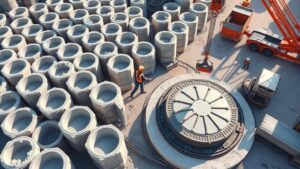
The compressive strength of an 80mm paver block typically ranges between 30 to 50 MPa. This measurement determines its load-bearing capability, essential for ensuring durability and safety in construction. The actual strength depends on factors such as cement content, water-cement ratio, material composition, and curing conditions. Adherence to standards like the Indian Standard IS 15658 is vital, setting minimum strength grades based on different traffic categories. Remember, the specific mix design, materials used, and the manufacturing process also greatly influence the strength outcomes. Exploring these details can provide deeper insight into optimizing paver block performance.
Key Takeaways
- The compressive strength of an 80mm paver block typically ranges from 30 to 50 MPa.
- It must meet the Indian Standard IS 15658 requirements for specific traffic categories.
- Factors like cement content, water-cement ratio, and curing conditions significantly influence strength.
- Proper compaction and curing during manufacturing are crucial for achieving desired strength.
- Regular testing ensures compliance with the minimum strength grades and durability standards.
Introduction
You must understand the compressive strength of 80mm paver blocks, as it’s crucial for evaluating their suitability in various construction applications. This strength indicates how much load these blocks can withstand before failure, a key factor in ensuring the longevity and safety of paved surfaces.
Additionally, several variables impact this strength, including material composition and manufacturing processes, which you’ll explore to fully grasp their implications.
Definition and importance of compressive strength for paver blocks
Compressive strength, a critical property of paver blocks, determines their ability to withstand loads without cracking. When you’re choosing concrete pavers, it’s essential to understand the role of compressive strength. This measure indicates the maximum load per unit area a paver can bear before failure.
The testing methodology involves subjecting a specimen, prepared under standardized conditions, to a steadily increasing load until it fractures. This process guarantees that each batch of paver blocks meets the designated strength grades, which are crucial for guaranteeing durability and safety. Specimen preparation must adhere strictly to protocols to achieve accurate results.
Therefore, knowing the compressive strength helps in selecting the appropriate paver for specific applications and environments.
Overview of factors affecting compressive strength
Several factors influence the compressive strength of paver blocks, including material composition, curing conditions, and block geometry. The mix design plays an important role; the cement content and water-cement ratio must be carefully balanced to achieve the desired strength. High-quality aggregates improve the durability and load-bearing capacity, while the inclusion of fiber reinforcement can enhance the toughness and crack resistance of the pavers.
| Factor | Impact on Compressive Strength |
|---|---|
| Cement Content | Increases with higher content |
| Water-Cement Ratio | Ideal ratio enhances strength |
| Fiber Reinforcement | Enhances toughness and durability |
Understanding these variables helps you optimize the block design for your specific needs, ensuring longevity and functionality in your paving projects.
Standards and Specifications

You’ll find that the Indian Standard IS 15658 sets specific benchmarks for the compressive strength necessary for paver blocks, including those with an 80mm thickness.
It’s important to compare these standards with international counterparts such as ASTM C936 and BS EN 1338 to guarantee global compliance and quality assurance.
Understanding these specifications will help you gauge the durability and suitability of paver blocks for various construction projects.
Indian Standard IS 15658 requirements for compressive strength of paver blocks
As you evaluate the specifications laid out by Indian Standard IS 15658, it’s important to understand how it categorizes paver blocks into different strength grades based on anticipated traffic loads. These grades guarantee that the selected pavers can withstand the stresses from pedestrian to heavy vehicular traffic.
Familiarizing yourself with these requirements will help you choose the appropriate grade for your project’s specific needs.
Minimum strength grades for different traffic categories (pedestrian, light/heavy vehicular)
The Indian Standard IS 15658 specifies distinct minimum compressive strength requirements for paver blocks depending on their intended use in pedestrian, light vehicular, or heavy vehicular traffic areas.
For pedestrian traffic, a lower 28-day strength suffices, whereas vehicular traffic demands higher resistance, considering loading rates and potential failure loads.
Your choice must align with these standards to guarantee durability and safety in application areas.
Comparison with other international standards like ASTM C936, BS EN 1338
When evaluating the compressive strength of 80mm paver blocks, it’s important to take into account international standards such as ASTM C936 and BS EN 1338. ASTM C936 specifically addresses solid concrete interlocking paving units, setting a minimum compressive strength of 55 MPa, which guarantees durability and suitability for various load-bearing applications.
On the other hand, BS EN 1338 is focused on concrete paving blocks used in Europe, with requirements that vary based on the intended use but generally emphasize strength development over time to meet safety and longevity criteria.
As a manufacturer, adhering to these standards not only helps in meeting legal requirements but also in assuring customers of the product’s reliability and performance. Always check these specifications to ensure compliance and ideal product quality.
Materials and Mix Design

As you explore the materials and mix design for 80mm paver blocks, it’s important to understand the typical concrete mix proportions used.
You’ll find that emerging sustainable materials offer viable alternatives that can meet or exceed the performance standards.
Additionally, incorporating fiber reinforcement plays a significant role in enhancing the compressive strength of these paver blocks.
Conventional concrete mix proportions for paver blocks
When you’re crafting paver blocks, the cement content plays a pivotal role in determining their compressive strength. You’ll need to balance the water-cement ratio carefully, as it plays a crucial role in the curing process and final strength.
Additionally, the quality of aggregates mustn’t be compromised; higher quality aggregates contribute to enhanced durability and strength of the paver blocks.
Influence of cement content, water-cement ratio, aggregate quality on strength
The strength of 80MM paver blocks greatly relies on the cement content, water-cement ratio, and the quality of aggregates used in the mix.
- Cement Content: Higher cement content can enhance compressive strength.
- Water-Cement Ratio: Ideal ratios yield the strongest bonds.
- Aggregate Quality: Superior aggregates contribute to durability and load-bearing capabilities.
Focus on mix optimization to achieve the desired compressive strength.
Emerging sustainable materials
You’ll find that integrating recycled aggregates, fly ash, and slag into the mix design can greatly enhance the sustainability of 80MM paver blocks.
These materials not only reduce the environmental footprint but also potentially improve the compressive strength of the pavers.
It’s important to assess the proportions and compatibility of these substitutes to guarantee top performance and durability.
Recycled aggregates, fly ash, slag
Incorporating recycled aggregates, fly ash, and slag into the mix design enhances the sustainability and performance of 80mm paver blocks. Here’s how these materials contribute:
- Recycled aggregates reduce waste and decrease natural resource usage.
- Fly ash improves the durability and reduces the water demand.
- Slag increases the compressive strength and longevity of paver blocks.
These sustainable materials not only lower costs but also increase structural integrity.
Role of fiber reinforcement in enhancing strength
Adding fiber reinforcement to the mix design greatly enhances the compressive strength of 80mm paver blocks. When you integrate fibers such as steel, glass, or synthetic into the concrete, you’re not just boosting its strength; you’re also notably improving its durability and structural capacity. This performance enhancement is essential, especially in applications where the paver blocks are subjected to high traffic or load-bearing scenarios.
The fibers distribute throughout the concrete, providing resistance against micro-cracking and contributing to the overall toughness of the paver blocks. This results in a more resilient and robust material that can withstand various stresses and strains, ensuring a longer lifespan and reduced maintenance costs. Therefore, fiber reinforcement is a key component in achieving superior performance in paver block installations.
Manufacturing Process

To guarantee maximum compressive strength in your 80mm paver blocks, you’ll need to meticulously manage each step of the production process.
You must apply precise compaction pressure and technique, as these greatly influence the strength development of the blocks.
Additionally, it’s essential to maintain proper curing conditions and durations to achieve the desired structural integrity and durability.
Key steps in paver block production
You’ll start the production of 80mm paver blocks by thoroughly mixing the required raw materials to guarantee uniformity.
Next, you’ll mold the mixture into desired shapes before subjecting them to high-pressure compaction to enhance their density and strength.
Mixing, molding, compaction, curing
In the production of 80mm paver blocks, the initial step involves carefully blending the raw materials to guarantee consistency throughout the batch.
- Mixing: Guarantees all components are thoroughly combined.
- Molding: Shapes the mixture into the desired form.
- Compaction and Curing: Applies pressure to compact, followed by proper curing conditions to enhance strength.
Master these stages to optimize the manufacturing process of your paver blocks.
Effect of compaction pressure and technique on strength development
Understanding the impact of compaction pressure and technique is essential for optimizing the strength development in the manufacturing process of 80mm paver blocks. The right compaction pressure ensures that the aggregate particles are properly embedded within the cement matrix, greatly enhancing the compressive strength of the finished product. It’s not just about applying high pressure; it’s the uniformity and consistency of this pressure that contribute to improved production consistency and quality control.
Adjusting the technique, such as the rate and duration of compaction, can further refine these results. You must make sure that the compaction process doesn’t lead to segregation of the mix, which can weaken the structural integrity. This balance is vital for achieving the best strength in your paver blocks.
Importance of proper curing conditions and duration
Guaranteeing the paver blocks are properly cured under controlled conditions greatly impacts their overall durability and strength. The curing process is crucial for the paver blocks to reach their maximum compressive strength, a key indicator of their ability to withstand loads and wear over time. Proper curing also contributes to the quality assurance of the paving blocks, ensuring consistent performance throughout their service life.
- Controlled Environment: Maintaining a consistent temperature and humidity optimizes the hydration process of the cement.
- Curing Duration: Adequate time allows for complete cement hydration, typically a minimum of 7 days.
- Monitoring: Regular checks during curing prevent defects and ensure uniform quality across all paver blocks.
Therefore, curing isn’t just a step but a cornerstone in paver block manufacturing.
Testing Methodology

To accurately determine the compressive strength of 80mm paver blocks, you’ll begin by following the detailed procedure outlined in IS 15658.
You’ll calculate the strength by dividing the failure load by the face area of the block.
Additionally, consider correction factors for specimen thickness to accurately interpret the results.
Detailed procedure for compressive strength testing as per IS 15658
You’ll start by meticulously preparing the specimen, ensuring it meets the exact dimensions and conditions outlined in IS 15658.
Next, you must confirm that the compression machine used complies with the necessary specifications to yield valid results.
Specimen preparation, machine requirements, loading rate
Begin by preparing the specimen of the 80mm paver block as outlined in IS 15658, ensuring it meets all specified dimensions and surface requirements.
- Machine Requirements: Use a calibrated compression testing machine with accurate load application.
- Loading Rate: Apply the load at a uniform rate as specified, typically between 2 kN/s to 3 kN/s.
- Quality Testing: Confirm dimensional tolerance and structural integrity before testing.
Calculation of compressive strength from failure load and face area
Calculating the compressive strength of an 80mm paver block involves dividing the failure load by the face area. You’ll need to use this formula for a precise measurement: Compressive Strength = Failure Load / Face Area. This calculation is critical for understanding whether your paver blocks meet the required standards for durability and safety.
| Parameter | Description |
|---|---|
| Failure Load | Maximum load the paver withstands before failing |
| Face Area | Surface area in contact during testing |
| Compressive Strength | Result from dividing failure load by face area |
| Standards | Guidelines that specify how to perform the test |
Ensure you’re familiar with the interpretation of these results, as they indicate the paver block’s ability to withstand loads.
Correction factors for specimen thickness and interpretation of results
After determining the basic compressive strength, it’s important to take into account correction factors for specimen thickness to ensure accurate results. According to IS 15658, these factors are vital for interpreting the true compression strength of paver blocks.
- Specimen Size Impact: The thickness and size of the specimen greatly influence the measured compression strength. Thinner specimens might yield higher strength values.
- Standardization: Applying correction factors helps standardize results across different test conditions and specimen sizes, enhancing reliability.
- Interpretation Guidelines: Proper application of these factors allows for more accurate assessment and comparison of the compression strength of different paver blocks.
Typical Compressive Strength Values
You’ll find that the 28-day compressive strength of 80mm paver blocks typically ranges between the M30 and M50 grades.
It’s important to monitor how strength develops over time at intervals of 7, 14, 28, 56, and 90 days to understand the material’s behavior.
Additionally, comparing these lab-tested values with the manufacturer’s specifications can highlight any discrepancies or confirm the quality of the pavers.
28-day compressive strength range for M30 to M50 grade 80mm paver blocks
The typical compressive strength range for M30 to M50 grade 80mm paver blocks spans from 30 MPa to 50 MPa after 28 days of curing. When you’re selecting the right paver blocks for your project, it’s essential to understand how the compressive strength of these blocks evolves over time, even though specific day intervals like 7-day strength, 14-day strength, 56-day strength, and 90-day strength will be discussed later.
Here’s what you should keep in mind for these grades:
- M30 Grade: Designed for moderate to heavy traffic, offering a balance between durability and cost-effectiveness.
- M40 Grade: Provides enhanced durability, suitable for areas with higher traffic and load requirements.
- M50 Grade: The highest standard, recommended for industrial or high-load areas.
Strength development trends at 7, 14, 28, 56 and 90 days
To understand how paver blocks’ strength increases over time, consider the typical compressive strength values at 7, 14, 28, 56, and 90 days. Initially, you’ll notice a rapid increase in compressive strength, particularly between 7 and 28 days. This period is important as the chemical processes responsible for strength gain—hydration and curing—are most active. By day 28, paver blocks generally achieve approximately 60-70% of their ultimate strength.
The subsequent growth, up to days 56 and 90, shows a slower rate of increase but contributes significantly to long-term performance. This includes enhancements in flexural strength and split tensile strength, reinforcing the material’s durability against physical stresses and weather conditions. Observing these strength development trends helps in predicting the block’s performance in practical applications.
Comparison of lab-tested values with manufacturer specifications
Comparing lab-tested compressive strength values with those specified by manufacturers reveals whether the paver blocks meet or exceed the expected standards. When you’re evaluating the quality of 80mm paver blocks, it’s imperative to scrutinize:
- Compressive Strength: Are the lab-tested values within the range of manufacturer specifications? This ensures the structural integrity and suitability for use.
- Technical Specifications: Do the test results align with the detailed technical specifications provided by the manufacturer?
- Product Certification: Check if the paver blocks have valid product certifications that verify compliance.
These evaluations are essential for confirming that the paver blocks you’re using are reliable and adhere to safety and quality standards. Always make sure that the compressive strength meets or surpasses the manufacturer specifications for best performance.
Relationship with Other Properties
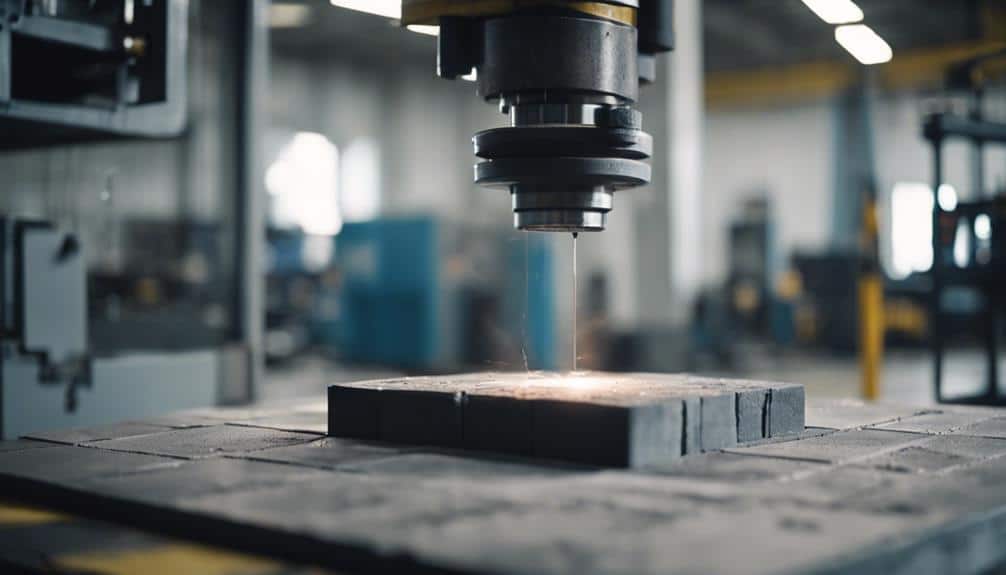
Understanding the relationship between compressive strength and other mechanical properties is essential for your application of 80mm paver blocks.
You’ll find that increased compressive strength often correlates with enhanced flexural and split tensile strength, impacting the block’s overall performance.
Additionally, it’s important to take into account how this strength influences abrasion resistance and durability, while also balancing factors like permeability and slip resistance to meet specific usage demands.
Correlation between compressive strength and flexural strength, split tensile strength
Examining the relationship between compressive strength and other mechanical properties reveals that both flexural strength and split tensile strength closely correlate with the compressive strength of 80mm paver blocks.
- Flexural Strength: This measures the ability of paver blocks to resist bending. Higher compressive strength often implies greater flexural strength, essential for effective load transfer under traffic loads.
- Split Tensile Strength: Reflects the resistance to tension-induced stress. Pavers with higher compressive strength typically exhibit better performance under tensile stresses, enhancing overall durability.
- Load Transfer Efficiency: Strong interlocking pavers distribute loads more evenly, reducing the risk of cracking under heavy traffic.
Understanding these correlations is key to predicting the performance of paver blocks in real-world conditions.
Influence of compressive strength on abrasion resistance and durability
Building on the established importance of compressive strength, let’s now explore how it impacts the abrasion resistance and overall durability of 80mm paver blocks.
When you increase the compressive strength, you’re fundamentally enhancing the paver’s ability to resist wear and tear caused by foot and vehicle traffic. This increased strength directly contributes to improved abrasion resistance, ensuring that the pavers maintain their structural integrity and aesthetic appeal over time.
Furthermore, higher compressive strength typically extends the life cycle of the pavers. This attribute is vital in minimizing fatigue resistance, where repeated loads can cause wear. By optimizing compressive strength, you’re not only ensuring a longer service life but also contributing to a more durable, reliable paving solution.
Balancing strength with other requirements like permeability, slip resistance
While enhancing the compressive strength of 80mm paver blocks is essential, it’s equally important to balance this strength with other properties like permeability and slip resistance to meet diverse application needs. You need pavers that not only withstand load but also cater to safety and environmental concerns.
- Permeability: Guarantees proper drainage, reducing puddles and water logging, which is vital for maintaining the integrity of the paver installation.
- Slip Resistance: Critical for safety, especially in wet conditions. A textured surface can help prevent slips and falls.
- Interlocking Design: Facilitates load distribution while contributing to the overall stability and durability of the pavement structure.
Balancing these properties ensures that your paver blocks aren’t only strong but also functional in various environments.
Practical Implications
Understanding the compressive strength of 80mm paver blocks is essential for predicting their long-term performance under various environmental conditions.
You’ll find that reviewing case studies of paver installations, where optimized strength parameters were vital, highlights the importance of this property.
Additionally, implementing rigorous quality control measures during production can help guarantee that the strength of these paver blocks remains consistent, safeguarding their durability and functionality.
Importance of compressive strength for long-term performance in different exposures
Compressive strength is essential for ensuring the durability of 80MM paver blocks across various environmental conditions. Here’s how it affects long-term performance:
- Exposure Conditions: High compressive strength helps paver blocks withstand diverse exposure conditions, from heavy traffic to severe weather, ensuring structural integrity.
- Freeze-Thaw Resistance: Adequate compressive strength enhances freeze-thaw resistance, preventing cracks and damage over cycles of freezing and thawing, vital in colder climates.
- Sulfate Resistance: Blocks with high compressive strength are more resistant to sulfate attacks from soil and water, which can cause deterioration over time.
Understanding these factors ensures you choose paver blocks that maintain their aesthetics and functionality, regardless of the stresses they face.
Case studies of successful paver block installations with optimized strength
To illustrate the practical applications, consider the real-world examples of 80MM paver block installations where optimized compressive strength has led to outstanding durability and performance. These case studies showcase the robustness and sustainability of such pavement designs in various settings.
| Location | Application | Outcome |
|---|---|---|
| City Square | Public Walkways | Excellent wear, minimal repairs |
| Retail Complex | Parking Areas | Sustained heavy traffic load |
| Residential Area | Driveways | Long-lasting aesthetic appeal |
| Industrial Estate | Loading Bays | Withstood constant heavy loads |
| Park Pathways | Recreational Paths | Maintained integrity and safety |
These examples underline the critical role of compressive strength in the installation and long-term success of pavement systems.
Quality control measures during production to ensure consistent strength
Implementing stringent quality control measures during the production of 80MM paver blocks guarantees that they consistently meet or exceed required compressive strength standards. To achieve this, you’ll need to focus on several critical components:
- Regular testing of raw materials: Ensuring all materials, especially cement and aggregates, meet your specifications for quality and purity.
- Controlled addition of admixtures: Precise measurement and mixing of admixtures can greatly affect the consistency and final strength of paver blocks.
- Strict adherence to curing protocols: Proper curing is essential to achieve desired compressive strength; this includes maintaining the correct temperature and humidity levels.
Conclusion

You’ve seen how various factors affect the compressive strength of 80mm paver blocks.
Now, you must consider optimized mix designs and rigorous testing protocols to meet desired strength levels.
Looking ahead, it’s essential to explore further research that could enhance the performance of these paver blocks.
Recap of key factors influencing the compressive strength of 80mm paver blocks
Understanding the key factors that influence the compressive strength of 80mm paver blocks is essential for optimizing their performance and durability. You’ve seen how important proper subgrade preparation and the right choice of bedding sand are. Additionally, chemical components like superplasticizers and methods such as air entrainment greatly affect the integrity and longevity of the blocks.
Key factors include:
- Subgrade Preparation: Ensuring a solid and even base.
- Bedding Sand Quality: Utilizing appropriate granularity and compaction.
- Chemical Additives: Incorporating superplasticizers for improved workability and air-entraining agents to mitigate freeze-thaw vulnerabilities.
Recommendations for mix design, manufacturing, and testing to achieve target strength
Now let’s focus on optimizing the mix design, refining manufacturing processes, and implementing rigorous testing methods to guarantee that your 80mm paver blocks meet the desired compressive strength.
For the mix design, carefully select aggregate quality and cement types that enhance both compressive strength and impact resistance. Adjust water-cement ratios for best hydration without compromising the block’s integrity.
During manufacturing, maintain consistent pressure and curing times to ensure uniformity across batches.
Implement a testing regime that includes not only compressive strength assessments at various stages of curing but also evaluates impact resistance. This structured approach guarantees each batch satisfies the stringent criteria required for durable, high-performance paver blocks.
Future research directions for enhancing paver block performance
Exploring innovative material compositions and advanced curing techniques represents the next step in advancing the performance of 80mm paver blocks. Future research can greatly enhance paver block performance by focusing on the following areas:
- Development of green materials: Integrate sustainable resources to reduce the carbon footprint while maintaining or improving compressive strength.
- Optimization of curing processes: Experiment with different temperatures and humidity levels to identify ideal conditions that enhance strength and durability.
- Longitudinal field studies: Conduct extensive testing under real-world conditions to assess performance over time and improve material formulations accordingly.
You’ll contribute to a more sustainable infrastructure by prioritizing these research directions, thereby lowering environmental impact and enhancing the structural integrity of constructed spaces.
Frequently Asked Questions
Can 80MM Paver Blocks Be Used in Residential Driveways?
Yes, you can use 80mm paver blocks for residential driveways. They’re durable enough to handle vehicle weights and frequent use, ensuring longevity and maintaining appearance under typical residential traffic conditions.
How Do Weather Conditions Affect 80MM Paver Blocks?
Just like Achilles had his heel, your 80mm paver blocks have vulnerabilities to weather. Freeze-thaw cycles can cause cracking, while extreme heat might lead to warping or softening of the material.
What Are the Color Options for 80MM Paver Blocks?
You can choose from a variety of colors for 80mm paver blocks, including red, grey, black, and beige. Each color can complement different design aesthetics, enhancing the visual appeal of your paving project.
How Much Does It Cost to Install 80MM Paver Blocks?
The cost to install 80mm paver blocks varies based on materials, labor, and project size. You’ll typically spend between $10 to $25 per square foot, including installation by professionals. Plan your budget accordingly.
Are 80MM Paver Blocks Environmentally Friendly?
Yes, 80mm paver blocks are environmentally friendly as they’re often made from recycled materials. They reduce runoff and can be reused, making them a sustainable choice for paving solutions.
Conclusion
To sum up, mastering the compressive strength of an 80mm paver block is like discovering the keystone in an arch. It’s crucial for guaranteeing the longevity and reliability of your paving projects.
By strictly adhering to the specified standards, employing a meticulous mix design, and adopting a precise manufacturing process, you’ll secure that the paver blocks can withstand the tests of both time and pressure, serving as a steadfast foundation for any pathway or pavement.
Related Articles

Are you ready to learn the secret of efficient concrete transportation? In this article, we will delve into the intriguing Read more

Is it more cost-effective to mix your own concrete or have it delivered? This article examines the factors to consider Read more

Do you want to ensure the structural integrity of your concrete construction project? Then, rebar is a crucial component you Read more