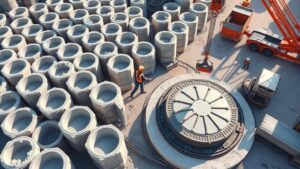
Ready-made concrete stairs offer you a durable and cost-effective solution for modern construction. They’re designed to withstand various environmental conditions, optimising construction efficiency by reducing on-site time and labour costs. With a focus on materials that promise long-term benefits, these stairs are recognised for their high tensile strength and rapid installation capabilities. The incorporation of steel reinforcement guarantees enhanced durability and stability, while customisation options allow for tailored aesthetics. Considering the reduced maintenance requirements and the potential for long-term cost savings, it’s clear why they’re a growing choice among builders. Further exploration will reveal even more advantages and possibilities.
Key Takeaways
- Ready-made concrete stairs offer enhanced durability and high tensile strength, making them a long-lasting option.
- They reduce on-site construction time and labour costs, optimising construction efficiency.
- With steel reinforcement, these stairs ensure increased durability and stability.
- Customisation options allow for a tailored aesthetic, matching various design requirements.
- The cost-effective nature includes reduced maintenance requirements, leading to long-term cost savings.
Introduction
You’ve likely noticed the increasing use of precast concrete stairs in modern construction due to their efficiency and durability. This article aims to give you a concise overview of why these stairs are becoming a staple in building projects and what sections we’ll explore to understand their advantages fully.
The growing popularity of precast concrete stairs in modern construction
The increasing adoption of precast concrete stairs in modern construction reflects a shift towards efficiency, durability, and design flexibility. You’re observing a trend where the inherent benefits of precast concrete stairs—such as their robustness and the ability to withstand various environmental conditions—are being leveraged to optimise construction efficiency.
This method reduces on-site construction time and labour costs, aspects meticulously analysed in cost analysis strategies for large-scale projects. Modern construction methodologies now prioritise materials and techniques that offer long-term benefits, and precast concrete stairs fit this criterion perfectly.
Their durability not only guarantees a longer lifespan for the structures they’re integrated into but also contributes to a reduction in maintenance and repair costs, aligning with the economic and practical demands of contemporary architectural endeavours.
Understanding Precast Concrete Stairs

You’ll first need to grasp what precast concrete stairs are, including their essential characteristics and why they stand out.
Understanding the manufacturing process and the materials, such as rapid-set concrete and steel reinforcement, is important for appreciating their robustness and efficiency.
These components contribute to their superiority over traditional poured-in-place stairs, offering significant advantages in terms of strength, speed of installation, and overall durability.
Definition and key characteristics
Often, precast concrete stairs are recognised for their durability and high tensile strength, offering a robust and efficient solution for various construction projects. Utilising rapid-set concrete, these stairs guarantee a quicker installation time compared to traditional methods, leading to significant labour savings.
The precast advantages extend beyond speed to encompass enhanced structural integrity, as they’re manufactured in controlled environments, ensuring consistent quality. When it comes to a concrete staircase, the precast method stands out for its ability to withstand wear and tear, making it a preferred choice for both commercial and residential buildings.
A cost comparison reveals that, while the initial investment might be higher, the longevity and reduced maintenance requirements of precast stairs offer substantial savings over time, solidifying their position as a cost-effective option.
Manufacturing process and materials used
The manufacturing process of precast concrete stairs involves a meticulous combination of high-quality materials, including cement, aggregates, and water, precisely mixed to achieve the desired strength and durability. This concrete mix design is crucial in guaranteeing the structural integrity and longevity of the stairs.
During prefabrication, reinforcement placement is carefully executed to enhance the load-bearing capacity, adhering to stringent quality assurance protocols. These steps guarantee each unit meets predefined standards before it leaves the factory.
The prefabrication benefits extend to surface treatments, which are applied to improve aesthetics and resistance against wear and environmental factors. Through these processes, precast concrete stairs emerge as a robust, efficient solution for modern construction, embodying precision engineering and material science advancements.
Rapid-set concrete and its benefits
In understanding precast concrete stairs, it’s essential to recognise the advantages of rapid-set concrete, which greatly accelerates construction timelines. This material enhances sustainability by reducing material consumption and minimising waste. Additionally, its energy efficiency contributes to lower overall project costs.
Here’s a breakdown of rapid-set concrete benefits:
| Benefit | Description |
|---|---|
| Accelerated curing | Speeds up project completion, reducing labour costs. |
| Waste reduction | Minimises excess material, aligning with sustainability goals. |
| Energy efficiency | Lowers energy use during manufacturing, cutting carbon footprint. |
| Reduced material consumption | Uses fewer resources, promoting environmental responsibility. |
| Cost breakdown | Offers a detailed view of savings, particularly in labour and time. |
Steel reinforcement and other components
To fully grasp the durability and stability of precast concrete stairs, it’s important to understand that steel reinforcement and other components play a pivotal role. In staircase construction, steel reinforcement isn’t just an add-on; it’s a fundamental aspect that guarantees the longevity and safety of the structure. This integration greatly enhances durability, making the stairs not just robust but also cost-effective in the long run.
Quality control during the manufacturing process ensures that each component, from the steel reinforcement to the concrete mix, meets specific standards. This precision guarantees that the stairs withstand various loads and stresses over time. By prioritising these elements, precast concrete stairs offer a reliable, efficient solution for both residential and commercial construction projects, marrying durability with cost-effectiveness in a way that traditional methods struggle to match.
Advantages over traditional poured-in-place stairs
You’ll find that precast concrete stairs offer superior quality control and consistency compared to traditional poured-in-place methods. Their production in controlled environments leads to faster installation and greatly reduces labour costs.
Additionally, these stairs boast enhanced durability and longevity, alongside a wide range of customisation options to fit specific project requirements.
Quality control and consistency
One significant advantage of precast concrete stairs over traditional poured-in-place options is their superior quality control and consistency. Utilising durable materials, precision engineering guarantees each unit meets rigorous standards.
This uniformity aids in more accurate cost estimating, eliminating the variability often encountered with site-specific conditions. The controlled factory environment assures each stair section is flawlessly constructed, ensuring long-lasting performance and reliability.
Faster installation and reduced labour costs
Beyond quality control, precast concrete stairs greatly expedite installation processes and slash labour costs, offering a clear advantage over traditional poured-in-place methods.
With off-site manufacturing, you’re cutting down on project timeline considerably as assembly, transportation, and site preparation occur simultaneously. This streamlined approach not only accelerates construction but also guarantees a higher return on investment by minimising delays and reducing the workforce needed on-site.
Durability and longevity
Precast concrete stairs greatly outlast their poured-in-place counterparts, offering enhanced durability and longevity to any construction project. This sustainable construction choice guarantees low maintenance and superior weather resistance.
Customisation options
While durability and longevity stand as significant benefits, the customisation options offered by precast concrete stairs further elevate their advantage over traditional poured-in-place stairs.
You’ll find that 3D-printed formwork allows for intricate designs unachievable in cast-in-place comparisons. Additionally, innovative materials and stair finishes can be tailored to specific aesthetic or functional requirements, offering a level of customisation that traditional methods simply can’t match.
Design Possibilities and Inspiration

You have a variety of configurations at your disposal when considering ready-made concrete stairs. These configurations include straight, L-shaped, U-shaped, and spiral options.
Straight, L-shaped, U-shaped, and spiral configurations
Exploring the design possibilities of ready-made concrete stairs reveals that straight, L-shaped, U-shaped, and spiral configurations offer distinct aesthetic and functional advantages for various architectural contexts. These modular stairs can transform stair design by optimising the installation sequence, especially in compact spaces, offering space-saving solutions without compromising style or durability.
| Configuration | Ideal for |
|---|---|
| Straight | Simplistic, direct paths in spacious or limited areas. |
| L-shaped | Corner utilisation, adding visual interest and functionality. |
| U-shaped | Seamless connections between floors in medium to large spaces. |
| Spiral | Space-saving in tight areas, adding a focal point of elegance. |
| Compact Modular | Efficient use in extremely limited spaces, showcasing innovative design. |
Each configuration presents a unique set of benefits, tailored to enhance the spatial and aesthetic value of environments.
Incorporating precast stairs in different settings
You can greatly enhance the aesthetic and functional aspects of residential homes, commercial buildings, and public spaces by incorporating precast concrete stairs.
Each setting offers unique design challenges and opportunities, from integrating into the architectural style of a home to ensuring durability and safety in high-traffic public areas.
Analysing these environments allows for the tailored application of precast stairs, maximising both visual appeal and practical utility.
Residential homes
Incorporating precast concrete stairs into residential homes offers a multitude of design possibilities, enhancing both functionality and aesthetic appeal across various settings.
- Residential stairs promise long-term savings by reducing maintenance needs.
- Adhering to safety standards, these stairs provide slip resistance, ensuring homeowner safety.
- Precast stairs in residential settings meet varying maintenance requirements, blending durability with minimal upkeep.
Commercial buildings
Precast concrete stairs elevate commercial building designs by providing durable, versatile, and aesthetically pleasing access solutions.
| Feature | Benefit |
|---|---|
| Modular construction | Facilitates quick, precise installation |
| Fire resistance | Enhances building safety |
| Maintenance schedule | Lowers long-term costs |
| Environmental benefits | Promotes sustainability |
These stairs offer commercial stairs solutions that combine fire resistance, reduced maintenance, and environmental benefits, ensuring your project’s success.
Public spaces and outdoor environments
Public spaces and outdoor environments gain enhanced functionality and aesthetic appeal with the strategic placement of ready-made concrete stairs. Consider these key benefits:
- Durability: Outdoor stairs withstand harsh weather, maintaining integrity over time.
- Cost-effectiveness: Prefabricated options reduce installation time and costs.
- Green Building: Concrete staircases contribute to sustainable design in public spaces, aligning with green building principles.
Technological Advancements in Precast Stair Production

You’re now encountering the frontier of technological advancements in precast stair production.
3D-printed formwork enables the creation of stairs with complex geometries, while computer-aided design (CAD) and modelling software streamline the design process.
Robotic fabrication and the use of innovative materials and finishes further enhance efficiency and aesthetic appeal in manufacturing.
3D-printed formwork for complex geometries
In the domain of precast stair production, 3D-printed formwork stands out as a groundbreaking advancement, enabling the creation of complex geometries with unprecedented precision and efficiency. This technology leverages robotic fabrication to produce custom moulds, which are instrumental in offsite manufacturing processes. Here’s how it transforms the industry:
- Complex Geometries: The ability to create intricate shapes and designs that were previously impossible or cost-prohibitive with traditional formwork.
- Robotic Fabrication: Enhances precision in the production of 3D-printed formworks, reducing errors and material wastage.
- Offsite Manufacturing: Streamlines the production process, allowing for the prefabrication of components in a controlled environment before transport to the construction site.
This innovation not only elevates design possibilities but also optimises efficiency and sustainability in building construction.
Computer-aided design (CAD) and modelling software
Building on the foundation set by 3D-printed formwork, computer-aided design (CAD) and modelling software further revolutionise the precast stair production process by enabling more accurate and detailed planning.
This integration of CAD software into the design-build workflow streamlines the translation of conceptual designs into precise, manufacturable components. By leveraging the capabilities of modelling software, you can anticipate and resolve potential structural issues before production, greatly reducing waste and costs.
Moreover, the automation features inherent in these software tools enhance construction scheduling, allowing for tighter project timelines and more efficient resource allocation. The synergy between CAD and modelling software not only optimises the design phase but also propels the construction industry towards greater efficiency and accuracy in precast stair manufacturing.
Robotic fabrication and automation in manufacturing
Robotic fabrication and automation have become pivotal in enhancing the efficiency and precision of precast stair production. These industry advancements lead the charge towards streamlining processes, from handling raw materials to securing the final product for dispatch. Here’s how they’re shaping the future:
- Increased Production Speed: Automation markedly reduces the time it takes to produce each stair unit, allowing for higher output rates.
- Enhanced Accuracy and Quality: Robotic arms guarantee each component is handled, measured, and cut with precision, minimising errors and material waste.
- Safer Work Environment: Automation takes over the more hazardous tasks, reducing workplace accidents.
These future trends in robotic fabrication and automation in manufacturing not only promise cost savings but also pave the way for more innovative designs and sustainable practices in the precast stair industry.
Innovative materials and finishes
Following the discussion on robotic fabrication and automation, we now turn our attention to the advancements in innovative materials and finishes that are setting new benchmarks in precast stair production.
You’ll find that the incorporation of anti-slip coatings and colour pigments enhances not only the aesthetics but also the safety of these stairs. Additionally, the development of textured finishes increases tactile feedback, reducing the risk of slips and falls.
Importantly, the focus on recyclability and reusability of materials reflects a growing commitment to environmental sustainability. These technological advancements guarantee that precast concrete stairs aren’t only durable and cost-effective but also adaptable to modern design requirements and environmental standards.
Sustainability and Environmental Benefits
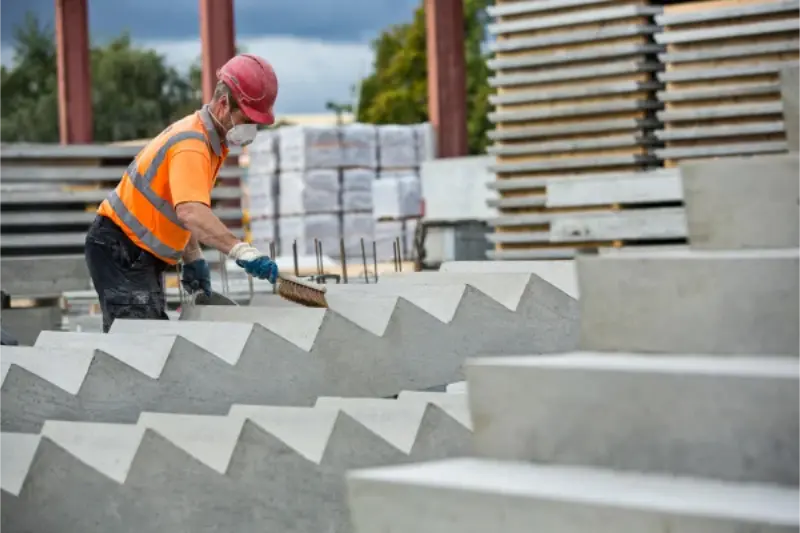
You’ll find that ready-made concrete stairs offer significant sustainability and environmental benefits. Their production requires less waste and material, making them a more efficient choice compared to traditional cast-in-place stairs.
Additionally, their recyclability and contribution towards LEED credits underscore their role in promoting green building practices.
Reduced waste and material consumption compared to cast-in-place stairs
Opting for ready-made concrete stairs greatly reduces waste and material consumption compared to traditional cast-in-place methods, offering a more sustainable building option. This approach aligns with contemporary needs for environmental stewardship by:
- Minimising Foundation Requirements: Prefabricated units are designed with efficiency in mind, requiring less material for the foundation, thereby conserving resources and reducing the environmental footprint.
- Simplifying Post-Installation and Finishing Processes: The precision in manufacturing limits the need for extensive post-installation adjustments and finishing, further decreasing material usage.
- Enhancing Lifecycle Costing: Ready-made stairs exhibit superior durability and require fewer repair techniques over time, contributing to a reduction in materials needed for maintenance and eventual replacement.
Energy efficiency in the manufacturing process
Beyond reducing waste, ready-made concrete stairs also offer sustainability benefits through energy-efficient manufacturing processes. The use of advanced energy modelling in the production facilities optimises the use of resources, greatly reducing the carbon footprint associated with the manufacturing process. This approach not only aligns with the principles of green architecture but also enhances the thermal insulation properties of the stairs, contributing to the overall energy efficiency of the buildings they are installed in.
| Aspect | Impact |
|---|---|
| Energy Modelling | Reduces energy consumption and operational costs |
| Carbon Footprint | Lowers greenhouse gas emissions during production |
| Manufacturing Process | Streamlines production for minimal energy waste |
| Green Architecture | Promotes sustainability and efficiency in construction |
Recyclability and reusability of precast components
How do the principles of recyclability and reusability enhance the environmental benefits of precast concrete components? By prioritising these principles, the construction industry greatly reduces its environmental impact, aligning with green building practices. Here’s how:
- Minimising Waste: Precast components, including stairs, can be easily dismantled and reused in new projects, reducing the need for new materials.
- Conserving Resources: Recycling concrete reduces the demand for virgin materials, conserving natural resources and lessening the extraction impact.
- Lowering Carbon Footprint: The process of recycling concrete emits less carbon dioxide compared to manufacturing new construction materials, contributing to sustainability efforts.
LEED credits and green building certification
Incorporating ready-made concrete stairs into your construction project can greatly contribute to achieving LEED credits and enhancing green building certification. By prioritising these prefabricated elements, you’re not only streamlining the construction process but also substantially reducing the environmental impact associated with traditional building methods.
The use of ready-made stairs aligns with sustainability principles by minimising waste and promoting resource efficiency, two key factors in obtaining LEED credits. Additionally, this approach supports social sustainability by ensuring safer construction practices and reducing on-site accidents.
The strategic selection of materials and construction methods that contribute to green building certification demonstrates a commitment to environmental stewardship and can lead to improved energy efficiency, ultimately benefiting both the planet and your project’s bottom line.
Installation and Integration Process

To guarantee a smooth installation of ready-made concrete stairs, you’ll need to first focus on site preparation and understanding foundation requirements.
Transporting and handling precast stair units demands careful consideration to avoid damage, while the assembly and securing process must be meticulously planned to guarantee stability.
Integrating these stairs with other building elements, such as landings and railings, alongside post-installation finishing and maintenance, requires a precise approach for best durability and functionality.
Site preparation and foundation requirements
Before installing ready-made concrete stairs, you must verify that the site is properly prepared and the foundation meets specific requirements. Guaranteeing a successful installation involves meticulous attention to:
- Site Preparation: Clear the area of debris and level the ground. This stage is critical for the accurate placement and alignment of the stairs, preventing future settlement or misalignment issues.
- Foundation Requirements: The foundation must be designed to support the weight of the concrete stairs. This involves calculating load distribution and ensuring the foundation material is compact and stable.
- Formwork Design and Curing Process: Although not directly involved with ready-made stairs, understanding the formwork design and curing process is essential for any adjustments or minor pours needed at the site. Additionally, make sure that lifting equipment is adequately rated for the stair’s weight, ensuring a safe installation process.
Transporting and handling precast stair units
Having prepared the site and confirmed the foundation’s readiness, you must now focus on the logistics of transporting and handling precast stair units for installation and integration. Effective supply chain management is vital, ensuring timely delivery while minimising potential damage. Logistics planning becomes a pivotal aspect, requiring detailed coordination between the manufacturing plant and the construction site. This involves precise scheduling, route optimisation, and considering site logistics for the arrival and movement of heavy units.
Conducting a thorough risk assessment is essential to address health and safety concerns, identifying potential hazards associated with lifting and moving large precast components. Implementing robust safety protocols, including the use of appropriate lifting equipment and ensuring all personnel are adequately trained, mitigates these risks, ensuring a smooth and safe installation process.
Assembling and securing the stairs in place
Once the precast stair units arrive on-site, it’s vital to accurately position and securely fasten them to guarantee structural integrity and alignment with the building’s design specifications. The integration of ready-made stairs involves a meticulous process, guaranteeing a seamless fit within the structure.
Here are the critical steps:
- Place and Align: Carefully position the stairs, ensuring they align perfectly with the designated area.
- Secure Connection: Use specified connection details to anchor the stairs to the building, employing bolts or welding as required.
- Finish with Grout and Sealant: Apply grout filling in gaps to provide additional stability and finish with sealant application for waterproofing and protection.
This methodical approach guarantees the ready-made stairs are integrated flawlessly, maintaining both functionality and aesthetic coherence.
Integrating with other building elements (landings, railings, etc.)
To uphold a cohesive structure, it’s vital to meticulously integrate pre-made concrete stairs with adjacent building elements such as landings and railings. This process requires a deep understanding of staircase design ideas and adherence to building codes to guarantee safety and functionality. You’ll need to evaluate the compatibility of the stairs with existing or planned landings, making sure that the shift between levels is seamless and meets all necessary specifications.
Moreover, integrating railings involves precision to align with both the aesthetic and safety standards dictated by building codes. This step isn’t just about installation but about ensuring that the integration supports the overall design vision while maintaining structural integrity. It’s essential to contemplate the load requirements, materials compatibility, and the seamless integration with other building elements to achieve a harmonious and compliant installation.
Post-installation finishing and maintenance
Start right away on post-installation finishing and maintenance tasks to maintain the structural integrity and aesthetic appeal of your concrete stairs. Effective maintenance not only guarantees durability but also enhances cost-effectiveness by prolonging the stairs’ lifespan.
Based on user feedback and best practices, consider these steps:
- Cleaning Methods: Implement regular cleaning using pH-neutral cleaners to prevent damage to concrete surfaces.
- Sealing: Apply a high-quality sealant to protect against moisture and wear. This step is critical in preventing early deterioration.
- Routine Inspections: Conduct annual inspections to identify and rectify any signs of wear or damage, such as cracks or chips, promptly.
Adhering to these maintenance practices will ensure that your ready-made concrete stairs remain both functional and visually appealing for years to come.
Cost Analysis and Comparison

You’ll need to understand the factors that influence the cost of precast concrete stairs, including material and labour expenses.
Comparing these costs to traditional methods reveals significant differences in initial outlay and long-term savings.
Analysing the return on investment shows how precast options can offer financial benefits over time.
Factors influencing the cost of precast concrete stairs
Several factors, including material costs, design complexity, and installation requirements, greatly impact the overall cost of precast concrete stairs. When conducting an economic analysis, it’s important to take into account these variables as they directly influence the feasibility study and project management strategies. Value engineering can play a pivotal role in optimising these costs without compromising quality, aligning with best practices in the construction industry.
- Material Costs: The price of concrete and reinforcement materials can fluctuate, affecting the final cost.
- Design Complexity: Custom designs or additional features such as integrated handrails increase production efforts and costs.
- Installation Requirements: The site’s accessibility, the need for specialised equipment, and labour costs can vary significantly, impacting the overall expense.
Understanding these factors ensures a thorough cost analysis, guiding informed decision-making in the construction process.
Cost breakdown and comparison with traditional methods
Delving into the cost breakdown of ready-made concrete stairs reveals significant financial advantages when compared to traditional construction methods. By analysing the expenses associated with both approaches, it’s evident that ready-made stairs provide a cost-effective turnkey solution.
The up-front costs of traditional methods, including labour, materials, and the potential for delays, often surpass those of precast options. Ready-made concrete stairs offer a durable alternative, minimising the need for repairs and maintenance.
In addition, the efficiency of installation with ready-made options reduces labour costs substantially. As you assess the overall expenditure, the durable nature and reduced labour associated with ready-made concrete stairs position them as a financially savvy choice over traditional methods, aligning with the goal of achieving a balance between cost efficiency and structural integrity.
Long-term cost savings and return on investment
Over time, investing in ready-made concrete stairs leads to substantial long-term cost savings and a strong return on investment, particularly when factoring in reduced maintenance and repair expenses. The durability and cost-effectiveness of these stairs become evident through a thorough post-occupancy evaluation, highlighting several key aspects:
- Durability: Concrete stairs withstand wear and tear far better than other materials, greatly lowering the frequency and cost of repairs.
- Cost-effective maintenance: The inherent strength and resilience of concrete minimise maintenance demands, contributing to long-term cost savings.
- Return on Investment: The initial investment is quickly offset by the reduced lifecycle costs, resulting in a favorable return on investment over time.
These factors collectively underscore the economic advantages of ready-made concrete stairs, confirming their value as a long-term investment.
Conclusion

As you consider integrating ready-made concrete stairs, it’s important to review their key benefits, including durability and cost-effectiveness.
Anticipate future industry advancements that could further enhance their value.
Recap of the key benefits and advantages of precast concrete stairs
Precast concrete stairs offer substantial benefits, including durability and cost-effectiveness, that merit close examination. When you explore the advantages of precast concrete, you’re looking at a solution that brings unparalleled value to construction projects. Here’s why:
- Durability: Precast concrete is renowned for its exceptional material strength, able to withstand severe weather conditions, fire, and heavy loads without compromising its structural integrity over time.
- Cost-Effectiveness: The initial investment in precast stairs might seem significant, but when you factor in their longevity and minimal maintenance requirements, the cost benefits become evident.
- Construction Efficiency: Utilising precast concrete stairs accelerates the construction timeline, as these components are manufactured off-site and ready for immediate installation upon arrival, significantly reducing on-site labour costs and potential delays.
These characteristics underscore why precast concrete stairs are a preferred choice for projects demanding reliability, affordability, and efficiency.
Future trends and potential advancements in the industry
Looking ahead, the precast concrete industry is poised for innovative advancements that promise to further enhance its appeal and utility in modern construction.
You’ll notice a shift towards minimalist and industrial designs, which not only cater to aesthetic preferences but also optimise space utilisation and structural integrity.
The industry’s focus on improving acoustic performance addresses the increasing demand for quieter living and working environments.
Additionally, the integration of Building Information Modelling (BIM) technologies represents a significant leap forward, enabling more precise and efficient design, fabrication, and installation processes.
Lastly, advancements in the formulation and application of expansion joints promise to improve the longevity and durability of precast concrete stairs, ensuring they remain a cost-effective and reliable choice for both residential and commercial structures.
Final recommendations and guidance for readers considering precast stairs
When contemplating the integration of precast concrete stairs into your construction project, it’s important to weigh both their functional and aesthetic advantages against your specific needs. Here are some final recommendations and guidance:
- Evaluate Durability: Precast stairs offer unparalleled strength and longevity. Confirm their durability aligns with the demands of your project environment.
- Analyse Cost-Effectiveness: While initial costs may be higher, the long-term savings in maintenance and replacement expenses make precast stairs a cost-effective solution.
- Consult with Experts: Engage with professionals who’ve experience in designing and installing precast stairs to tailor the best solution for your needs.
Incorporating precast stairs can be a smart choice, offering both durability and cost-effectiveness, but it’s essential to contemplate these aspects carefully to make an informed decision.
Frequently Asked Questions
Can Precast Stairs Be Customised After Installation?
Yes, you can customise precast stairs after installation, but it’s complex. You’ll need to take into account the material’s limitations and might require professional help for cutting or adding features without compromising the structure’s integrity.
How to Repair Chips or Cracks in Precast Stairs?
To mend the scars on your precast stairs, you’ll need a concrete filler for minor cracks and a patching compound for larger ones. Carefully apply, smooth out, and let it cure as directed.
Are Precast Stairs Suitable for All Climates?
Yes, precast stairs are generally suitable for all climates due to their durability and resistance to various weather conditions. You’ll find they withstand extreme temperatures well, making them a versatile choice for any environment.
What Is the Lifespan of Ready-Made Concrete Stairs?
Your ready-made concrete stairs can last over 50 years with proper care. This durability stems from concrete’s resistance to weather, wear, and tear, making it a cost-effective choice for long-term structural solutions.
How Do Precast Stairs Compare to Wooden Stairs in Fire Safety?
Precast stairs outperform wooden stairs in fire safety, as they’re non-combustible and resist fire longer. This makes them a safer choice, reducing the risk of fire spreading and providing more time for evacuation.
Related Articles

Are you ready to learn the secret of efficient concrete transportation? In this article, we will delve into the intriguing Read more

Is it more cost-effective to mix your own concrete or have it delivered? This article examines the factors to consider Read more

Do you want to ensure the structural integrity of your concrete construction project? Then, rebar is a crucial component you Read more