To optimise concrete strength through aggregate gradation, aim for a well-graded mix that balances coarse and fine aggregates. This approach reduces voids, improves packing density, and lowers water demand, ultimately enhancing compressive strength. Use gradation techniques to analyse combined aggregates and ensure they meet UK standards. Adjusting the water-cement ratio can further strengthen your mix while keeping it workable. By exploring these factors, you can significantly boost your concrete’s durability and performance.
Key Takeaways
- Use well-graded aggregates to reduce voids, which improves workability and lowers water demand, leading to stronger concrete mixes.
- Strike a balance between fine and coarse aggregates to enhance bond strength and durability, while achieving optimal packing density.
- Aim for an aggregate size of around 25 mm to boost compressive strength and minimise micro-cracking.
- Keep the water-cement (W/C) ratio low, ideally around 0.40, to enhance strength and reduce porosity in the concrete.
- Include intermediate aggregates and adjust their proportions to optimise overall concrete performance and maintain cost-effectiveness.
Understanding Aggregate Gradation

Understanding aggregate gradation is crucial for achieving optimal concrete strength and performance. It refers to the distribution of particle sizes, which significantly affects workability, strength, durability, and cost.
You should classify aggregates as well-graded, uniformly graded, gap-graded, or open-graded, as each type influences concrete properties in different ways. For instance, well-graded aggregates can minimise voids, helping to control density and reduce water demand. By incorporating well-graded aggregates, you can achieve a dense matrix that enhances overall concrete stability. Additionally, selecting the right aggregate size is essential to ensure strength and structural integrity.
To analyse particle size distribution accurately, employ gradation testing techniques such as sieve analysis and the percent retained method.
By ensuring your gradation stays within specified limits, you can enhance your concrete mix design. This will improve workability and compressive strength while saving on materials.
Precision in gradation is vital for producing high-quality concrete.
The Relationship Between Aggregate Size and Concrete Strength

When selecting aggregate size, it’s important to find a balance between workability and strength. Larger aggregates can reduce water demand and improve the consistency of the mix, but they might also weaken the concrete’s compressive strength due to increased porosity and poorer bonding at the interface. For instance, in a structural application like building foundations, opting for a smaller aggregate size can enhance strength and durability. Understanding this relationship allows you to choose the right aggregate size for specific projects. Additionally, the importance of aggregate composition significantly influences the overall performance of concrete, making it essential to select aggregates that complement the desired strength of the mix. Furthermore, the inclusion of rebar in concrete can further enhance the overall strength and longevity of the structure.
Optimal Aggregate Size
The size of aggregates is crucial for concrete strength. An optimal aggregate size of around 25 mm (1 inch) helps improve compressive strength by reducing the water-cement ratio due to less surface area. Larger aggregates can enhance packing density and reduce voids, but if they’re too large, they may cause stress concentrations and micro-cracking, which weaken the concrete. On the other hand, smaller aggregates offer more surface area for bonding but require more water, potentially compromising strength. The shape and texture of the aggregates also matter; cubical or spherical particles create stronger bonds. A well-balanced mix of fine and coarse aggregates ensures maximum bond strength and durability in your concrete. Additionally, proper aggregate gradation optimizes particle distribution, enhancing the overall performance of the concrete mix. Moreover, the incorporation of fibres can significantly improve tensile strength, allowing for better crack control and overall durability of the concrete structure.
Impact on Workability
Aggregate size significantly affects concrete workability and overall mix strength. Larger aggregates usually require less water due to their reduced surface area, which improves flow and consistency.
On the other hand, smaller aggregates increase the surface area, leading to higher water needs and potentially compromising workability. Angular aggregates can create more friction, making compaction more challenging and weakening the interaction between particles.
To maintain workability and enhance strength, it’s crucial to achieve the right particle distribution through proper gradation, which reduces voids.
Finding the right balance is key; excessively large aggregates can impede compaction and bonding, while smaller aggregates may improve packing density but can result in stiffer mixes.
A well-chosen combination of aggregate sizes optimises both workability and strength in concrete.
Importance of Combined Aggregate Gradation

Combined aggregate gradation is crucial for improving packing density in concrete mixes.
By reducing voids, you minimise the amount of cement paste required, which optimises material use and cuts costs. This efficient packing not only enhances the strength of the concrete but also lowers permeability, making it more durable against environmental factors.
For example, a well-graded mix can significantly extend the lifespan of structures exposed to harsh weather conditions.
Enhanced Packing Density
Optimising packing density in concrete is crucial and hinges on the careful selection of aggregate gradation. Well-graded aggregates, which minimise void spaces between particles, can significantly enhance packing density.
By achieving the right aggregate distribution, you can reduce the amount of cement paste needed, thereby improving concrete properties. For example, using well-graded aggregates that include intermediate sizes can fill in gaps effectively, potentially cutting cement paste usage by up to 16% in high-strength mixes.
This optimisation not only reduces shrinkage and lowers hydration heat but also enhances durability by decreasing permeability. Furthermore, a continuous gradation helps to prevent microstructural defects, ensuring a more uniform finish.
Reduced Void Content
Reducing void content in aggregate gradation is crucial for improving concrete performance. By minimising voids, you decrease the amount of cement paste required, which helps control material costs and enhances the economy of concrete.
A well-graded aggregate mix boosts durability by lowering permeability and reducing the likelihood of cracking. Additionally, managing combined gradation carefully prevents the overuse of paste, which can compromise the concrete’s strength if it exceeds what’s necessary for filling voids.
The total paste volume is determined by the aggregate’s void content, highlighting the importance of effective gradation control. Ultimately, minimising void content enhances both fresh and hardened concrete performance by balancing paste volume and workability, ensuring optimal aggregate performance.
Effects of Void Content on Concrete Strength

As void content in concrete increases, its compressive strength generally decreases. For every percentage point of voids beyond the optimum level, the compressive strength can drop by around 5%. This decline also impacts permeability and durability, including resistance to freeze-thaw cycles. To minimise voids and improve their distribution, effective compaction methods are vital for optimal performance.
| Void Content (%) | Compressive Strength (MPa) | Permeability Influence |
|---|---|---|
| 5 | 40 | Low |
| 10 | 35 | Moderate |
| 15 | 30 | High |
Maintaining appropriate void content is essential for ensuring both durability and the desired strength in concrete applications.
Physical Properties of Aggregates Influencing Strength

The physical properties of aggregates are crucial in determining the strength and durability of concrete. For instance, harder and tougher aggregates enhance resistance to wear and fracture, ensuring the concrete lasts longer under load.
The texture and shape of aggregates also matter; rough, angular aggregates create a better mechanical interlock, improving bond strength, whereas smoother aggregates may weaken it.
Generally, denser aggregates lead to stronger and stiffer concrete, while suitable elasticity in aggregates helps minimise internal stresses. Strong adhesion between aggregates and cement paste is essential for effective load transfer and overall stability.
Moreover, aggregates need to be mechanically stable to withstand environmental conditions, such as freeze-thaw cycles and chemical attacks.
Choosing the right aggregates based on these properties directly impacts the performance and integrity of concrete. For example, using granite aggregates can provide greater durability for a pavement, while limestone might be more suitable for less demanding applications.
Standards and Specifications for Aggregate Gradation

When optimising concrete strength, it’s crucial to understand the ASTM grading limits for selecting the appropriate aggregate gradation.
Additionally, consider the NCMA specification guidelines, which offer further insights for specific applications.
Adhering to these standards ensures a strong mix, ultimately improving the performance and durability of your concrete.
ASTM Grading Limits
Understanding ASTM grading limits is crucial for ensuring optimal concrete performance. Fine aggregate must adhere to specific sieve analysis requirements to maintain workability and prevent issues like bleeding.
Coarse aggregate shouldn’t have more than 1.0% passing the #200 sieve to ensure strength and durability. Quality limits are established to assess aggregate toughness through performance tests, such as the Los Angeles abrasion test and soundness tests.
Furthermore, fine aggregates should be free from organic impurities to prevent adverse reactions in damp conditions. Proper gradation curves, obtained from sieve analysis, illustrate the distribution of sizes, which is vital for optimising concrete mixes and achieving the desired strength and durability.
NCMA Specification Guidelines
When optimising concrete strength, it’s crucial to follow NCMA specification guidelines for aggregate gradation. These guidelines often recommend blending aggregates, typically suggesting a mix of 65% fine aggregate and 35% coarse aggregate. This combination improves workability and reduces void content, optimising the gradation for concrete masonry units.
Project specifications usually set limits on the percentage of material retained on individual sieves to ensure a consistent particle size distribution. Using a 0.45 power chart can help verify that the gradation is within ±2% of the ideal line.
Additionally, it’s important to consider aggregate reactivity to comply with ASTM standards, reducing the risk of performance issues in the concrete. Adhering to these NCMA practices will significantly enhance your project’s durability and strength.
Techniques for Optimizing Aggregate Gradation

To optimise aggregate gradation effectively, focus on combined aggregate blends instead of individual components. Choose aggregates that reduce paste content while ensuring workability and ease of placement.
Utilise gradation techniques like the Tarantula Curve and Coarseness Factor Chart to assess combined gradation curves, adjusting blend percentages for the best results. Incorporating intermediate aggregates fills gaps between coarse and fine fractions, improving packing and potentially lowering cement needs.
This can reduce paste content by up to 16%, enhancing cost-effectiveness and concrete quality. By refining particle distribution and optimising gradation, you can achieve greater durability, minimise shrinkage risks, and ultimately improve concrete performance while saving on material costs.
Impact of Aggregate Packing Density on Strength
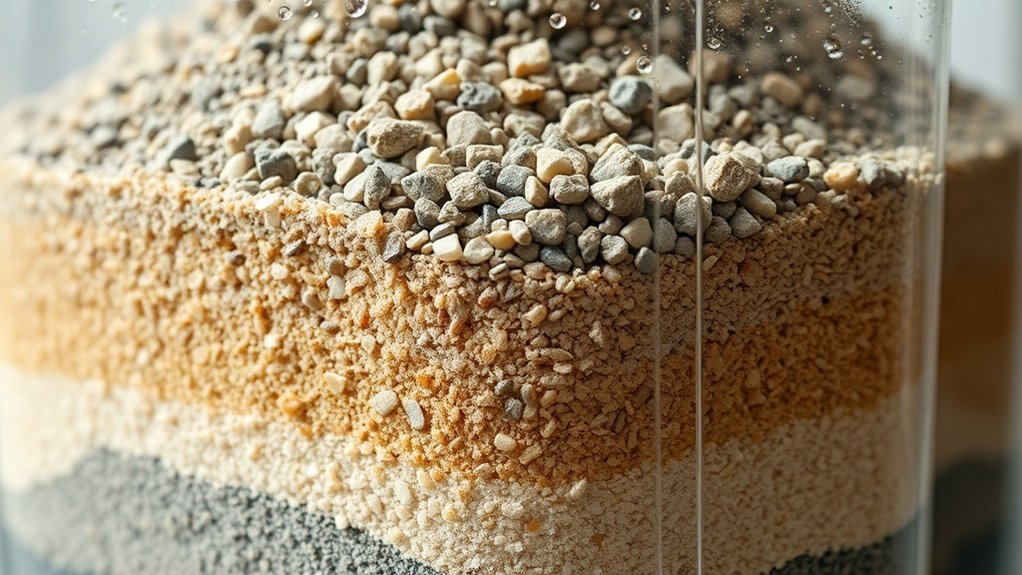
Optimising aggregate gradation not only improves the overall mix but also significantly impacts aggregate packing density, which in turn affects concrete strength. A higher packing density reduces voids and increases the volume fraction of aggregates in the concrete, leading to improved compressive strength and elastic modulus. Statistical analyses show a clear positive relationship between packing density and strength.
| Packing Density (%) | Compressive Strength (MPa) | Elastic Modulus (GPa) |
|---|---|---|
| 60 | 20 | 25 |
| 70 | 30 | 35 |
| 80 | 40 | 45 |
| 90 | 50 | 55 |
| 100 | 60 | 65 |
Better packing increases stiffness, reduces permeability, and enhances durability, making your concrete mix not only stronger but also more cost-effective.
The Role of Water-Cement Ratio in Strength Development
The water-cement ratio (W/C) is crucial for developing concrete strength, significantly affecting its mechanical properties and durability. A lower W/C ratio, generally below 0.45, results in greater compressive strength by reducing porosity and increasing the density of the cement paste.
Conversely, too much water creates capillary pores, leading to micro-cracks and diminished durability. For instance, using a W/C ratio of 0.40 instead of 0.60 can enhance the concrete’s strength considerably.
Models like Abrams’ formula illustrate the negative correlation between W/C ratio and strength. To strike a balance between workability and strength, admixtures such as superplasticisers can be used, enabling lower W/C ratios without sacrificing flow.
Thus, controlling the W/C ratio is essential for producing durable, high-strength concrete.
Future Research Directions in Aggregate Gradation and Strength

Advancements in aggregate gradation research hold great potential for improving concrete strength and performance.
Future studies should leverage advanced imaging and real-time monitoring systems to continuously optimise aggregate performance. Incorporating machine learning models can help predict concrete strength based on specific gradation profiles, which can lead to better mix designs.
The use of new sensors and automated sorting equipment will enhance aggregate selection, ensuring that target gradations are consistently achieved.
Moreover, integrating digital twin technology will enable simulations of how different aggregate gradations affect concrete performance prior to mixing.
It’s also crucial to address current gaps in standards and specifications, as updated guidelines will facilitate the adoption of innovative gradation designs for sustainable, high-strength concrete solutions.
Frequently Asked Questions
How Does Aggregate Shape Affect Concrete Strength?
The shape of aggregates significantly impacts concrete strength due to its effect on particle interlock. Angular aggregates improve interlocking and enhance bond strength, resulting in stronger concrete. In contrast, rounded aggregates lead to reduced interlock, which can weaken the overall structure. Therefore, selecting the right type of aggregate is crucial for optimal concrete performance. For example, when constructing a load-bearing wall, using angular aggregates would be preferable to ensure greater strength and durability.
What Role Does Aggregate Moisture Content Play in Strength?
Aggregate moisture content plays a crucial role in the strength of concrete. It affects the moisture balance and how much water the aggregates can absorb. If there’s too much moisture, it raises the water-to-cement ratio, which can weaken the mix. On the other hand, not having enough moisture makes the concrete harder to work with, ultimately reducing its durability and performance. For example, think of a sponge—if it’s too wet, it can’t soak up water effectively, just like overly wet aggregates can compromise a concrete mix.
Can Recycled Aggregates Be Used for Optimizing Strength?
Yes, recycled aggregates can be used to optimise strength. By incorporating these materials, you not only improve strength but also support sustainability. For instance, using reclaimed concrete in new builds can maintain structural integrity while reducing waste. This approach effectively balances performance with environmental responsibility.
How Does Temperature Affect Aggregate Gradation and Strength?
Temperature significantly influences aggregate gradation, which in turn affects the strength of concrete. Warmer temperatures can enhance workability, making it easier to mix and place. However, excessive heat can disrupt the packing of particles, leading to uneven distribution. Conversely, extreme cold can weaken concrete by causing microstructural changes and inadequate compaction, ultimately resulting in a loss of strength.
What Are the Economic Implications of Optimizing Aggregate Gradation?
Optimising aggregate gradation can lead to considerable cost savings through improved material efficiency. By reducing cement use and enhancing workability, you can decrease direct costs, cut down on waste, and increase production efficiency. This ultimately boosts project profitability and supports sustainability. For instance, using the right mix of aggregates can lead to a stronger concrete that requires less cement, saving money and resources in the long run.
Conclusion
Just like a skilled chef carefully chooses and blends ingredients to create the perfect dish, optimising aggregate gradation is vital for achieving strong concrete. By understanding the importance of aggregate size, packing density, and the water-cement ratio, you can create a durable mix that withstands the test of time. Each element is crucial, ensuring your concrete is not only strong but also resilient against various challenges.

Crafting the ideal concrete mix involves precise ratios and techniques that can elevate your project—discover the secrets to achieving unmatched Read more

The choice of aggregate size in concrete mix design is crucial for strength and durability, but what hidden factors could Read more

Learn how cementitious properties influence mix design and discover the key factors that can enhance your concrete's strength and durability. Read more